
Red List of Earth Life Facing Extinction Keeps Growing
© 2009 by Linda Moulton Howe
“Ever since we have been doing the Red List, the numbers go up every year.
...We are certainly looking at an extinction crisis where things are accelerating
and it's an out of control stage.” - Craig Hilton-Taylor, Mgr., IUCN Red List, U. K.
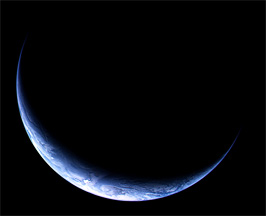
This crescent sliver of Earth's South Pole was photographed
on November 12, 2009, by Rosetta, a European Space Agency
spacecraft, from about 400,000 miles away.
November 19, 2009 Cambridge, England - This past spring, the United Nations Environment Program declared 2010 to be the Year of Biodiversity. The goal is to unite 40 international organizations to assess the loss of biodiversity on Earth now and what to do in the future to keep Earth life from dying out in the face of climate change, loss of habitats and onslaughts from pesticides and other toxins in the environment. The 2010 Year of Biodiversity slogan is “Life in harmony, into the future.”

But earlier this month, the International Union for Conservation of Nature (IUCN) issued its second 2009 Red List of endangered species at risk of extinction. At least 1 in 3 amphibians, more than 1 in 5 known mammals, over a quarter of reptiles and 70% of plants are facing extinction now. And one animal that's been on the Red List has now gone extinct in the wild. That's the Kihansi spray toad of southern Tanzania.

Kihansi spray toad of southern Tanzania was declared extinct
in the wild in 2009. Some zoos have a few remaining toads in captivity
in the hope they can one day be reintroduced into a restored ecosystem. Scientists
from Tanzania's University of Dar es Salaam will visit New York City's Bronx Zoo
to learn how to breed toads in their homeland. Image by Julie Larsen Maher,
Wildlife Conservation Society.
Recently I talked about the latest Red List of potential extinctions with biologist Craig Hilton-Taylor, Manager of Conservation International (IUCN) based in Cambridge, England.
Interview:
Craig Hilton-Taylor, Manager, Conservation International Extinction Red List, Cambridge, England: “As of the end of 2009, we have looked at just under 48,000 species - that's 47,677 to be precise. So, we haven't looked at all species in the world. There are over two million species out there that have been described. So, we have only looked at the tip of the iceberg of species. But of those, nearly 17,000 are threatened with extinction - so quite a high percentage are threatened with extinction.
IS THIS THE HIGHEST NUMBER OF POTENTIAL EXTINCTIONS THAT YOU HAVE EVER REPORTED ON THE RED LIST?
This is the highest number. Ever since we have been doing the Red List, the numbers go up every year. They don't ever go down. But there are lots of changes in the list. So, it's not just that the numbers are going up. What we're also seeing is the movement between the categories. There are species that were listed as vulnerable five years ago that are now listed as endangered or critically endangered. So, even within the categories, things are getting worse. They (threatened categories) are all facing mass extinctions. We are certainly looking at an extinction crisis where things are accelerating and it's an out of control stage.
1 Out of 3 Amphibians
Is Threatened with Extinction
What we've seen with amphibians is a massive population crash. Lots of amphibian species around the world because of a fungal disease that has been spread around the world - they still don't know the mechanisms behind that rapid spread and what is making it worse. We think there is some interaction with climate change.
THAT'S THE CHYTRID FUNGUS?
Chytrid fungus, that's correct.
IF I UNDERSTAND CORRECTLY, IT IS STILL SPREADING AND IS KILLING AMPHIBIANS AT AN INCREASING RATE.
It is, that's right. So we have many of the zoos around the world are rushing around madly trying to collect amphibians from the wild that are not infected to bring them ito captive situations as an insurance policy to keep amphibians going as species in captivity until such time that we can find a cure for the fungal disease. Then they can put the captive amphibians back into the wild again.
SO, THE AMPHIBIANS RIGHT NOW ARE FACING THE MOST IMMINENT EXTINCTION CRISIS?
Exactly, and one of the species that we listed this year - the Kihansi spray toad, which comes from Tanzania and was confined to a very small area - that species we have officially declared this year as extinct in the wild. The only animals left are a few sitting in some zoos.
IN THE ASSESSED SPECIES, DO YOU INCLUDE THE CORALS THAT ACCORDING TO SOME RESEARCH COULD BE COMPLETELY WIPED OUT BY 2050, THAT'S ONLY 40 YEARS FROM NOW THAT ALL THE CORALS IN THE OCEANS OF THE WORLD COULD BE GONE?
That's correct. Last year, we brought in 800 of the coral species - the warm water reef-forming coral - the ones that people see in all the diving videos on television and so on. We assessed all of those last year and they came on to the Red List and a very high percentage of them are threatened and that's all because of ocean warming and ocean acidification. If those trends continue - yes, the future of corals looks very, very bleak. And it's not just the corals themselves. It's all the fish and other organisms that live in those coral reefs.
BECAUSE THE CORAL REEFS PROVIDE HOMES FOR SO MANY MARINE ANIMALS.
Exactly, so the effects are going to be enormous if we lose those corals.
AT THE BEGINNING OF OUR PHONE CONVERSATION, YOU SAID, 'WAIT UNTIL YOU HEAR ABOUT WHAT IS COMING NEXT.'
Well, every year, we produce an update of the Red List. In fact, this most recent is the second one we've done this year of 2009. Next year, we know we have several big data sets coming in from several different parts of the world looking at different groups of species. Just from the initial look at that information, it's going to show that the picture is even worse than we think it is now.
We think with the chytrid fungus, the reason it's spreading and being as bad as it is, is because of some interaction between the fungus and climate change. Conditions are changing the fungal environment some how and making the fungus more virulent. But we really don't understand what that relationship is.
The in the oceans, there is warming and increased acidity all linked into climate changing. It's very difficult to say it's all climate change because it manifests itself in so many different ways. So, it's very hard when you are assessing the species and can see populations going down - it's hard to say that's because of climate change. You tend to pick up on the more immediate things such as disease and changes in the habitat. But what is causing those changes in habitat are not always 100% clear.
BUT THE CORALS WOULD FALL INTO THE CATEGORY OF?
Corals would certainly, yes. There's a pretty clear case now for the link between climate change and what is happening with ocean warming and acidification.
Chile Vineyards and African Butterflies
Forced to Move by Global Warming
RECENTLY I READ A REPORT THAT THE GRAPE GROWERS IN CHILE, THAT HAVE MADE SO MANY WONDERFUL WINES, THAT THEY ARE NOW HAVING TO MOVE 500 MILES FURTHER SOUTH (TOWARDS ANTARCTICA) BECAUSE OF CLIMATE CHANGE THAT IS AFFECTING THE DRYNESS AND TEMPERATURE TO KEEP GOOD GROWING CONDITIONS FOR THEIR GRAPES.
That's right. And we've tried to do a Red List of butterflies in Europe at the moment. We had a check list of butterflies in Europe, but in fact, if you look at that check list and look at what was in Europe ten years ago and what there is now, butterfly composition is changing. There are species moving into Europe from Africa as they move northward because of changes in climate. So, we're now having to assess a different set of species because the butterflies are coming in from an area where they never used to come from historically.
WOW, IF YOU HAVE BUTTERFLIES COMING ALL THE WAY FROM AFRICA NOW INTO EUROPE AND THE BUTTERFLIES THAT WERE IN EUROPE - WHERE HAVE THEY GONE? HAVE THEY GONE INTO DENMARK AND FINLAND AND FURTHER NORTH?
We're still looking at results. We don't know because it's still an early part of the process, but we aren't quite sure. And the populations of butterflies are also going down, declining in many parts of Europe. So, we'll have a better idea next year what's happening with them.
And this is the whole challenge now with conservation planning because we have this whole network of protective areas such as nature parks and nature reserves around the world. But are they in the right places for the future conservation of species? If species have to move, is there a reserve they can move to? And how do they move there? Are they the right corridors and places they can travel through safely and get to where they need to go to? So, a lot of conservation planning now is trying to look at future scenarios and saying, 'Well, if the climate is going to change this way, this is how it's going to have to shift. Do we have a particular area in that site in the future that the species could survive in that area in the future?
IT'S AS IF THE ENTIRE PLANET IS BECOMING A MOVING TARGET?
Yes, it's a huge challenge in terms of conversion because in many cases, the protected areas we currently have are going to be in the wrong places completely!”
Next up beginning December 7 to 18, 2009, are meetings in Copenhagen, under the 192-nation UN Framework Convention on Climate Change (UNFCCC), to produce a post-2012 pact to seriously cut back on greenhouse gases that are increasing.
The U. S. Department of Energy's Oak Ridge National Laboratory released data in the journal Nature Geoscience on November 17, 2009, that worldwide carbon dioxide pollution jumped 2% in 2008. It's estimated that 715.3 trillion tons of industrial carbon dioxide has been released into the Earth's atmosphere since 1982. The U. S. is responsible for about 20 tons of CO2 per person each year and China is at 5.8 tons per person and increasing.
Global Warming Moves African
Butterflies to Catalonia, Spain

Catalonia surrounds Barcelona, Spain, a nearly 200 mile shift northward
for several butterfly species from northern Africa and the Canary Islands.
Butterflies provide direct evidence that climate is changing so much that African butterfly species are moving to Catalonia, Spain, surrounding Barcelona for the first time on record. An example is the famous monarch butterfly, Danaus plexippus, from North Africa and the Canary Islands. Since record breaking temperatures in the summer of 2003, the monarch has been moving northward.

Monarch butterfly, Danaus plexippus, from North Africa
and the Canary Islands has been documented near Barcelona,
Spain, for the first time on record since 2003.
Another example is the desert orange tip, Colotis evagore, native to north African desert regions. Since the summer of 2004, this butterfly species has established itself for the first time in the Catalonia region of Spain around Barcelona.

Desert orange tip, Colotis evagore, native to north
African deserts has established itself in the Catalonia region
of Spain since the summer of 2004. Image © Matt Rowlings.
Another butterfly traveling from north Africa to Catalonia is the Euchloe belemia, which appeared for the first time on record outside Barcelona in the spring of 2008. This was a shift northwards of its normal African range by nearly 200 miles.

Green-striped Euchloe belemia butterfly from north Africa
appeared for the first time on record outside Barcelona in the spring of 2008.
Coral Reefs Are Dying Out
“Unless something very remarkable happens during (Copenhagen) December 2009's
climate talks, the world's reefs will be reduced to slime-covered rubble by 2050.”
- Alex Rogers, Institute of Zoology, London

Warm water bleaching of coral.
Photo by Tyler Smith of Marine Photobank.
The future survival of the world's coral reefs is looking so bleak that scientists meeting in Copenhagen, Denmark, in October have proposed storing samples of coral species in cryogenic vaults of liquid nitrogen. The idea is to wait out the turbulent global climate to see if world temperatures stabilize so that the corals could be safely returned to the oceans. Coral reefs are a major source of food, income and protection for about half a billion people and provide homes for so many marine creatures.
Ironically, the Copenhagen meeting of Global Legislators Organization for a Balanced Environment said there is not much chance that world governments will agree to enough greenhouse gas cutbacks to prevent the predicted rise in temperatures over this century.
Chile's Leading Vineyards
Planting Higher and Further South

Vineyard in Chile's Elqui Valley may be one that is forced
to move southward due to global warming. Photo © 2009 by Tim Abbott.
Earthwatch reports that Chile’s leading wine producers may have to move their vineyards farther south as climate change makes their current locations too dry and warm. “A Pricewaterhouse Coopers study warns that ideal climatic conditions needed for grape growing will shift to higher Chilean latitudes due to a 30% reduction in rainfall and an expected temperature rise of 2.7 degrees Fahrenheit in established production areas.”
The Santiago Times reports that some famous wineries have already begun planting vines about 500 miles south of the country’s primary wine country.
As Arctic Sea Ice Melts, Walruses Die

Arctic walrus resting on ice floe. Image courtesy NOAA.
The United States Geological Survey in October 2009, issued a report about accelerated sea ice melt in the Arctic Chukchi Sea that caused panicked walruses to stampede. 131 dead bodies were found near Icy Cape, Alaska on September 14, a “highly unusual” event, according to scientists. Ice floes normally give walruses floating nurseries for their young pups and places to dive for clams and other marine food. As more and more ice melts, walruses that have been around for at least 15 million years are becoming a threatened species.
More Information:
For further information about global warming and environmental challenges, please see Earthfiles Archive (some selected reports below).
• 03/30/2009 — European Honey Bee Decline Continues While Aggressive Africanized Honey Bees Attack in Southern U. S.
• 03/06/2009 — Unexplained Stranding of 200 Pilot Whales and Dolphins
• 02/26/2009 — Unprecedented Northeast Bat Die-off Spreading Rapidly
• 01/29/2009 — Part 1: Nanodiamonds Link Outer Space Impactors to Earth Extinctions 12,900 Years Ago
• 01/29/2009 — Part 2: Nanodiamonds Link Outer Space Impactors to Earth Extinctions 12,900 Years Ago
• 12/21/2008 — Mystery of Missing East Coast Acorns
• 10/24/2008 — Rapidly Changing Earth
• 09/26/2008 — NRDC Sues EPA for Honey Bee Lab Data and EPA Approves Another Bee-Killing Pesticide
• 08/31/2008 — Honey Bees Not Healthy in U. S. or U. K.
• 08/29/2008 — Still No Sunspot Action on the Sun
• 08/26/2008 — Update: Earthfiles Viewer Comments About UFOs and 14th Century Black Death
• 08/15/2008 — Amphibian Warning Bell of Mass Extinctions
• 06/21/2008 — Updated June 25, 2008: Increasingly Acidic Pacific Coast Waters Threaten Marine Life
• 04/10/2008 — Honey Bee Collapse Now Worse on West Coast
• 03/28/2008 — Deer Mutilation in Longs, South Carolina, Two Helicopters and Large, White Sphere
• 03/27/2008 — Ice Block Size of Northern Ireland Has Broken From Wilkins Ice Shelf in West Antarctic Peninsula
• 02/29/2008 — Mysterious Bat Deaths in New York, Vermont and Massachusetts
• 02/05/2008 — Federal Court Rejects Bush Navy Sonar Exemption
• 01/24/2008 — Part 17, Final: In League With A UFO, Interview with Lou Baldin
• 01/18/2008 — Amphibians Dying Out At Alarming Rate
• 01/15/2008 — Updated: More Sky Spiral Mysteries in Iraq, Canada and Germany
• 01/12/2008 — Our Milky Way Galaxy On Collision Course with Huge Gas Cloud - 40 Million Years from Now
• 01/11/2008 — Canadian "Disc" and Smoke Spiral Still A Mystery
• 01/10/2008 — Solar Cycle 24 Has Begun
• 12/13/2007 — Update: As CO2 Increases, Carbonic Acid Build Up in Oceans Expected to Kill Off Coral Reefs by 2050
• 12/11/2007 — More Confirmation of May 1974 Discs in Albuquerque and Huge Cylinder Craft At White Sands Proving Ground.
• 12/08/2007 — Another Eyewitness to Glowing Disc and Military Security in Albuquerque, New Mexico
• 11/29/2007 — Part 1: Glowing Disc Encounter with Military in Albuquerque, NM
• 11/29/2007 — Part 2: Glowing Disc Encounter with Military in Albuquerque, NM
• 11/29/2007 — Part 3: Glowing Disc Encounter with Military in Albuquerque, NM
• 11/20/2007 — Do Black Budget Trillions Support A Secret American Space Program?
• 11/08/2007 — More Unusual Animal Deaths
• 10/05/2007 — Earlier, Faster and Deeper Arctic Ice Melt Down
• 09/18/2007 — E. coli and Salmonella Continue to Threaten American Bagged Salad Greens
• 08/17/2007 — Two Bulls and Several Cows Dead and Mutilated in Manitoba, Canada
• 08/10/2007 — Levitation Possible by Reversing Casimir Force
• 08/08/2007 — 2007's Warm, Erratic Global Weather
• 08/03/2007 — The Milky Way Is Devouring the Alien Sagittarius Dwarf Galaxy
• 07/28/2007 — Mysterious Aerial Lights Over Stratford-upon-Avon, July 14, and Farnborough, Hampshire, on July 22, 2007
• 07/14/2007 — Schofield Barracks, Oahu, Hawaii - Huge, Lime Green Oval Craft Hovered Over Battalion Headquarters
• 07/13/2007 — Iowa Minister Reports Large "Crab/Scorpion" Creature Attacked Cow
• 07/11/2007 — Mystery of Night Shining Clouds - Another Global Warming Change?
• 06/28/2007 — Hackenberg Apiary, Pennsylvania - 75-80% Honey Bee Loss in 2007. What Happens If Colony Collapse Disorder Returns?
• 06/21/2007 — Large Lake in Southern Chile Has Disappeared
• 06/01/2007 — Is Earth Close to Dangerous Tipping Point in Global Warming?
Websites:
International Union for Conservation of Nature (IUCN): http://www.iucn.org/
IUCN Extinction Red List:
http://www.conservation.org/FMG/Articles/Pages/red_list_conservations_red_alert.aspx
Endangered Species International: http://www.endangeredspeciesinternational.org/amphibians3.html
Institute of Zoology: http://www.zsl.org/science/
Wildlife Conservation Society: http://www.wcs.org/
Biodiversity 2010: http://www.twentyten.net/
Mongabay.com: http://news.mongabay.com/2009/1104-hance_kihansi.html
The Nature Conservancy: http://www.nature.org/
World Wildlife Fund: http://www.worldwildlife.org/
Audubon Society: http://www.audubon.org/
U. N. Environment Program: http://www.unep.org/Documents.Multilingual/Default.asp?
ArticleID=6182&DocumentID=585&l=en |