

Earthfiles Homepage Earthfiles Homepage
Headline News


LOGIN
LOGOUT

HELP


Add to My Yahoo!
Earthfiles Podcast


Earthfiles, news category.


Share:

Moultrie Game Camera Manager Puzzled by “Milk Bottle” Images

© 2009 by Linda Moulton Howe

“This is the first time that our Moultrie game trail camera
people have ever seen anything like those ‘milk bottle’ images.
The head of Moultrie engineering, research and development now
has the photos, but so far no explanation.” 
- Gene Matchen,
Manager, Moultrie
Customer Service
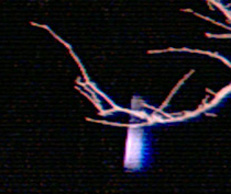


“Milk bottle” aerial object caught by game trail camera
behind tree branch on December 1, 2008, between 11:05 PM and
11:29 PM Central in Edom, Texas. Image provided by camera owner.


See: September 11, 2009 Earthfiles
for full report about “milk bottle” images.


October 20, 2009  Birmingham, Alabama -  For thirty years, Moultrie Game Feeders and Game Trail Cameras have had a reputation for being reliable, durable quality performance. The company sells infrared game cameras, flash cameras and camera accessories. One of its most popular game trail cameras is Moultrie's D-40 digital trail camera to monitor deer and other animal habits and patterns.

Moultrie GameSpy D40 Digital Trail Camera:  Click for website

- 4.0 megapixel digital camera has a quick trigger time, 45-ft flash and 60-day battery life.
- Color day and night pictures
- Video clips during the day
- Imprint time, date and camera ID on every photo or video
- Laser and IR aim for quick and precise camera set-up
- Multi-shot pictures (up to 3 shots)
- Weather-resistant, airtight camera housing and seal
- Operates on 6 D-cell batteries (sold separately)

Beginning in November 2007, I received the following series of unusual Moultrie game trail images from Bob Coine, President and Owner of Heartland Studios, Inc., in Oregon, Illinois.

In order to keep track of how many white-tailed bucks and does use his farm and to estimate ages of the bucks, Bob explained that he uses a variety of game trail cameras. He has pure infrared cameras that do not flash and take images in non-visible infrared; standard 35mm cameras; and digital cameras that have an infrared beam to detect motion, which then triggers the camera to flash in the visible light spectrum.

Six photographs below taken in visible flash mode on November 16, 2007, beginning at 3:59 AM over a three minute time span, have been a mystery and so have several other images taken by Moultrie game trail cameras in several other states the past two years. So, in late September, I sent the “milk bottle” images to the Customer Service Department of Moultrie Game Feeders and Game Trail Cameras in Birmingham, Alabama, to ask if their technical department might have an explanation for the unusual images.

On Friday, October 16, 2009, Gene Matchen, Moultrie Customer Service Manager, called me and said, “This is the first time that our Moultrie Game Trail Camera people have ever seen anything like those “milk bottle” images. The head of Moultrie engineering, research and development now has the photos, but so far we have no explanation.”


Bob Coine, President and Owner of Heartland Studios, Inc., in Oregon, Illinois:  “In the first picture, a deer is triggering the camera as the deer walks by. The deer appears to be 30 or 40 yards out from the camera, maybe a little bit farther. It’s just a normal deer-walking-by photograph with that white thing on the right side of the frame.

Image 1 = 3:59 AM Central


Above:  Image 1 at 3:59 AM Central, November 16, 2007, Oregon, Illinois.
Camera: Moultrie GameSpy D-40 Digital Flash Trail ( 4 megapixel).
  Below: Image 1
cropped larger to show the deer walking by, the object's detail and “rays” above and below.


Image 1 at 3:59 AM cropped. In the foreground are grass and weeds
for a distance of 10 or 12 feet from the camera. Then a combine-flattened area
and beyond that, harvested corn stubble where the deer is walking. Estimated
distance from camera to strange object is 10 to 20 feet.

Image 2 = 3:59 AM

The 2nd picture, there is no deer. The strange object has moved to the right slightly.


Image 2 at 3:59 AM. The small white spot near center of this and the other images
is a neighbor's yard light approximately 3/4s of a mile distant.

Image 3 = 4:00 AM

The 3rd picture, it’s moved a little back to the left.


Image 3 at 4:00 AM.

Image 4 = 4:01 AM

The next (4th)  triggered event at 4:01 AM, you have a deer back in the frame appearing to look at the strange object. What is odd is that the deer is in a state of alarm, meaning its tail is up. A white tail deer uses their tail up as a signal. Their tail can tell many different stories in communication with other animals. But in this image, the deer’s eyes and ears are focused toward the object and its tail is up in the alarm position.


Image 4 at 4:01 AM.


Image 4 at 4:01 AM cropped larger to show the alarmed deer,
object's detail and “rays” above and below strange object.

Image 5 = 4:02 AM

In the next (5th) picture, the deer is gone, the object has moved back to the right.


Image 5 at 4:02 AM.

Image 6 = 4:02 AM

The last (6th) picture in the series, the strange object has moved a little back to the left and slightly down. The strange white object does move kind of up and down as well as side-to-side.


Image 6 at 4:02 AM.


Other September 2009
Game Trail Camera Images in Texas

“Corkscrew” and “Fins” likely insects in motion blur.


Upper right red circle is Cass County, Texas.
Lower red circle is region of Gregg and Upshur Counties in Texas.
Left red circle is Van Zandt County, Texas.

           
Left:  September 10, 2009, at 6:10 AM Central, second of two mysterious images
within six hours on game trail camera owned by hunter Doyle Brogan in Cass County, Texas.
Middle:  September 12, 2009, at 8:56 PM Central, “corkscrew” on Stealth Cam owned by another Cass County, Texas hunter; Right: August 26, 2009, “finned” image on game camera owned by Don Noble of Gladewater, Texas, in Gregg and Upshur Counties. Other recent “milk bottle” images from Edom
in Van Zandt County, Texas, are reported in September 11, 2009, Earthfiles.

The center “corkscrew” and “fins” on the right are almost certainly flying insects caught in motion blur of camera's time lapse. Roger Harris, is a software engineer who has worked for fifteen years at Verizon in Colorado Springs, Colorado. He watched a Learning Channel program called Strange Science in 1999 that demonstrated how moths and other insects create fin and corkscrew motion blur patterns when a camera shutter speed is slow, such as 1/50th to 1/100th of a second, common at night in game trail cameras.


Interview:

Roger Harris, Verizon Software Engineer, Colorado Springs, Colorado: “Motion blur can affect any camera, but with video cameras, when you have successive frames, it’s pretty easy to identify motion blur by the patterns that you see from one frame to the next. When you are looking at the motion blur of a bug – say it moves ten times its own length during the image capture time on a camera – that’s going to be 90% transparent then. You’re seeing through the motion blur streak for 90% of the exposure time.

Video cameras are limited in shutter speed because they have to capture 30 frames per second, which is 60 fields per second. That means the longest exposure time they can use is 1/60th of a second.

If it were a still camera, it can be any shutter speed you want from fractions of seconds up to a minute or more if you wanted to. But if they are still images, there should be EXIF data with the image that tells you the exposure time. To get that, you need the original images and if you have any kind of photo editor that will show the EXIF data, it will show the time captured, exposure time, aperture setting and so on.

WHAT WOULD BE THE AVERAGE SHUTTER SPEED THAT WOULD PRODUCE THAT SINE-WAVE PATTERN OF AN INSECT FLYING THROUGH THE AIR?

Anything above 1/100th of a second. Most of the video shots that I have of insects in motion blur were 1/60th of a second. But with motion blur, it’s all relative: how far does the object appear to move during exposure time?

IS THERE A SHUTTER SPEED RATE IN WHICH YOU WOULD NEVER GET MOTION BLUR?

Well, I’d say about 1/500th of a second. Above that shutter speed, insects look like insects.

YOU’RE NOT GOING TO FIND 1/500TH OF A SECOND ON GAME TRAIL CAMERAS BECAUSE THE HUNTERS ARE TRYING TO VIEW IN THE NIGHT.

Yes, at night the average shutter speed is probably around 1/50th or 1/60th of a second, or even slower such as 1 second. A lot depends on the sensitivity of the chip, but there is an automatic exposure setting program running there that is looking at the field and deciding how much light it has. Most cameras have an aperture that you can open up, but once you’ve opened them up all the way, the only thing you can do is take longer exposure times.

What’s happening with the insects is that they are fairly small relative to how fast they are traveling. If a bug is flying only about 20 mph, let’s say, and if it is a half-inch long bug, it’s going to move 6 inches during the time of a 1/60th camera field capture. That means that bug is going to look like it’s 12 times longer than it is wide. If the bug is only a few feet in front of the camera, a 6-inch streak is quite noticeable.

[ Editor’s Note: Wikipedia - How fast can insects fly? The male deer bot fly is reputed to develop flying speeds of up to several hundred miles per hour, but this may be just an exaggeration. The tabanid fly, which is related to horse flies, has been clocked in at 90 miles per hour. Hawkmoths, from the Sphingidae family, have been timed at a solid 33 miles per hour. A horsefly (Hybomitra hinei wrighti) was recently clocked at 145 km/h! Dragonflies of the Anax parthenope species have been clocked in at almost 18 miles per hour. Honeybees fly at about a moderate 7 miles per hour, and have to beat their wings 190 times per second to do it. Speeds vary amongst butterfly species (for some reason the poisonous varieties are slower than non-poisonous ones). The fastest butterflies (skippers) can fly at about 30 miles per hour or more. Slow flying butterflies fly at only 5 mph. Insect airspeed is affected by mass, size, age, gender, feeding, water content, activity type, temperature, humidity, solar radiation, wind, oxygen level, ascent angle and even habitat isolation. More research needs to be done in order to determine the fastest insect.]

If it’s a small bug, say 1/8th of an inch long, and is only 12 inches in front of the camera, it might only be moving 10 mph and it would create a 3-inch-long streak in that exposure time. So, the thing about bugs is not that they fly that fast, but they are fairly small relative to how fast they are traveling.

WHY THE CONNECTED ARCS OR SINE WAVES?

What’s happening there is that bugs have different wing beats.

[ Editor’s Note: Wikipedia - How fast can insects flap their wings? Insects with the fastest wing beating frequency are the no-see-ums (very tiny midges), which beat their hairy wings 1,046 times per second, or 62,000 beats per minute, the record holder for an animal with the fastest fluttering wings. Male mosquitoes don't even come close with wings that beat 450 to 600 times per second. Cabbageworm butterflies are perhaps the slowest with wings that beat only 9 times per second. Source: 1001 Questions Answered About Insects by Alexander and Elsie Klots.
Mosquitoes = 988 – 1,046 strokes per second
Honey Bee = 250
Housefly = 190
Bumblebee = 130
Hornet = 100
Hummingbird Hawk Moth = 85
Large white butterfly = 12 ]

What that means is that you are seeing several wing beats during an exposure time. If you knew what kind of bug that was in each of those Texas images, you could figure out how long the exposure time was pretty closely by counting how many wing images you see.


Eerie “Blades of Light” in Longview, Texas
September 9-10, 2009

WHAT ABOUT THE ‘BLADES OF LIGHT’ PHOTOGRAPHED IN CASS COUNTY, TEXAS BY DOYLE BROGAN ON SEPTEMBER 9 TO 10, 2009? DOYLE HAS HUNTED IN THAT REGION FOR 30 YEARS, GOT MOULTRIE GAMESPY D40 DIGITAL TRAIL CAMERAS ABOUT SIX YEARS AGO, RUNS FOUR OF THEM 24 HOURS A DAY, SEVEN DAYS A WEEK, AND TOLD ME HE HAS NEVER SEEN ANYTHING LIKE THE STRANGE LIGHTS BEFORE.

They don’t look like any typical insect in motion blur that I’m familiar with. But we’re still talking about a fairly long exposure time and you can’t rule out motion blurring when you’re talking about long exposure times. It’s hard to pin down exactly what it is, but I wouldn’t necessarily call it mysterious unless you can rule out motion blur. A firefly could have been close to the camera, but you can’t tell how far away it was from those images.

DO YOU HAVE ANY MOTION BLUR IMAGES OF FIRE FLIES?

No. I don’t believe I’ve seen any.”


5 Frames in Time Sequence Order from 9:43 PM Central, September 9, 2009,
to 9:07 AM, September 10, 2009, by Doyle Brogan, Longview, Texas


Time period between the two blades of light: about 6 hours.
All images © 2009 by Doyle Brogan.


Interview:

Doyle Brogan, retired supervisor for heavy duty truck manufacturer, Longview, Texas:

"WHAT WAS YOUR FIRST REACTION TO SEEING THE TWO UNUSUAL FRAMES OF BLADES OF LIGHT IN YOUR DIGITAL IMAGES FROM YOUR MOULTRIE GAME CAMERA?

I had no idea what it could be. I think there was some 30 pictures on the card and I immediately printed the two frames of the strange lighted stuff out on my computer to look at it closer. I just could not figure it out. The next day, it started raining and I didn’t go up there until the Tuesday after the previous week when I collected those pictures. So that’s when I contacted the television station in Longview, KYTX.

I went back to the location on Tuesday morning,  Sept. 15, 2009, around 9:30 AM with TV reporter. We drove to where the Moultrie game camera was and it was pouring down rain. We couldn’t see any physical traces of any burning on the ground even though there was a lot of water on the ground. I haven’t been back there since. I want to know what it is and where it comes from!”

If other Earthfiles viewers and podcast listeners have any more information about these odd game trail camera images, or have anomalous game trail images yourself, please email:  earthfiles@earthfiles.com.  All requests for confidentiality are honored.


More Information:

For further information about anomalous game trail camera images, please see Earthfiles Archive reports below.

• 09/11/2009 — More Aerial “Milk Bottles” Photographed By Game Trail Cameras
• 04/07/2008 — Part 2: Bizarre Objects Caught by Illinois and Missouri Game Trail Cameras
• 04/07/2008 — Part 1: Bizarre Objects Caught by Illinois and Missouri Game Trail Cameras


Websites:

Heartland Studios, Inc., Oregon, Illinois: http://www.heartlandillinois.com

http://www.heartlandillinois.com/v2/About_Us/Unexplained_Photo.php


Credits  
Copyright © 1999 - 2009 by Linda Moulton Howe.
All Rights Reserved.
www.earthfiles.com
earthfiles@earthfiles.com

Republication and redissemination of the contents of this screen or any part of this website are expressly prohibited without prior Earthfiles.com written consent.

Privacy Policy | Terms & Conditions
Refund Policy


Copyright © 1999 - 2009, Earthfiles.com /DigitalEyeCandy.ca
All rights reserved.

[Valid RSS]