Earthfiles Homepage Earthfiles Homepage
Environment


LOGIN
LOGOUT

HELP


Add to My Yahoo!
Earthfiles Podcast
Earthfiles Shop


Earthfiles, news category.


Share:
 

BP's Gulf Crude Oil Nearly 40% Methane -
Will Huge Dead Zone Follow?

© 2010 by Linda Moulton Howe


“This is the most vigorous eruption of methane from the sea floor
that's been witnessed in the modern history of humans.”    

- John Kessler, Ph.D., Chemical Oceanographer, Texas A & M


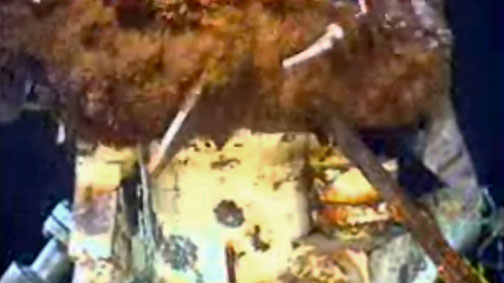
This image from video on Thursday, July 1, 2010, shows crude oil erupting
from BP's (British Petroleum) Macondo broken wellhead that contains nearly 40%
methane dissolving in the Gulf of Mexico. Video image by BP PLC.


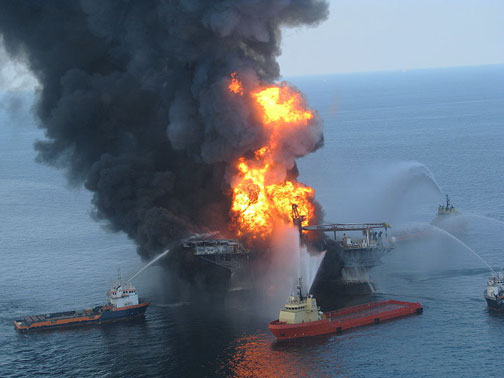
The BP (British Petroleum) Deepwater Horizon drilling rig exploded on April 20, 2010.
The huge fire on the Deepwater Horizon semi-submersible Mobile Offshore Drilling Unit
(MODU) was about 40 miles (64 km) southeast of the Louisiana coast in the Macondo
Prospect oil field. The explosion killed 11 workers and injured 17 others; another
98 people survived without serious physical injury. It caused the Deepwater Horizon to burn
and sink, and started a massive ongoing offshore oil spill in the Gulf of Mexico; this is now
considered the largest environmental disaster in U.S. history. Image by U. S. Coast Guard.


July 6, 2010  College Station, Texas - After the BP (British Petroleum) Deepwater Horizon drilling rig exploded on April 20, 2010, and its Macondo wellhead broke a mile down on the Gulf of Mexico sea floor, that uncontrolled eruption of crude oil, under the extreme pressure of being a mile under the ocean water, has turned into the worst environmental disaster in United States history. Some scientists wonder if the BP oil catastrophe could be creating yet a second disaster where the oil-contaminated Gulf will end up with a huge dead zone without oxygen where marine life cannot live?

By July 1, government estimates put the volume of crude oil contaminating Gulf waters at 140 million gallons since the explosion. Until now, the Permex Ixtoc I oil blowout in the Gulf had been the biggest, lasting from June 3, 1979, until March 23, 1980, spilling 3 million barrels (126 million gallons).

But making the BP Macondo eruption even worse is the fact that the spewing crude oil contains 40% natural gas of which most is methane that can end up depleting oxygen and causing one or more dead zones where marine life cannot live.

The reason is that all those methane hydrocarbons now in the water are food for microorganisms. In the expected feeding frenzy, those methane-eating organisms will deplete the oxygen and produce a dead zone. How big an oxygen-depleted dead zone depends on how fast the oxygen is depleted and if there is any fresh oxygen supply going into the Gulf currents.

A chemical oceanographer, who studies how methane is emitted from the sea floor naturally and enters into water and the atmosphere, uses isotope biogeochemistry to study how gases in ocean waters might contribute to global warming. Methane is a potent greenhouse gas that is able to warm twenty times more effectively than carbon dioxide. If a lot of methane were suddenly to enter the Earth's atmosphere, global warming would be increased.

Now he wants to find out if any of that methane gas spewing a mile down in the Gulf is reaching the surface and rising into the air. He also wants to know how much methane is dissolving in Gulf waters and being eaten by microbes.

Prof. John Kessler, Chemical Oceanographer at Texas A & M, organized a team of twelve scientists to find out some answers about the methane. The National Science Foundation (NSF) funded his efforts for a 10-day-project that ended on June 28, 2010.

During that time, BP allowed them to take methane measurements as close as one-third mile from the Ground Zero Deep Horizon oil rig and out to a radius of about eight miles around the rig. In that zone, Prof. Kessler and his team measured dissolved methane from the surface down to the broken well head. Recently he told me, “We saw concentrations in the bottom third of the water (about 3,000 to 4,000 feet down) with methane at the lowest being about 10,000 times above background; on average about 100,000 times above background; and sometimes even one million times above background!


Interview:


John Kessler, Ph.D., Professor of Chemical Oceanography, Texas A & M University,
doing lab test of methane concentration in Gulf of Mexico oil-contaminated water
during June 2010 research funded by the National Science Foundation.
Image © 2010 by Prof. John Kessler.

John Kessler, Ph.D., Prof. of Chemical Oceanography, Texas A & M University, College Station, Texas:  “This is the most vigorous eruption of methane from the sea floor that’s been witnessed in the modern history of humans. If we have dumped all this methane food into the Gulf of Mexico, will that cause a feeding frenzy that will lead to significant depletions in the dissolved oxygen in the waters?

IS IT TRUE THAT YOU HAVE NOW MEASURED THE LARGEST VOLUME OF METHANE GOING INTO OCEAN WATERS THAT YOU’VE EVER SEEN?

That could very well be true. It is certainly the fastest one that I have ever seen. And depending upon how long this lasts, who knows how large it might actually get?


“G
round Zero” at BP's Macondo oil rig one mile above the Gulf of Mexico sea floor
where the broken wellhead continues to erupt with methane-saturated crude oil that can
end up depleting oxygen and causing one or more dead zones where marine life
cannot live. Image © 2010 by Prof. John Kessler.

WHAT DID YOU FIND IN TERMS OF THE AMOUNTS OF METHANE AS YOU LOOKED AT DEPTHS AND BROADNESS?

We surveyed from the surface of the ocean all the way down to the sea floor. We surveyed from within one-third mile of ground zero (Deepwater Horizon rig) all the way out 7 to 9 miles in a radius around the wellhead. What we noticed in terms of depths was that most of this methane is staying in the deep one-third of the ocean water. We were seeing concentrations in those deep depths (3000-4000 feet down).

We found dissolved methane concentrations ranging from 10,000 times above background methane to an average about 100,000 times above background. We also saw a few samples that were even starting to approach one million times above background!

WHAT ARE THE IMPLICATIONS OF THAT?

That’s what we are trying to figure out right now. I think the biggest ramification is the loss of oxygen that is dissolved in the waters. What we are talking about are the deep waters around the spill zone and we surveyed between 6 to 8 miles radius from ground zero. With all of those hydrocarbons now in the water that can be food for microorganisms can lead to significant oxygen drawdowns and potentially dead zones. What we’re trying to determine now is: will these dead zones develop? Will the microorganisms that feed on methane be able to feed at a significant rate that will deplete the amount of oxygen faster than any new, fresh oxygen might be supplied to these regions?

[ Editor's Note:  Wikipedia - “Methane is a chemical compound with the chemical formula CH4. It is the simplest alkane, and the principal component of natural gas. Burning methane in the presence of oxygen produces carbon dioxide and water.


Methane is a relatively potent greenhouse gas. Compared with carbon dioxide, it has a higher global warming potential. The abundance of methane in the Earth's atmosphere in 1998 was 1745 parts per billion (ppb), up from 700 ppb in 1750. By 2008, however, global methane levels, which had stayed mostly flat since 1998, had risen to 1,800 ppb. By 2010, methane levels, at least in the Arctic, were measured at 1850 ppb, a level scientists described as being higher than at any time in the previous 400,000 years. In addition, there is a large, but unknown, amount of methane in methane clathrates in the ocean floors. The Earth's crust contains huge amounts of methane.]


So Far, No Methane At Gulf Surface,
But Oxygen Depletion As Much As 30%

In the upper part of the ocean water right at the sea surface, we didn’t really see much of an increase above background. Then in the middle portion of the water, it was kind of a transition zone between the very methane-concentrated deep water and the low concentration surface water. What that tells us is that most of the methane is being emitted from the broken riser pipe and dissolving rather rapidly in the bottom waters. Then a very small amount, if any, is actually making it up into the atmosphere. Everything is just dissolving in the lower water and staying there.

Right now in the Deep Water Horizon event, while this is very fast and very striking, it’s unbelievably localized. In fact, even if you take the most generous estimates about how quickly material is coming out of the broken riser pipe and you were to say 100% of that methane was to go into the atmosphere, because it is so localized, it still would have an insignificant influence on the methane concentration in the atmosphere. There are plenty of other methane sources around the planet that swamp this Gulf methane signal. That’s mainly because – even though this is very, very fast, it’s a very localized event. It’s not a global event. It’s happening at only one place on the sea floor.

But what our evidence is indicating is that most of the methane that is being emitted is still staying dissolved in the deep waters.  It’s actually not even getting to the atmosphere. So, even if 100% of the methane was emitted to the atmosphere, because it is so localized, it’s not going to have a significant impact on global warming and it seems like most of it is staying in the water anyway.

SO, THE METHANE INCREASE FROM THE UNCONTROLLED OIL HOLE MIGHT NOT HAVE MUCH IMPACT ON GLOBAL WARMING, BUT WHAT ABOUT ALL THE MARINE LIFE IN THE GULF OF MEXICO?

Coincident with these areas of high methane concentrations, we are also seeing significant drawdowns in the amounts of oxygen. These reductions of dissolved oxygen have not gotten to a critical stage yet – a stage that could be harmful to marine organisms. But nonetheless, we definitely notice significant drawdowns in oxygen. In some locations, it would be as low as just a couple of percent draw down. But at other locations, it could be as much as 30% of a draw down.

BENZENE DANGERS?

[ Editor's Note:  Wikipedia - “Benzene is a colorless and highly flammable liquid with a sweet smell and a relatively high melting point. Because it is a known carcinogen, its use as an additive in gasoline is now limited, but it is an important industrial solvent and precursor in the production of drugs, plastics, synthetic rubber, and dyes. Benzene is a natural constituent of crude oil, and may be synthesized from other compounds present in petroleum.” ]

When you’re out there, you smell that oil and gas component of it and that’s the VOC, volatile organic compounds, that are emitted from this spill. One of those more deadly compounds is benzene and as we were out there working, we certainly had to monitor the benzene levels. When they became high working outside on the back of the boat, we would have to wear respirators just to protect ourselves from the benzene.

Now, the actual size of those benzene plumes in the atmosphere – and if they had any possibility of coming over an urbanized area where they could affect significant numbers of human beings is something that I just don’t know.


Prof. John Kessler on left with research colleague wearing respirators when the
benzene levels in the air became too high. BP (British Petroleum)
drilling rig behind the scientists. Images provided by Prof. Kessler.


Likelihood of New Dead Zone
in Gulf of Mexico?

“Certainly, depending upon how long this event goes on
and how much methane gets in the bottom waters, it’s going
to be a longer-term problem that we do see these dead zones developing
six months down the road, a year down the road, possibly two years down the road.”

OUT OF THIS CATASTROPHE, ARE WE GOING TO END UP WITH ONE OR MORE GIGANTIC DEAD ZONES WHERE NO MARINE LIFE CAN LIVE IN THE GULF OF MEXICO?

That’s what we are trying to determine right now. We have some more samples and analyses to do, but certainly we need to get back out on the water and make some more measurements. We do have some drawdowns in oxygen. These dead zones emerge when the amount of oxygen that’s normally dissolved in the water decreases by approximately two-thirds. And right now, at the most, we are seeing approximately a one-third reduction in the amount of oxygen. But there is a massive amount of methane and natural gas dissolved in the bottom waters. And what we want to know then is how quickly it’s being consumed by organisms that are using up oxygen?

Certainly, depending upon how long this event goes on and how much methane gets in the bottom waters, it’s going to be a longer-term problem that we do see these dead zones developing six months down the road, a year down the road, possibly two years down the road. But this is definitely a very challenging question to address. Not only do we have to look at the chemistry of natural gas/methane and oil dissolving in the waters, but we have to look at the biology consuming it and removing oxygen.

We also have to look at the physics of it and how water masses that come from outside the oil spill area might have normal concentrations of oxygen that might mix with these more contaminated waters and thus act to dilute out the contaminants and provide fresh oxygen to the oxygen zones.

The extent of that oxygen reduction will depend on the extent of the oil spill. If it is capped tomorrow, that is certainly going to lead to a lower amount of oxygen reduction than if it is capped a year from now. But there will be noticeable oxygen reductions. There is no doubt about it.


Could Methane Gas Bubble
Explode Through Gulf Crust?

THE HUFFINGTON POST RECENTLY HAD AN ARTICLE SPECULATING THAT THERE IS SO MUCH METHANE COMING OUT IN THE CRUDE OIL THAT IT COULD IMPLY A METHANE BUBBLE BENEATH THE BOTTOM CRUST THAT COULD EXPLODE AND BE ANOTHER CATASTROPHE? FROM WHAT YOU KNOW ABOUT THE CHEMISTRY, IS THERE ANY POSSIBILITY THAT A METHANE BUBBLE COULD BREAK THROUGH THE CRUST WHERE THE OIL HOLE IS?

This is definitely a possible scenario. And these sorts of massive eruptions in Earth's past are what I’m interesting in studying by using the Deep Horizon oil spill as an analog for that. In the history of our planet, there is significant evidence of massive methane eruptions from the sea floor. This tragic oil disaster simulates such a massive eruption and enables us to have a better understanding about where that methane might go and how it might cycle in the natural environment.

But we also need to look at what is probable. A massive eruption that is described – one of these catastrophic doomsday like events – is a very, very improbable event. And even in terms of this oil spill is a very unlikely event to happen. But that’s not to say that it won’t happen. It's in the realm of possibilities, but it’s most likely not probable. So because it does have this catastrophic nature to it, what I recommend is continuing the measurement campaign that we have started and others have done as well to really put some numbers on what's happening with the methane.

There’s a tremendous pressure down there. All of that pressure wants to spew the natural gas/methane out to an area of lower pressure.

WE ARE DEALING WITH AN ERUPTION COMING OUT OF AN UNCONTROLLED HOLE UNDER THE PRESSURE OF A MILE OF WATER AND THEN ANOTHER MILE OR TWO OF ROCK DOWN TO THE MACONDO OIL SOURCE.

That’s correct. What we need to do is find out if the pressures down there are above what would normally be at those depths. If there is a methane bubble under the crust that is hypothesized, and that is exerting an additional amount of pressure, then what we need to be able to do is compare what pressures are being seen at this location versus what would be seen without a big methane bubble present.


Huge Sea Floor Eruption 10,000 Years Ago?

WHEN IN HISTORIC TIMES WAS THE MOST RECENT METHANE BUBBLE EXPLOSION IN AN OCEAN THAT  CAUSED AN IMPACT ON GLOBAL CLIMATE AND PERHAPS KILLED LIFE AROUND IT?

(laughs)  That’s a great question! There have been several of these events in the past and the most recent event that some scientists believe could have occurred from a massive sea floor methane eruption was probably around 10,000 years ago. Another event few people argue against being a methane explosion occurred about 55 million years ago.

WHAT IS THE EVIDENCE THAT SUGGESTS THERE MIGHT HAVE BEEN A BIG METHANE BUBBLE ERUPTION 10,000 YEARS AGO?

A lot of it has to do with looking at natural isotopes. What those are is looking at the individual atoms and the atomic properties of the methane molecule. Methane is one carbon and four hydrogen atoms. If we look at the carbon atom of that methane molecule, and as this methane gets ejected from the sea floor into the water and potentially the atmosphere, it imparts these carbon atomic signatures, these isotopic fingerprints, on a lot of other carbon reservoirs around the planet. And so we can follow these carbon reservoirs, these carbon atomic fingerprints, across the planet and use them as proxies for these types of methane events.

WHAT IS THE SIGNATURE FROM 10,000 YEARS AGO THAT SAYS TO YOU THERE MIGHT HAVE BEEN A LARGE METHANE BUBBLE EXPLOSION THAT CAUSED AN IMPACT ON CLIMATE AND EARTH LIFE?

What we see are the isotopes of carbon across the planet and a shift towards one of the isotopic components of carbon. What could cause this isotopic shift – this atomic fingerprint shift?

The analogy is that you can take all the forms of carbon that are plant life, which has one type of atomic fingerprint. Then completely convert them to another type of carbon that could account for it. But that would mean converting all of the plant material on Earth into carbon dioxide. That seems highly unlikely that you would have all plant material completely convert to carbon dioxide.

THAT WOULD IMPLY GIGANTIC FIRE?

That’s correct. Another more reasonable possibility would be to take a rather small fraction of the oceanic methane carbon and convert that into carbon dioxide. Say if we took 20 to 40% stored in the sea floor, released that and converted that to carbon dioxide, which seems much more reasonable, and that could account for all of these carbon isotopic fingerprints that we see in so many reservoirs across the planet.

IF 10,000 OR 55 MILLION YEARS AGO, THERE WERE LARGE METHANE BUBBLE EXPLOSIONS ON THE EARTH THAT AFFECTED THE ENTIRE GLOBAL ATMOSPHERE, WHAT IS THE MECHANISM THAT YOU HYPOTHESIZE COULD CAUSE A GLOBAL METHANE EXPLOSION? WOULD THERE BE ANY WARNING?

Well, there is certainly a lot of effort going on out there right now to understand how much methane is coming out and one would think you would start to see increased emissions of methane and natural gas before a methane explosion on the sea floor.

There are instruments down there. BP is publishing numbers regularly about the amount of methane that is coming out from the broken riser pipe. Exactly how quickly a release might occur would determine how catastrophic an event might be. But again, we really need to not focus so much on what are some unlikely Doomsday scenarios because the situation out there is bad enough as it is! We need to understand what is going on presently. At the same time, we cannot ignore these Doomsday scenarios.

IS THERE ANY EVIDENCE ABOUT THE THINNESS OR THICKNESS OF THE CRUST AT THE BOTTOM OF THE GULF THAT MIGHT TELL YOU OR NOT WHETHER METHANE COULD EXPLODE MORE EASILY THROUGH THE BOTTOM OF THE GULF?

Yeah, that’s a really good question. There have been rumors, I could say, that because the methane and natural gas are escaping from the well so quickly that it’s causing a collapse in the well. If the well were to collapse, then that could potentially provide a new conduit for oil and gas to escape from the sea floor and not just the broken riser pipe. And certainly a lot of the underwater vehicles, the remotely-operated vehicles, could image these sorts of failures that might occur.

WHAT DO YOU THINK WORST CASE COULD BE?

Worst case is that this is not capped in the next year or possibly longer and you have this large amount of material spewing out and contaminating the Gulf waters and coastal regions and just making a huge mess of everything.

WITHOUT END IN SIGHT?

That’s correct.”


Websites:

Prof. John Kessler, Texas A & M:   http://tamunews.tamu.edu/2010/05/26/prof-heads-out-to-study-gulf-oil-spill-with-first-nsf-grant/

Profile:  http://ocean.tamu.edu/profile/JKessler

KBTX.Com, College Station, Tx:  http://www.kbtx.com/local/headlines/96946314.html


Credits  
Copyright © 1999 - 2010 by Linda Moulton Howe.
All Rights Reserved.
www.earthfiles.com
earthfiles@earthfiles.com

Republication and redissemination of the contents of this screen or any part of this website are expressly prohibited without prior Earthfiles.com written consent.

Privacy Policy | Terms & Conditions
Refund Policy


Copyright © 1999 - 2010, Earthfiles.com / DigitalEyeCandy.ca
All rights reserved.

[Valid RSS]