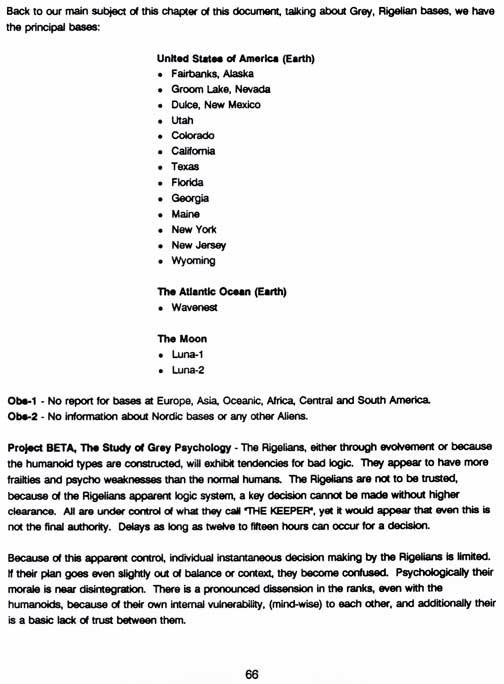
“Normally the Greys during an abduction make an insertion
of a 3mm device (SBMCD) through the nasal cavity into more close proximity to the brain of the abductee and after implementing subliminal post-hypnotic suggestions that could compel the abductee to perform some specific act within the next two to five years (after implant).”
“A completely unexpected surprise is that the chemistry of Enceladus,
what's coming out from inside, resembles that of a comet. To have primordial material coming out from inside a Saturn moon raises many questions on the formation of the Saturn system.”
- Hunter Waite, a Principal Investigator, Cassini Mission
On Wednesday, March 12, 2008, NASA's Cassini spacecraft flew along the south pole of Enceladus to sample water-ice, dust and gas in the geyser plumes that erupt there. This was the first of four Cassini flybys of Enceladus planned for 2008, the second coming in August. Image 2007 by Cassini-Huygens spacecraft.
March 30, 2008 Pasadena, California - NASA reported this week:
NASA's Cassini spacecraft tasted and sampled a surprising organic brew erupting in geyser-like fashion from Saturn's moon Enceladus during a close flyby on March 12. Scientists are amazed that this tiny moon is so active, "hot" and brimming with water vapor and organic chemicals.
New heat maps of the surface show higher temperatures than previously known in the south polar region, with hot tracks running the length of giant fissures. Additionally, scientists say the organics "taste and smell" like some of those found in a comet. The jets themselves harmlessly peppered Cassini, exerting measurable torque on the spacecraft, and providing an indirect measure of the plume density.
Click here to subscribe and get instant access to read this report.
Click here to check your existing subscription status.
“We’re talking about essentially up to around 2 miles per second (15,000 mph). So, this (Carancas stoney meteorite) was coming in at a very high speed.”
- Prof. Peter Schultz, Brown University
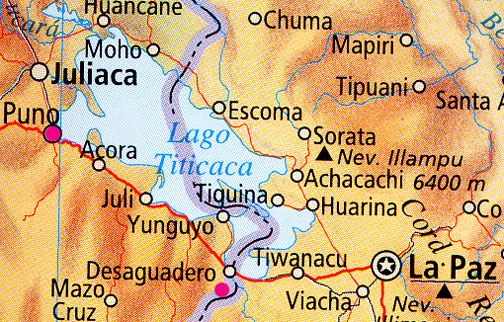
Not far from Lake Titicaca and Puno in southern Peru, is the small farming town of Carancas on a high Andean plateau near the Bolivian border (pink circle below Desaguadero).
March 28, 2008 Providence, Rhode Island - It was 11:45 AM on Saturday, September 15, 2007, when alpaca farmer, Justina Limache, heard a “thunderous roar from the sky.” Scared, she grabbed her 8-year-old granddaughter and ran into her house. For the next few minutes, Justina heard rocks raining down on the roof so loudly that she worried her house would collapse. What 74-year-old Justina Limache did not know was that a meteorite had fallen near her home in Carancas, Peru, 62 miles (100 kilometers) southeast of Puno and not far from Lake Titicaca. Carancas is a farm community of about 2,000 people who raise cows, alpacas, llamas and other animals on the high Andean plateau near the Bolivian border.
Click here to subscribe and get instant access to read this report.
Click here to check your existing subscription status.
“Even though this object (Planet X) might be at 100 A. U., if it’s a bright object, if its surface reflects light sufficiently, then it might easily be picked up - and perhaps other objects like it - by these new surveys coming on line even next year (2009) and in the next several years.”
- Prof. Mark V. Sykes, Ph.D., Planetary Science Institute
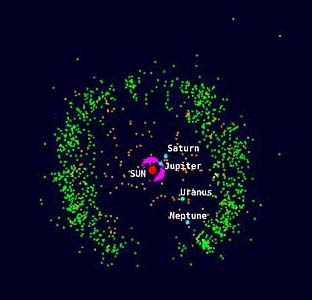
Illustration of possible Earth-size planet beyond Pluto and Kuiper Belt at 100 Astronomical Units (A. U.) from our sun (upper right). Theorized by Kobe University Japanese scientists because of perturbations in the orbits of other bodies in that region of solar system. Illustration courtesy Kobe University, Japan.Illustration of Kuiper Belt objects (green) ranging from 42 to 47 Astronomical Units (A. U.) from the sun beyond Pluto. Illustration courtesy Kobe University, Japan.
March 28, 2008 Tucson, Arizona - The upcoming April 2008 printed issue of The Astronomical Journal will have this intriguing paper: “An Outer Planet Beyond Pluto and the Origin of the Trans-Neptunian Belt Architecture.” The authors are Patryk Lykawka and Tadashi Mukai from the Graduate School of Science, Earth and Planetary Sciences, Kobe University, Japan. After studying perturbations and highly angled inclinations to the plane of the inner solar system among objects in a region 100 Astronomical Units (A. U.) from our sun far beyond Pluto, the Japanese scientists propose the discovery of a nearly Earth-size planet out there that takes 1,000 years to orbit the sun. Prof. Tadashi Mukai says, “We have been able to identify more than 1,100 objects beyond Neptune since 1992, and a huge number of objects are showing large orbital eccentricities and elliptical orbits.”
Click here to subscribe and get instant access to read this report.
Click here to check your existing subscription status.
“The deer was just lying there, except it was missing the two eyes,
the side of the cheek and the rear of the animal was completely cored out. No blood.So, it was a very,very strange occurrence.”
- Retired Broadcast Engineer, New York
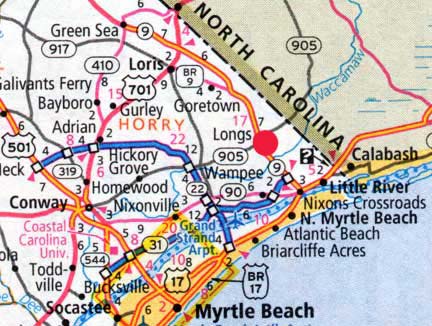
Longs, South Carolina (red circle) is near the North Carolina border northeast of Myrtle Beach, a resort town and home of Myrtle Beach AFB until its closure in 1993.
March 28, 2008 Longs, South Carolina - This week I received an email from a retired broadcasting engineer. He and his wife are currently spending the winter in Longs, South Carolina, near North Myrtle Beach. Their permanent residence is in New York State. The couple traveled to a recreational vehicle park in October 2007, where they have been living until they return to New York on April 1st. Last Thursday, March 20th, the husband – who has asked I not use his name – drove his car to a store, taking Southern Heights Drive towards Route 905. At that intersection, there is a small open field and he could see a deer down on its right side.
Click here to subscribe and get instant access to read this report.
Click here to check your existing subscription status.
“The Wilkins breakout won't have any effect on sea-level because that ice is floating already, but it is another indication of the impact that climate change is having on the region. We believe the Wilkins has been in place for at least a few hundred years. But warm air and exposure to ocean waves are causing a break-up.”
- Ted Scambos, Ph.D., Glaciologist, University of Colorado
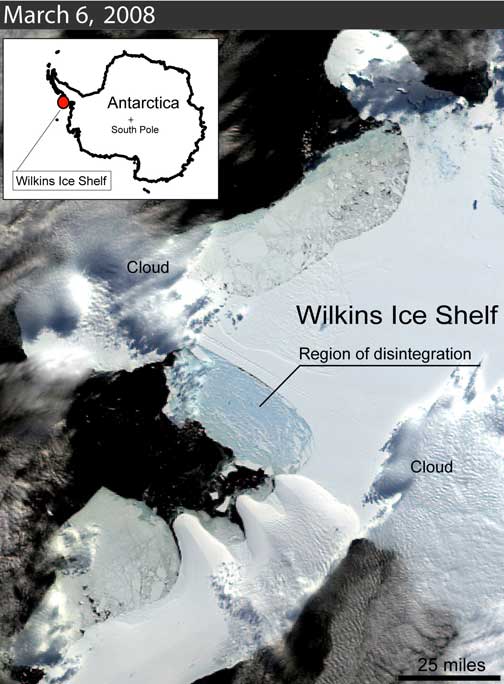
Above and below satellite images of the Wilkins Ice Shelf in the West Antarctic Peninsula where a huge 160-square-mile-chunk of ice disintegrated between February 28 and March 8, 2008. The ice section that broke away measured 25-miles-long (41 kilometers) by 1.5-miles-wide (2.5 kilometers). All that's holding back the rest of the Wilkins Ice Shelf is a narrow band of ice, which might also give way in the near future. Image courtesy NSIDC.
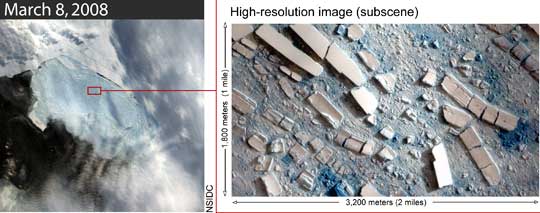
Left: Red rectangle is blown up on right to show the large chunks in the disintegrated mass of Wilkins Ice Shelf the size of Northern Ireland that broke off between February 28, and March 8, 2008. Image courtesy NSIDC.
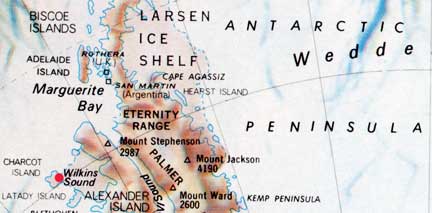
March 27, 2008 Boulder, Colorado - In West Antarctica on March 8, 2008, at the Wilkins Ice Shelf which floats on the Pacific Ocean not far from the southern tip of South America, a slab of ice as large as Northern Ireland broke off. The 160-square-mile ice chunk had been there for perhaps 1,500 years. But between February 28 and March 8, 2008, NASA’s Earth Observing System Aqua and Terra satellites photographed the Wilkins’ disintegration.
Click here to subscribe and get instant access to read this report.
Click here to check your existing subscription status.
March 21, 2008 Albuquerque, New Mexico - It’s ironic that in March 2008, a TV network such as FOX in New York City and the cable distributor, History Channel, would finally do reports about the strange, aerial, dragonfly-shaped craft that first showed up in 2007 photographs – a whole year after events without doing any substantive research. Their sarcastic reports have left viewers with the false impression that the photos were all from California and most likely CGI/Photoshop creations. Neither conclusion is true.
Why did FOX have a segment about the dragonfly drones? Because the Los Angeles Times on March 18, 2008, headlined: “A UFO Cold Case” with a photograph of two private investigators named Frankie Dixon and T. K. Davis. The two were hired by a European group to track down one of last year’s eyewitnesses who photographed a dragonfly machine over a power line in Capitola, California, on May 16, 2007.
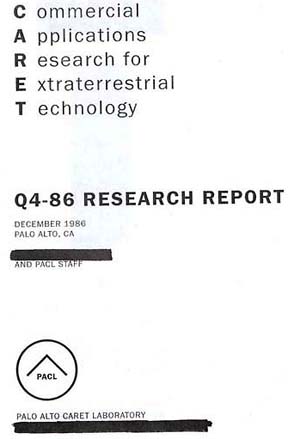
March 21, 2008 Albuquerque, New Mexico - After the Big Basin craft, no other photographs of the mysterious dragonfly-shaped drones emerged in 2007. But on Tuesday, June 26, 2007, the mystery of the dragonfly-shaped aerial drones took another turn with the release of an alleged secret report containing photographs of alleged extraterrestrial technologies, entitled “Commercial Applications Research for Extraterrestrial Technology” – known with the acronym CARET, which contained a “Q4-86 Research Report,” dated December 1986, Palo Alto, California, by the Palo Alto CARET Laboratory, also known as PACL (pronounced “packel”). See: Isaac Release and 062607Earthfiles Parts 1 and 2.
Cover of CARET Q4-86 Research Report, December 1986, Palo Alto, California, and PACL Staff, Palo Alto CARET Laboratory. Document provided by "Isaac" electronically on June 26, 2007.
Click here to subscribe and get instant access to read this report.
Click here to check your existing subscription status.