






Honey Bee Disappearances Not “Solved” by Virus and Fungi

“Beekeepers there in North Dakota saw so many dead bees ... and we sent some samples into a lab in Florida and they found Imidacloprid in the honey and the bees and the wax. I mean, that pretty much nails it down.”

- Daniel F. Mayer, Ph.D., Entomologist
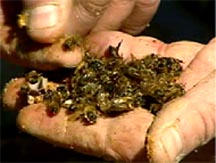
In Colony Collapse Disorder, honey bees either don't return to the hive or are found dead around the honey bee colony (above image).

Bayer v. Beekeepers

by Katherine Eban, October 8, 2010 from Fortune.com: "What a scientist didn't tell The New York Times about his study on bee deaths"

As for the Bayer-Bromenshenk connection, in 2003 a group of 13 North Dakota beekeepers brought a class-action lawsuit against Bayer, alleging that the company's neonicotinoid, Imidacloprid, which had been used in nearby fields, was responsible for the loss of more than 60% of their hives. "My bees were getting drunk," Chris Charles, a beekeeper in Carrington, N.D., and a plaintiff in the lawsuit, told me in 2008. "They couldn't walk a white line anymore -- they just hung around outside the hive. They couldn't work."

Charles and the other North Dakota beekeepers hired Bromenshenk as an expert witness. Bayer did not dispute that Imidacloprid was found among the bees and their hives. The company simply argued that the amount had not been enough to kill them.

As the North Dakota lawsuit moved forward, an expert witness for the beekeepers, Dr. Daniel Mayer, a now retired bee expert from Washington State University, traveled to 17 different bee yards in North Dakota and observed dead bees and bees in the throes of what looked like Imidacloprid poisoning, he told me in 2008. He theorized that after foraging in planted fields where the seeds had been treated with Imidacloprid, the bees then brought the pesticide back to the hive, where it built up in the wax combs.


Click here to subscribe and get instant access to read this report.

Click here to check your existing subscription status.

Existing members, login below:

Dead Sea Scrolls Going Online

“We are establishing a milestone connection between progress and the past to preserve this unique heritage for future generations. At the end of a comprehensive and profound examination, we have succeeded in recruiting the best minds and technological means to preserve this unrivaled cultural heritage treasure which belongs to all of us, so that the public with a click of the mouse will be able to freely access history in its fullest glamour.”

- Shuka Dorfman, Director, Israel Antiquities Authority


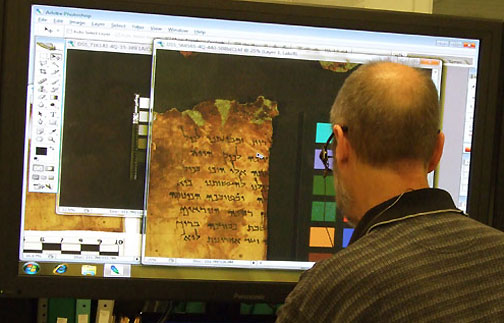
Scholar working with Dead Sea Scroll images on computer.  The Israel Antiquities Authority is collaborating with the Google R&D center in Israel to upload all 30,000 Dead Sea Scrolls fragments, as well as additional data that will allow users to perform searches across a broad range of data in a number of languages and formats. Image 2010 courtesy Israel Antiquities Authority.

October 21, 2010  Jerusalem, Israel - The entire collection of 900 Dead Sea Scroll manuscripts made from 30,000 Dead Sea Scroll fragments are being digitally photographed by the Israel Antiquities Authority and Google's Research and Development center in Israel to put the entire historic writings online. According to the Antiquities Authority, the digital Dead Sea Scrolls will be equal in quality to actually viewing them in person.

NASA space age multi-spectral imaging technology will be used to produce high-resolution images of the sometimes-faded texts that may reveal new letters and words. The estimated cost of $3.5-million will be funded by the Israel Antiquities Authority and Google R&D's division in Israel. The entire Dead Sea Scroll collection will be made available online free of charge online in a searchable database complemented by translations. The first images could go online in the next few months, with the project completed within five years.


Click here to subscribe and get instant access to read this report.

Click here to check your existing subscription status.

Existing members, login below:

Part 1: 2010 Half-Cat Mutilations

“It appeared the 2010 cats in Vancouver were cut in half surgically, and we had one half-cat looked at by a veterinarian and it was determined that cat was cut post-mortem.”

- Sgt. Peter Thiessen, RCMP


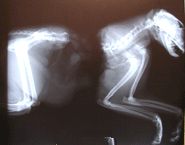
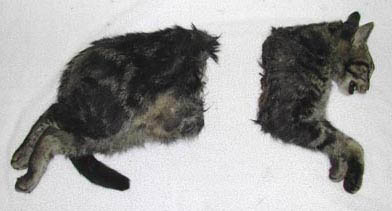
Above: Mutilated male cat was found first week of August 2003, in Bothell Washington. Veterinarian Cherie Good, D.V.M., placed cat remains to show width of cat's cut out middle section. Below is an x-ray of the same cat showing the dark space in the back half that indicates all internal organs were removed. Photograph and x-ray © 2003 by Cherie Good, D.V.M.


October 12, 2010  Vancouver, B. C., Canada - Since June 2010, at least nine half-cats have been reported to the Royal Canadian Mounted Police in the White Rock, Langley, and West Vancouver regions around Vancouver, British Columbia. No photographs of the current cat victims are available, but today I interviewed one of the investigators, Sgt. Peter J. Thiessen, Senior Media Relations for the Lower Mainland District of the Royal Canadian Mounted Police in Surrey, B.C., Canada.

Vancouver, British Columbia, Canada, has been the location of many half-cat mutilations for at least twenty years. In July to September 2010, White Rock, Langley and West Vancouver experienced at least nine bloodless, half-cat cases reported to the Royal Canadian Mounted Police office in Surrey, B. C.   Bellingham, Washington, (bottom red circle) has also had several half-cat mutilations over the past couple of decades.

Interview:

Sgt. Peter J. Thiessen, Senior Media Relations Officer, Lower Mainland District of the Royal Canadian Mounted Police, Surrey, British Columbia, Canada:  “I first became aware of the half-cat problem several weeks ago in July 2010 when we had several reports in White Rock, British Columbia (southeast of Vancouver and northwest of Bellingham, Washington). White Rock had three separate half-cat incidents over several months. Then I became aware that another adjacent community, Langley, outside of Vancouver, B. C., had five similar half-cats in the weeks of July and August 2010.


Click here to subscribe and get instant access to read this report.

Click here to check your existing subscription status.

Existing members, login below:

Part 2: History of Half-Cat Mutilations

“Some of the cats were cut in half with what some say is almost surgical precision, others disemboweled or skinned.”

- The New York Times, August 13, 1989


Above: Mutilated male cat was found first week of August 2003, in Bothell Washington. Veterinarian Cherie Good, D.V.M., placed cat remains to show width of cat's cut out middle section. Below is an x-ray of the same cat showing the dark space in the back half that indicates all internal organs were removed. Photograph and x-ray © 2003 by Cherie Good, D.V.M.


Return to Part 1


October 12, 2010  Albuquerque, New Mexico - The following is an overview of the many half-cat mutilations I have reported about at Earthfiles.

In 1978 in St. Catharines near Toronto, Canada, authorities were frustrated by more than 100 missing cats and dogs and many others found in their owners' yards cut in half, skinned, decapitated, disemboweled, or paws removed, without blood at the site.

Ten years later on August 13, 1989, The New York Times reported about 67 cats found mutilated in Tustin, California - a suburb of Los Angeles near Santa Ana. The NYT wrote:


Click here to subscribe and get instant access to read this report.

Click here to check your existing subscription status.

Existing members, login below:

Part 3:  What A Biophysicist Says About Crop Formations

“I have never seen such rapid changes from plant sample to plant sample in both of the ring circles. That means the plasma energies were so compartmentalized that wheat growing only twelve inches from another sample was very different.”

- W. C. Levengood, Biophysicist

Return to Part 1

October 11, 2010  Albuquerque, New Mexico  -  The following is my presentation at the Brazil Conference: “Science Discusses the Crop Circle Phenomenon,”  September 25 – 26, 2010, in  Sao Paulo and Rio de Janeiro.

As a science and environment investigative reporter, I made my first trip to Wiltshire County, England, in July 1992, to explore the beautiful mystery of crop formations. The first pattern I stepped into convinced me I had encountered a powerful and profound force. A group of us heard about this a pattern of five circles below Milk Hill and had walked along the crest to look from above. The sky was blue, the wheat was glistening and there were five circles, four connected by undulating paths and one circle by itself.


Click here to subscribe and get instant access to read this report.

Click here to check your existing subscription status.

Existing members, login below:

Part 1:  U. K. Farmers Impressed by High Strangeness in Crop Formations

“As we pulled out of the ground some of those crisp, 90-degree bent - but uncreased and unbroken - canola stems to show the farmer and to show him that the petals on the canola were completely intact, that angry farmer started to completely soften.”

- Gary King, Videographer, CropCircleReporter.com

On September 26, 2010, Earthfiles Reporter and Editor Linda Moulton Howe landing in Rio de Janeiro, Brazil, to speak for “Science Discusses the Crop Circle Phenomenon” organized by MIST Productions and the good efforts of Brazilian producers Marta Jaramillo and Anna Sharp. Image © 2010 by Linda Moulton Howe.
Rain forest-covered volcanic walls rise straight up from many streets of the beautiful, French-Portuguese style Rio surrounded by the breath-taking beauty of wild nature and the powerful Atlantic Ocean. September 26, 2010 image © by Linda Moulton Howe.
Our hotel was across the street from the beach that ended at a rain forest mountain rising into the misty clouds.  September 26, 2010 image © by Linda Moulton Howe.
Rain came and went during our stay in Rio de Janeiro, but on September 27, 2010, I was able to photograph atop the 2,400-foot-tall Corcovado Mountain, Rio’s most famous monument, Christ The Redeemer (Cristo Redentor). Constructed in 1931, Christ The Redeemer stands upright 98 feet tall and weighs 1.4 million pounds (700 tons), with outstretched, protective arms over Rio. Image © 2010 by Linda Moulton Howe.
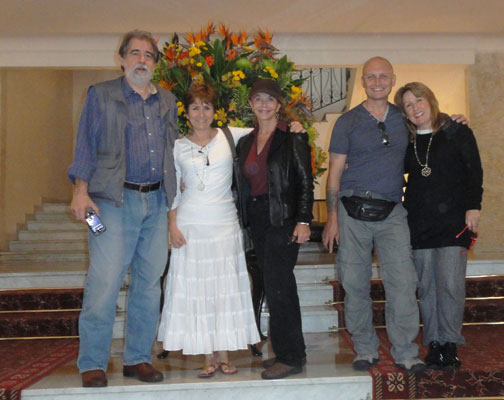
September 27, 2010, in lobby of Copacabana Palace Hotel, Rio de Janeiro. L-R: Speaker Jonathan Paul de Vierville, San Antonio, Texas; Clara Lucia Gomez, Colombia; speaker Linda Moulton Howe, Albuquerque, New Mexico; speaker Gary King, Melksham, Wiltshire, England; MIST producer Marta Jaramillo, Sao Paulo, Brazil.

October 9, 2010  Albuquerque, New Mexico - On September 23, 2010, I flew from Albuquerque to Sao Paulo, Brazil, to join four other speakers to present information about global crop formations before two audiences in Sao Paulo on September 25th and in Rio de Janeiro on September 26th. The conference title was “Science Discusses the Crop Circle Phenomenon” organized by MIST Productions and the good efforts of Brazilian producers Marta Jaramillo and Anna Sharp. 


Click here to subscribe and get instant access to read this report.

Click here to check your existing subscription status.

Existing members, login below:

Part 2:  U. K. Farmers Impressed by High Strangeness in Crop Formations

07-07-07 East Field Phenomenon Reprinted on October 9, 2010


Updated Part 1:  1,033-Foot-Long East Field Wheat Formation “Happened Within 90 Minutes.” Investigators presented video and eyewitness evidence at July 19, 2007, press conference in Coronation Hall, Alton Barnes, Wiltshire, U.K.

© 2007 by Linda Moulton Howe

“We were the first to reach the formation at 4 AM (July 7, 2007) after seeing a very bright flash of light. The wheat circles were raised 6 inches above the ground so when we stepped in, the plants crunched under our feet like we were stepping on delicate crystals.”

- Gary King, Cardiff, U. K. Paralegal

4 AM digital images added below.

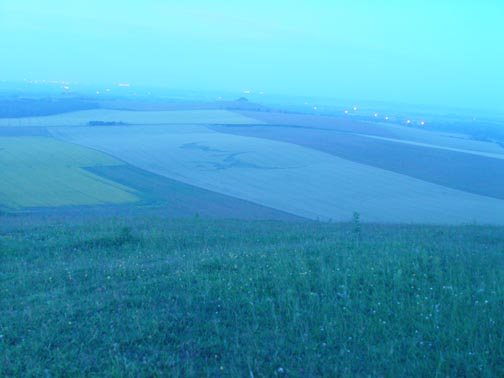
Approximately 3:20 AM, Saturday, July 7, 2007, Alton Priors, Wiltshire, England. Sony digital still frame in pre-dawn misty haze from atop Knap Hill looking toward Woodborough Hill (center dark clump of trees near horizon.) Vast wheat formation of 150 circles spread across 1,033 feet was created some time in the previous 90 minutes to hour and 45 minutes. Image © 2007 by Winston Keech.

Return to Part 1

July 19, 2007 / Updated  July 27, 2007  Alton Barnes, Wiltshire  -  Gary King is 41-years-old and currently a Linguistics student at Cardiff University in Wales, U. K. Between 1985 and 1987, he had worked as a paralegal in London and then moved on to form his own private investigator company to trace missing persons and investigate cases of matrimonial discontent. He was doing private-I work until July 1997, when he walked into his first English crop formation "and life has changed considerably ever since," Gary told me in a July 11, 2007, phone interview. He explored Navaho reservations in Arizona, studied the dance traditions of West Africa, increased his knowledge of Tai Chi and other martial arts. He began to realize that he was becoming increasingly sensitive to the seen and unseen.


Click here to subscribe and get instant access to read this report.

Click here to check your existing subscription status.

Existing members, login below:

Gobekli Tepe: 12,000 Years Old and Rewriting Human History

“This time what came first was the temple and then the city.”

- Klaus Schmidt, Ph.D., German Archaeological Institute

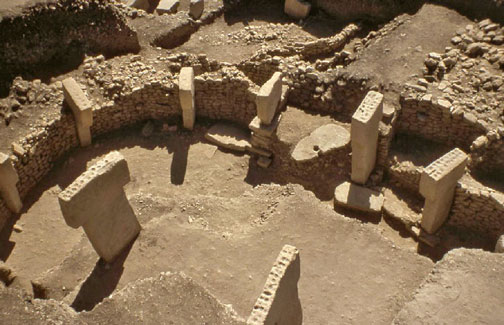
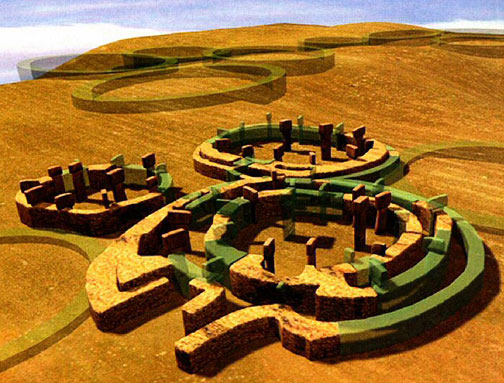
12,000-year-old circles of limestone columns weighing from 7 to 15 tons or more have been excavated in Gobekli Tepe, Turkey, about 6 miles southeast of Urfa. Older than Egypt, Sumeria and Stonehenge, 40 standing T-shaped columns have so far been uncovered in four circles 98 feet (30 meters) in diameter. Only 5% of the temple complex in repeating circles has been uncovered. Ground-penetrating radar indicates there are 250 more pillars in circles extending over another 25 acres of the 30-acre ancient site. Image © 2008 by Haldun Aydingun.
Ground-penetrating radar surveys indicate there might be at least 250 more standing stones in 18 still-buried circles. Finely honed reliefs and some 3-dimensional sculptures on the limestone columns depict boars, foxes, lions, birds, snakes, scorpions, vultures, reptiles, humans and other figures. Illustration © by Die Beweise.


Click here to subscribe and get instant access to read this report.

Click here to check your existing subscription status.

Existing members, login below:

Invasion of “Super Bed Bugs” in America

“A recent National Pest Management Association survey found that 95% of some 1,000 pest control companies across the world are dealing with bed bugs on a daily basis.”

- Dini Miller, Ph.D., Assoc. Prof. of Entomology, Virginia Tech


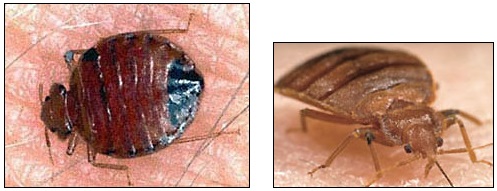
Adult bed bugs (Cimex lectularius) are about the size of apple seeds (3/16th inch),  have six legs, no wings, and are light reddish-brown (right) and look darker after feeding (left). Feeding every five to seven days, to fill up on their host's blood takes five to ten minutes and their favorite food is human blood. From pinhead-size white eggs, bed bugs hatch and grow through five larva stages of translucent whitish-yellow color over ten weeks to the sixth stage of adulthood. Their life span averages six months to a year while the  bugs hide out in mattress seams, box springs, baseboard crevices, behind wallpaper and clutter around beds between blood feedings. The thermal death point (for bed bugs) is about 118 degrees Fahrenheit. Images courtesy CDC.
Adult bed bugs (Cimex lectularius) are about the size of apple seeds (3/16th inch), have six legs, no wings, and are light reddish-brown (right) and look darker after feeding (left). Feeding every five to seven days, to fill up on their host's blood takes five to ten minutes and their favorite food is human blood. From pinhead-size white eggs, bed bugs hatch and grow through five larva stages of translucent whitish-yellow color over ten weeks to the sixth stage of adulthood. Their life span averages six months to a year while the bugs hide out in mattress seams, box springs, baseboard crevices, behind wallpaper and clutter around beds between blood feedings. The thermal death point (for bed bugs) is about 118 degrees Fahrenheit. Images courtesy CDC.

September 30, 2010  Blacksburg, Virginia - Two weeks ago on the weekend of September 18, 2010, the Nike sports company shut down its 95,000-square-foot Niketown store in Midtown Manhattan. And kept it closed for more than a week. To do what? To exterminate the bed bugs that had literally taken over every nook and cranny of the building.


Click here to subscribe and get instant access to read this report.

Click here to check your existing subscription status.

Existing members, login below:

Part 6:  Beyond Aztec and Wright-Patterson – John Smith’s Sexual Encounter with Black-Haired Female

“It’s not where they are coming from, but what they are up to that bothers us. My advice to you is not to talk about these things any more and leave to authorities.”

- Secret Service Agent told John Smith, Technical Illustrator, Rochester, New York

Return to Part 1.

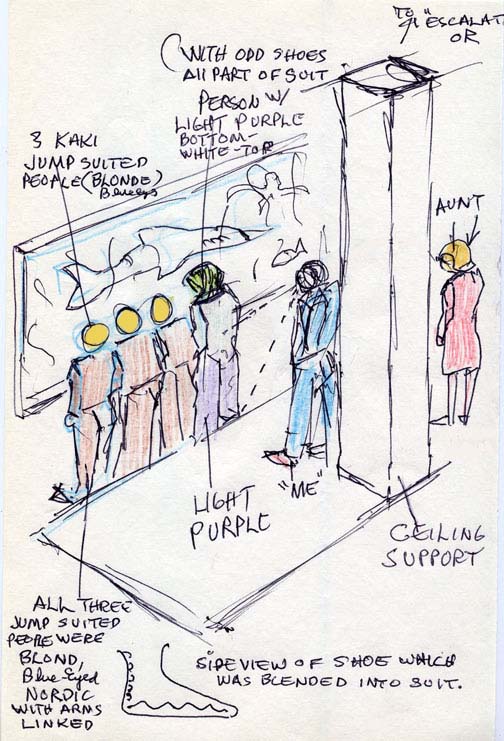
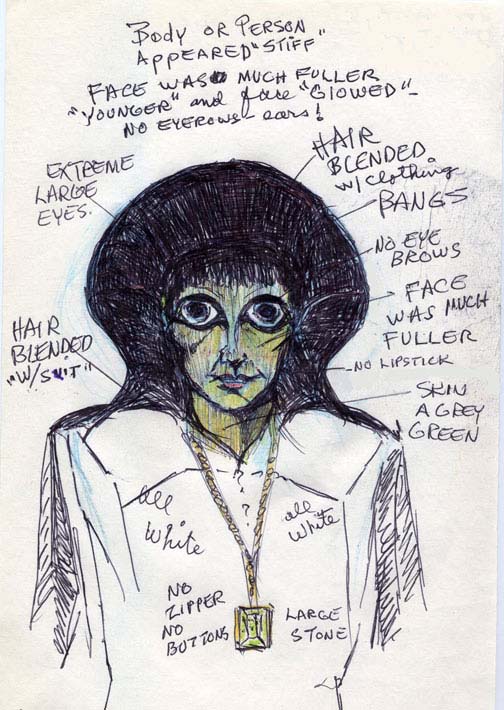
September 23, 2010  Rochester, New York - Beyond the 1958 conversation at Friden, Inc., in Rochester, New York, between technical illustrator John Smith and a secretary from the ATIC division (later Foreign Technology Division, FTD) of Wright-Patterson AFB, three years later in March 1961, he was on vacation with his wife and Aunt Jane at Marineland on the Palos Verdes Peninsula, “when the strangest experience of my life occurred.” In this final Part 6, John Smith describes more detail about what happened when the cobra-haired female smiled strangely at him. Now in 2010, his intuitive sense is that a big change is coming to Earth.

Sketch of three blond beings in khaki jump suits with their arms linked together as well as arm linked with the taller, “cobra-haired” female on far right. Behind them is John Smith leaning against ceiling support column. His aunt is on the other side of the column. His wife was further back from aunt and not in sketch. All were watching the marine creatures swimming in tank at Marineland in 1961. Illustration © 2010 by John Smith.
Sketch of taller, grey-green skin, “cobra-hair” female on far right of blond beings at Marineland in 1961. Illustration by John Smith.


Click here to subscribe and get instant access to read this report.

Click here to check your existing subscription status.

Existing members, login below: