
Cosmic Rays Reaching Earth At Highest Level in 50 Years
© 2009 by Linda Moulton Howe
“We think if the tilt of the sun’s solar magnetic fields
continue to decline over the next few months or year, the intensity
of cosmic rays reaching Earth will go up even more – perhaps from 19%
to even 30% more than we have ever observed in the Space Age.”
- Richard Mewaldt, Ph.D., Cal Tech Physicist
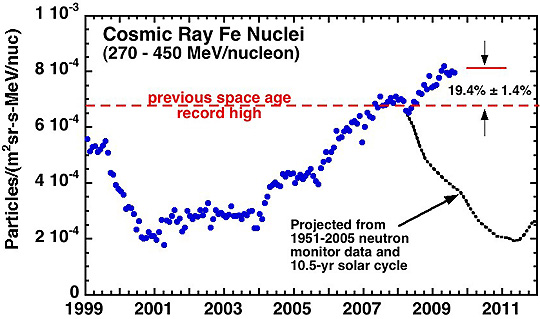
Galactic cosmic ray intensities are 19% higher for all elements.
Graphic by Richard Mewaldt, Cal Tech.
October 6, 2009 Pasadena, California - In August 1997, a satellite was launched called the Advanced Composition Explorer (ACE) to “study the particles that come near the Earth from our Sun, from space between the planets and from the Milky Way galaxy beyond our solar system.” The ACE satellite is positioned at “L-1,” a site a million miles in front of the Earth with the sun some 92 million miles beyond.

Logo for Advanced Composition Explorer satellite launched
August 1997 to study solar particles and galactic cosmic rays. Image courtesy NASA.
Space weather has become increasingly important in the modern Space Age of astronauts, shuttles, International Space Station, so many satellites and dreams of bases on the moon and Mars. If the sun unleashes a big coronal mass ejection with energetic particles headed for Earth that can cause geomagnetic storms here, the ACE satellite can give a half-hour to an hour warning so military and industrial managers can help protect orbiting satellites.
Cosmic Rays
In addition to solar particles, another highly energetic particle from the Milky Way galaxy reaches Earth's atmosphere all the time. Cosmic rays can damage electronic systems and even DNA in living creatures.

When a high-energy cosmic ray enters the atmosphere,
it can cause an “air shower.” The cosmic ray hits a molecule
in the atmosphere and “breaks up,” producing lots more sub-atomic
particles. The cosmic ray (red center top) breaks up into sub-atomic particles
that can include protons (green), neutrons (orange), pions (yellow),
muons (purple), photons (blue), and electrons & positrons (pink).
Illustration by Randy Russell, NASA and NCAR.
The number of cosmic rays reaching Earth are lower when the sun is active and has a strong, turbulent magnetic field that interferes with cosmic ray travel. But when the sun is not active, more cosmic rays reach Earth. The sun is supposed to be in an increasingly active period of Solar Cycle 24 with a solar maximum originally expected in 2011 to 2012. But the sun has been abnormally quiet. Scientists have not seen such a low sunspot number since around 1913, the beginning of the 20th Century. Further, the magnetic field of the sun is at the lowest magnetic field strength measured in at least fifty years from the beginning of the Space Age.

A collision between a high-energy cosmic ray particle and an atom
in a photographic emulsion, as viewed through a microscope.
Image credit: NASA, Dr. David P. Stern.
At the August 3 to 7, 2009, at the Solar Heliospheric and Interplanetary Environment (SHINE) meeting in Wolfville, Nova Scotia, Richard Mewaldt, Ph.D., Senior Research Associate in Physics at the California Institute of Technology Kahill Astrophysics Laboratory in Pasadena, presented his latest ACE data on cosmic ray intensity change since April 2009, the last six months.
Interview:
Richard Mewaldt, Ph.D., Senior Research Associate in Physics, California Institute of
Technology, Pasadena, California: “What we’ve measured is that over the past six months or so, the cosmic ray intensity has been about 19% higher than it was at any other time in the Space Era. We can track this back to solar minima in 1965, using spacecraft data. The amount is out of the box that we thought cosmic rays were in. It’s a higher intensity for all the elements in the periodic table that make up cosmic rays – we can measure them all the way from helium up through iron and the intensity of all of these elements has increased.
One thing that we notice is that this intensity is correlated with the so-called tilt of the solar magnetic fields. The solar wind carries out the sun’s magnetic field that excludes the cosmic rays because they are scattered and deflected by the magnetic field, which is now weaker.
On a shorter time scale, when that tilt increases, there is pattern we refer to as a ‘ballerina skirt’ as the solar wind carries the magnetic field out. It means that if the cosmic rays coming in are going along the folds in the skirt and that’s a longer distance than if it were flat.
Right now, the tilt has reduced to about 20 degrees and it has gotten much lower during previous solar minimum, down to 5 or 10 degrees. We think if the tilt of the sun’s solar magnetic fields continue to decline over the next few months or year, the intensity of cosmic rays reaching Earth will go up even more – perhaps from 19% to even 30% more than we have ever observed in the Space Age.
THAT IS UNPRECEDENTED IN THE MODERN AGE?
It’s unprecedented in the modern age, but we actually do have some records of what cosmic rays have done over the past thousand years or so. That’s because when cosmic rays hit the top of the atmosphere, they produce some radioactive isotopes such as beryllium-10 and carbon-14, which then precipitate out of the atmosphere and they end up in the polar ice, both in Antarctica and the Arctic.

Ice Core sample taken from drill.
Photo by Lonnie Thompson, Byrd Polar Research Center.
By taking an ice core that goes back for centuries, scientists can measure how much of the radio isotopes are present in very thin layers of the ice core and they can trace back solar cycles that go over a thousand years. It turns out that the activity over the past 50 years of the Space Era has actually been on average much lower than it has been over the past thousand years.
Maunder Minimum, 1654 to 1715
70 years of very few sunspots and “Mini Ice Age”

Between 1645 and 1715, the Maunder Minimum coincided with a period
of lower-than-average global temperatures. During one 30-year period within the
Maunder Minimum, astronomers observed only about 50 sunspots, as opposed
to a more typical 40,000–50,000 sunspots in modern times.
You’ve perhaps heard of the Maunder Minimum? It’s a time when the sun was very quiet in 1645 to 1715. Cosmic ray intensity then was about 2.5 times higher than it has been at typical solar minima we’ve experienced during the modern Space Era.
We’ve had satellites up there (since 1960s) during a time that’s been relatively quiet as far as cosmic rays are concerned, which means our sun has been more active than average over history. Maybe things are just coming back to a more normal state?
WHAT IS THE HIGHEST INTENSITY OF COSMIC RAYS YOU HAVE BEEN ABLE TO FIND IN ICE CORES?
I think it’s about 2 times what we had before this recent climb in the past six months up 19% and this increase so far is roughly twice as high as the past 50 years until now.
WAS THAT INTENSITY OF COSMIC RAYS IN THE PAST ONLY DURING THE MAUNDER MINIMUM?
No, most of the time in the ice cores, it was higher than what we've experienced the past 50 years in the Space Age. The Maunder Minimum was probably the highest.
IS IT FAIR TO CONCLUDE THAT THE ICE CORES INDICATE OUR SUN HAS BEEN LESS ACTIVE IN THE PAST?
Yes, I think that’s a fair and logical conclusion – the sun has been much less active like the Maunder Minimum and it does seem to occur in cycles, maybe every 200 years or so the sun is less active. So, we just started going into space at a time when the sun was more active than usual and the cosmic rays were lower.
Impacts of Increased
Cosmic Rays on Earth Life?
IF COSMIC RAYS ARE GOING TO CONTINUE TO INCREASE TO POSSIBLY 30% MORE INTENSITY, WHAT WOULD THE IMPACT BE ON EARTH LIFE?
Astronauts, in particular, if they were trying to take a trip to Mars would definitely be affected. To a lesser extent, space hardware is also affected by cosmic rays because the rays can cause electronic circuits to fail.
A factor of 2 increase in cosmic ray intensity would make a big difference for astronauts because if we look at what the radiation levels are even if cosmic rays did not increase, it would be a difficult trip for astronauts. They would be encountering significantly increased chances of getting cancer and other complications later on in their life.
Whether or not cosmic rays play a role in other aspects of Earth’s climate is a very controversial issue that people are investigating, but I don’t think we can say definitely cosmic rays lead to those affects.
ASTRONAUTS WOULD HAVE TO WORRY ABOUT INCREASED SOLAR RADIATION GETTING TO THEM IN WHATEVER SPACE VEHICLE THEY TRAVELED IN AND COSMIC RAYS ARE KNOWN TO CAUSE GENETIC MUTATIONS IN DN
That’s true.
ISN’T IT POSSIBLE THAT IF WE WERE MOVING INTO AN ERA OF INCREASING COSMIC RAYS AND A MORE QUIET SUN, WE COULD END UP WITH MORE DNA ANOMALIES IN EARTH LIFE?
I think there is an effect, but most of the radiation we get on Earth is from radioactive materials in the air and soil, such as radon released by the decay of uranium and other radioactive substances. That’s where people living on the Earth get most of their radiation – from those natural cause rather than from cosmic rays.
But airline personnel that fly to Europe over the North Pole get a higher dose and statistically, they would be at higher risk.
Could the Sun Enter
Another Maunder Minimum Now?
IS IT POSSIBLE WE COULD BE MOVING INTO ANOTHER MAUNDER MINIMUM NOW?
It’s always possible. A couple of years of abnormal activity might not be significant yet. In another five years, the sun might return to what we’ve seen. Or in the next solar cycle, the sun might be even less active. Who knows?
BUT IF OUR SUN WERE TO GO INTO A MAUNDER MINIMUM NOW, THAT THESE THREE QUIET YEARS EXTEND FOR ANOTHER FIFTY, IS IT LIKELY THE EARTH WOULD COOL DOWN?
That happened back then – an unusual climate.
A MINI ICE AGE.
That’s correct. One thing we know is happening now is that at high altitude, the density of the Earth’s atmosphere is shrinking. It’s like space is closing in on us. The fact that the sun is less active is causing the outer Van Allen belt of the Earth is much weaker than it has typically been because the solar wind has been weaker. The solar wind sort of drives the radiation belts and they are all weaker right now. So far the sun has remained much more quiet for longer than we ever expected.
RIGHT, AND IT’S BAFFLING SOLAR PHYSICISTS.
Well, I think it’s baffling them alright, but part of it is we never had such good measurements as we have now a hundred years ago. We know there was also a period in 1913 when there was a very low sunspot number. The sun went for a hundred days or so before anyone observed a sunspot then. We are close to that level this time. That means there was evidence this unusual solar quiet has occurred before.
So, now during the modern Space Era, we’re encountering new conditions. We’re learning that the space environment that we thought we had a good handle on can vary more than we thought. It’s more unpredictable. The conditions in space and the effect the sun has on the Earth, we’ve certainly moved into a new era that we haven’t experienced in the past fifty years.
An Unpredictable Sun Makes
Space Travel More Difficult
Another consequence of Solar Cycle 24 not acting like we expected is if we were going to try to plan a trip to Mars to avoid the most intense cosmic ray activity, we are learning it’s harder to predict when that will occur.
WOULD ASTRONAUTS ON A TRIP TO MARS BE AWARE OF INCREASED COSMIC RAYS?
We would not know about galactic cosmic rays in that they can be passing through you all the time and cause radiation affects on cells and DNA, but we’re not aware of it. I mean, it’s happening to us here on Earth also.
A solar storm, we would probably be aware because there would be a radiation monitor on board the spacecraft and they would know the radiation in a large solar event can go up a factor of a thousand for a day or so. Shields would be needed to protect them. Instruments can also have problems during intense solar activity. Communications become more difficult during a big solar eruption.
WHAT WOULD SYMPTOMS IN HUMANS BE IN A STRONG SOLAR RADIATION EVENT?
If you had a big solar event where particles were accelerated to high energies that last for several days, astronauts could experience radiation sickness. That would be nausea and then disorientation as blood chemistry is affected. If the solar radiation were high enough for a long time, solar radiation can cause death. That’s why it’s important to have a shielded section of the spacecraft as the ISS has.
HOW DO YOU SHIELD?
Thicker shielding or fuel tanks that have fuel in them put matter in the way of the cosmic rays. Also, polyethylene (plastic) is a good shield because it has a lot of hydrogen atoms in its structure and that slows down solar energetic particles. The difference between solar energetic particles and galactic cosmic rays is that solar particles maximum intensities are not at very high energies. So putting material between you and that radiation will slow it down and make it stop.
But for highly energetic galactic cosmic rays, you can’t have enough shielding to keep them out.
IF A SPACE VEHICLE WERE MADE OUT OF STRONG PLASTIC, THAT WOULD SHIELD ASTRONAUTS ENOUGH?
It would reduce the intensity so they would be safe enough, yes. Maybe the astronaut quarters would be good to be constructed out of plastic inside a metal spacecraft.
I’ve also seen press releases from NASA where they might be able to build local shielding into a space suit. You want to protect the blood forming organs and heavy bone marrow such as hips. Shielding in suits might work without adding to much weight to a spacecraft.
WATER IN THE WALLS OF A SPACECRAFT – WOULD THAT BE AFFECTIVE SHIELDING?
Yes, water would be great.
BUT IT’S HEAVY?
Yes. But if you need water with you anyway, you might as well place it as a shield.
IF WE CAN LAUNCH TO MARS, DO YOU THINK SCIENTISTS WILL KNOW IF THE SHIELDING IS ADEQUATE FOR HUMANS?
For galactic cosmic rays, I think we have measurements of how intense they are on Mars. We’ve sent numerous spacecraft out into the solar system and we know that cosmic rays gradually increase as you move out into the solar system. So, we would know that amount.
For solar energetic particles, you can never predict what the sun is going to do, so there might be an eruption that’s dangerous. But the further you go from the sun, distance would reduce the impact of a solar event the farther the astronauts were from the sun. And you would get more warning because it would take longer for the solar energetic particles to get to you. With a warning, you could get to shielded sections of the spacecraft.”
Our spotless sun on October 6, 2009 by SOHO.
More Information:
For further information about solar activity, please see reports below in the Earthfiles Archive:
• 07/11/2009 — Update Podcast: Is Sudden Solar Intensity of July 5 - 7 What U.K. Spring Crop Formations Forecast for Oddly Quiet Sun?
• 05/12/2009 — Part 3: Astronomical Information in U.K. 2009 Crop Formations?
• 05/02/2009 — Long Minimums Usually Mean Weaker Maximums, But Sun Could Still Have Big X-Flares in 2011 to 2012
• 04/30/2009 — Part 2: First 2009 U. K. Crop Formations Counting Down to 2012?
• 04/07/2009 — Longest Solar Minimum Since 1913
• 03/06/2009 — Unexplained Stranding of 200 Pilot Whales and Dolphins
• 01/29/2009 — Part 1: Nanodiamonds Link Outer Space Impactorsto Earth Extinctions 12,900 Years Ago
• 01/29/2009 — Part 2: Nanodiamonds Link Outer Space Impactors to Earth Extinctions 12,900 Years Ago
• 12/21/2008 — Mystery of Missing East Coast Acorns
• 09/23/2008 — Solar Wind Pressure Lowest in 50 Years
• 08/29/2008 — Still No Sunspot Action on the Sun
• 01/10/2008 — Solar Cycle 24 Has Begun
• 08/08/2007 — 2007's Warm, Erratic Global Weather
• 07/11/2007 — Mystery of Night Shining Clouds - Another Global Warming Change?
• 06/22/2007 — Dragonfly "Drone" Seen October 1995 in Arizona
• 06/21/2007 — Large Lake in Southern Chile Has Disappeared
• 06/01/2007 — Is Earth Close to Dangerous Tipping Point in Global Warming?
• 02/23/2007 — Scientists Hope "Amphibian Arks" Can Save Frogs and Toads
• 01/13/2007 — Confusing Sun: Will Solar Cycle 24 Be Most Intense On Record?
• 01/10/2007 — 2006: USA's Warmest Year On Record
• 12/07/2006 — Earth Headed for Warmest Period in 55 Million Years?
• 09/09/2006 — Methane - Another Threat in Global Warming
• 08/23/2006 — Solar Cycle 24 - Headed for Intense X Flares by 2010-2012?
• 07/18/2006 — 2006 - Hottest Year So Far in U. S. History
• 03/23/2006 — Part 15 - Peculiar Phenomenon: Early United States Efforts to Collect and Analyze Flying Discs
• 11/18/2005 — Is the Sun Heating Up?
• 09/23/2005 — 9 X-Class Solar Flares Between September 7 - 19, 2005.
• 03/20/2005 — Astronaut John Young: "The Moon Can Save Earth's Civilization."
• 02/11/2005 — Sunspot Region 720 Emitted Strongest Solar Radiation Since October 1989.
• 06/08/2004 — Part 3: Whistleblower Microbiologist Dan Burisch Interview on June 7, 2003
• 10/29/2003 — Fifth Intense Solar X-Flare - What's Happening On the Sun?
• 09/07/2001 — Black Hole At Center of Milky Way - More Evidence
• 10/25/1999 — A Blast of Solar Wind Provokes Aurora Over Northern U. S.
Websites:
Advance Composition Explorer (ACE) Mission: http://www.windows.ucar.edu/tour/link=/space_missions/aceindex.html
How deadly are cosmic rays? http://www.msnbc.msn.com/id/32587618
NASA Solar Cycle Prediction: http://solarscience.msfc.nasa.gov/predict.shtml
NASA Solar Physics: http://solarscience.msfc.nasa.gov/
Solar and Heliospheric Observatory (SOHO): http://sohowww.nascom.nasa.gov/
Space Weather: http://www.spaceweather.com/
Sunspots: http://en.wikipedia.org/wiki/Sunspot
3-D Surface of the Sun: http://www.lmsal.com/Press/SPD2003.html
High Altitude Observatory (HAO): http://www.hao.ucar.edu/
National Center for Atmospheric Research (NCAR): http://www.ncar.ucar.edu/
Ulysses Solar Mission: http://www.esa.int/esaSC/120395_index_0_m.html
Max Planck Earth Science and Climate Research: http://www.mpg.de/english/researchFields/CPT/GEO/index.html
NASA TRACE Coronal Explorer: http://sunland.gsfc.nasa.gov/smex/trace/
Solar Influences Data Analysis Center (SIDC): http://sidc.oma.be/
Maunder Minimum 1645 - 1715: http://en.wikipedia.org/wiki/Maunder_minimum
Dalton Minimum: http://en.wikipedia.org/wiki/Dalton_Minimum
|