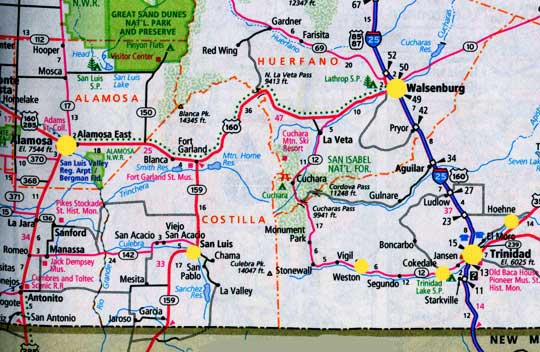
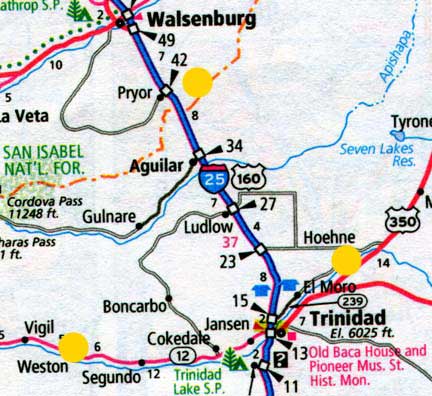
Updated: April 3, 2009 San Luis, Colorado - On March 27, 2009, after my 4-part Earthfiles report was posted about the three, bloodless, cattle mutilations in the Weston to Trinidad to Walsenburg region of southern Colorado, I received the following email and photo (with two enlargements) wondering if the unidentified aerial object seen and photographed over San Luis, Colorado, was similar to the round, silver, aerial craft that Mike Duran saw in February 2009, near Cokedale, about three weeks before his cow mutilation was discovered on March 8. See: 032009 Earthfiles.
Click here to subscribe and get instant access to read this report.
Click here to check your existing subscription status.
“I think bringing African bees to Brazil in 1957 for hybridization experiments was the environmental blunder of the 20th Century!”
- Jerry Hayes, Apiary Dir., Florida Dept. of Agriculture
Left: European honey bees surround their queen on right that has larger body and short wings. Right: Africanized honey bees surround their queen on right, marked with pink dot for clarity. The only scientific way to distinguish between the two honey bee species is DNA analysis.
March 30, 2009 Gainesville, Florida - The mysterious disappearance of hundreds of European honey bee colonies in Pennsylvania was first reported in late fall 2006. In the past three years, the baffling empty hive syndrome called Colony Collapse Disorder (CCD) has been reported in many parts of the world. Some beekeepers have lost nearly 100% of their bees. Even though nicotine-based pesticides are high on the culprit list, to date, scientists have not been able to pinpoint the exact cause - and empty hives continue - although the good news is that American bees are not disappearing as rapidly as they were.
Click here to subscribe and get instant access to read this report.
Click here to check your existing subscription status.
“I think it’s something extraterrestrial. That’s all I can assume it could be – whether it’s a little green man or what, I don’t know. But I don’t believe that either human or animal as I know them could accomplish this (mutilation).”
March 27, 2009 Walsenburg, Colorado - Jim Garren is 70-years-old and retired from his CPA profession to full time ranching since 1993 on three ranches - two in southern Colorado and one in Missouri. One of his Colorado ranches is twelve and a half miles southeast of Walsenburg and only about twenty miles from Tom Miller's ranch in Hoehne where the 1-week-old calf was found bloodlessly eviscerated on March 17, 2009.
Click here to subscribe and get instant access to read this report.
Click here to check your existing subscription status.
“It was like lots of tissue was taken from the calf and then the carcass was dropped from a high elevation and when it hit the ground, it crushed the pelvis, which was dislocated.”
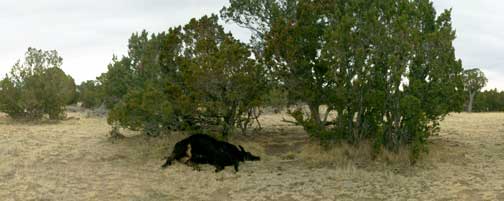
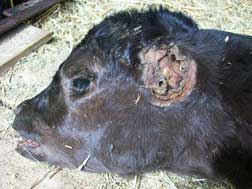
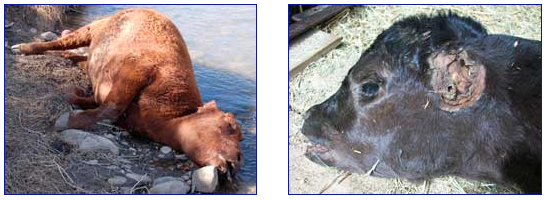
Updated March 25 / Original report March 23, 2009 Hoehne, Colorado - I arrived back at my Albuquerque, New Mexico, office from the Duran mutilation investigation on Sunday night, March 15. Two days later on the morning of Tuesday, March 17, in Hoehne, Colorado - about fifteen miles northeast of Trinidad and about 40 miles east of Mike Duran’s place - rancher Tom Miller was stunned to find a 1-week-old male calf next to the feed bin dead and so bizarrely mutilated that it might be unique in animal mutilation history. In all the mutilation cases I have investigated, I don't think I've ever seen anything like this one.
Click here to subscribe and get instant access to read this report.
Click here to check your existing subscription status.
March 20, 2009 Corpus Cristi, Texas and Weston, Colorado:
Corpus Cristi, Texas: Half Cat Mutilation
On March 18, 2009, Corpus Cristi police investigated a cat found cut in half near the city’s Club Estates Elementary School on the south side of Corpus Christi. The cat was cut cleanly through its middle with a smooth incision. Its organs had been removed and were not at the scene. 31 cat mutilations have been reported to Corpus Christi police since April 2008. Twelve of those 31 cats have been found in the same general area on the south side of the city. Police have no suspects and have not made any arrests. Anyone with information, please call Corpus Christi CrimeStoppers at: 361-888-8477.
Click here to subscribe and get instant access to read this report.
Click here to check your existing subscription status.
Updated March 16 of original report March 14, 2009 Perris, California - A year ago on May 14, 2008, at 3 AM Pacific south of Needles, California, on the Colorado River near Topock, Arizona, a long-time houseboat resident calling himself River Bob was stunned to see a large, bright “fiery object” hurtling from the sky toward him. From the upper deck on his houseboat, he was puzzled by the vivid turquoise blue-green amid other more fiery red, yellow and orange colors. Despite the strange blue-green color, River Bob thought perhaps he was watching a plane about to crash. Whatever hit the ground was picked up within fifteen minutes by a large sky crane helicopter and carried away.
Click here to subscribe and get instant access to read this report.
Click here to check your existing subscription status.
March 12, 2009 Beavercreek, Oregon - On January 29, 2009, I filed a 2-part Earthfiles report about more mysterious, multi-colored aerial light patterns photographed over Reno, Nevada, and Empire, Ohio. A week later, I received an email from a retired Wisconsin businessman in rural Elmwood, Wisconsin, who has taken more than one hundred digital still frames of a reappearing bright, aerial object. His images like all the others appear to be 3-dimensional, multi-colored patterns in the sky, changing shape every second or two.
Click here to subscribe and get instant access to read this report.
Click here to check your existing subscription status.
“An effort was made in the large King Island stranding to return the animals to deeper water, but in some cases, the animal turned around from deeper water and went straight back to the beach.”
- Scott Baker, Ph.D., OSU Marine Mammal Institute
“It is pretty darn sad, you can hear them crying.”
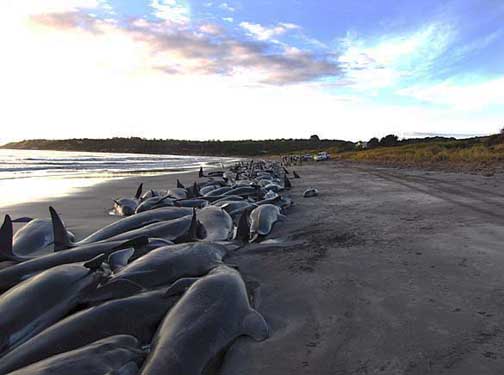
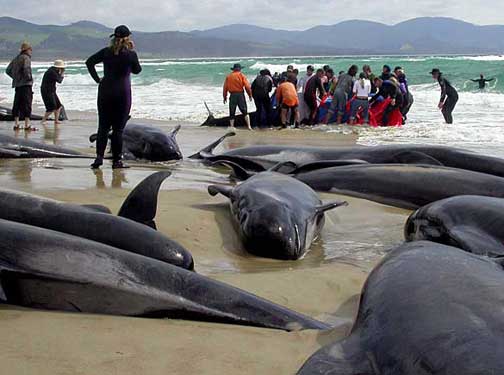
200 pilot whales (species of dolphin) and a few bottle-nosed dolphins began mass stranding on Sunday, night, March 1, 2009, at a King Island beach above. On March 2, 2009, about 50 animals were saved by human volunteers (below) and the rest died. King Island is in the Bass Strait between northern Tasmania, an Australian state, and Melbourne, Australia. Image courtesy Liz Wren, Tasmanian Parks and Wildlife Service.On March 2, 2009, volunteers saved about fifty of the 200 pilot whales (dolphins) and bottle-nosed dolphins that beached on King Island north of Tasmania beginning on March 1, 2009. An unusual series of strandings has occurred since early Nov. 2008, when 60 pilot whales were stranded not far from King Island; on Nov. 29, 2008, 150 pilot whales and dolphins stranded and all died near King Island; in January 2009, 50 sperm whales stranded and all died near King Island. Scientists are puzzled by the the unexplained series of cetacean beachings. Image courtesy Liz Wren, Tasmanian Parks and Wildlife Service.
March 2, 2009
“One of the biggest mass beachings in Australia, 200 pilot whales came ashore on King Island on Sunday evening, March 1, only 54 of which are still alive. Among the whales are a number of dolphins, according to Chris Arthur, from Tasmania's Parks and Wildlife. Around 150 local people are helping parks officials in trying to refloat the whales from a Naracoopa beach and shepherd them back to sea, where a large number of whales were still milling in a pod.”
March 6, 2009 Newport, Oregon - Scientists who study whales and dolphins are puzzled about repeated strandings of large numbers of pilot whales – which are actually large dolphins – and other dolphins and sperm whales on or around King Island north of the Australian state, Tasmania. There was also highly strange – perhaps unprecedented behavior – in Manila Bay, Philippines, last month on February 10, 2009, when 500 melon-headed dolphins filled Manila Bay and swam back and forth as if completely disoriented.
Click here to subscribe and get instant access to read this report.
Click here to check your existing subscription status.






 March 2, 2009