“Paul Bennewitz wondered if the underground military governmental complex was hiding information in league with the bad E. T.s who mutilated animals and abducted the mother and son in the beam of light.”
- Leo Sprinkle, Ph.D., Prof. Emeritus, Psychology
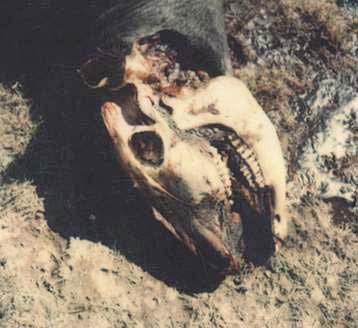
Colorado Grazing Association's mutilated cow found on July 26, 1977, with jaw stripped as thousands have been on cattle, horses, goats, sheep, deer and other animals around the world since the 1960s and before. Photograph by the Logan County Sheriff's Office, Sterling, Colorado.
October 3, 2008 Laramie, Wyoming - My investigations of the worldwide bloodless animal deaths - that law enforcement has long called “mutilations” - began in September 1979, almost thirty years ago. I was Director of Special Projects in the Denver, Colorado, CBS affiliate, that was then KMGH-TV. For nine months, eighteen hours a day without stop, I tried to get to the bottom of what was causing the animal mutilation mystery. My greatest surprises were the law enforcement who told me they knew we were dealing with “creatures from outer space,” as they put it, because of the aerial discs, beams of light and even non-human creatures encountered by eyewitnesses in pastures where mutilated animals were found.
Click here to subscribe and get instant access to read this report.
Click here to check your existing subscription status.
October 3, 2008 Albuquerque, New Mexico - The following transcript concludes my third taped phone interview with Stein on June 1, 1998. I asked him if he would try to add more details about his August 1958 trip with his CIA boss and three other CIA colleagues (secret Project Blue Book analysis group) to Nellis AFB, Area 51, Groom Lake, Nevada.
Click here to subscribe and get instant access to read this report.
Click here to check your existing subscription status.
October 1, 2008 Avebury, Wiltshire, England - Cropcircleconnector.com received the following email report on September 28, 2008, about a new formation seen from the air at Avebury Down near the ancient stone circles of Avebury, Wiltshire.
Click here to subscribe and get instant access to read this report.
Click here to check your existing subscription status.
“The officer said it looked like a clean, bloodless cut across my cat's chest, right underneath her breast (through cat's spine).”
- Helen Cary, Bermuda Dunes, California
September 29, 2008 Albuquerque, New Mexico - There is one environmental assault I wish I never had to report about, but new cases are persistent. These are the bloodlessly mutilated cats, rabbits, dogs, horses, cows – and even kangaroos and koalas - around the world. The following are only some of the unusual animal deaths since June 2008. There have also been several animal mutilation reports from Argentina and other South American regions and in the future, I will devote another Earthfiles to those South American cases.
Click here to subscribe and get instant access to read this report.
Click here to check your existing subscription status.
“Sometimes in combination, multiple pesticides are many times more toxic than either one would be individually ...A chemical combination can be 1,000 times more toxic than each of the individual pesticides.”
- Aaron Colangelo, Sr. Attorney, NRDC
September 25, 2008 Washington, D. C. - For two years, honey bees have been dying and disappearing in massive numbers throughout North America, Europe and spreading to other parts of the world. Half of Italy’s bee population died in 2007 and in September 2008, the Italian government issued a ban on four nicotine-based pesticides linked to honey bee deaths, including clothianidin and imidacloprid. Argentina has lost more than 30% of its bees and the British Beekeepers Association reports that one-third of English honey bee hives did not survive through this past spring. The Association says if colony collapse disorder continues, “honey bees will disappear completely from Britain by 2018, causing calamitous economic and environmental problems.”
Click here to subscribe and get instant access to read this report.
Click here to check your existing subscription status.
Cell Phone Use Linked to Male InfertilityHands-Free Calls May Expose Sperm to Radiation
By Denise Mann
“Sept. 19, 2008 -- Men, beware: Using a hands-free device with a cell phone may affect your fertility if you keep your phone close to your testicles, Cleveland Clinic researchers warn in the journal Fertility and Sterility.
Men who use these hands-free devices tend to carry their cell phones in their pants pocket or clipped to their belts at the waist while in talk mode. As a result, they may be exposing their testicles to damaging radio frequency electromagnetic waves, explains Ashok Agarwal, Ph.D., head of the Andrology Laboratory and the Director of the Center for Reproductive Medicine at the Glickman Urologoical and Kidney Institute at the Cleveland Clinic in Ohio.
‘The Bluetooth devices, which many people are using these days because of health or safety concerns, may not be always so safe. There is a downside,’ he says.
Cell Phone Radiation Affects Sperm Quality
To arrive at their findings, researchers collected semen samples from 32 men and divided each man's sample into two parts. They placed half of the semen samples 2.5 centimeters away from a 850 MHz frequency cell phone in talk mode for one hour. Most cell phones used in the U.S. are 850-900 MHz. They chose this distance because it is the typical distance between the testes and the trouser pockets.”
September 25, 2008 Washington, D. C. - On September 19, 2008, the published research of Ashok Agarwal, Ph.D., Director of the Center for Reproductive Medicine at the Cleveland Clinic in Ohio made national and international headlines. This was Dr. Agarwal's second study of cell phone radiation on sperm and he reported: “On average, there was an 85% increase in the amount of free radicals for all the subjects in the study. Free radicals have been linked to decreased sperm quality in previous studies.” In another study, Dr. Agarwal found that 361 men who used their cell phones more than four hours a day had significantly lower sperm quality than those who used their cell phones for less time.
Click here to subscribe and get instant access to read this report.
Click here to check your existing subscription status.
“I’m sure the CIA would have killed me to prevent my getting out and talking about the classified UFO stuff. We had 26 people to start with in that CIA Project Blue Book and I was the only one that survived and got out because my boss helped me with the phony body cover.”
September 24, 2008 Albuquerque, New Mexico - The following transcript is from the third taped interview I did by phone with Stein a day after I played excerpts from the previous two recordings with Stein's permission on Dreamland hosted by Art Bell. Since Stein had been warned that his or my or both of our phones were tapped, I called to check about any repercussions from the radio program. He said no one had called him at that point. I also asked him if he could send me copies of his Army Signal Corps discharge records from 1956 to 1960.
Click here to subscribe and get instant access to read this report.
Click here to check your existing subscription status.
“The entire sun is blowing solar wind significantly less harder, about 20% to 25% less harder and 13% lower temperature, than it was during the previous solar minimum a decade ago. ...Over the entire record of solar wind observations (about 50 years), this is the lowest prolonged pressure that we’ve ever observed.”
– Dave McComas, Ph.D., Solar Wind Principal Investigator, Ulysses
Sun depicted as bright white-yellow object on left blowing off electrons, protons and some heavy ions at nearly 1 million mph (400 kilometers/second) past the earth and out through the solar system. NASA's and ESA's Ulysses spacecraft has measured the pressure of the solar wind decreasing 20% to 25% since 1990. Implications for Earth and solar system are unclear. Graphic illustration by NASA Goddard Space Flight Center.
September 23, 2008 Pasadena, California - NASA produced a media teleconference today with Ulysses spacecraft scientists to announce, “The entire sun is blowing significantly less hard, about 20% to 25% less hard, than it was during the previous solar minimum a decade ago and its solar wind temperature has lowered 13%.” Ulysses is the first spacecraft from Earth to orbit around the poles of the sun. Since its launch on October 6, 1990, from the Space Shuttle Discovery (mission STS-41) as a joint venture of NASA and the European Space Agency, Ulysses has completed almost three orbits around the sun's poles that began with the 1990 solar minimum, included the 2000 solar maximum and is running out of heat and power as it nearly completes a third orbit during this 2008 solar minimum that has had a prolonged period without sunspots.
Click here to subscribe and get instant access to read this report.
Click here to check your existing subscription status.
“One second, the glowing sphere was between the two Cobras; the next it was moving vertical with out any sort of turn, and it started making amazing, impossible 90-degree turns in the air, which is something I know no sort of aircraft can do at those speeds.”
- U. S. Marine, Camp Lejeune, NC
September 23, 2008 Camp Lejeune, Jacksonville, North Carolina - Recently I received an email from a U. S. Marine stationed at Camp Lejeune, near Jacksonville, North Carolina.
Click here to subscribe and get instant access to read this report.
Click here to check your existing subscription status.
“This is a classic Titanic situation in the sense that what we saw with the Fannie and Freddie bailouts and the Bear Stearns bailouts and now the AIG request for more than forty billion more dollars from the federal government – it’s just like the Titanic where the rich and affluent were given the lifeboats and the rest of the people went under from steerage. The rich and powerful are too big to fail; the rest of us are too small to save.”
- Gerald Celente, Editor and Publisher, The Trends Journal
“They (Republican Party) had begun to consider the Government of the United States as a mere appendage to their own affairs. We know now that Government by organized money is just as dangerous as Government by organized mob.”
Crowd at New York's American Union Bank during a bank run early in the Great Depression that began in 1929. The bank opened in 1917, and went out of business on June 30, 1931. Image source Wikipedia.Crowd at IndyMac Bank in Pasadena, California, on Friday, July 11, 2008, after the federal government took control in the second-largest bank failure in U. S. history. Financial experts predicted at least 50 to 100 bank failures in the United States after IndyMac Bank.
Updated 11:00 PM EDT September 17, 2008 - Dow closed 450 down today in continuing “Economic 9/11,” after Feds loan AIG $85 billion and oil and metals spiked upward. “Right now, citizens don't trust banks and bankers don't trust other bankers. The financial system is freezing up,” said a CNBC Business Network analyst.
Investors also considered a report on new home construction that showed that housing starts dipped to a 17-year low. Further, the FDIC website lists 11 bank failures in 2008 since April, the latest being Silver State Bank in Henderson, Nevada, on September 5, 2008. The Pasadena, California, IndyMac Bank FDIC takeover on July 11, 2008, was the second largest bank failure in American history.
Click here to subscribe and get instant access to read this report.
Click here to check your existing subscription status.