“In Jordan alone, we've got stone-built structures that are
far more numerous than the Nazca Lines, far more extensive
in the area that they cover, and far older.”
- David Kennedy, Ph.D., Univ. of Western Australia
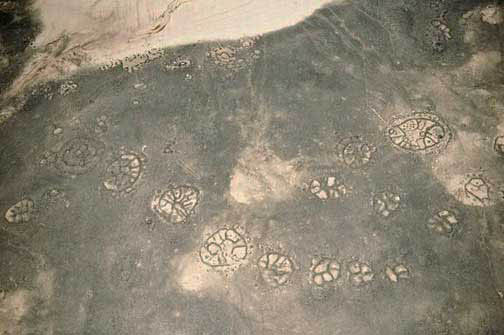
The area near the Azraq Oasis a little south of Azraq ed Duruz, Jordan (east of Amman) has hundreds circular structures made of stone that date back at least 2,000 years old - and perhaps even 9,000-years-old. These wheel structures are often found on lava fields and range from 82 feet to 230 feet (25 meters to 70 meters) across. Archaeologists used to believe that the Azraq Oasis wheels were used as a cemetery, but that is now in doubt. None of the stone patterns can be seen from the flat ground, only from the air. Aerial image by David L. Kennedy, Ph.D., Aerial Photographic Archive for Archaeology in the Middle East (APAAME).The Harrat Ash Shaam (also known variously as the Harrat Ash Shamah and the Harrat e-Shamah) is a volcanic field covering a total area of some 40,000 square kilometers (15,000 square miles). This massive alkaline volcanic field extends from southern Syria, across Jordan east of Amman near Azraq ed Duraz, and into northwestern Saudi Arabia. Thousands of circular patterns in the black lava rocks date back between 2,000 and 9,000 years ago, but functions are unknown.
September 16, 2011 Syria, Jordan, Saudi Arabia - Scientists at the University of Western Australia have taken almost 45,000 aerial images of mysterious stone circles, or “wheels,” they have found by satellite-mapping technologies in Syria and Saudi Arabia and an aerial photography project in Jordan. The number of stone patterns in only the region of Harrat ash-Shaam of Jordan are 1,000 or more.
Click here to subscribe and get instant access to read this report.
Click here to check your existing subscription status.
“ ... there is no evidence for a Planet X. There is no evidence for Nibiru.
Neither one of them exist. So, there is absolutely nothing to be
concerned about with regard to Comet Elenin.”
- Don Yeomans, Ph.D., Manager, Near-Earth Object (NEO) Program,
NASA Jet Propulsion Lab, Pasadena, California
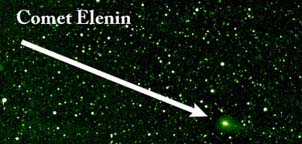
On August 6, 2011, NASA's Solar Terrestrial Relations Observatory (STEREO) spacecraft used its wide angle HI-2 camera with a green filter to image small Comet Elenin. Its closest approach to Earth is on October 16, 2011, at 22 million miles (35 million km) - too far to have any appreciable effect on our planet. See STEREO website.
August 26, 2011 Pasadena, California - Comet Elenin is a long-period comet discovered by Russian amateur astronomer Leonid Elenin eight months ago on December 10, 2010. Comet Elenin will make its closest approach to the Sun on September 10, 2011, and then a month later on October 16th, Elenin will be closest to Earth at a distance of about 22 million miles, or not much closer than the planet Venus. Those are the facts.
Click here to subscribe and get instant access to read this report.
Click here to check your existing subscription status.
“That’s one of the biggest questions for NASA as they go out to search
for signs of life elsewhere. What would alien life look like?”
- Michael Callahan, Ph.D., Astrochemist, NASA Goddard
Michael Callahan, Ph.D., NASA Goddard Space Flight Center in Greenbelt, Maryland, is the lead author of a paper in the Proceedings of the National Academy of Sciences that describes how his Goddard team ground up samples of twelve carbon-rich meteorites, nine of which were recovered from Antarctica. The team found adenine and guanine, which are components of DNA called nucleobases. The discovery adds to a growing body of evidence that the chemistry inside asteroids and comets is capable of making building blocks of essential biological molecules. See: PNAS.
August 26, 2011 Greenbelt, Maryland - There is an Astrochemistry Lab at the NASA Goddard Space Flight Center in Greenbelt, Maryland. There, Research Physical Astrochemist Michael P. Callahan, Ph.D., has been studying a dozen carbonaceous chondrite meteorites that have fallen from space to Earth. Nine of them came from Antarctica because he wanted to concentrate his research on meteorites that would be more protected from terrestrial contamination. The cold, icy environment of the South Polar region provides better preservation. What Dr. Callahan has been looking for in the carbon-rich meteorites are chemistries related to life that had to have been created in space.
Click here to subscribe and get instant access to read this report.
Click here to check your existing subscription status.
"There are at least 30 million supermassive black holes in the early universe.”
- NASA Chandra X-ray Center
“We know from observations of nearby galaxies, starting with our own Milky Way - but also extending to other galaxies in the nearby universe - we can actually deduce the presence of their local black holes and find that every galaxy probably does have a black hole at its center.”
- Mitchell Begelman, Ph.D., Dir., JILA; Prof. of Astrophysics, CU-Boulder
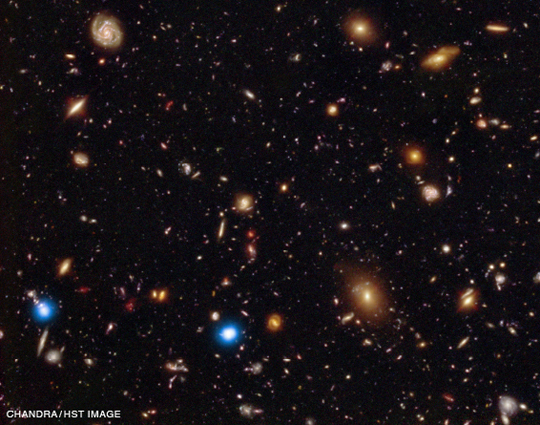
Composite image from NASA's Chandra X-ray Observatory and Hubble Space Telescope (HST) combines the deepest X-ray, optical and infrared views of the sky. The composite image shows a small section of the Chandra Deep Field South (CDFS), where the Chandra sources are blue, the optical HST data are shown in green and blue, and the infrared data from Hubble are in red and green. Using these images, astronomers have obtained the first direct evidence that black holes are common in the early universe and that very young black holes grew more aggressively than thought along side evolving galaxies. Image credit: X-ray: NASA/CXC/U.Hawaii/E.Treister et al; Infrared: NASA/STScI/UC Santa Cruz/G.Illingworth et al; Optical: NASA/STScI/S.Beckwith et al.
June 29, 2011 Boulder, Colorado - On June 15, 2011, NASA hosted a TV press conference with several astrophysicists, including Prof. Mitchell Begelman, Ph.D., Director of the Joint Institute for Laboratory Astrophysics (JILA) and Prof. of Astrophysics, University of Colorado, Boulder, Colorado. The news headline was “NASA's Chandra Finds Massive Black Holes Common in Early Universe.” The next day in the June 16, 2011, issue of Nature, astronomers described “Black Hole Growth in the Early Universe Is Self-Regulated and Largely Hidden from View.”
Click here to subscribe and get instant access to read this report.
Click here to check your existing subscription status.
“It would have been incredibly exciting and interesting and perhaps even historic if this were a real feature, but it appears to have just been some sort of mapping or mosaic mistake in the low-resolution data.”
- James Bell, Ph.D., Astronomer and Planetary Scientist, ASU
Mars Google map location: 71 49’19.73″N 29 33’06.53″W Allegedly discovered and posted on YouTube by American amateur astronomer David Martines, and reported June 2, 2011, by U. K.'s The Sun. See Martines video link in Websites at end of report.
June 14, 2011 Tempe, Arizona - On June 11, 2011, I reported an Earthfiles interview with Prof. James Bell, Ph.D., Prof. of Astronomy and Planetary Sciences, Arizona State University, in Tempe, Arizona, about the recent and controversial David Martines video at YouTube and related articles in the U. K. Daily Mail and The Sun. Please see 061111 Earthfiles.
Prof. Bell is an astronomer and planetary scientist who uses remote sensing, field studies, and laboratory studies to explore the geology, mineralogy, origin, and evolution of planetary surfaces. His current research focuses mostly on the geology and mineralogy of Mars using data from the Spirit and Opportunity Mars rovers. He is the lead scientist for those cameras and also works with images from the other Mars orbiters.
Click here to subscribe and get instant access to read this report.
Click here to check your existing subscription status.
“If this were like an alien space station or something, that would be the coolest thing ever! ... But I just don’t see any evidence that supports it.”
- James Bell, Ph.D., Astronomer and Planetary Scientist, ASU
Mars Google map location: 71 49’19.73″N 29 33’06.53″W Allegedly discovered and posted on YouTube by American amateur astronomer David Martines, and reported June 2, 2011, by U. K.'s The Sun. See Martines video link in Websites at end of report.
June 11, 2011 Tempe, Arizona - On June 2, 2011, the U. K. Sun online headlined ‘Space Station’ Found On Mars and included a video put together by an alleged American amateur astronomer named David Martines. In the video, Martines said a large, white structure is “something I discovered on Google Mars quite by accident at coordinates Latitude 71 49'19.73"N and Longitude 29 33'06.53"W.” Many websites picked up on the Martines video and National Public Radio also reported about the alleged discovery on June 7, 2011, in a science blog by Mark Memott. See Websites below.
Click here to subscribe and get instant access to read this report.
Click here to check your existing subscription status.
“SWIFT had never seen another object outside of our galaxy appear to act this way. It is quite unlike anything we've known before, except maybe blazars.”
- Andrew Fruchter, Ph.D., Astronomer, Space Telescope Science Institute
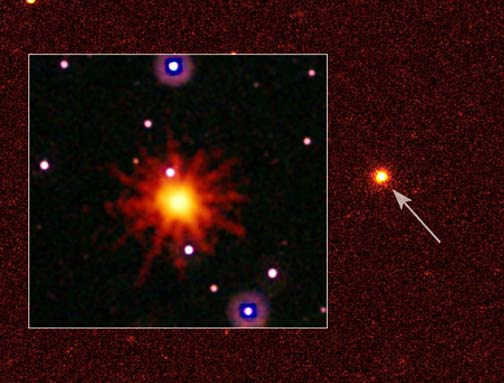
NASA's and ESA's SWIFT gamma-ray burst telescope detected a strong gamma ray burst (GRB) on March 28, 2011, that rapidly oscillated for more than a day and is still detectable after nearly a month. Normal gamma ray bursts last on average no more than 30 seconds. Could this be the first-ever image of a black hole tearing apart a star? April 4, 2011 image by Hubble Space Telescope.
April 29, 2011 Baltimore, Maryland - Since the Big Bang, the most powerful explosions in this universe are huge flashes of gamma-ray bursts, or GRBs. Extremely rare and fleeting, the sources of gamma-ray bursts are billions of light-years from Earth outside our Milky Way galaxy. Their gamma intensity is so great that if there were a GRB in our galaxy pointed directly towards Earth, it would cause mass extinction. So far scientists do not know what causes them. Are they black holes tearing massive stars apart? Or two neutron stars colliding? Or something else even more exotic?
Click here to subscribe and get instant access to read this report.
Click here to check your existing subscription status.
“Now we come to the problem of determining what to do if the inhabitants of celestrial (sic) bodies, or extraterrestrial biological entities (EBE), desire to settle here (Earth).”
- Physicists Robert Oppenheimer and Albert Einstein, June 1947
Burned memo, presumably written before assassination of John F. Kennedy on November 22, 1963, when either John A. McCone or Allen W. Dulles were Directors of the Central Intelligence Agency. In the TOP SECRET/MJ-12 red stamped 9-page document, the first page cropped above shows the document is “From: Director of Central Intelligence (MJ-1) to MJ-2 through MJ-7, with reference to: Project MAJESTIC and JEHOVAH (MJ); Project EVIRO; Project PARASITE; and Project PARHELION.”
April 18, 2011 and August 9, 2008 Albuquerque, New Mexico - Below is the last paragraph of the November 4, 1953, SECRET memorandum from President Eisenhower to the Director of Central Intelligence (Allen W. Dulles) that was introduced in Earthfiles Part 4. In this last paragraph, President Eisenhower mentions “Project JEHOVAH director Professor Albert Einstein and Doctor Robert Oppenheimer...”
Click here to subscribe and get instant access to read this report.
Click here to check your existing subscription status.