“Right now, we don't know whether finding perchlorate is good news or bad news for possible life on Mars.”
- Peter Smith, Ph.D., Phoenix Lander Principal Investigator
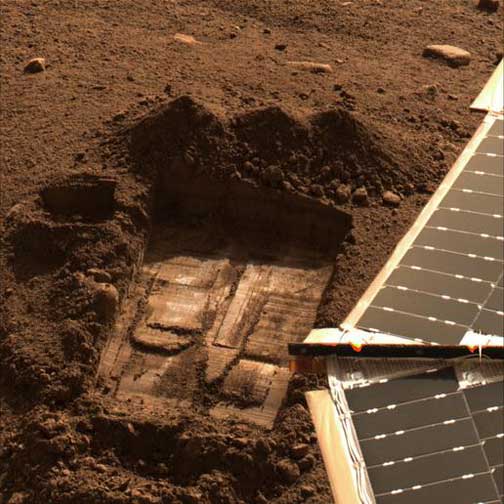
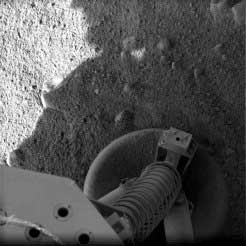
This image shows the trench informally called “Snow White” where the perchlorate has been detected. This image was acquired by NASA's Phoenix Mars Lander's Surface Stereo Imager on Sol 43, the 43rd Martian day after landing on July 8, 2008. Two samples were delivered to the Wet Chemistry Laboratory, which is part of Phoenix's Microscopy, Electrochemistry, and Conductivity Analyzer (MECA). The first sample was taken from the surface area just left of the trench and informally named “Rosy Red” It was delivered to the Wet Chemistry Laboratory on Sol 30 (June 25, 2008). The second sample, informally named “Sorceress” was taken from the center of the Snow White trench and delivered to the Wet Chemistry Laboratory on Sol 41 (July 6, 2008). Image credit: NASA/JPL-Caltech/Univ. of Arizona/Texas A&M.
August 5, 2008 Pasadena, California - Responding to the growing buzz on the internet about suppressed Mars Phoenix Lander data and the White House Science Adviser being briefed on a new and potentially disturbing discovery in the lander's soil analysis, today Phoenix mission scientists spoke and answered questions in an hour phone conference produced by NASA and JPL.
Click here to subscribe and get instant access to read this report.
Click here to check your existing subscription status.
August 3, 2008 Newport Beach, California - The following documents begin with the cover letter dated June 23, 1999, sent by the alleged CIA counter-intelligence leaker with the 9-page “burned memo” to Timothy Cooper at his Big Bear Lake, California, home.
Click here to subscribe and get instant access to read this report.
Click here to check your existing subscription status.
“We found a possible AWAC that maintained an altitude of about 41,000 feet, which is higher than most of your civilian aircraft fly. It was there for the entire time of our radar data and it’s flying figure 8s over the area – going as far as north Texas to as far south as the
northern Austin area.”
- Robert Powell, MUFON Director of Research
“I think the January 8, 2008, Carswell log book was blacked out on the ten F-16s because the military wanted as little known as possible about what their F-16s were doing that day.”
- Glen Schulze, Electrical Engineer and Radar Specialist
Updated: July 29, 2008 Littleton, Colorado - Interviews with Glen Schulze and Robert Powell continue in Part 2 about the discovery of an unknown object that reflected at least 200 skin-paint returns, but was not sending out transponder signals to the FAA radar towers. Further, that unknown aerial object was moving in a straight line between 6:51 PM and 8 PM towards the George W. Bush ranch in Crawford, Texas. Yet, Glen and Robert could not find any radar signals of jet activity responding to that unknown approaching the property of the American President.
Click here to subscribe and get instant access to read this report.
Click here to check your existing subscription status.
“When radar returns on one unknown object (no transponder beeps) did show up in the data from 6:51 PM to 8:00 PM, on our graph it was traveling a straight line headed for Crawford, Texas.”
- Glen Schulze, Electrical Engineer and Radar Specialist
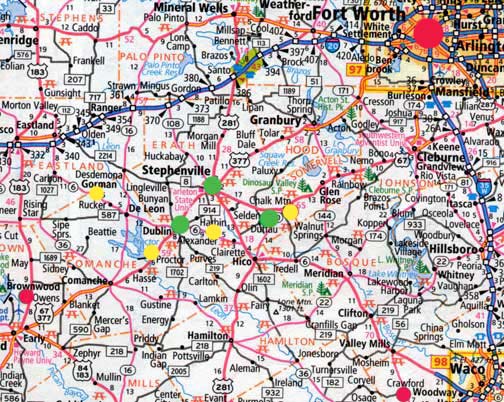
A triangle of three small towns (green) southwest of Fort Worth includes Stephenville, a city in and the county seat of Erath County, Texas, population 14,921 in 2000 census. Dublin, about eight miles southwest, has a population of 3,754. Straight east of Dublin about ten miles is Selden with a full time population of about seven. The Brownwood Military Operations Area (MOA) is further southwest in map's lower left red circle. The red circle in lower right corner of map is Crawford, Texas, ranch home of U. S. President George W. Bush. The Naval Air Station Joint Reserve Base at Carswell Field is five miles west of downtown Fort Worth, large red circle in upper map right. The four yellow circles at Gorman, Proctor Lake, Alexander and Chalk Mountain are UFO eyewitness locations on January 8, 2008, in addition to several other eyewitnesses in the green circles of Stephenville, Dublin and Selden, Texas.Naval Air Station Joint Reserve Base Fort Worth or NAS JRB Fort Worth, also known as Carswell Field, is now home to the U. S. Navy Reserve, U. S. Marine Corps Reserve, U. S. Air Force Reserve, and U. S. Air National Guard. The Carswell military complex is a military airfield located five miles (8 km) west of the central business district of Fort Worth, in Tarrant County, Texas, United States. This military airfield is operated by the United States Navy. The Air Force Reserve Command's Tenth Air Force headquarters and 301st Fighter Wing continue to be based at the installation, as well as the 136th Airlift Wing of the Texas Air National Guard. A number of Marine Corps aviation and ground units are also co-located at NAS JRB Fort Worth. Currently based Air Force aircraft are the F-16 Fighting Falcon and C-130 Hercules. Currently based Marine Corps aircraft are the F/A-18 Hornet and KC-130 Hercules.
July 26, 2008 Littleton, Colorado - Back in early January to mid-February 2008, a series of unidentified aerial lights and strange craft were reported by dozens of eyewitnesses in the Stephenville, Dublin, and Selden region southwest of Dallas/Fort Worth, Texas. One especially active date was January 8, 2008, beginning a few minutes after 6 PM Central with three eyewitnesses sitting on a hill in Selden southeast east of Stephenville and straight east of Dublin.
Click here to subscribe and get instant access to read this report.
Click here to check your existing subscription status.
“We are not looking for live microbes on this Phoenix instrument suite.
We would not detect them. What we are looking for are the organic compounds that might be the food that could create life, either in the past or some time in the future.”
- Barry Goldstein, Phoenix Project Manager, JPL
Phoenix Mars Lander footpad after landing at 4:53 p.m. Pacific, Sunday, May 25, 2008. Image credit: NASA; JPL; Cal Tech; University of Arizona.
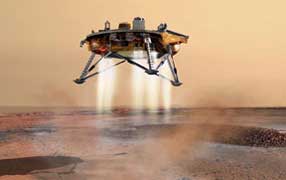
May 29, 2008 Pasadena, California - On Sunday, May 25, 2008, at about 4:53 p.m. Pacific time, NASA and JPL’s Mars Phoenix Lander reached the North Pole of Mars with only minor glitches. First, the sleeve on its robotic arm designed to dig into the Martian permafrost wasn’t completely off, but corrected itself later on. Then the UHF radio signal from the Mars Reconnaissance Orbiter satellite suddenly and mysteriously shut off. Scientists are depending on the MRO radio to communicate with the Phoenix Lander. The radio silence, fortunately, was temporary and only delayed for a day the GO! signal to slowly start the deployment of the Phoenix robotic explorer and its digging arm. In a press conference on Tuesday, May 27th, Phoenix mission officials showed a Mars Reconnaissance Orbiter photograph of the Phoenix hanging from its parachute as it drifted down about 12 miles in front of a North Pole Crater.
Click here to subscribe and get instant access to read this report.
Click here to check your existing subscription status.
“A completely unexpected surprise is that the chemistry of Enceladus,
what's coming out from inside, resembles that of a comet. To have primordial material coming out from inside a Saturn moon raises many questions on the formation of the Saturn system.”
- Hunter Waite, a Principal Investigator, Cassini Mission
On Wednesday, March 12, 2008, NASA's Cassini spacecraft flew along the south pole of Enceladus to sample water-ice, dust and gas in the geyser plumes that erupt there. This was the first of four Cassini flybys of Enceladus planned for 2008, the second coming in August. Image 2007 by Cassini-Huygens spacecraft.
March 30, 2008 Pasadena, California - NASA reported this week:
NASA's Cassini spacecraft tasted and sampled a surprising organic brew erupting in geyser-like fashion from Saturn's moon Enceladus during a close flyby on March 12. Scientists are amazed that this tiny moon is so active, "hot" and brimming with water vapor and organic chemicals.
New heat maps of the surface show higher temperatures than previously known in the south polar region, with hot tracks running the length of giant fissures. Additionally, scientists say the organics "taste and smell" like some of those found in a comet. The jets themselves harmlessly peppered Cassini, exerting measurable torque on the spacecraft, and providing an indirect measure of the plume density.
Click here to subscribe and get instant access to read this report.
Click here to check your existing subscription status.
“We’re talking about essentially up to around 2 miles per second (15,000 mph). So, this (Carancas stoney meteorite) was coming in at a very high speed.”
- Prof. Peter Schultz, Brown University
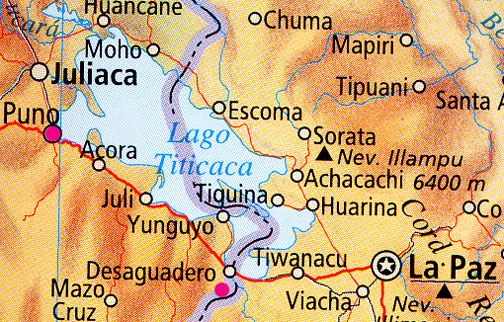
Not far from Lake Titicaca and Puno in southern Peru, is the small farming town of Carancas on a high Andean plateau near the Bolivian border (pink circle below Desaguadero).
March 28, 2008 Providence, Rhode Island - It was 11:45 AM on Saturday, September 15, 2007, when alpaca farmer, Justina Limache, heard a “thunderous roar from the sky.” Scared, she grabbed her 8-year-old granddaughter and ran into her house. For the next few minutes, Justina heard rocks raining down on the roof so loudly that she worried her house would collapse. What 74-year-old Justina Limache did not know was that a meteorite had fallen near her home in Carancas, Peru, 62 miles (100 kilometers) southeast of Puno and not far from Lake Titicaca. Carancas is a farm community of about 2,000 people who raise cows, alpacas, llamas and other animals on the high Andean plateau near the Bolivian border.
Click here to subscribe and get instant access to read this report.
Click here to check your existing subscription status.
“Even though this object (Planet X) might be at 100 A. U., if it’s a bright object, if its surface reflects light sufficiently, then it might easily be picked up - and perhaps other objects like it - by these new surveys coming on line even next year (2009) and in the next several years.”
- Prof. Mark V. Sykes, Ph.D., Planetary Science Institute
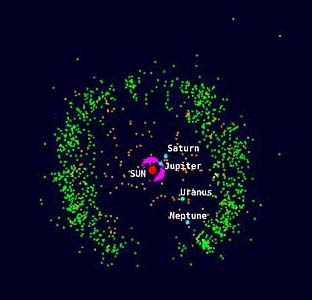
Illustration of possible Earth-size planet beyond Pluto and Kuiper Belt at 100 Astronomical Units (A. U.) from our sun (upper right). Theorized by Kobe University Japanese scientists because of perturbations in the orbits of other bodies in that region of solar system. Illustration courtesy Kobe University, Japan.Illustration of Kuiper Belt objects (green) ranging from 42 to 47 Astronomical Units (A. U.) from the sun beyond Pluto. Illustration courtesy Kobe University, Japan.
March 28, 2008 Tucson, Arizona - The upcoming April 2008 printed issue of The Astronomical Journal will have this intriguing paper: “An Outer Planet Beyond Pluto and the Origin of the Trans-Neptunian Belt Architecture.” The authors are Patryk Lykawka and Tadashi Mukai from the Graduate School of Science, Earth and Planetary Sciences, Kobe University, Japan. After studying perturbations and highly angled inclinations to the plane of the inner solar system among objects in a region 100 Astronomical Units (A. U.) from our sun far beyond Pluto, the Japanese scientists propose the discovery of a nearly Earth-size planet out there that takes 1,000 years to orbit the sun. Prof. Tadashi Mukai says, “We have been able to identify more than 1,100 objects beyond Neptune since 1992, and a huge number of objects are showing large orbital eccentricities and elliptical orbits.”
Click here to subscribe and get instant access to read this report.
Click here to check your existing subscription status.
“If I’m in a virtual reality, the graphics are great, but the plot sucks.”
- Student of Prof. Brian Whitworth
Virtual reality universe illustration by Prof. Seth Lloyd, Ph.D., Mechanical Engineering, MIT.
January 25, 2008 Auckland, New Zealand - A professor in Auckland, New Zealand, published a paper in December that seriously raises the question: could we be in a virtual reality world and universe where the “computer” behind-the-scenes has a processing speed of 186,282.397 miles per second - the maximum speed of light? The professor is Brian Whitworth, Ph.D., in Information Systems and now Senior Lecturer at the Institute for Information and Mathematical Sciences at Massey University in Auckland.
Click here to subscribe and get instant access to read this report.
Click here to check your existing subscription status.
“The sudden burst of radio energy lasted only 0.005 seconds, and had spectral characteristics that suggested that it was from a distant galaxy, probably billions of light-years from us."
- Seth Shostak, Ph.D., SETI Institute
January 16, 2008 Oakland, California - This afternoon, KTVU-TV Channel 2, removed their earlier report quoted below and by tonight, a correction was posted saying the mystery signal had been recorded by an Australian radio telescope (confirmed now to be the Parkes Radio Telescope) and that the complex signal is still being studied. Yesterday, KTVU-TV in the San Francisco Bay area, reported: “Across the globe, researchers searching for signs of life in space were abuzz this week with word that a mystery signal has been picked up by a giant radio-telescope (Arecibo) in Puerto Rico. Now the dilemma is -- how do you answer it? Dan Werthimer of the UC Berkeley SETI Project, said the dilemma is compounded by the fact that the signal may never be completely decoded. ‘We probably won't be able to decode it,’ he said. ‘We'll know something's out there, but we won't know much about their civilization.’” See: KTVU-TV.
Click here to subscribe and get instant access to read this report.
Click here to check your existing subscription status.