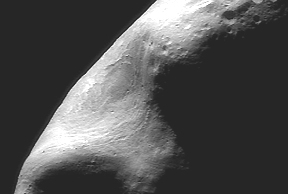
February 15, 2000 photograph while the NEAR satellite was passing directly over the large gouge "saddle" that is surprisingly smooth and free of craters. Detail down to 120 feet (35 meters) across. Narrow parallel troughs closely follow the shape of the saddle gouge. Photograph courtesy Johns Hopkins University Applied Physics Laboratory, Laurel, Maryland.
February 27, 2000 Laurel, Maryland - A human machine is orbiting an asteroid for the first time in known human history. It's a NASA satellite called NEAR for Near Earth Asteroid Rendezvous. NEAR moved into orbit around an asteroid called 433 Eros on February 14th. At first the NEAR satellite was photographing at a range of 210 miles. But this past week on February 23rd, NEAR moved into about 130 miles from Eros. The satellite will keep getting closer to the asteroid over the next 12 months until its mission is completed in February 2001.
Click here to subscribe and get instant access to read this report.
Click here to check your existing subscription status.
"I guess it's the equivalent of striking oil. It was enormously exciting. It was unbelievable."
- Tasios Melis, Ph.D.
Plant and Microbial Biology
University of California, Berkeley
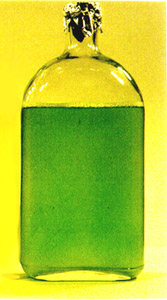
Beaker of Chlamydomonas reinhardtii algae culture which produces hydrogen gas in labs at University of California, Berkeley and National Renewable Energy Laboratory in Golden, Colorado. Photograph courtesy University of California, Berkeley, January 2000.
February 25, 2000 Berkeley, California - The journal, Plant Physiology, reported in February 2000 that for the first time scientists at the University of California, Berkeley and National Renewable Energy Laboratory (NREL) in Golden, Colorado, have been able to trigger a metabolic switch in algae to turn sunlight into large quantities of hydrogen gas. A joint patent on this new hydrogen production technique from plant photosynthesis has been filed by the two institutions.
Click here to subscribe and get instant access to read this report.
Click here to check your existing subscription status.
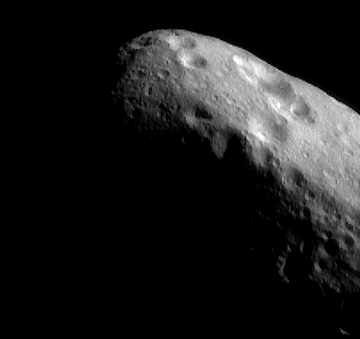
Near Earth Asteroid Rendezvous (NEAR) satellite photographs here and below of an asteroid called 433 Eros. NEAR moved into orbit around the 25 mile long asteroid on February 14, 2000 and took the first images from a range of 210 miles (330 km) above the asteroid's surface. Eros is about a hundred million miles from Earth in the asteroid belt between Earth and Mars. Photographs courtesy NASA and Applied Physics Laboratory, Johns Hopkins University, Baltimore, Maryland.
February 16, 2000 Baltimore, Maryland - It looks a bit like a 25 mile long, five mile wide potato. In one photo, it even resembles a Dutch shoe. Called 433 Eros, it's made out of iron and magnesium-bearing silicates and is now the focus of a NASA satellite called NEAR, Near Earth Asteroid Rendezvous. NEAR moved into orbit around Eros on February 14 and will stay there for the next year. Eros is one of the biggest asteroids in our Solar System circling between the earth and Mars. It's almost twice the size of Manhattan, measuring about 25 miles long and nearly five miles wide.
Click here to subscribe and get instant access to read this report.
Click here to check your existing subscription status.
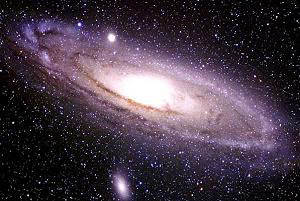
Two million light years away from our own Milky Way galaxy is the Andromeda galaxy photographed here. It is a spiral shape like the Milky Way galaxy and can be faintly seen with the naked eye in the northern sky. Photo courtesy NASA.
"Chandra's x-ray image of the cool temperatures in the black hole at the center of the Andromeda galaxy kind of flies in the face of what we think happens when matter falls into a black hole. It usually gets very hot.So, this is sort of a unique observation. I'm not aware of any other black hole systems where you see such cool x-ray radiation."
- Eliot Quataert, Ph.D., Astrophysicist -
January 28, 2000 Princeton, New Jersey - Observing x-ray and gamma ray emissions suggestive of a black hole at the center of many galaxies is old hat these days for astrophysicists. Our own Milky Way galaxy seems to have one and so does its nearby twin, the Andromeda galaxy. The suspected black hole at the center of the Milky Way is two and a half times more massive than our sun. But a black hole candidate at the center of Andromeda is 30 million times more massive than our sun.
Click here to subscribe and get instant access to read this report.
Click here to check your existing subscription status.
"Since it was first observed thirty-seven years ago, understanding the source of the X-ray background has been the Holy Grail of X-ray astronomy. Now, it is within reach."
- Dr. Alan Bunner, Director
NASA's Structure and Evolution of the Universe
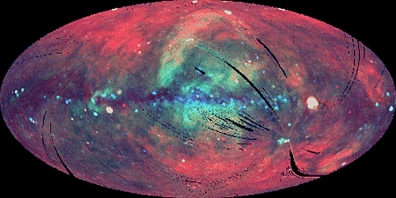
X-Ray Image: A view of our galaxy from the all-sky image by the German-led ROSAT x-ray observatory research "oriented so that the plane of our Milky Way Galaxy runs horizontally through the center. Both x-ray brightness and relative energy are represented with red, green and blue colors from lowest energy to highest. Over large areas of the sky a general diffuse background of x-rays dominates." Provided by NASA's Marshall Space Flight Center, Huntsville, Alabama.
January 17, 2000 Huntsville, Alabama - NASA's Chandra X-Ray Observatory was launched only five months ago, but it continues to astonish astronomers with its discoveries. One of the most perplexing cosmic mysteries has been the source of x-ray radiation that seems to pervade the universe.
Click here to subscribe and get instant access to read this report.
Click here to check your existing subscription status.
Finally some good news for NASA and astronomers. This Christmas week, astronauts were able to repair the orbiting Hubble Space Telescope with six new gyroscopes, a new computer, a new radio transmitter and more batteries. Hubble hasn't been able to work since November 13th. But now, the nine-year-old observatory should be back in service around the middle of January. NASA cut the repair trip short so the Discovery space shuttle and crew could land tomorrow, back in plenty of time before New Year's Eve and any possible Y2K computer problems.
Click here to subscribe and get instant access to read this report.
Click here to check your existing subscription status.
"Although life at the Martian surface would have been possible only 3.5 or 4 billion years ago, life could have existed on Mars any time from 4 billion years ago all the way up to the present. And if it does exist, it would be below the surface. "
- Bruce Jakowsky, Ph.D., Geologist and Planetary Scientist, University of Colorado, Boulder
December 2, 1999 Houston, Texas - On Friday, December 3rd, NASA's Polar Lander will set down on the South Polar Cap of Mars. Two probes designed to punch into the soil will be released. If all goes well, soil samples will be warmed up and analyzed for water. If there's ice, there might be liquid water underground. And if there's water, then life could still possibly exist on Mars - even if only bacteria and other microbes below the surface.
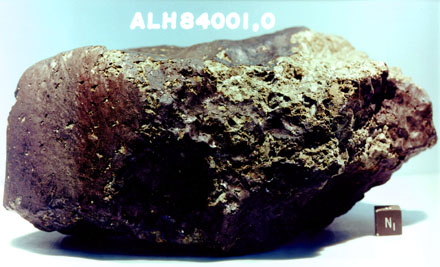
The Allan Hills, Antarctica ALH84001 meteorite discovered in 1984 that made worldwide headlines because scientists found rice-shaped carbon globules in tiny cracks on the rock which resembled earth bacteria. The carbon in this meteorite dates back about three billion years when Mars probably had water on its surface, was warmer and had a global magnetic field. Photograph provided by the NASA Johnson Space Center, Houston, Texas.
Click here to subscribe and get instant access to read this report.
Click here to check your existing subscription status.
"I think it's very unlikely that it was an engineered virus. It looks much more like there are sequences very similar in another part of the world, but that doesn't tell us anything about how it might have been introduced. And that is obviously cause for some concern."
- W. Ian Lipkin, M.D., Univ. of California at Irvine -
November 15, 1999 University of California-Irvine By the time the first frost touched Philadelphia this fall, dead crows and other birds in a couple of suburbs had been sent to laboratories to see if the Kunjin West Nile Fever Virus had spread from New Jersey, New York and Connecticut. The Pennsylvania test results are due soon and public health officials are concerned about the implications for next spring and summer. For the first time in history, this virus strain normally found only in Africa, Australia, the Middle East and Eurasia showed up in the United States. Fifty-six people in New York City were infected with the foreign virus and seven died, along with dozens of crows that are especially sensitive to the West Nile Virus. Transmission of the disease is through ticks, mites or mosquitoes that bite birds. Bird blood fills up with the virus rapidly over several days. During that time, insects can bite infected birds and then bite a human who can also become ill.
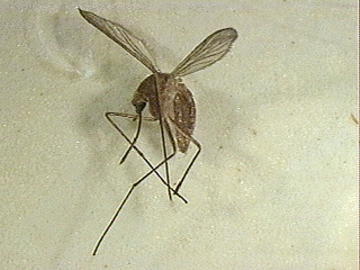
Photograph of Culex pipiens female mosquito, courtesy Entomology Image Gallery.
Click here to subscribe and get instant access to read this report.
Click here to check your existing subscription status.
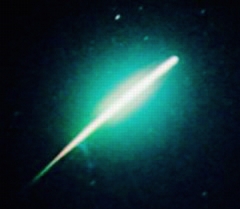
November 6, 1999 Chula Vista, California The International Meteor Organization (IMO) has announced a call for meteor observations between midnight and dawn local times on November 10, 11 and 12. This is not for the famous Leonids. A newly discovered comet this year called Comet LINEAR made its closest approach to the Sun in September. Earth will be passing through whatever dusty debris the comet left in our planet's orbital path on November 11th. This new meteor shower will be called Linearids, not to be confused with Leonids that will arrive a week later on November 18th. Those dates are around New Moon, so dark skies beyond city lights will help meteor watches. But since no one has seen this comet before, scientists don't know whether it will leave a strong meteor wake or not.
Click here to subscribe and get instant access to read this report.
Click here to check your existing subscription status.
"One would expect comets when they come in around the sun to be roughly uniform in their positions in space. So, if you plotted the closest point of the comet to the sun on a globe or sphere, the comets should be uniformly distributed. In fact, comets are not uniformly distributed."
- Daniel Whitmire, Ph.D., Professor of Physics,
University of Louisiana, Lafayette -
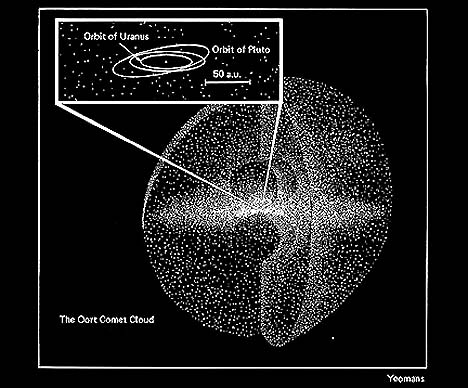
October 25, 1999 Lafayette, Louisiana Physicists in the United States and England have been studying the orbits of comets and are theorizing that something is pulling on the icy clumps that revolve at the dark and outermost edges of our solar system. The "perturber" might be a brown dwarf three times more massive than the sun and orbiting about three trillion miles from earth in the primeval Oort Cloud of ice, rocks and dust that literally surrounds the family of sun, planets, moons, asteroids and comets in our solar system.
Inset depicts nine planets of our known solar system embedded inside the large cloud of debris left over from the formation of our system known as the Oort Cloud. The hypothetical planet or brown dwarf "perturber" would be about halfway out from the center of the cloud. Diagram courtesy University of Michigan/NASA, 1999.
Click here to subscribe and get instant access to read this report.
Click here to check your existing subscription status.