
NASA Announces Strange “New Asteroid 2016 HO3”
Always Orbiting Earth While Both Orbit the Sun
© 2016 by Linda Moulton Howe

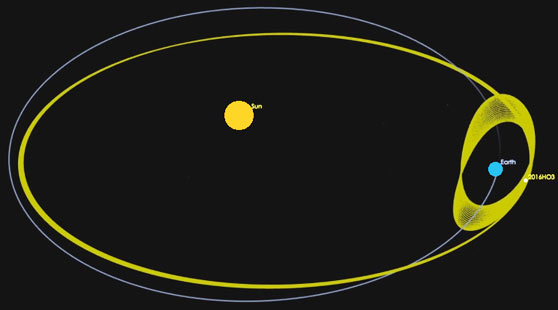
Our yellow sun is at the center of the orbital paths of blue-colored Earth and pale yellow
Asteroid 2016 HO3 that has been a persistent companion of Earth for a century
orbiting
around our planet, sometimes in front of Earth and sometimes in back of Earth,
but never coming closer than 9 million miles (14 million km) in yellow paths around blue Earth.
Its diameter is between 120 to 300 feet (40-100 m.) Illustration credit: NASA/JPL-Caltech.
June 16, 2016 Pasadena, California - Yesterday NASA/JPL's Near Earth Object Program (NEOP) announced a new discovery of a steady companion of Earth's for at least a century that keeps a persistent distance of 9 million miles as it constantly orbits Earth. NASA calls it 2016 HO3 and gives its size as between 120 and 300 feet (40-100 meters) in diameter.
Without explaining why one companion asteroid disappeared and this “new one” has been close to Earth for a century without advanced NASA technologies picking it up before now, Paul Chodas, Manager of NASA's Center for Near-Earth Objects (NEO) at the Jet Propulsion Lab in Pasadena, California, reports: “Since asteroid 2016 HO3 loops around our planet, but never ventures very far away as we both go around the sun, we refer to it as a quasi-satellite of Earth. One other asteroid — 2003 YN107 — followed a similar orbital pattern for a while over 10 years ago, but it has since departed our vicinity. This new asteroid is much more locked onto us. Our calculations indicate 2016 HO3 has been a stable quasi-satellite of Earth for almost a century, and it will continue to follow this pattern as Earth's companion for centuries to come.”
NASA says it was only this year that the government agency found this particular Asteroid 2016 HO3 by searching space for objects that might crash into Earth. So what is the so-called “Earth's second moon, 3753 Cruithne”?
3753 Cruithne — “Earth's Second Moon”
Wikipedia states that on October 10, 1986, amateur astronomer Duncan Waldron in Glasgow, Scotland, discovered a near-Earth asteroid in a photographic plate taken with the U. K. Schmidt Telescope at Siding Spring Observatory in Australia. It was named “3753 Cruithne,” inhabitants of ancient Ireland, also known as the Picts. This space rock is 3 miles in diameter (5 km) and its closest approach to Earth is 7,500,000 miles (12 million km). Cruithne has a 1 to 1 orbital resonance with Earth, so it travels around the sun with our planet on a 364-day revolution. But because Cruithne does not orbit Earth, it is a companion, not really Earth's second moon.
In spite of the 1986 history above, here is a NASA photograph taken from Lunar Orbiter 5, probably in 1968, Frame Number 5027_H2, that in the lower right quadrant in this enhanced image of that frame, was possibly 3753 Cruithne. That would have been at least two decades before the amateur astronomer in Glasgow.

Earthfiles viewers, please try this possible search path: Lunar Orbiter image gallery,
click on Lunar Orbiter 5, and search for frame 5027_H2 that might have been 1968
first photograph of 3753 Cruithne below in illustration. Image by NASA/JPL-Caltech.

Illustration of
3753 Cruithne by NASA/JPL-Caltech.
Also see other Earthfiles reports:
• 03/01/2013 — Strange Martian Moon Phobos - Could Its Dust Have Evidence of Life?
• 12/22/2011 — Updated: Asteroid YU55 “Puzzling Structures”: Equatorial Ridge and Tall, “Pointy” Hill? With mp3 interview.
More Information:
For further information about Near Earth Objects:
• 07/25/2002 — Mile and A Half Diameter Asteroid 2002 NT7 Might Impact Earth in 2019
• 07/11/2002 — Hubble Telescope Photographs Seven Objects Traveling In Pairs Beyond Pluto
• 12/01/2001 — 1200 B. C. - What Caused Earthquake Storms, Global Drought and End of Bronze Age?
• 02/16/2000 — 433 Eros, Orbiting An Asteroid Up Close
Mars, Phobos and Deimos, please see reports below from the Earthfiles Archive:
• 06/11/2011 — Part 1: Is This A Structure On Mars? Planetary Scientist Replies.
• 03/11/2004 — Updated - Mars Spirit and Opportunity Sol 65 and Sol 46
• 03/08/2004 — Updates from NASA's Rovers and ESA's Mars Express
• 03/05/2004 — Part 3 - Mars: A Sulfate Salty Planet - Could It Have Sulfate-Loving Microbes?
• 08/26/2003 — Mars At Its Closest August 27, 2003, At 2:51 a.m. PDT / 5:51 a.m. EDT.
Martian Rovers:
• 09/24/2012 — Updated: Why Is NASA Faking Gale Crater Images On Mars?
• 06/14/2011 — Part 2: Google Mars Update with Planetary Scientist James Bell
• 06/11/2011 — Part 1: Is This A Structure On Mars? Planetary Scientist Replies.
• 12/24/2009 — Does the Allen Hills Meteorite from Mars Contain Fossilized Microbial Life?
• 02/27/2009 — Part 2: Silicas - and Hot Springs? - Could Mean Ancient Life On Mars
• 01/25/2009 — Methane Mystery On Mars
• 08/05/2008 — Perchlorate Discovery by Phoenix Lander Does Not End Search for Life On Mars
• 05/29/2008 — Phoenix Robotic Arm Preparing to Dig Into Martian Permafrost
• 12/16/2005 — MARSIS Radar Looking Below Surface of Mars
• 08/24/2005 — Dust Devils and "Lemon Rinds" on Mars
• 03/26/2005 — Spirit Rover Finds Magnesium Sulfate Near "Larry's Lookout" in Columbia Hills on Mars.
• 02/26/2005 — Mars Spirit Rover Discovered Boundary Between Gusev Lava and Older, Water-Soaked Rocks in "Columbia Hills"
• 04/02/2004 — Updates on Spirit and Opportunity Rovers
• 03/31/2004 — Methane on Mars - Biology? Volcanic?
• 03/11/2004 — Updated - Mars Spirit and Opportunity Sol 65 and Sol 46
• 03/08/2004 — Updates from NASA's Rovers and ESA's Mars Express
• 03/05/2004 — Part 3 - Mars: A Sulfate Salty Planet - Could It Have Sulfate-Loving Microbes?
• 03/03/2004 — Part 1 - Mars: Meridiani Planum Was Once "Drenched With Water and Habitable"
• 03/01/2004 — Opportunity Grinds Bedrock; Spirit Ready to Grind "Humphrey"
• 02/10/2004 — Part 1 - Opportunity Investigating Bedrock and Spirit's Headed for Bonneville Crater
• 01/31/2004 — Opportunity Rolls Onto Martian Soil and Confirms Hematite
• 01/31/2004 — Is There Living Green Algae in the Gusev Crater on Mars?
• 01/24/2004 — Updated - Spirit Alive, But in "Critical" Condition. Mars Express Sees Water Ice and Ancient River Channel
• 01/21/2004 — Spirit Rover's First Martian Soil Analysis Has Surprises
• 01/09/2004 — Robotic "Geologists" on Mars
Websites:
"Small Asteroid Is Earth's Constant Companion," June 15, 2016, NASA Jet Propulsion Laboratory, California Institute of Technology, Pasadena, California:
http://www.jpl.nasa.gov/news/news.php?feature=6537
NASA's Planetary Defense Coordination Office (PDCO):
https://www.nasa.gov/planetarydefense/overview
Int'l. Astronomical Union Minor Planet Center, "the nerve center of asteroid detection in the Solar System": http://minorplanetcenter.net
Near Earth Object Program: http://neo.jpl.nasa.gov
"Evidence of Life On Mars Could Come from Martian Moon," June 28, 2012, Purdue University:
http://www.purdue.edu/newsroom/general/2012/120628T-MeloshHowellPhobos.html
Curiosity Rover Image of Phobos in Martian Daytime Sky:
http://mars.jpl.nasa.gov/msl/multimedia/raw/?rawid=0045MR0209002000E1_DXXX&s=45
Mars Science Laboratory Curiosity Rover Latest News:
http://mars.jpl.nasa.gov/msl/
Phobos, Moon of Mars: http://en.wikipedia.org/wiki/Phobos_(moon)
Transit of Phobos from Mars by NASA, Wikipedia:
http://en.wikipedia.org/wiki/Transit_of_Phobos_from_Mars
Jet Propulsion Lab, Pasadena, Images of Phobos:
http://photojournal.jpl.nasa.gov/target/phobos |