“The reports that I have gotten from beekeepers is that
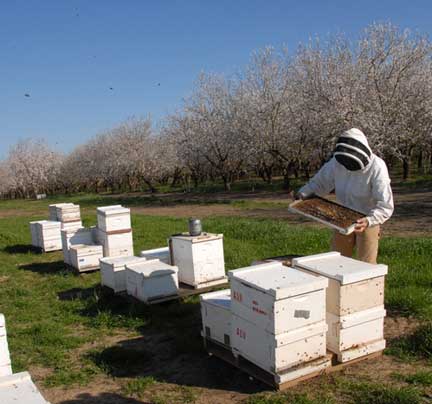
about 30% of the healthy colonies that have gone to California -
for this 2010 almond pollination to fulfill pollination contracts -
have died in two or three weeks”
- Jerry Hayes, Asst. Chief, Apiary Inspection, Florida Dept. of Agriculture
UC Davis bee breeder-geneticist Kim Fondrk in a Dixon, California, almond orchard. Photo by Kathy Keatley Garvey.Western honey bee, or European honey bee (Apis mellifera), gathering pollen from almond tree flower. Florida apiary expert, Jerry Hayes, estimates that more than 30% of American honey bees in commercial hives will have died by spring 2010, in the persistent mystery known as “colony collapse disorder.” Photo by Kathy Keatley Garvey.
February 18, 2010 Gainesville, Florida - The mysterious disappearance of hundreds of European honey bee colonies in Pennsylvania was first reported in late fall 2006. Since then, the baffling “empty hive” syndrome called Colony Collapse Disorder (CCD) has been reported in many parts of the world. Some beekeepers have lost nearly 100% of their bees. Even though nicotine-based pesticides and lack of plant and pollen diversity are high on the culprits list, there is still no single smoking gun answer. The truth appears to be a combination of assaults on soils, plants and air that weaken and kill pollinators in the 21st Century.
Click here to subscribe and get instant access to read this report.
Click here to check your existing subscription status.
“It was gold, bronze, mist and the three, small beings are inside it. ...you had to look really hard at this misty light – you could see sets of eyes inside the thing – black, big eyes just like in the movies!”
- Larry Warren, former RAF Bentwaters Airman
1st Class, in 1986 interview
February 8, 2010 Albuquerque, New Mexico - Continuing Part 3 of the May 18, 1986, interview of former RAF Bentwaters Airman 1st Class Larry Warren by New York mathematics professor, Benton Jamison, and Linda Moulton Howe, in New Haven, Connecticut.
Click here to subscribe and get instant access to read this report.
Click here to check your existing subscription status.
“‘What did I see in the sky?’ Within the hexagram passage were the words: ‘The Ancestors, the earlier kings, who use the firebird
to descend upon the cities.’”
- Sleep paralysis experiencer
Return to Parts 1 and 2
Earthfiles Scotland High Strangeness
January 30, 2010 Albuquerque, New Mexico - After my January 28 - 29, 2010, broadcast on Coast to Coast AM with George Noory about highest strangeness cases in Scotland with author and investigator, Malcolm Robinson, I received many emails from people reporting their own highly strange encounters with the unknown. I would appreciate hearing from other listeners and Earthfiles viewers about phenomena experiences. My email address is: [email protected].
Click here to subscribe and get instant access to read this report.
Click here to check your existing subscription status.
“Terahertz radiation passes through clothing and will pass right through the body, but passing through does not mean that it is doing damage on the way, especially not in short time durations of a minute or so (time in airport body scanners).”
- Philip C. Hanawalt, Ph.D., Stanford University Biologist
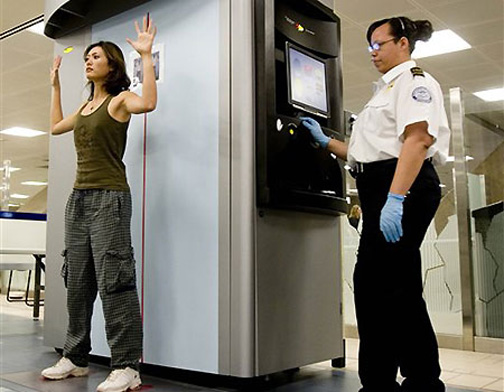
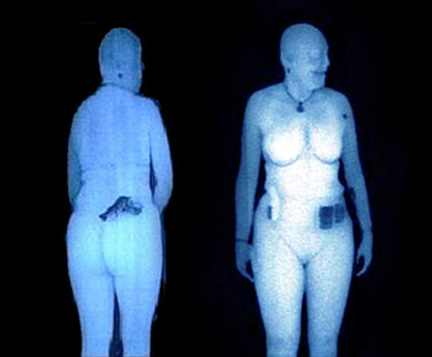
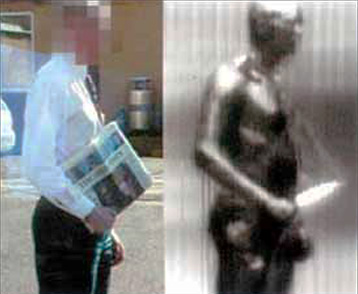
Are terahertz radiation full-body scanners a safe answer to more effective airport security? Would you object to walking through them? Are they a privacy invasion? Source: Consumertraveler.com.A terahertz full-body scanner which produces “naked” images of airline passengers has started a trial in the U. K.'s Manchester Airport.Terahertz millimeter waves between microwave and infrared frequencies can see through clothes and a newspaper. Source: Science Vol. 297, August 2, 2002.
January 28, 2010 Palo Alto, California - On Christmas day, December 25, 2009, Nigerian terror suspect Umar Farouk Abdul Mutallab went aboard Northwest Airlines Flight 253 with 80 grams of PETN (pentaerythritol tetranitrate) explosive powder sewed into the crotch of his underwear.
Click here to subscribe and get instant access to read this report.
Click here to check your existing subscription status.
“The witnesses said the small, grey beings were taking boxes and cylinders towards a triangle-shaped craft in the woods, not towards the light beams that were coming up from the ground further back in the woods.”
- Malcolm Robinson, Author, UFO Case Files of Scotland
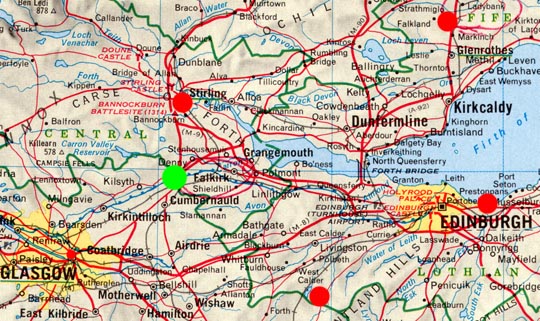
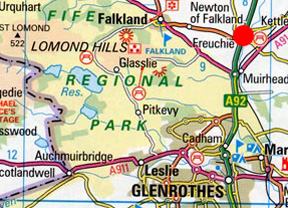
In central Scotland where the Firth of Forth bay joins the North Sea, the county of Fife north of Edinburgh (top right red circle) and the small village of Freuchie near Glenrothes was the location of a highly strange encounter with dozens of small, grey non-human beings and a triangular craft on September 23, 1996. Four years before on August 17, 1992, southwest of Edinburgh on the A70 near Harperrig Reservoir near a small town called Tarbrax (bottom circle), two men in a car encountered a disc over the road and lost 90 minutes of time. Residents in the region associate high strangeness phenomena with Bonnybridge (green circle) south of Stirling where UFO investigator Malcolm Robinson grew up and founded Strange Phenomena Investigations (SPI).Freuchie, Fife County, Scotland, and Falkland Hill.
January 28, 2010 London, England - When Malcolm Robinson, now 52, was a young boy in Stirling, Stirlingshire, Scotland, he was curious about legends of ghosts and other unusual phenomena. By 18, he wanted hard answers - were ghosts and UFOs real? Malcolm started contacting police, airports, local flying clubs and other authorities about times and dates of specific UFO reports to see if there were logical human explanations for what people said they were seeing.
Click here to subscribe and get instant access to read this report.
Click here to check your existing subscription status.
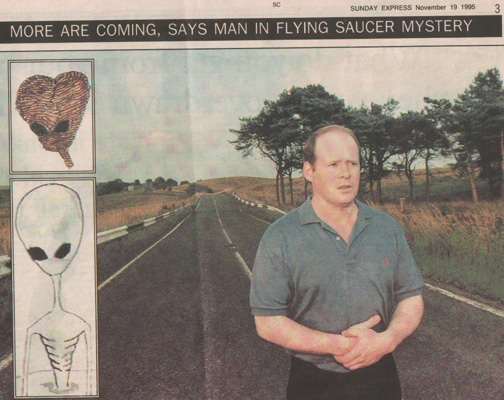
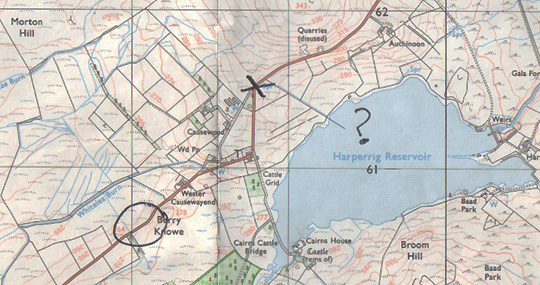
November 19, 1995, U. K. Sunday Express interview with Garry Wood (above) about his A70 abduction with Colin Wright near Tarbrax, Scotland, southwest of Edinburgh that occurred three years earlier on August 17, 1992.On August 17, 1992, southwest of Edinburgh on the A70 near Harperrig Reservoir near Tarbrax, Scotland, (bottom red circle), around 8 PM, two men in a car encountered a disc over the road and lost 90 minutes of time. Residents in the region associate high strangeness phenomena with Bonnybridge (green circle) south of Stirling where UFO Investigator Malcolm Robinson grew up and founded Strange Phenomena Investigations (SPI).Malcolm Robinson inked the black X on the A70 near Harperrig Reservoir as the estimated location for the Tarbrax, Scotland, abduction on August 17, 1992, around 8 PM, southwest of Edinburgh.
January 28, 2010 London, England - On October 5, 2009, STV.TV in Scotland reported that “Scotland's biggest UFO incident is being made into a film, depicting the story of two men who claim they were abducted from their car on the A70 road in West Lothian in 1992.”
Click here to subscribe and get instant access to read this report.
Click here to check your existing subscription status.
“To our surprise, the results show that these galaxies at 700 million
years after the Big Bang must have started forming stars hundreds of millions of years earlier, pushing back the time of the earliest star formation in the universe.”
- Ivo Labbe, Ph.D., Carnegie Institute of Washington
“These galaxies are only 1/20th the Milky Way's diameter.
...Yet they must be the seeds from which the great galaxies of today
were formed.”
- Pascal Oesch, Ph.D., and Marcella Carollo, Ph.D.,
Swiss Federal Institute of Technology
“The faintest galaxies are now showing signs of linkage
to their origins from the first stars. They are so blue that they
must be extremely deficient in heavy elements, thus representing
a population that has nearly primordial characteristics.”
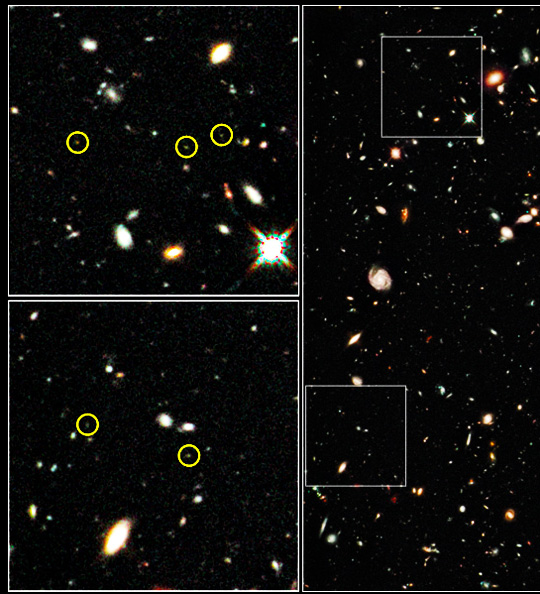
Section of earliest image yet taken of our universe by the Hubble Space Telescope, only 600 - 700 million years after the Big Bang that started our universe. The circled objects are light from “primordial galaxies” back 13 billion years ago of our 13.7-billion-year-old-universe in this unprecedented view of thousands of galaxies in various stages of assembly. Hubble Center: “This is the deepest image of the universe ever taken in near-infrared light by NASA's Hubble Space Telescope. The faintest and reddest objects (left inset) in the image are galaxies that correspond to ‘look-back times’ of approximately 12.9 billion years to 13.1 billion years ago. No galaxies have been seen before at such early epochs. These galaxies are much smaller than the Milky Way galaxy and have populations of stars that are intrinsically very blue. This may indicate the galaxies are so primordial that they are deficient in heavier elements, and as a result, are quite free of the dust that reddens light through scattering.” Object Name: HUDF WFC3/IR. Credit: NASA, ESA, G. Illingworth and R. Bouwens, UC-Santa Cruz and the HUDF09 Team.Portion of earliest universe photographed so far by Hubble Space Telescope. Hubble's WFC3/IR camera was able to make deep exposures to uncover new galaxies at roughly 40 times greater efficiency than its earlier infrared camera that was installed in 1997.
January 6, 2010 Baltimore, Maryland - NASA's Hubble Space Telescope has broken the distance limit for galaxies and uncovered a primordial population of compact and ultra-blue galaxies that have never been seen before. The deeper Hubble looks into space, the farther back in time it looks, because light takes billions of years to cross the observable universe. This makes Hubble a powerful “time machine” that allows astronomers to see galaxies as they were 13 billion years ago, just 600 million to 800 million years after the Big Bang that started our universe.
Click here to subscribe and get instant access to read this report.
Click here to check your existing subscription status.
“Malcolm Zickler and the other intelligence agents got around with all this propaganda about our loyalty to the country and ... Zickler comes out
and says, ‘If you make it too difficult for us,’ – and this is the one quote I’ll remember for the rest of my life – ‘If you make it too difficult for us, bullets are cheap.’”
- Larry Warren, former RAF Bentwaters Airman 1st Class, in 1986 interview
Updated with Larry Warren's comments below on February 7, 2010 / original report filed January 26, 2010 Albuquerque, New Mexico - In December 1980, at RAF Bentwaters and RAF Woodbridge in Suffolk County, England, not far from the coast northeast of London, Airman 1st Class Lawrence Patrick Warren, aka Larry Warren, was assigned to D Flight. The Shift Commander was U. S. Air Force Major Malcolm S. Zickler.
Click here to subscribe and get instant access to read this report.
Click here to check your existing subscription status.