“Each cone-shaped indention is a device that creates an electrical vortex
(sometime called a plasma or ion vortex), and like a tornado with multiple vortexes, they all the add up to cause one big vortex around the craft.”
“If you want to discover what may be happening in Texas, check the coordinates of 32 degrees North 01' 09" 97 degrees 41' 10" on Google Earth in Bosque County, Texas, between the towns of Glen Rose and Meridian.”
- Anonymous, 01-23-08
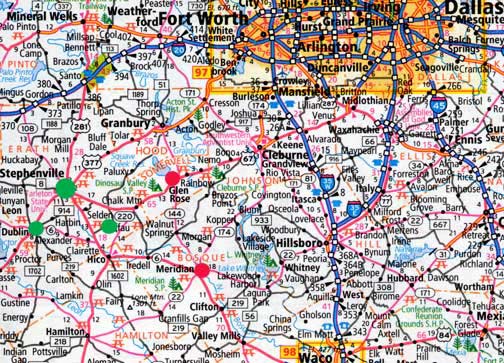
A triangle of three small towns (green circles) southwest of Fort Worth begins with Stephenville, a city in and the county seat of Erath County, Texas, population 14,921 in 2000 census. Then Dublin about eight miles southwest has a population of 3,754. Straight east of Dublin about ten miles is Selden with a full time population of about seven. Further east are Glen Rose and Meridian (red circles) referenced in first updated email below.
“If I’m in a virtual reality, the graphics are great, but the plot sucks.”
- Student of Prof. Brian Whitworth
Virtual reality universe illustration by Prof. Seth Lloyd, Ph.D., Mechanical Engineering, MIT.
January 25, 2008 Auckland, New Zealand - A professor in Auckland, New Zealand, published a paper in December that seriously raises the question: could we be in a virtual reality world and universe where the “computer” behind-the-scenes has a processing speed of 186,282.397 miles per second - the maximum speed of light? The professor is Brian Whitworth, Ph.D., in Information Systems and now Senior Lecturer at the Institute for Information and Mathematical Sciences at Massey University in Auckland.
Click here to subscribe and get instant access to read this report.
Click here to check your existing subscription status.
January 24, 2008 Albuquerque, New Mexico - Interview with author Lou Baldin continued in this final segment after the Earthfiles.com reprint of his 1997 book, In League With A UFO.
Click here to subscribe and get instant access to read this report.
Click here to check your existing subscription status.
“This recent and massive decline in amphibian populations,
that have been on Earth for millions of years, is one of the greatest extinction events in history.”
- Andrew Blaustein, Ph.D., Oregon State University
50% of some 6,000 described amphibian species, are threatened with extinction.
165 amphibian species believed to have already gone extinct, including 34 known to be extinct and 130 not found in recent years and possibly extinct.
500 amphibian species whose threats currently cannot be mitigated quickly enough to stave off extinction.
Harlequin Frog - 67% of Central and South America's 110 harlequin frog species are believed to have vanished during the 1980s and 1990s. A new study says the primary culprit is the pathogenic chytrid fungus Batrachochytrium dendrobatidis, which has been spurred by global warming. Photograph by Forrest Brem, NatureServ.
January 18, 2008 Corvallis, Oregon - Can you imagine what the Earth would be like without frogs, toads and salamanders? Mosquitoes, flies and other insect populations eaten by amphibians would soar. Until now, the possibility that frogs, toads and salamanders that have been living on this planet for millions of years could ever disappear was unthinkable. 2008 has been declared the Year of the Frog by Amphibian Ark.org, which is trying to let the world know that amphibians are dying out in ever-increasing numbers. Scientists say that without immediate public, zoo and government efforts to conserve them, this century could see the extinction of nearly half of all the world's 6,000 amphibian species.
Click here to subscribe and get instant access to read this report.
Click here to check your existing subscription status.
“I don’t know how you can make a piece of metal that large with no bolts, rivets, seams or welds. I’ve never seen anything like this.”
- Ricky Sorrells, Metal Welder and Machinist, Dublin, Texas
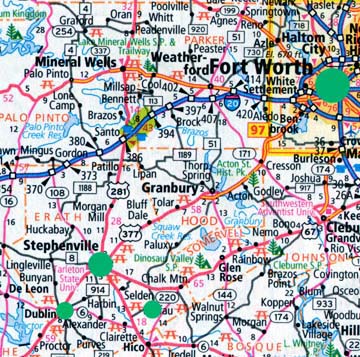
A triangle of three small towns southwest of Fort Worth includes Stephenville, a city in and the county seat of Erath County, Texas, population 14,921 in 2000 census. Dublin about eight miles southwest has a population of 3,754. Straight east of Dublin about ten miles is Selden with a full time population of about seven.
Updated with computer graphic illustration below on January 24, 2008
January 18, 2008 Dublin, Texas - The first week of January 2008, came with shocks for at least three dozen people living in Dublin, Stephenville and Selden, Texas, southwest of Fort Worth. The shocks were yellow, red, blue and white lights that showed up after sunset – lights so bright that eyewitnesses compared them to a welder’s torch.
Click here to subscribe and get instant access to read this report.
Click here to check your existing subscription status.
“The sudden burst of radio energy lasted only 0.005 seconds, and had spectral characteristics that suggested that it was from a distant galaxy, probably billions of light-years from us."
- Seth Shostak, Ph.D., SETI Institute
January 16, 2008 Oakland, California - This afternoon, KTVU-TV Channel 2, removed their earlier report quoted below and by tonight, a correction was posted saying the mystery signal had been recorded by an Australian radio telescope (confirmed now to be the Parkes Radio Telescope) and that the complex signal is still being studied. Yesterday, KTVU-TV in the San Francisco Bay area, reported: “Across the globe, researchers searching for signs of life in space were abuzz this week with word that a mystery signal has been picked up by a giant radio-telescope (Arecibo) in Puerto Rico. Now the dilemma is -- how do you answer it? Dan Werthimer of the UC Berkeley SETI Project, said the dilemma is compounded by the fact that the signal may never be completely decoded. ‘We probably won't be able to decode it,’ he said. ‘We'll know something's out there, but we won't know much about their civilization.’” See: KTVU-TV.
Click here to subscribe and get instant access to read this report.
Click here to check your existing subscription status.
"I thought first it was a tornado, but then it started to glow and the stripe become brighter.”
- Virginia Vater, Gadebusch, Germany
Update 11 AM Mountain, January 15, 2008:January 15, 2008 Edmonton, Alberta, Canada - This is where the "disc" and smoky corkscrew report began in North Tryon, Prince Edward Island, Canada, on December 26, 2007, around 5:45 PM. Return to: January 15, 2008 Earthfiles re: Prince Edward Island Spiral
“Humans are here to determine where we go after the moment of death,
which is related to how much more information and truths we become aware of, or not.”
January 13, 2008 Albuquerque, New Mexico - Lou Baldin was born on October 7, 1952, in Verona, Italy. In 1957, when Lou was five, he moved with his parents and siblings to Patterson, New Jersey, where his father set up a bakery that was not successful. Three years later in 1960, the family moved to Kansas City, Missouri. As a young child, Lou Baldin said he had other vivid memories of where he came from before he was born in Italy. That other existence was in a non-organic energy form. By age twelve and beyond, Lou also became aware of other non-human intelligences he characterizes as negative, sabotaging, and in competition with the goals of his prior existence where energy fields focus upon the evolution of souls.
Click here to subscribe and get instant access to read this report.
Click here to check your existing subscription status.
“Smith's Cloud is eleven thousand light-years long, 2,500 light-years wide and is only 8,000 light-years from our Milky Way Galaxy's disk. It is moving toward our galaxy at more than 150 miles per second, aimed to strike at an angle of about 45 degrees.”
- National Radio Astronomy Observatory
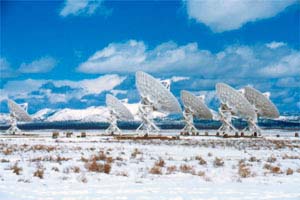
The Very Large Array (VLA) near Socorro, New Mexico. Image courtesy NRAO/Laure Wilson Neish.
January 12 , 2008 Austin, Texas - The National Radio Astronomy Observatory (NRAO) is a facility of the National Science Foundation, operated under cooperative agreement by Associated Universities, Inc. Its headquarters and technology center are in Charlottesville, Virginia which coordinate the research of the Green Bank Telescope (GBT) in West Virginia; the Very Large Array, Very Long Baseline Array and Expanded Very Large Array in Socorro, New Mexico; and two other instruments in Tucson, Arizona, and Santiago, Chile.
Click here to subscribe and get instant access to read this report.
Click here to check your existing subscription status.
“There are a number of indicators that suggest Solar Cycle 24 Maximum
should be a big cycle.”
- David Hathaway, Ph.D., NASA
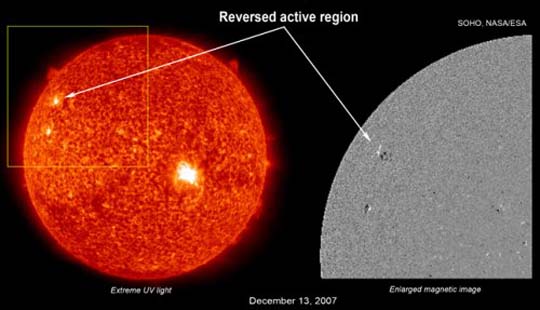
On left, is Extreme UV-wavelength image of the sun and on right, a B&W magnetogram showing positive (white) and negative (black) magnetic polarities. On December 11, 2007, this new high-latitude active solar region was magnetically reversed from sunspot magnetic directions in the previous Solar Cycle 23. So, this new sunspot officially marks the beginning of Solar Cycle 24. Images courtesy SOHO/NASA/ESA.
January 10, 2008 Huntsville, Alabama - One month ago on December 11, 2007, a patch of magnetism on the sun was declared by NASA to be the first official sunspot of the new Solar Cycle 24. The spot was in a high-latitude on the sun with reversed polarity from the previous Solar Cycle 23 that has been in minimum for a long time. The sun has had a blank face without any sunspots for days and weeks at a time. But from now forward to 2012, sunspots should start appearing again all over the sun, leading up to what NASA astrophysicist, David Hathaway, Ph.D., thinks will be one of the more intense solar maximums on record. Dr. Hathaway is the Solar Physics Team Leader at NASA’s Marshall Space Flight Center in Huntsville, Alabama. He received his Ph.D. in astrophysics from the University of Colorado in Boulder in 1979.
Click here to subscribe and get instant access to read this report.
Click here to check your existing subscription status.