Y2K Nuclear Concern and Global Warming Update

December 19, 1999 Harrisburg, Pennsylvania -

1) Nuclear Power Security

While everyone is waiting for the countdown on New Year's Eve, Y2K glitches have already started to appear. Instead of the year 2000, the number 1900 has been showing up on various documents around the country. And on December 15th in Vancouver, British Columbia, a new computerized smoke alarm installed in the city's SkyTrain went off and stopped the whole system. Thousands of commuters and holiday shoppers were stranded. Ironically, the new computerized alarm was supposed to prevent Y2K shutdown problems.

Photograph of Three Mile Island nuclear power plant located in Middletown, Pennsylvania, a few miles south of Harrisburg, the state capital. On March 28, 1979, the worst commercial nuclear disaster in U. S. history occurred when a pump failed in the reactor cooling system. Nearly a million gallons of radioactive water escaped through an open valve onto the reactor building basement floor. Radioactivity was also released into the air. Photograph courtesy U. S. Nuclear Regulatory Commission.


Click here to subscribe and get instant access to read this report.

Click here to check your existing subscription status.

Existing members, login below:

Six More Planets Discovered 60 to 190 Light Years Away

"There are an estimated 10 billion large gaseous planets in our Milky Way galaxy alone and at least one trillion galaxies in this universe. Even if only one out of a trillion of those galaxies had life, you'd still be talking about 10 billion places where life exists."

- Steve Vogt, Ph.D., Astronomer, Univ. of California at Santa Cruz -

Star HD195019 is located in the constellation Delphinus. The large gaseous planet that orbits the star once every 18.3 days is estimated to have a mass equal to 3.5 Jupiters and is referred to as HD195019b. The planet is about .14 Astronomical Units from the star. One A. U. equals the mean distance from the Earth to the Sun, 93 million miles. Artwork © 1999 by Lynette Cook, used with artist's permission. http://www.spaceart.org/lcook/extraso2.html


Click here to subscribe and get instant access to read this report.

Click here to check your existing subscription status.

Existing members, login below:

Short Environmental Updates

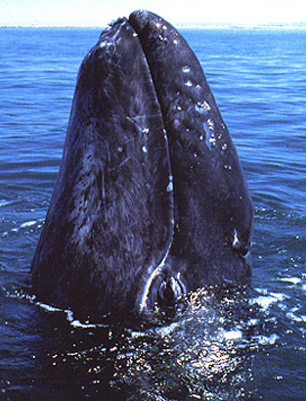
A newborn Gray Whale in the San Ignacio Lagoon, Baja, California, the last Gray Whale nursery in North America © 1999 by Frank Balthis, Natural Resources Defense Council.

November 18, 1999 ­

Orca Whales Contaminated by Ocean Chemical Pollution

­ Orca "killer whales" throughout the world are now contaminated by a poison that the United States and Canada banned twenty years ago, but other countries such as Russia still use. That poison is PCBs, poly chlorinated biphenyls, once used everywhere for cooling and insulating electrical transformers and coloring newspaper comics. PCBs were even sprayed on country roads to keep dust down. Dr. Rob Macdonald, an oceanographer for the Canadian Institute of Ocean Sciences in Sidney, British Columbia, says "the PCB paintbrush has covered the globe." Marine scientists are concerned that the oceans are so polluted with the dangerous chemicals.


Click here to subscribe and get instant access to read this report.

Click here to check your existing subscription status.

Existing members, login below:

Update on Deformed Calf Fetus

November 13, 1999  Las Vegas, Nevada ­ This past week I talked with Colm Kelleher, Ph.D. Biochemistry and Deputy Administrator at the National Institute for Discovery Science (NIDS) in Las Vegas, Nevada. NIDS paid for a necropsy on the deformed calf fetus born October 22, 1999 at a ranch owned by Joe Martinez in Los Brazos, New Mexico. (See: Earthfiles November 7, 1999 report.) Dr. Kelleher told me that after my radio and Earthfiles.com reports, he requested that the one eyeball from the deformed fetus that had been stored at minus 85 degrees F. be thawed for further examination. I asked Dr. Kelleher if any specific study of the eyeball had been made before by veterinarian Leroy Martinez or NIDS scientists prior to freezing. He said none had been, so now the eye would be studied further. After thawing and further examination, NIDS provided a photograph of the deformed fetus's comma-shaped cornea and elongated pupil shown below.

Eye from deformed calf fetus has two major abnormalities: First, the cornea  has a "comma" shape with an angular lateral protrusion. Second, the pupil is an  "elongated aperture with rounded edges." Photograph © 1999 by  National Institute for Discovery Science, Las Vegas, Nevada.
Eye from deformed calf fetus has two major abnormalities: First, the cornea has a "comma" shape with an angular lateral protrusion. Second, the pupil is an "elongated aperture with rounded edges." Photograph © 1999 by National Institute for Discovery Science, Las Vegas, Nevada.


Click here to subscribe and get instant access to read this report.

Click here to check your existing subscription status.

Existing members, login below:

Environmental Updates and Calf Fetus Shocks Los Brazos, New Mexico

Update Note: More information about fetus eye examination will be added to this report on or about November 13, 1999. Also, please see web site listing below.

November 7, 1999 Environmental Updates -

Primitive Fish A Half A Billion Years Ago

One of the challenges of science is to figure out the beginning of things, from the dawn of the cosmos to how long ago vertebrate animals with bones first appeared on earth. In this past week's journal Nature, two Chinese teams reported the discovery of fish-like fossils with primitive backbones that are about 530 million years old. That puts them in the middle of the Cambrian epoch when all kinds of animal life proliferated on this planet. For Cambridge, England scientist, Simon Morris, the fact there were primitive fish nearly half a billion years ago means that "the so-called Cambrian explosion was more abrupt and dramatic than we thought."


Click here to subscribe and get instant access to read this report.

Click here to check your existing subscription status.

Existing members, login below:
A U. S. Army Infantryman’s Abduction

October 24, 1999  Findlay, Ohio ­ This week, I interviewed a man who fought in Vietnam from 1966 to 1967 and then came back to California to finish his service, as he said, "in the Combat Developments Experimental Command at Hunter Liggett Military Reservation eighty miles from Fort Ord in the middle of the Mojave Desert."

Editor's Clarification since radio broadcast and posting of this report:

Hunter Liggett Military Reservation is located between Monterey and Paso Robles, California, not in or near the Mojave Desert. This fact was brought to my attention by several earthfiles.com visitors. I confirmed the location now called Fort Hunter Liggett on a map and called George Ritter.

He said, "I came out of Vietnam and went straight to Fort Ord on the ocean. But for the assignment with that Experimental Command, we were bussed for two hours into a desert that I was told was the Mohave Desert. Coming from Findlay, Ohio, I didn't know anything about California and have always assumed that was the desert we were in. I know we passed Soledad prison and Lockwood on our way to where we had guard duty."


Click here to subscribe and get instant access to read this report.

Click here to check your existing subscription status.

Existing members, login below:

Short Updates About Environmental Problems

October 24, 1999 ­

Insecticides and Rat Poisons Hurting Children and Other Life

On Friday, October 22nd, milk contaminated with insecticide killed at least 28 children ages 5 to 15 and sickened 20 others in a Peruvian village. Powdered milk received at their school was prepared in a pot used earlier to mix insecticide.

­ In Apopka, Florida near Orlando, hordes of mice turned up for reasons unknown and residents laid out poisons and traps. Now eagles and hawks and other birds of prey are turning up sick from eating the mice.


Click here to subscribe and get instant access to read this report.

Click here to check your existing subscription status.

Existing members, login below:

Bird Deaths In Mascoutah, Illinois and Erie, Pennsylvania

October 21, 1999 ­ 

1) Mascoutah, Illinois Red-winged Blackbird Deaths

Last weekend on October 16-17th, a large flock of birds migrating south through the mid-West landed in two fields near Mascoutah, Illinois. That's a small farm community about 30 miles southeast of St. Louis, Missouri. Residents noticed the birds were not moving and the Illinois Department of Natural Resources was notified. Their agents got into the fields to collect birds for analyses. Agents reported that all the birds - mostly male red-winged blackbirds, some grackles and other blackbirds - had their wings outstretched, laying tilted to one side with their beaks sticking straight down into the soil.

Male Red-winged Blackbird Agelaius phoenicus  © 1993 Kirtley Perkins.
Male Red-winged Blackbird Agelaius phoenicus © 1993 Kirtley Perkins.

As of October 21, 1999 the official count was 27,000 birds dead over twenty acres and the cause was declared deliberate poisoning of seed grain with the insecticide, Furadan. A reporter and photographer from the Belleville Illinois News Democrat got to the fields before all the birds had been picked up. I talked with Tim Vizer who is the newspaper's Chief Photographer about his assignment to Mascoutah.


Click here to subscribe and get instant access to read this report.

Click here to check your existing subscription status.

Existing members, login below:

Last 1999 Crop Formation in Wiltshire, England

October 14, 1999 Avebury, Wiltshire, England ­

Aerial photograph © 1999 by Ulrich Cox and Peter Sorensen, September 1, 1999, Avebury, Wiltshire, England.

Peter Sorensen, Videographer, writes in an e-mail: "This eight-armed formation that appeared with the mathematical symbol for Pi next to it at Avebury, Wiltshire was discovered on September 1, 1999 ­ the latest date so far on record for an English crop formation to appear."


Click here to subscribe and get instant access to read this report.

Click here to check your existing subscription status.

Existing members, login below:

Hurricane Floyd Runoff Suffocating North Carolina Estuary

October 10, 1999  New Bern, North Carolina ­ On Friday, October 8th, the non-profit North Carolina Coastal Foundation met in Raleigh to discuss how effective coastal management has been. The impact of Hurricane Floyd dominated the discussion. Dr. Hans Paerl, a marine scientist at the University of North Carolina said, "What we're seeing is an ecological event on the catastrophic scale."

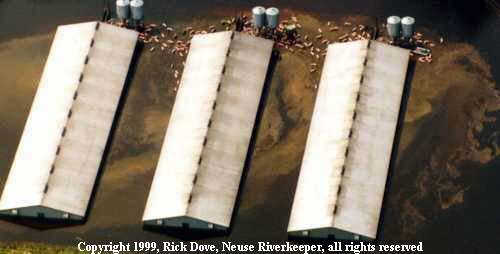
Hurricane Floyd dumped twenty inches of rain on eastern North Carolina on September 16th. The water killed about fifty people as it filled the river basins to overflowing. The flood waters tore through houses, hog lagoons and sewer plants that had been constructed along the Neuse and Tar Rivers. Everything was dumped into Albemarle-Pamlico Sounds, the second largest estuary in the United States.


Click here to subscribe and get instant access to read this report.

Click here to check your existing subscription status.

Existing members, login below:
EARTHFILES