“Ice asks no questions, presents no arguments, reads no newspapers, listens to no debates. It is not burdened by ideology and carries no political baggage as it changes from solid to liquid. It just melts.”
- Henry Pollack, Ph.D., Geophysicist and Author, A World Without Ice
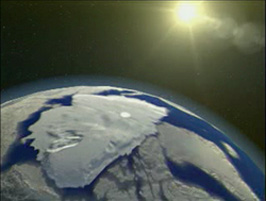
Sea ice melt in the Arctic, Greenland, and elsewhere is likely to affect future temperatures in the regions because ice reflects much of the sun's radiation back into space while dark ocean water absorbs more of the sun's energy. As ice melts, more exposed ocean water changes the Earth's albedo, or fraction of energy reflected away from the planet. This leads to increased absorption of energy that further warms the planet in what is called ice-albedo feedback and Earth gets warmer. Illustration by NASA.
December 5, 2009 Albuquerque, New Mexico - This week 2007 Nobel Peace Prize participant and Professor Emeritus Geophysicist Henry Pollack, Ph.D., was in Albuquerque to speak at the University of New Mexico about his new book, A World Without Ice, released in October 2009. I was able to interview him before his presentation about the recent leaked climate data scandal, the upcoming December 7 to 18, 2009, Copenhagen global climate conference that Dr. Pollack will attend and his perspective on Earth's climate past, present and future. According to the United Nation's Inter-Governmental Panel on Climate Change (IPCC), Earth will warm up between 1.4 degrees Celsius and 5.8 degrees Celsius (roughly 2 degrees Fahrenheit to 10 degrees Fahrenheit) by the end of this century.
Click here to subscribe and get instant access to read this report.
Click here to check your existing subscription status.
“If the current [ice melt] trend continues or gets worse, Antarctica could become the latest contributor to sea level rises in the world. It could start to lose more ice than Greenland in a few years.”
- Jianli Chen, Ph.D., University of Texas-Austin
December 2, 2009 Norwich, England - Phil Jones, Ph.D., Director, Climatic Research Unit (CRU) and professor in the School of Environmental Sciences, University of East Anglia in Norwich, England, used the word “trick” to “hide the decline” in a chart detailing a recent plateau of global temperatures. Dr. Jones's email is among thousands of pieces of correspondence among various scientists about global climate change data. Dr. Jones argues he used the word “trick” to mean “a clever thing to do.” Further embarrassing leaked emails include how to keep scientific work that is critical of a global warming trend out of peer-reviewed journals.
Phil Jones, Ph.D., Director, Climatic Research Unit (CRU) and Prof. of Environmental Sciences, University of East Anglia, Norwich, England, stepped down on Tuesday, December 1, 2009, pending the university's independent inquiry about allegations of scientific misconduct. Image by U. of East Anglia.
Click here to subscribe and get instant access to read this report.
Click here to check your existing subscription status.
“At the moment of eye contact with that Grey, it was like seven different feature films started rapidly running through my mind all at the same time with sound, temperature, touch and 3-dimensional gold symbols superimposed over the films.”
- Retired U.S. AFOSI Agent
December 1, 2009 Albuquerque, New Mexico - In my 1984 research files about high strangeness in the non-human phenomena, I typed the following notes after an interview with a man who had retired from the U. S. Air Force Office of Special Investigations (AFOSI). He implied that he actually received his check from an American intelligence agency when he said, “The AFOSI is convenient cover for U. S. intelligence all over the world.” He would talk to me only off the record and this is the first time I have put his alleged experience in a public forum.
Click here to subscribe and get instant access to read this report.
Click here to check your existing subscription status.
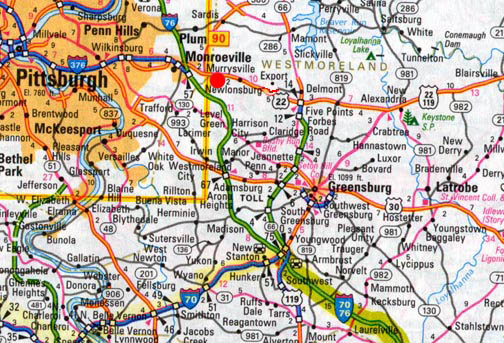
November 25, 2009 Murrysville, Pennsylvania - Alison Kruse, 47, is the owner of a construction site development company in the Murrysville, Pennsylvania, region about 20 miles east of Pittsburgh. Her home is about a quarter mile from old abandoned coal mines that give off radon gas from uranium decay and often the family hears low frequency hums that are sometimes loud enough to vibrate inside their heads. The hums seem to come from underground.
Click here to subscribe and get instant access to read this report.
Click here to check your existing subscription status.
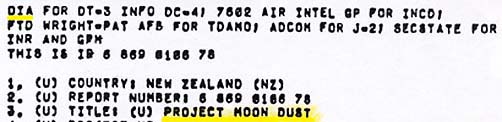
U. S. Department of Defense, Joint Chiefs of Staff Message Center, from Defense Intelligence Agency (DIA) concerning Project Moon Dust information from New Zealand location received on November 13, 1978.
Timeline of Metal Spheres Discovered South of Ashburton, New Zealand:
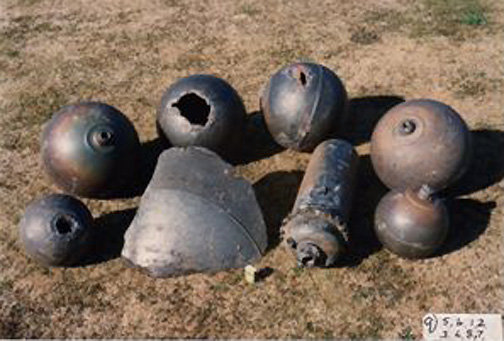
1) 4 similar-sized titanium alloy balls 15 inches in diameter landed on John Lindores farm about 10 miles south of Ashburton on April 3, 1972. Soviets denied metal balls were remnants of Venus-bound spacecraft later renamed Cosmos 482. But New Zealand authorities said Cyrillic Russian writing was found, even though never photographed.
2) 2 other smaller titanium alloy balls, a larger piece of spacecraft and a cylindrical structure were also found by other residents April 3, 1972, a little further south of Ashburton.
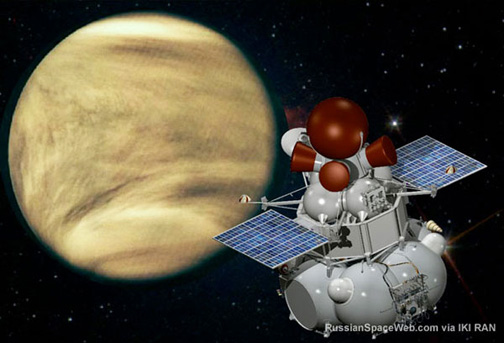
Russian Space Web.com illustration of “the Venera-D spacecraft approaching clouds-veiled Venus. Shown configuration was only one of several designs envisioned at the conclusion of the project's definition phase in September 2009. A ball-shaped capsule containing the main lander can be seen at the top, with four mini-capsules carrying atmospheric balloons attached just below it. Individual entry capsules for each balloon would allow to deploy scientific sensors over much wider regions of the planet then it would be possible if they were all released from a single descent vehicle.”
3) Silicon-aluminum alloy sphere found October 24, 1978, by farmer John Lovett also south of Ashburton.
4) Silicon-aluminum alloy sphere found November 5, 1978, by New Zealand DSIE (Defense Security Information Exchange) also south of Ashburton.
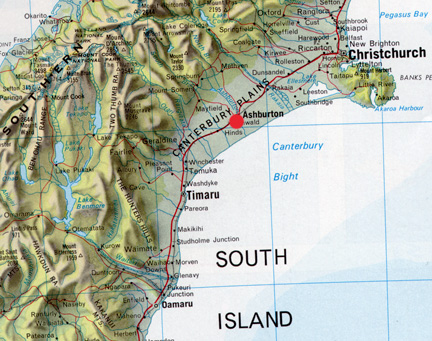
The triangle pattern of metallic spheres discovered between April 3, 1972, and October 24 and November 5, 1978, were in a region about ten miles south of Ashburton, South Island, New Zealand.
November 18, 2009 Albuquerque, New Mexico - On March 31, 1972, the Soviet Union launched a Venus 9 spacecraft later renamed Cosmos 482 with the goal of making a Venus trajectory for exploration. But four days later on April 3, 1972, the Venus 9 failed as it tried to move into the planned Venus trajectory. At 1 AM on April 3, 1972, a farmer named John Lindores of Ashburton, New Zealand, reported that four red-hot, metallic balls about 38 centimeters in diameter (15 inches) landed on his farm near Ashburton. Two smaller spheres, a larger spacecraft piece and cylindrical structure were found further south of John Lindores farm by other residents.
Click here to subscribe and get instant access to read this report.
Click here to check your existing subscription status.
“We are absolutely and totally confident that the LHC machine
is perfectly safe, just as we were last year. And I'm not at all worried
about it being destroyed by its own future!”
- Lyndon Evans, Ph.D., Physicist and Manager, LHC Construction
“We’re really confident with the LHC that we’re going to find
the Higgs boson or something similar, which will help to explain what’s
going on in the universe.”
- Steven Goldfarb, Ph.D., LHC Muon Spectrometer, ATLAS Experiment
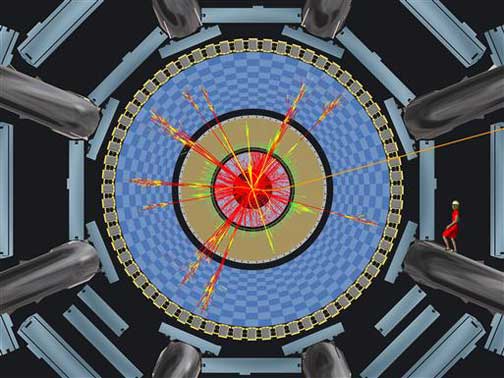
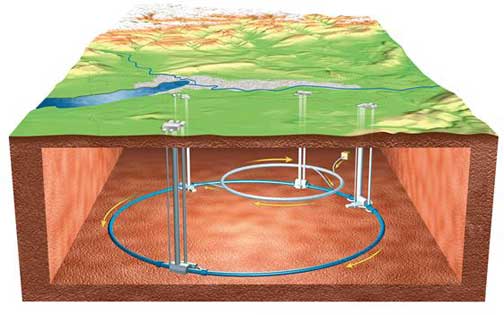
Looking straight down a segment of the 17-mile-long circular Large Hadron Collider (LHC) accelerator. Image courtesy CERN LHC.In some theories, microscopic black holes may be produced in particle collisions that occur when very-high-energy cosmic rays hit particles in our atmosphere. These microscopic-black-holes would decay into ordinary particles in a tiny fraction of a second and would be very difficult to observe in our atmosphere. The ATLAS Experiment offers the exciting possibility to study them in the lab (if they exist). The simulated collision event shown is viewed along the beampipe. The event is one in which a microscopic-black-hole was produced in the collision of two protons (not shown). The microscopic-black-hole decayed immediately into many particles. The colors of the tracks show different types of particles emerging from the collision (at the center). Computer graphic and actual Large Hadron Collider image below courtesy CERN LHC.This computer-generated image shows the location of the 17-mile-long (27 km) Large Hadron Collider (LHC) tunnel (in blue) about 300 feet down on the Swiss-French border. The four main experiments (ATLAS, CMS, ALICE, and LHCb) are located in underground caverns connected to the surface by 50 meter to 150 meter pits. Part of the pre-acceleration chain is shown in gray. Illustration courtesy CERN LHC.
November 19, 2009 CERN Geneva, Switzerland - Beginning Friday night, November 20, 2009, on the border between Switzerland and France, not far from Geneva, and three hundred feet underground, humans will try again to start producing subatomic energies close to those in the Big Bang. By early Saturday morning, the first beam of particles should be circulating one way around the LHC’s 17-mile-long underground ring. Then a second beam traveling in the opposite direction should start soon after. But the first low-energy collisions won't happen until about a week later.
Click here to subscribe and get instant access to read this report.
Click here to check your existing subscription status.
November 19, 2009 Olympia, Washington - James E. Clarkson, 58, now retired from the Aberdeen, Washington, Police Department, currently investigator for Washington State agencies in the field of administrative law and Chief Investigator for Washington State MUFON continues with excerpts from his June 27, 1997, recorded interview with June Crain Kaba at her Ocean Shores, Washington, home before her death on August 23, 1998.
Interview:
James E. Clarkson, Investigator for Washington State Agencies and Chief Investigator, MUFON-Washington State, Olympia, Washington: “June talked about the scientists and engineers who came back from New Mexico where they had experimented with the V-2 rocket and later with the Aerobee rocket. They saw UFOs routinely while they were doing their work.
Click here to subscribe and get instant access to read this report.
Click here to check your existing subscription status.
“Ever since we have been doing the Red List, the numbers go up every year. ...We are certainly looking at an extinction crisis where things are accelerating and it's an out of control stage.”
- Craig Hilton-Taylor, Mgr., IUCN Red List, U. K.
This crescent sliver of Earth's South Pole was photographed on November 12, 2009, by Rosetta, a European Space Agency spacecraft, from about 400,000 miles away.
November 19, 2009 Cambridge, England - This past spring, the United Nations Environment Program declared 2010 to be the Year of Biodiversity. The goal is to unite 40 international organizations to assess the loss of biodiversity on Earth now and what to do in the future to keep Earth life from dying out in the face of climate change, loss of habitats and onslaughts from pesticides and other toxins in the environment. The 2010 Year of Biodiversity slogan is “Life in harmony, into the future.”
Click here to subscribe and get instant access to read this report.
Click here to check your existing subscription status.
“He brought in ‘two little men (non-human).’ He called them ‘little green men.’ Then he described them as a ‘greenish-blue.’ And they were 4-feet-tall. And they were dead.”
- June Crain, Secretary, Air Material Command, Wright Field, Ohio, 1942-1952
November 19, 2009 Olympia, Washington - Recently in Las Vegas at Ryan Wood's UFO Crash Conference, a former police detective shared a tape recorded interview he did on June 27, 1997, with a 72-year-old woman who had worked as a secretary for the War Department at Wright Field, Ohio, from 1942 until 1952. Before marriages, her name then was June Crain and during her work at Wright Field, she said she held both a SECRET and Q clearance (under authority of Atomic Energy Commission), heard about UFO crashes in New Mexico and retrievals of non-human bodies, and even held in her own hands a piece of “spaceship” metal that she could not cut and no matter how hard she twisted, the metal would always spring back to its original shape.
Click here to subscribe and get instant access to read this report.
Click here to check your existing subscription status.
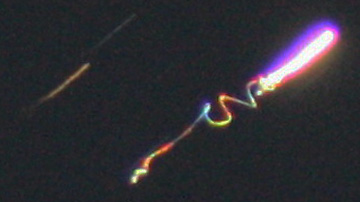
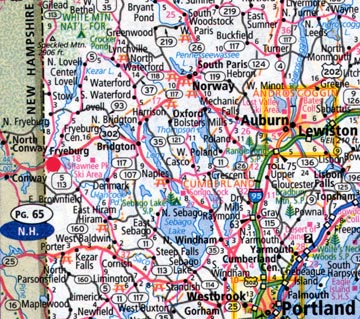
November 11, 2009 Fryeburg, Maine - On October 12, 2009, Earthfiles reported an interview with Jonathan Spak, 37-years-old, owner of a restaurant who photographed anomalous, colorful lights over Fryeburg, Maine. Now a month later on November 4, 2009, Jonathan has photographed more anomalous lights that are included in this Earthfiles report. If anyone else might be having repeated sightings of multi-colored, aerial lights that persist in a specific geographical area, please email me at [email protected].
Click here to subscribe and get instant access to read this report.
Click here to check your existing subscription status.