
Part 1: Idaho Hunters Describe Huge Triangle Aircraft Over Their Campsite 

“That red light came on simultaneously with a really deep, low-pitched throb, a deep base that was not loud, just perceptible, an immense amount of power.”

- Kris Bales, Hunter

Click for podcast.
Click for podcast.

May 28, 2009  Bend, Oregon  -  One of the most important UFO-related government documents to emerge since the early 1980s is entitled:  “Restricted SOM1-01 Majestic-12 Group Special Operations Manual, Extraterrestrial Entities and Technology, Recovery and Disposal - TOP SECRET/MAJIC EYES ONLY.” It's dated April 1954, only seven years after a UFO crash made headlines in July 1947 near Roswell, New Mexico. The cover page is also stamped with the official United States War Office seal that was still used in 1954. In Part 3 of this report, I am reprinting the entire SOM1-01 training manual for Earthfiles viewers.

 

Click here to subscribe and get instant access to read this report.

Click here to check your existing subscription status.

Existing members, login below:

Part 2: Idaho Hunters Describe Huge Triangle Aircraft Over Their Campsite 

“This thing really didn’t bank like an aircraft - it just sort of slid! I could not hear a thing. Couldn’t smell anything. That was very perplexing how something this size could maneuver like it was with no audio sounds at all!”

- Marc Bales, Pilot

Click for podcast.
Click for podcast.

Return to Part 1

May 28, 2009  Bend, Oregon  -  Kris Bales’ younger brother, Marc, works in their Bend, Oregon, construction company. Marc Bales also flies his own plane and watched the huge triangle aircraft at their Challis, Idaho, hunting camp site through 10X binoculars with the eyes and mind of a pilot.


Click here to subscribe and get instant access to read this report.

Click here to check your existing subscription status.

Existing members, login below:

Long Minimums Usually Mean Weaker Maximums, But Sun Could Still Have Big X-Flares in 2011 to 2012

“If this solar minimum keeps going past thirteen years, we’ve only had one cycle before that lasted nearly fourteen years. That was about the time of our American revolution! Solar cycle 4 started in 1785, and went from then to almost 1800.”

- David Hathaway, Ph.D., Heliophysics
Team Leader, NASA Marshall Space Flight Center


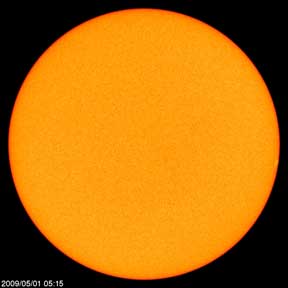
Spotless sun on May 1, 2009. Out of 365 days in 2008, 266 were without sunspots. So far in 2009, January had 25 sunspot free days; February had 23 sun spot free days; March had 28 sun spot free days and April was generally spotless . Image source:  SOHO.
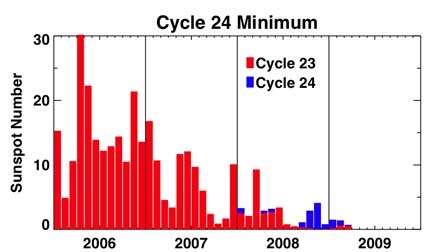
The last Solar Cycle 23 minimum began in May 1996. The next Solar Cycle 24 was expected to start some time in 2007 with a new crop of sunspots. But it is now April 2009, and this has been the most spotless sun in a century. Graphic by David Hathaway, NASA.

May 2, 2009  Huntsville, Alabama -  A sunspot is a region of intense magnetic activity on the Sun's surface that are cooler than the rest of the sun. That's why they appear as dark spots. Sunspots are at temperatures of roughly 4,000 to 4,500 Kelvin, which is 6,740 to 7,640 degrees Fahrenheit, and are surrounded by hotter solar material around 5,800 Kelvin, or 9,980 degrees Fahrenheit.


Click here to subscribe and get instant access to read this report.

Click here to check your existing subscription status.

Existing members, login below:

Part 1: April 2009 Chemistry Report about Nano-Thermitic Material Discovered in 9/11 World Trade Center Dust

“We have discovered distinctive red/gray chips in all the samples we have studied of the dust produced by the destruction of the World Trade Center.
...The red portion of these chips is found to be an unreacted thermitic material incorporating nanotechnology and highly energetic. ...The carbon content of the red material indicates that an organic substance is present. This would be expected for super-thermite formulations in order to produce high gas pressures from ignition and thus make them explosive.”

- April 2009 Bentham Open Chemical Physics Journal, Volume 2

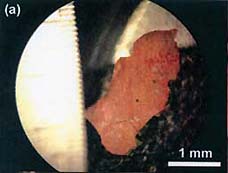
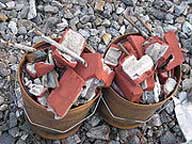
Top:  Photomicrograph of red/gray chip from samples of the WTC dust involved in this study. 31-page report with photomicrographs and spectra were published April 3, 2009, in The Open Chemical Physics Journal.   Bottom:  Red-gray residues of burnt thermite used by railway workers to cut or weld railroad tracks shown in Wikipedia.

May 1, 2009   Copenhagen, Denmark - On April 4, 2009, I received an email in which the subject line said:  “Active Thermitic Material Discovered in Dust from the 9/11 World Trade Center Catastrophe.” A hot link was included and I ended up at a website entitled Bentham Open Access, The 2009 Open Chemical Physics Journal, Volume 2, where I clicked on DOWNLOAD. A 25-page PDF with many color photomicrographs and spectra ended up on my desktop. See:  Bentham Open Chemical Physics Journal, Vol. 2.


Click here to subscribe and get instant access to read this report.

Click here to check your existing subscription status.

Existing members, login below:

Part 2: April 2009 Chemistry Report about Nano-Thermitic Material Discovered in 9/11 World Trade Center Dust

“This nano-thermitic evidence can be ignored to our peril because something very nefarious happened on 9/11.”

- Steven E. Jones, Ph.D., Physicist

Top:  Photomicrograph of red/gray chip from samples of the WTC dust involved in this study. 31-page report with photomicrographs and spectra were published April 3, 2009, in The Open Chemical Physics Journal.   Bottom:  Red-gray residues of burnt thermite used by railway workers to cut or weld railroad tracks shown in Wikipedia.

Return to Part 1

May 1, 2009  Spring City, Utah - The third listed author on the April 2009 Bentham Open Chemical Physics Journal paper is Steven E. Jones, Ph.D., Prof. Emeritus of Physics from Brigham Young University and now a private citizen who has long been investigating what exactly happened to bring the two World Trade Center towers and Building 7 straight down and so quickly.


Click here to subscribe and get instant access to read this report.

Click here to check your existing subscription status.

Existing members, login below:

Apollo Astronaut Edgar Mitchell Says Governments Covering Up E. T.s

“I happen to be privileged enough to be in on the fact that we have been visited on this planet and the UFO phenomenon is real, although it has been covered up by our governments for quite a long time.”

- Edgar Dean Mitchell, Ph.D., retired Apollo 14 Astronaut, on Kerrang! Radio, U. K.


Apollo 14 crew from left: Astronauts Stuart A. Roosa, Alan B. Shepard and Edgar D. Mitchell, February 1971. Photograph courtesy NASA.

July 25, 2008  West Midlands, U. K.  - In the West Midlands of the United Kingdom this week, Nick Margerrison, host of Kerrang! Radio's The Night Before Team, interviewed retired 78-year-old Apollo 14 Astronaut Edgar Mitchell, Ph.D., who earned his Doctor of Science degree in Aeronautics and Astronautics from the Massachusetts Institute of Technology.


Click here to subscribe and get instant access to read this report.

Click here to check your existing subscription status.

Existing members, login below:

Apollo Astronaut Edgar Mitchell Says Governments Covering Up E. T.s

“I happen to be privileged enough to be in on the fact that we have been visited on this planet and the UFO phenomenon is real, although it has been covered up by our governments for quite a long time.”

- Edgar Dean Mitchell, Ph.D., retired Apollo 14 Astronaut, on Kerrang! Radio, U. K.


 Apollo 14 crew from left: Astronauts Stuart A. Roosa, Alan B. Shepard and Edgar D. Mitchell, February 1971. Photograph courtesy NASA.
Apollo 14 crew from left: Astronauts Stuart A. Roosa, Alan B. Shepard and Edgar D. Mitchell, February 1971. Photograph courtesy NASA.

July 25, 2008  West Midlands, U. K.  - In the West Midlands of the United Kingdom this week, Nick Margerrison, host of Kerrang! Radio's The Night Before Team, interviewed retired 78-year-old Apollo 14 Astronaut Edgar Mitchell, Ph.D., who earned his Doctor of Science degree in Aeronautics and Astronautics from the Massachusetts Institute of Technology.


Click here to subscribe and get instant access to read this report.

Click here to check your existing subscription status.

Existing members, login below:

Longest Solar Minimum Since 1913

“It's a fascinating time. It's the quietest sun in a century,
since the solar cycle of 1902 to 1913. ”

- Mark Miesch, Ph.D., NCAR's High Altitude Observatory


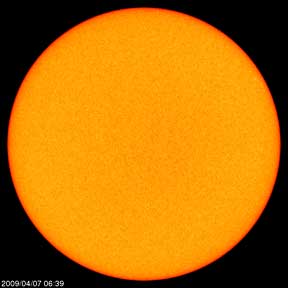
Spotless sun on April 7, 2009. Out of 365 days in 2008, 266 were without sunspots. So far in 2009, January had 25 sunspot free days; February had 23 sun spot free days; and March had 28 sun spot free days. Image source:  SOHO.

Click for podcast.

April 7, 2009  Huntsville, Alabama and Boulder, Colorado -  A sunspot is a region of intense magnetic activity on the Sun's surface that are cooler than the rest of the sun. That's why they appear as dark spots. Sunspots are at temperatures of roughly 4,000 to 4,500 Kelvin, which is 6,740 to 7,640 degrees Fahrenheit, and are surrounded by hotter solar material around 5,800 Kelvin, or 9,980 degrees Fahrenheit.


Click here to subscribe and get instant access to read this report.

Click here to check your existing subscription status.

Existing members, login below:

Part 2: Silicas – and Hot Springs? – Could Mean Ancient Life On Mars

“To be honest, what would surprise me the most would be if life never was on the planet Mars. That would be surprising and give us all some pause and make us wonder – why?”

- Dorothy Z. Oehler, Ph.D, NASA Johnson Space Center     

Dark “horse head” of Syrtis Major Planum rises at center of this Hubble telescope image of Mars. On the right side of that darkness is Elysium Planitia; on the left is Arabia Terra. Image courtesy Hubble.

Return to Part 1

February 27, 2009  Houston, Texas - Other scientists studying a completely different part of Mars in Arabia Terra have also discovered features they think are the residue of hot springs, largely based on the tell-tale oval rings that closely resemble hot springs in Yellowstone National Park and Dalhousie, Australia. In a recent issue of Astrobiology, NASA Johnson Space Center planetary geologists described one mound on Mars named Vernal crater that could be a dried up hot springs?


Click here to subscribe and get instant access to read this report.

Click here to check your existing subscription status.

Existing members, login below:

Part 1: Silicas – and Hot Springs? – Could Mean Ancient Life On Mars

“On Earth, hydrothermal deposits [hot springs] teem with life and the associated silica deposits typically contain fossil remains of microbes.”

- Jack Farmer, Ph.D., Astrobiology, Arizona State Univ.


Dark “horse head” of Syrtis Major Planum rises at center of this Hubble telescope image of Mars. On the right side of that darkness is Elysium Planitia; on the left is Arabia Terra. Image courtesy Hubble.

Click here for podcast.

February 21, 2009  Albuquerque, New Mexico - NASA landed the two Mars rovers, Spirit and Opportunity, near the Martian equator on opposite sides of the red planet in January 2004. The goal was to look for evidence of water. Spirit and Opportunity recently came out of 2008 winter hibernation and started their fifth Martian spring of exploring.


Click here to subscribe and get instant access to read this report.

Click here to check your existing subscription status.

Existing members, login below:

EARTHFILES