May 25, 2001 Washington, D. C. - The United States now has one hundred fifteen million cell phone subscribers. In only three more years, global use of cell phones is estimated to reach 2.1 billion . Yet, no one can guarantee their safety.
Click here to subscribe and get instant access to read this report.
Click here to check your existing subscription status.
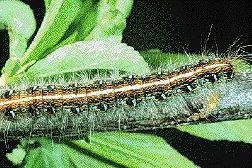
Eastern Tent Caterpillar feeds on wild black cherry tree leaves which contain cyanide. The insects overwhelmed Kentucky trees and fields in the spring of 2001. Is there a connection to the aborted foal syndrome? Photograph courtesy University of Kentucky College of Agriculture.
News Update - May 24, 2001 Lexington, Kentucky - Tonight laboratory experts confirmed that liver enzymes which indicate cyanide poisoning were confirmed in pathology analyses of aborted fetuses and foals. The main suspect for the cyanide source remains the Eastern Tent Caterpillar combined with the cyanide in wild cherry tree leaves containing more cyanide than normal because of the freeze after record high temperatures in mid-April. Still unknown is exactly how the caterpillar cyanide gets into the pregnant mares. While scientists begin more tests on pasture grasses, Lexington horse breeders are going to cut down wild cherry trees near their pastures and spray the Tent Caterpillar moths before they lay eggs that would hatch next spring.
Click here to subscribe and get instant access to read this report.
Click here to check your existing subscription status.
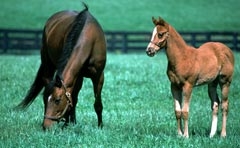
Lexington, Kentucky thoroughbred mare and foal. Photograph courtesy University of Kentucky.Between April 28 and May 16, 2001, 477 cases of first trimester dead fetuses and third trimester stillborn foals were reported to the Livestock Disease Diagnostic Center in Lexington, Kentucky.
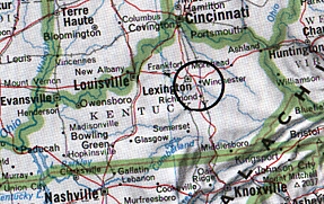
May 16, 2001 Lexington, Kentucky - Seventeen thousand thoroughbred mares live in the Kentucky blue grass fields around Lexington, the largest racehorse breeding area in the United States. Since the end of April 2001, pregnant mares have lost 477 fetuses and stillborn foals. Last year, only 46 aborted foals or fetuses were reported to the University of Kentucky Livestock Disease Diagnostic Center. That means something has caused a 700% increase in fetal deaths.
Click here to subscribe and get instant access to read this report.
Click here to check your existing subscription status.
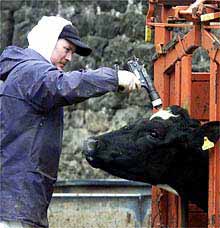
The Dutch Agriculture Minister confirmed last week that four cows and hundreds of goats in Holland are infected and the herd and flocks must be destroyed and incinerated. The European Union quickly imposed a ban on livestock exports from the Netherlands and on exports of meat, dairy and animal products from four Dutch provinces. About 17,000 animals within a 1000 yard radius of the three infected farms will be killed.
Click here to subscribe and get instant access to read this report.
Click here to check your existing subscription status.
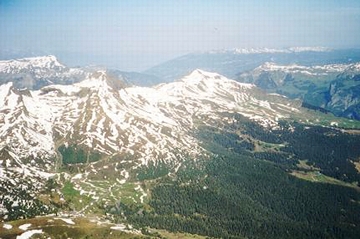
March 24, 2001 Swiss Alps - The United Nations Intergovernmental Panel on Climate Change (IPCC) reported this week that the Alps are warming up faster than the rest of he world. Prof. Martin Beniston, head of the Geosciences Department of the University of Fribourg, predicted that global warming could push the snow line up from 1200 to 1800 meters (3,816-5,724 feet).
Click here to subscribe and get instant access to read this report.
Click here to check your existing subscription status.
March 21, 2001 - It was only six months ago that Presidential campaigner George Bush pledged to regulate power plant emissions of carbon dioxide in order to help reduce global warming. But this month as president, he has now reversed himself saying there is a national energy crisis. At the same time, a study was published in the journal Nature confirming unequivocally that greenhouse gases are increasing. Scientists at London's Imperial College compared 1997 infrared reflections of carbon dioxide, methane and ozone from Earth's surface and found less was escaping into space compared to satellite data in 1970. Atmospheric physicist John Harries said, "We're absolutely sure; there's no ambiguity. This shows the greenhouse effect is operating, and what we are seeing can only be due to the increase in the gases."
Click here to subscribe and get instant access to read this report.
Click here to check your existing subscription status.
March 21, 2001 Greensboro, Vermont - After months of legal battles, the U. S. Department of Agriculture acted today and took 233 sheep from Vermont farmers, Houghton Freeman and Linda and Larry Faillace. It started back in July 2000 when four sheep on their Greensboro, Vermont farm tested positive for antibodies to Transmissible Spongiform Encephalopathy, or TSE, - a family of diseases caused by misshapen proteins called prions - the most famous being BSE, bovine spongiform encephalopathy, or Mad Cow disease. The destructive proteins attack the spinal cord and brain, literally eating holes in tissues which deteriorate to resemble a sponge, always ending in death.
Click here to subscribe and get instant access to read this report.
Click here to check your existing subscription status.
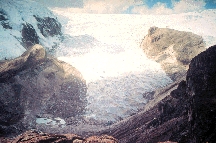
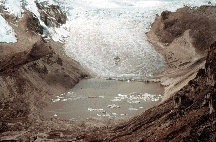
"Since 1963, the Qori Kalis glacier in Peru's Quelccaya ice cap
in the Southern Andes has shrunk by at least 20%.
The rate of retreat has been 509 feet per year, or 1.3 feet per day!
You can literally sit there and watch it retreat.
And if you assume that the current rate of retreat will continue,
this ice cap will disappear some time between 2010 and 2020."
- Lonnie Thompson, Ph.D., Glacial Geologist, Ohio State University -
Qori Kalis glacier in Peru's Quelccaya ice cap, Southern Andes. Image on top, 1978. Image on bottom, 2000, shows new 10 acre lake from ice melt. Twenty percent decrease in square kilometers of ice, retreating at 1.3 feet per day since 1963. Photographs by Lonnie Thompson, Ph.D.
March 4, 2001 Columbus, Ohio - At the American Association for the Advancement of Science (AAAS) meeting in San Francisco on February 25, Prof. Lonnie Thompson from Ohio State University's Department of Geological Sciences presented a paper entitled "Disappearing Glaciers - Evidence of A Rapidly Changing Earth." He spoke before a special session of Earth Systems Science: The Quiet Revolution, organized by the International Geosphere/Biosphere program. Dr. Thompson has completed 37 expeditions since 1978 to collect and study perhaps the world's largest archive of glacial ice cored from the Himalayas, Mount Kilimanjaro in Africa, the Andes in South America, the Antarctic and Greenland.
Click here to subscribe and get instant access to read this report.
Click here to check your existing subscription status.
International computer projections for the next 100 years all agree that the world's average temperature will rise. How high depends upon greenhouse gas build up, but the range will be between 2.5 and 10.5 degrees Fahrenheit. To put that into perspective, if we go back to the last time the earth was 10 degrees cooler than it is now, we have to go back at least ten thousand years to the end of the last Ice Age. So, it took 10,000 years for the earth to warm up 10 degrees F. since ice last covered North America, but may take only the next 100 years to heat up another 10 degrees.
Click here to subscribe and get instant access to read this report.
Click here to check your existing subscription status.
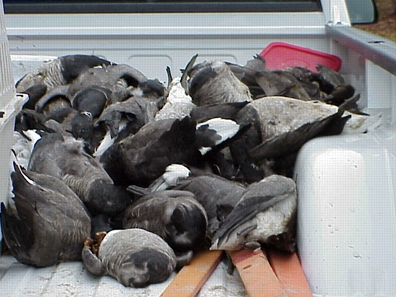
"Scientists can't remember ever seeing a situation like this
where we've just had one species die, especially in this large a number."
- Tracy Casselman, U. S. Fish and Wildlife -
Dead Atlantic brant geese collected for lab studies by U. S. Fish and Wildlife Service at Forsythe National Wildlife Refuge, Oceanville, New Jersey. Photo courtesy USFWS.
February 18, 2001 New York City - Increasing carbon dioxide and other greenhouse gases in the earth's atmosphere ARE raising the global average mean temperature, physicists say, and 100 nations have ratified the Kyoto Protocol that requires a cutback in emissions. But none of those nations are industrial like the United States, which is responsible for 25% of the world's atmospheric pollution. So far the U. S. refuses to ratify the Kyoto Protocol because American industry argues it cannot afford the economic costs of complying with emission cutbacks. This week the United Nations agreed to delay greenhouse talks until June or July, hoping for American involvement. But this delay further frustrates environmental groups who argue that President Bush was quick to create a high-level team to develop new sources of oil and other fossil fuels that will put even more CO2 into the atmosphere, while ignoring the consequences of burning fossil fuels.
Click here to subscribe and get instant access to read this report.
Click here to check your existing subscription status.