— “The MERS coronavirus is a threat to the entire world.”
- Margaret Chan, M. D., Dir.-Gen., W.H.O., May 28, 2013
— “This is the first time health care workers have been
diagnosed with MERS infection after exposure to patients.”
- World Health Organization, May 15, 2013
— “Of most concern is the fact that the different clusters
of MERS seen in multiple countries increasingly supports the hypothesis
that when there is close human contact, this MERS coronavirus
can transmit from person to person.”
- Keiji Fukuda, Asst. Dir.-General, W.H.O.
Photomicrograph of new MERS-CoV coronavirus (yellow) that first emerged from the Middle East, but with modern air travel has spread to Europe. A second patient in Paris, France, was hospitalized this week infected by MERS-CoV. Image credit: NIAID/RML. See: W. H. O.
May 31, 2013Chicago, Illinois - Last week the World Health Organization (W.H.O.) reported that a nurse and two health care workers in Saudi Arabia were infected after treating patients with MERS, Middle East Respiratory Syndrome, a name suggested in the May 15, 2013, Journal of Virology by a Coronavirus Study Group. A WHO spokesperson told reporters on May 15th, “This is the first time health care workers have been diagnosed with MERS infection after exposure to patients.”
Click here to subscribe and get instant access to read this report.
Click here to check your existing subscription status.
“We're getting closer and closer to the point where we don't have enough bees in this country to meet pollination demands.”
- Dennis vanEngelsdorp, Ph.D., Entomologist, Univ. of Maryland
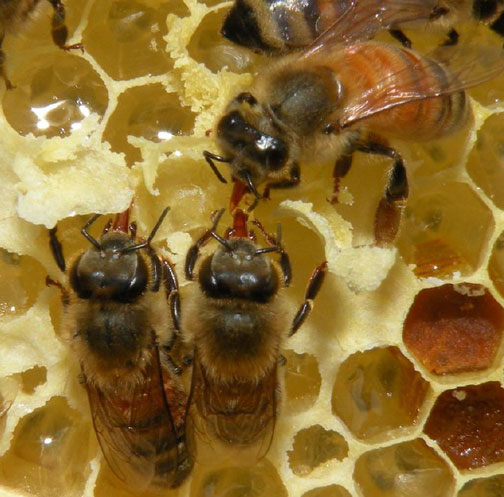
Honey bees image by Jessica Lawrence, Eurofins Agroscience Services, Bugwood.org.
Neonicotinoid Clothianidin Pesticide and Honey Bees: “Among the neonicotinoids, clothianidin is among those most toxic for honey bees; and this combined with its systemic movement in plants has produced a troubling mix of scientific results pointing to its potential risk for honey bees through current agricultural practices. Our own research indicates that systemic pesticides occur in pollen and nectar in much greater quantities than has been previously thought, and that interactions among pesticides occurs often and should be of wide concern.”
- James Frazier, Ph.D., Prof of Entomology,
Penn State College of Agricultural Sciences
May 31, 2013 Niwot, Colorado - In early May 2013, the U. S. Department of Agriculture, apiary scientists and beekeepers all confirmed that the deaths and disappearances of honey bees in the United States in the winter of 2012 to 2013 rose again to at least one-third of all honey bee colonies.
Click here to subscribe and get instant access to read this report.
Click here to check your existing subscription status.
— “Less than three acres of trees in Mexico were occupied by Monarch butterflies this winter - about 1/20th of what it has been in the past....The scale of the loss of habitat is so big that unless we compensate for it in some way, the Monarch population will decline to the point where it will disappear.”
- Chip Taylor, Ph.D., Prof. of Biology, Univ. of Kansas;
Founder and Director of Monarch Watch, Lawrence, Kansas
March 28, 2013Lawrence, Kansas - In the 1970s, Monsanto began producing the herbicide glyphosate, a broad leaf and grass weed killer called Roundup. Farmers liked it because it would kill many different types of weeds. Then Monsanto came up with genetically engineered corn and soybean crops that had their DNA altered to resist glyphosate. Farmers could now spray glyphosate everywhere without killing their corn and soybean crops. By 2007, glyphosate was the most used herbicide in United States agriculture. But what came next were “Superweeds” resistant to glyphosate. Monsanto scientists told farmers to simply apply more glyphosate.
Click here to subscribe and get instant access to read this report.
Click here to check your existing subscription status.
— “The sounds being heard are coming from the Earth itself. Changes deep inside the core are vibrating the crust near thin areas and causing the crust to act like a speaker most often times projecting deep waves up to the ionosphere where they are (bounced back) at audible frequencies... These inner ground vibrations are also what is causing the sink hole issue around the world... and underground water sources are being vibrated to the point of dispersion.”
- Retired electronics engineer 2005, Hill AFB, Utah
— “Then an explosion happened right in the middle of my living room that had the sound and force of an explosion with an after-sound of breaking glass.”
- Resident Anna Hoaglan, Woodland Hills, CA, March 7, 2013
— “This sounded like someone set off dynamite in front of my house.”
- Eddie Lashley, Louisville, Kentucky, on March 17, 2013
— “Why was the Civil Air Patrol Wing at Bowman Field, Kentucky, monitoring with a Cessna Skyhawk over Louisville from June through October 2012, for 6 to 8 hours a day on a classified mission?”
- Kentucky resident between Fort Knox and Louisville, Kentucky
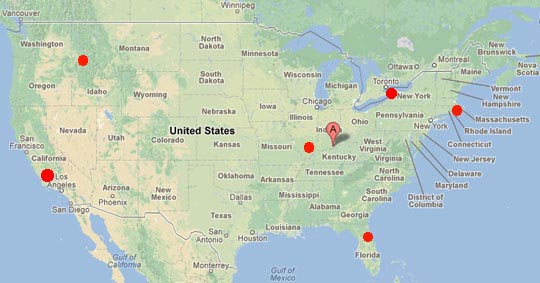
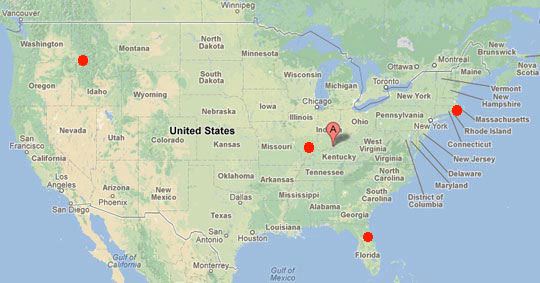
Strange sounds ranging from breaking glass and metal crashing to loud house and bone-rattling booms have been reported between March 7 - 23, 2013. In Woodland Hills, CA, (far left red circle) on March 7th, a resident reported sound of breaking glass sound at 3:30 PM Pacific. Loud booms were reported on March 13, in Tiverton and Little Compton, Rhode Island, and Westport, Massachusetts (far right red circle) that are 940 miles east of Louisville, KY (Google pointer). Between March 11-15, loud booms were heard in Alabama, NY, (red Great Lakes circle) between Lake Erie and Lake Ontario; March 16-17, loud booms in Kamiah, Idaho, 65 miles east of Lewiston (upper left red circle), is 2,102 miles northwest of Louisville that is straight east of southern Illinois and Indiana where loud booms were reported March 16-17 in all three states. Then on Thursday, March 21, 2013, near 9 PM EST, residents from several counties around Gainesville, Florida (north central Florida red circle) reported similar house-shaking, window-rattling.
Updated March 28 / Original report on March 19, 2013 Louisville, Kentucky - Since March 7, Earthfiles has received many more boom, light flash, military helicopter and higher strangeness sounds of metal crashing and glass breaking reports - but no physical evidence or known source. Here is a sampling:
Click here to subscribe and get instant access to read this report.
Click here to check your existing subscription status.
–“The west side of Gainesville flooded our communications center around 9 PM (March 21) with calls about a window-clattering and wall-shaking boom.”
- Sheriff's Lt. Art Forgey, Alachua County, Florida
– “USGS (U.S. Geological Survey) has not reported any earthquake activity in our area during that time (March 16), leaving the cause of these reports as somewhat of a mystery.”
- Ryan Buckingham, Director, Franklin County,
Illinois Emergency Management Agency
– “Anyone who had property damage from vibrations” reported from Louisville to Fort Knox, Kentucky, on March 17, 2013, “can file a claim with Fort Knox.”
- Fort Knox Army Base Press Release
Loud house and bone-rattling booms were reported between March 13 - 17, 2013, in the following locations. Kamiah, Idaho, 65 miles east of Lewiston (upper left red circle) is 2,102 miles northwest of Louisville, Kentucky (Google pointer) that is straight east of southern Illinois boom reports. Tiverton and Little Compton, Rhode Island and Westport, Massachusetts (far right red circle) are 940 miles east of Louisville. Then on Thursday, March 21, 2013, near 9 PM EST, residents from several counties around Gainesville, Florida (north central Florida red circle) reported similar house-shaking, window-rattling.
March 23, 2013 Gainesville, Florida, and Southern Illinois - Residents in several counties in North Central Florida - including Alachua and Marion around Gainesville - were literally shaken on Thursday night, March 21, 2013, at around 9 PM EST. Hundreds of people called 911 and other authorities such as the Alachua County Sheriff's Office about hearing a loud boom that shook windows and walls. The Sheriff's Office contacted the Florida Division of Emergency Management's State Warning Point Office and was told that “military maneuvering of some kind” might be involved. But to date, no specific details have been confirmed by any military about who was doing what maneuvering in what location that would shake people in several north central Florida counties at the same time.
Click here to subscribe and get instant access to read this report.
Click here to check your existing subscription status.
“We've looked all around (1st ice crater in Dawes Pond). There doesn't appear to beanything else that could have caused this except something that fell out of the sky.”
- Jim Gillard, Manager, Twillingate Astronomical
Observatory, Badger, Newfoundland
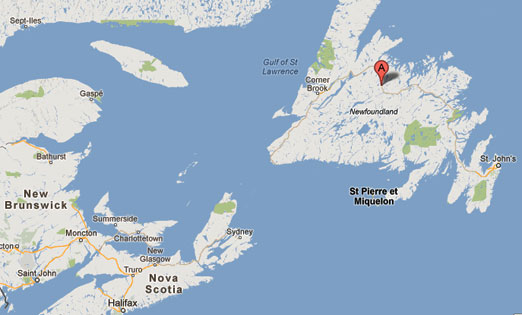
Strange “frozen waves” near the second crater in 2-foot-thick ice, this one at Powderhorn Lake, photogaphed by cabin owner Peter Butler on Sunday, March 10, 2013.Dawes Pond and Powerhorn Lake are about four miles apart at the Google map pointer near Badger, Newfoundland, Canada.
March 13, 2013 Dawes Pond and Powderhorn Lake, Badger, central Newfoundland, Canada - Two mysterious ice craters surrounded by odd, rising ice patterns that resemble frozen waves have been reported by cabin owners living about four miles apart, one on Dawes Pond and the second on Powderhorn Lake - both near Badger, Newfoundland, Canada.
Click here to subscribe and get instant access to read this report.
Click here to check your existing subscription status.
“Once we put the (Hobart, Tasmania) fire out, we kind of walked through the fire and tried to find something. We thought a flare or something might have landed there, but we could not find any (flare) or cause.”
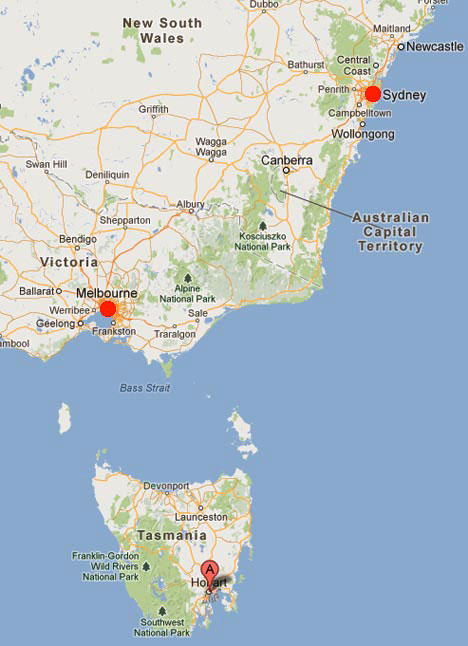
March 10, 2013 Hobart, Tasmania - Early Saturday morning, March 2, 2013, something happened on a dry grass hill in Hobart, Tasmania, that caused a localized fire shown in an Australian Broadcasting Corporation News photo below. Even though there is a strict ban on fireworks in Tasmania because of the fire hazard in their 2013 hot, summer drought, officials speculated the cause was somebody's fireworks. But not confirmed.
Click here to subscribe and get instant access to read this report.
Click here to check your existing subscription status.