
Honey Bee Deaths Higher Again in 2012-2013 Winter: One-Third of American Colonies Died Out.

“We're getting closer and closer to the point where we don't have enough bees in this country to meet pollination demands.”

- Dennis vanEngelsdorp, Ph.D., Entomologist, Univ. of Maryland
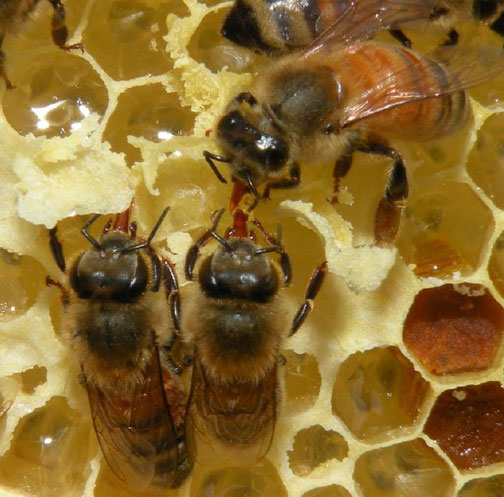
 Honey bees image by Jessica Lawrence, Eurofins Agroscience Services, Bugwood.org.
Honey bees image by Jessica Lawrence, Eurofins Agroscience Services, Bugwood.org.

Neonicotinoid Clothianidin Pesticide and Honey Bees:  “Among the neonicotinoids, clothianidin is among those most toxic for honey bees; and this combined with its systemic movement in plants has produced a troubling mix of scientific results pointing to its potential risk for honey bees through current agricultural practices. Our own research indicates that systemic pesticides occur in pollen and nectar in much greater quantities than has been previously thought, and that interactions among pesticides occurs often and should be of wide concern.”

- James Frazier, Ph.D., Prof of Entomology, Penn State College of Agricultural Sciences


May 31, 2013  Niwot, Colorado - In early May 2013, the U. S. Department of Agriculture, apiary scientists and beekeepers all confirmed that the deaths and disappearances of honey bees in the United States in the winter of 2012 to 2013 rose again to at least one-third of all honey bee colonies.


 

Click here to subscribe and get instant access to read this report.

Click here to check your existing subscription status.

Existing members, login below:

MERS Cases and Death Toll Continue to Rise

Saudi Arabia health officials and the World Health Organization reported on Thursday, May 30, 2013, that three more people there have died today after contracting the MERS coronavirus. Since March at least 50 people in Saudi Arabia, the United Arab Emirates, Tunisia, Jordan, Qatar, France, Germany and the United Kingdom have been infected by MERS and 30 have died. Image © 2013 by CBS.

— “The MERS coronavirus is a threat to the entire world.”

- Margaret Chan, M. D., Dir.-Gen., W.H.O., May 28, 2013

— “This is the first time health care workers have been diagnosed with MERS infection after exposure to patients.”

- World Health Organization, May 15, 2013

— “Of most concern is the fact that the different clusters of MERS seen in multiple countries increasingly supports the hypothesis that when there is close human contact, this MERS coronavirus can transmit from person to person.”

- Keiji Fukuda, Asst. Dir.-General, W.H.O.

Photomicrograph of new MERS-CoV coronavirus (yellow) that first emerged from the Middle East, but with modern air travel has spread to Europe. A second patient in Paris, France, was hospitalized this week infected by MERS-CoV. Image credit: NIAID/RML. See:  W. H. O.

May 31, 2013  Chicago, Illinois - Last week the World Health Organization (W.H.O.) reported that a  nurse and two health care workers in Saudi Arabia were infected after treating patients with MERS, Middle East Respiratory Syndrome, a name suggested in the May 15, 2013, Journal of Virology by a Coronavirus Study Group. A WHO spokesperson told reporters on May 15th, “This is the first time health care workers have been diagnosed with MERS infection after exposure to patients.”


Click here to subscribe and get instant access to read this report.

Click here to check your existing subscription status.

Existing members, login below:

Part 1: Army/CIA Unit Studied the Real UFO Blue Book Cases

“In 1946-1947, the United States had a scientific mission to Antarctica under Admiral Byrd and we had military interaction there with aliens and their saucer craft, like a mini-war. We lost all of our aircraft.”

- “Stein,” Former Army/CIA UFO Analyst

- Update:  May 5, 2013 - On Friday, May 3, 2013, at the Citizen Hearing On Disclosure at the National Press Club in Washington, D. C., the brief videotaped interview with “Anonymous” is the same “Kewper” that I interviewed in May to June 1998 over some sixteen hours of phone and face-to-face audiotapes. “Anonymous” and “Kewper” are also the same “Stein” in this 20-part Earthfiles series. “Anonymous Kewper Stein” is very ill and wanted to finally put his face to his firsthand account he gave me and was threatened about because he described for me in great detail his CIA work on extraterrestrial matters in the late 1950s.

Original Earthfiles 20-part Interview with Former Army/CIA UFO Analyst based on 1998 transcripts first released by Linda Moulton Howe beginning August 27, 2008,  Albuquerque, New Mexico - Ten years ago in April 1998, I received a phone call from a California resident who said he was an acquaintance of a man whose father-in-law had worked for the Central Intelligence Agency in the late 1950s and his work included E. T. and UFO investigations. The caller thought I should talk with the son-in-law to see if  I could speak with the then 62-year-old father-in-law living in the southeastern United States whose health was deteriorating.


Click here to subscribe and get instant access to read this report.

Click here to check your existing subscription status.

Existing members, login below:

Part 4: Taxonomy of Extraterrestrial Biological Entities (EBEs)

“Mr. President, the five species are called Ebens, Archquloids, Quadloids, Heplaloids and Trantaloids. These names were given to the alien species by the intelligence community, specifically MJ-5.  The Ebens are friendly; the Trantaloids are the dangerous ones.”

- From alleged transcript of classified tape recording made at Camp David, Maryland, during a presidential briefing for then-President Ronald Reagan, March 6 - 8, 1981, regarding the subject of Unidentified Flying Objects and Extraterrestrial Visitation to Earth. Briefing by then-CIA Director William Casey.


Return to Part 1

April 5, 2013  Albuquerque, New Mexico - Continuing with taxonomy and third listed Alien Species in RELEASE 27a - Reagan Briefing, described as a “Transcript of classified tape recording made at Camp David, Maryland, during a presidential briefing regarding the subject of UNIDENTIFIED FLYING OBJECTS and EXTRATERRESTRIAL VISITATION of Earth. President RONALD REAGAN was present. The recording was made between March 6 and 8, 1981.”


Click here to subscribe and get instant access to read this report.

Click here to check your existing subscription status.

Existing members, login below:

Part 1: 12,000-Year-Old Gobekli Tepe – Is It Linked to the Star Deneb in the Cygnus Constellation?

“What was so important to these early people that they gathered to build (and bury) the stone rings? The gulf that separates us from Gobekli Tepe's builders is almost unimaginable.”

- Smithsonian Reporter Andrew Curry

“If you start looking into the religious ideas of cultures and indigenous civilizations, you'll find that the star Deneb, Cygnus constellation, in the Milky Way's Dark Rift was seen as a point of entry and exit into the sky world. It was seen as this is where the souls came from and this is where the souls return to in death.”

- Andrew Collins, Author, The Cygnus Mystery © 2006/2007


March 29, 2013   Gobekli Tepe 8 miles northeast of Sanliurfa, Turkey-

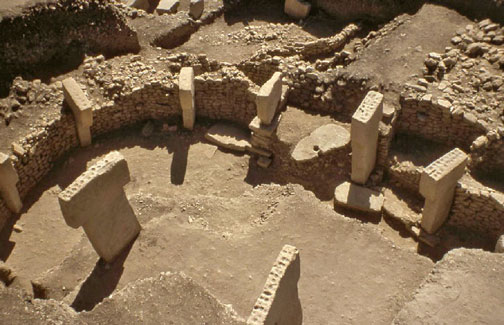
12,000-year-old circles of limestone pillars each weighing from 10 to 20 metric tons or more have been excavated in Gobekli Tepe, Turkey, about 9 miles (15 km) northeast of Sanliurfa, formerly known as Urfa or Edessa. More than twice the age of Mesopotamia,  40 standing T-shaped columns have so far been revealed in four circles between 30 feet  and 98 feet (10 to 30 meters) in diameter. Ground-penetrating radar indicates there  are still 250 more pillars buried in 16 circles extending over another 22 acres of the 30-acre Neolithic site. Image © 2008 by Haldun Aydingun.
12,000-year-old circles of limestone pillars each weighing from 10 to 20 metric tons or more have been excavated in Gobekli Tepe, Turkey, about 9 miles (15 km) northeast of Sanliurfa, formerly known as Urfa or Edessa. More than twice the age of Mesopotamia, 40 standing T-shaped columns have so far been revealed in four circles between 30 feet and 98 feet (10 to 30 meters) in diameter. Ground-penetrating radar indicates there are still 250 more pillars buried in 16 circles extending over another 22 acres of the 30-acre Neolithic site. Image © 2008 by Haldun Aydingun.


Click here to subscribe and get instant access to read this report.

Click here to check your existing subscription status.

Existing members, login below:

Part 2: 12,000-Year-Old Gobekli Tepe – Was It A Soul Recycling Machine Linked to Deneb in the Cygnus Constellation?

“Gobekli Tepe is a place of death; a place of re-birth. ... people who would enter into those enclosures ... and stand in between those two monoliths ... would quite literally be then projected out into the sky.”

- Andrew Collins, Author, The Cygnus Mystery

Return to Part 1.

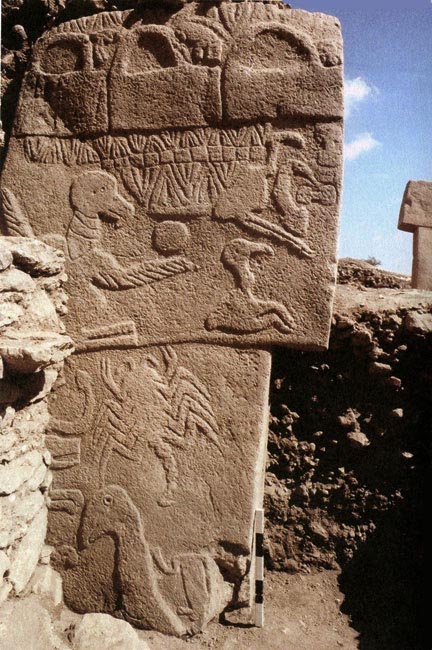
March 29, 2013   Gobekli Tepe 8 miles northeast of Sanliurfa, Turkey - Even though Gobekli Tepe is carbon dated to 12,000 years ago, there is one excavated stone pillar that has what looks like a bird with outstretched wings and a circular object that provokes comparison to the shen symbol of Egypt seven thousand years later.

12,000-year-old carved limestone pillar of layered symbols at Gobekli Tepe excavation. Photo by Klaus Schmidt, Ph.D.
12,000-year-old carved limestone pillar of layered symbols atGobekli Tepe excavation. Photo by Klaus Schmidt, Ph.D.


Click here to subscribe and get instant access to read this report.

Click here to check your existing subscription status.

Existing members, login below:

GMO Herbicides Threaten Monarch Butterfly Migration

— “Less than three acres of trees in Mexico were occupied by Monarch butterflies this winter - about 1/20th of what it has been in the past....The scale of the loss of habitat is so big that unless we compensate for it in some way, the Monarch population will decline to the point where it will disappear.”

- Chip Taylor, Ph.D., Prof. of Biology, Univ. of Kansas; Founder and Director of Monarch Watch, Lawrence, Kansas


The Monarch butterfly is famous for its southward migration and northward return in summer from Canada to Mexico and Baja California which spans the life of three to four generations of the butterfly.
Female Monarchs have darker veins on their wings. Photo © by Kenneth Dwain Harrelson. Male Monarchs have a spot called the androconium in the center of each hind wing. Photo © 2007 by Derek Ramsey.


March 28, 2013 Lawrence, Kansas -  In the 1970s, Monsanto began producing the herbicide glyphosate, a broad leaf and grass weed killer called Roundup. Farmers liked it because it would kill many different types of weeds. Then Monsanto came up with genetically engineered corn and soybean crops that had their DNA altered to resist glyphosate. Farmers could now spray glyphosate everywhere without killing their corn and soybean crops. By 2007, glyphosate was the most used herbicide in United States agriculture. But what came next were “Superweeds” resistant to glyphosate. Monsanto scientists told farmers to simply apply more glyphosate.


Click here to subscribe and get instant access to read this report.

Click here to check your existing subscription status.

Existing members, login below:

EARTHFILES