
Environmental Update April 16, 2000

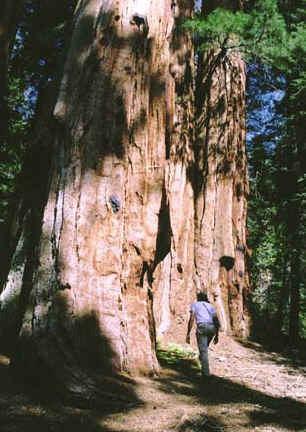
Giant California Sequoias are the largest living organism on the earth today. Some are more than 3000 years old, rise up to 300 feet tall, and measure 100 feet around the base. Photograph courtesy Sierra Club.

April 16, 2000  Washington, D. C. - This past week, President Bill Clinton declared a large section of the Sequoia National Forest in California to be a "national monument" in order to permanently preserve the giant redwood trees. The President used his executive authority under the 1906 Antiquities Act which allows U. S. Presidents to safeguard objects of historic or scientific interest without going to Congress.


Click here to subscribe and get instant access to read this report.

Click here to check your existing subscription status.

Existing members, login below:

Secret Radar Stations in New Mexico, Part 1

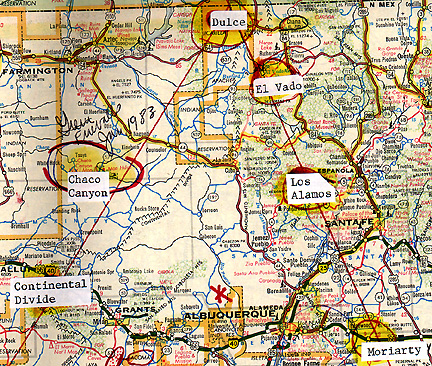
A triangle of sensitive geographic areas and three secret experimental microwave radar stations. Construction begun in late 1947 of El Vado (AFS-P8), Moriarty (AFS-P7), and Continental Divide (AFS-P51). The three radar stations were part of the U. S. Aircraft Control and Warning (AC&W) system that also became known as LASHUP. One of El Vado's specific missions was to protect the Los Alamos Laboratory and the Atomic Energy Commission's atomic bomb production at Los Alamos and Sandia Base.

April 2, 2000  Santa Fe, New Mexico - The New Mexico legislature is in session and in February 2000 State Representative J. Andrew Kissner (Las Cruces, Dona Ana County) was successful in having a once-secret experimental microwave radar station at El Vado in Rio Arriba County north of Los Alamos added to the New Mexico State Historical Register. The importance of the El Vado radar site is underscored by the fact that its construction was specifically authorized by President Harry S. Truman himself.


Click here to subscribe and get instant access to read this report.

Click here to check your existing subscription status.

Existing members, login below:

Secret Radar Stations in New Mexico, Part 2

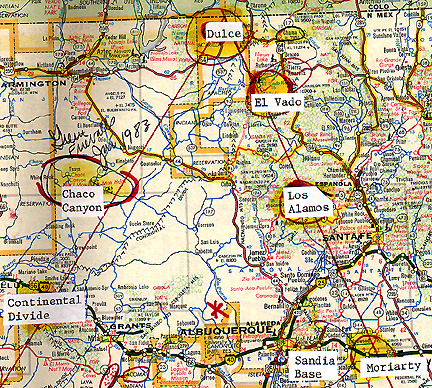
 A triangle of sensitive geographic areas and three secret experimental microwave radar stations. Construction begun in late 1947 of El Vado (AFS-P8), Moriarty (AFS-P7), and Continental Divide (AFS-P51). The three radar stations were part of the U. S. Aircraft Control and Warning (AC&W) system that also became known as LASHUP. One of El Vado's specific missions was to protect the Los Alamos Laboratory and the Atomic Energy Commission's atomic bomb production at Los Alamos and Sandia Base.
A triangle of sensitive geographic areas and three secret experimental microwave radar stations. Construction begun in late 1947 of El Vado (AFS-P8), Moriarty (AFS-P7), and Continental Divide (AFS-P51). The three radar stations were part of the U. S. Aircraft Control and Warning (AC&W) system that also became known as LASHUP. One of El Vado's specific missions was to protect the Los Alamos Laboratory and the Atomic Energy Commission's atomic bomb production at Los Alamos and Sandia Base.


Click here to subscribe and get instant access to read this report.

Click here to check your existing subscription status.

Existing members, login below:

Update – Mysterious Fires Southeast of Scott, Arkansas

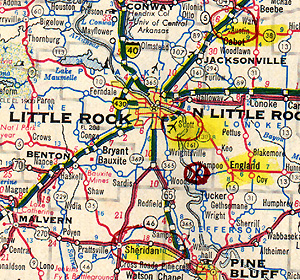
Red X marks area of mysterious fires at the intersection of Lonoke, Pulaski and Jefferson Counties in Arkansas, first reported to 911 by the Little Rock Airport and a Scott resident around 11:20 PM CST on Thursday, March 9, 2000.

March 16, 2000  Scott, Arkansas - The mystery of unexplained fires about 25 miles southeast of Little Rock, Arkansas might actually be related to a fiery bolide that apparently came down and evaporated north of Austin around 8:30 PM CST, March 9th. I interviewed one eyewitness from Cabot, Arkansas today who wishes to remain anonymous, but told me, "It was 8:25 p.m. We were on Stagecoach Road and Highway 38 outside Old Austin. We started driving down the road heading home and I looked over at my husband and right there to his left, I could see out of nowhere running parallel with us on the road was what we thought at first was a small airplane on fire."


Click here to subscribe and get instant access to read this report.

Click here to check your existing subscription status.

Existing members, login below:

Environmental Updates and Mysterious Fires Near Scott, Arkansas

1999-2000 Warmest Winter On Record

Winter for Philadelphia this year was a few cold, snowy days at the end of January into February. Before then and since, it has been unusually warm. And yesterday on March 11th, big, booming thunderstorms with lightning and heavy rain roiled around here most of the day through last night.


Click here to subscribe and get instant access to read this report.

Click here to check your existing subscription status.

Existing members, login below:

Is 433 Eros Asteroid Younger Than Expected?

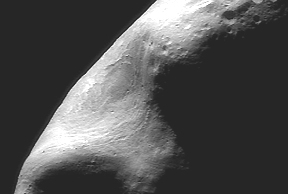
February 15, 2000 photograph while the NEAR satellite was passing directly over the large gouge "saddle" that is surprisingly smooth and free of craters. Detail down to 120 feet (35 meters) across. Narrow parallel troughs closely follow the shape of the saddle gouge. Photograph courtesy Johns Hopkins University Applied Physics Laboratory, Laurel, Maryland.

February 27, 2000  Laurel, Maryland - A human machine is orbiting an asteroid for the first time in known human history. It's a NASA satellite called NEAR for Near Earth Asteroid Rendezvous. NEAR moved into orbit around an asteroid called 433 Eros on February 14th. At first the NEAR satellite was photographing at a range of 210 miles. But this past week on February 23rd, NEAR moved into about 130 miles from Eros. The satellite will keep getting closer to the asteroid over the next 12 months until its mission is completed in February 2001.


Click here to subscribe and get instant access to read this report.

Click here to check your existing subscription status.

Existing members, login below:

New Energy Patent – Hydrogen Gas from Algae

"I guess it's the equivalent of striking oil. It was enormously exciting. It was unbelievable."

- Tasios Melis, Ph.D.
Plant and Microbial Biology
University of California, Berkeley

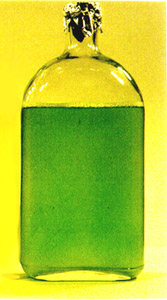
Beaker of Chlamydomonas reinhardtii algae culture which produces hydrogen gas in labs at University of California, Berkeley and National Renewable Energy Laboratory in Golden, Colorado. Photograph courtesy University of California, Berkeley, January 2000.

February 25, 2000 Berkeley, California - The journal, Plant Physiology, reported in February 2000 that for the first time scientists at the University of California, Berkeley and National Renewable Energy Laboratory (NREL) in Golden, Colorado, have been able to trigger a metabolic switch in algae to turn sunlight into large quantities of hydrogen gas. A joint patent on this new hydrogen production technique from plant photosynthesis has been filed by the two institutions.


Click here to subscribe and get instant access to read this report.

Click here to check your existing subscription status.

Existing members, login below:

433 Eros, Orbiting An Asteroid Up Close

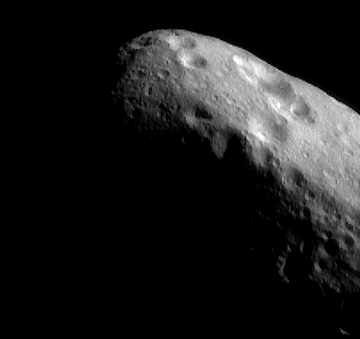
Near Earth Asteroid Rendezvous (NEAR) satellite photographs here and below of an asteroid called 433 Eros. NEAR moved into orbit around the 25 mile long asteroid on February 14, 2000 and took the first images from a range of 210 miles (330 km) above the asteroid's surface. Eros is about a hundred million miles from Earth in the asteroid belt between Earth and Mars. Photographs courtesy NASA and Applied Physics Laboratory, Johns Hopkins University, Baltimore, Maryland.

February 16, 2000  Baltimore, Maryland - It looks a bit like a 25 mile long, five mile wide potato. In one photo, it even resembles a Dutch shoe. Called 433 Eros, it's made out of iron and magnesium-bearing silicates and is now the focus of a NASA satellite called NEAR, Near Earth Asteroid Rendezvous. NEAR moved into orbit around Eros on February 14 and will stay there for the next year. Eros is one of the biggest asteroids in our Solar System circling between the earth and Mars. It's almost twice the size of Manhattan, measuring about 25 miles long and nearly five miles wide.


Click here to subscribe and get instant access to read this report.

Click here to check your existing subscription status.

Existing members, login below:

Microwaves and Cell Phones – An Update

February 5, 2000 Christ Church, New Zealand - Since my January 30th radio and Earthfiles reports about the microwave research of Neil Cherry, Ph.D., Biophysicist at Lincoln University in Christ Church, New Zealand, I have received many questions from viewers and listeners. Dr. Cherry considers the proliferation of cell phones, microwave towers and microwave pollution to be a serious contributor to cancer, brain tumors and increasing neurological problems among the human population. Several thousand more microwave towers are expected to be built in the United States in the next few years. The following are a series of audience questions and Dr. Cherry's responses this week.


Click here to subscribe and get instant access to read this report.

Click here to check your existing subscription status.

Existing members, login below:

More Bans on Cell Phone Use by Drivers

Microwave Tower.
Microwave Tower.

January 30, 2000 Philadelphia, Pennsylvania - First an Ohio town banned cell phone use by drivers. Now, the borough of Conshohocken west of Philadelphia has become the second community in Pennsylvania to prohibit motor vehicle drivers from using cell phones while driving. Pennsylvania's governor is even considering a legislative proposal to ban cell phone use by drivers throughout the state. Recently a 2-year-old girl was killed in a collision caused by a driver dialing a cell phone. Another child was recently killed by a distracted cell phone user. Conshohocken Police Chief James Dougherty added, "We've had problems with people driving through town talking on cell phones where they've almost hit people. They're not paying attention."


Click here to subscribe and get instant access to read this report.

Click here to check your existing subscription status.

Existing members, login below:

EARTHFILES