First Ever Dinosaur Tail Tissue Found Covered with Feathers

“The more we see these feathered dinosaurs and how widespread the feathers are, things like a scaly velociraptor seem less and less likely and they've become a lot more bird-like in the overall view.”

- Ryan McKellar, Ph.D., Paleontologist, Royal Saskatchewan Museum, Canada

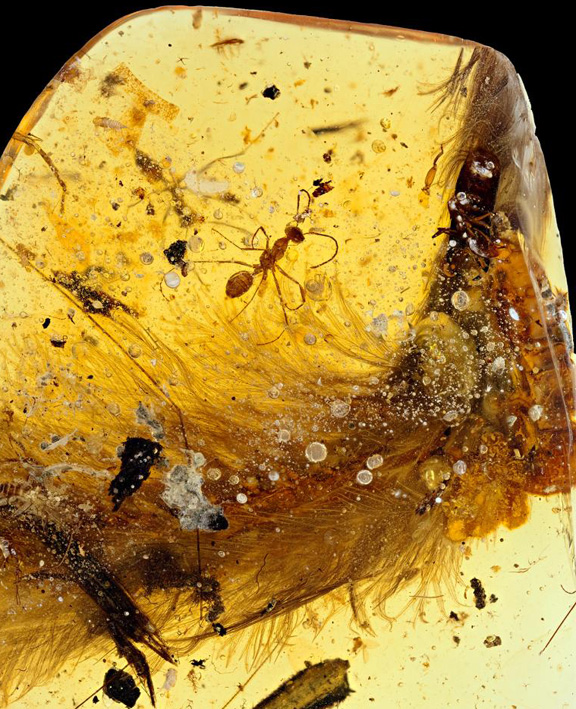
Feathers on actual tail skeletal tissue of a young coelurosaurian dinosaur. Half the tail was trapped in amber 99 million years ago. This is the first discovery of dinosaur feathers on tissue and reinforces the mind-bending evidence that many dinosaurs had feathers instead of reptilian scales. Image by Royal Saskatchewan Museum/R. C. McKellar.


Click here to subscribe and get instant access to read this report.

Click here to check your existing subscription status.

Existing members, login below:
Gobekli Tepe Pillars Etched On Bone Found At 12,000-Year-Old Site

“Even though the etched bone plaque bears no holes — which indicates it was not used as a pendant — it could still have functioned as an amulet or talisman ... imbuing the bone plaque with a mystical quality in order to connect it with the Gobekli site.”

- Andrew Collins, Gobekli researcher and author, 2015


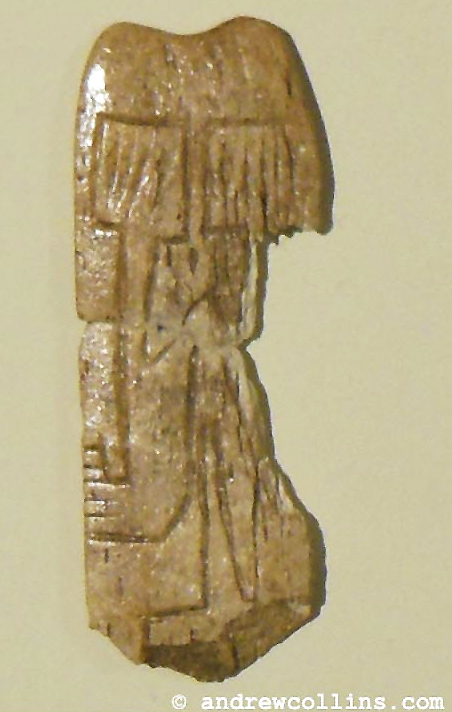
Bone etching of what appears to be Gobekli Tepe T-shaped pillars with a humanoid holding its hands around one of the tall pillars staring outward with large, black eyes, a long triangular face and small mouth. The existence of this "etched bone plaque"  currently on display at the Sanliurfa Museum in southern Turkey near Gobekli Tepe  was introduced by researcher and author Andrew Collins in September 17, 2015, Ancient Origins, and on November 7, 2015, at Queen Mary University in London. The etched bone was first noticed in the museum by Matthew Smith, a British  telecommunications consultant from the Middle East's Qatar,  who was visiting the Gobekli Tepe archaeological site.
Bone etching of what appears to be Gobekli Tepe T-shaped pillars with a humanoid holding its hands around one of the tall pillars staring outward with large, black eyes, a long triangular face and small mouth. The existence of this "etched bone plaque" currently on display at the Sanliurfa Museum in southern Turkey near Gobekli Tepe was introduced by researcher and author Andrew Collins in September 17, 2015, Ancient Origins, and on November 7, 2015, at Queen Mary University in London. The etched bone was first noticed in the museum by Matthew Smith, a British telecommunications consultant from the Middle East's Qatar, who was visiting the Gobekli Tepe archaeological site.


Click here to subscribe and get instant access to read this report.

Click here to check your existing subscription status.

Existing members, login below:

Part 2: Self-Activating Intelligence of Dragonfly and James Webb Telescopes

“As soon as a supernova is detected, it sends a signal to a bunch of telescopes and they will  — sometimes within seconds —  move to that position and start taking images without a human ever being in the middle.”

- Pieter van Dokkum, Ph.D., Prof. of Astronomy, Yale University

Dragonfly telescope in Cloudcroft, NM, thinks for itself while it hunts for dark matter galaxies. Image by Pieter van Dokkum, Ph.D., Astronomer, Yale University.

Return to Part 1:

September 30, 2016 New Haven, Connecticut - One of the most anticipated astronomy breakthroughs since the Hubble and Spitzer Space Telescopes is expected to come from the James Webb Space Telescope now scheduled for launch in October 2018. The JWST will have the Earth's best resolution and sensitivity ranging from long-wavelength visible light (orange-red), through near-infrared to the mid-infrared. It's theme is to “see first light,” meaning as far back in time to the beginning of this universe as possible.


Click here to subscribe and get instant access to read this report.

Click here to check your existing subscription status.

Existing members, login below:
More Evidence of Ancient Thermonuclear Explosions On Mars At American Inst. of Astronautics and Aeronautics 2016 Space Conference

John E. Brandenburg, Ph.D., plasma physicist from Morningstar Applied Physics LLC, Madison, Wisconsin, will be among NASA managers and astronauts along with Boeing, Northrop Grumman and other aerospace managers to present a technical paper for the American Institute of Astronautics and Aeronautics (AIAA) 2016 Space Conference in Long Beach, Calif. about accumulating data that support his hypothesis that there were two hydrogen bomb explosions in the air over Cydonia Mensae and Galaxias Chaos in the Martian northern hemisphere eons ago.

“We have evidence on Mars of two big nuclear explosion at two sites and if you look at the map, those sites are directly upwind of Cydonia Mensae and Galaxias Chaos — meaning they were targeted on those areas.”

- John E. Brandenburg, Ph.D., Morningstar Applied Physics

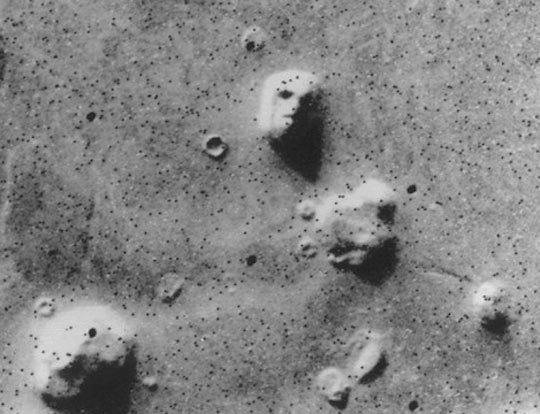
"Face On Mars" photograph taken by the Viking 1 orbiter and released by NASA/JPL on July 25, 1976. The large mesa sculptured as a face is 1.2 miles (2 km) long in Cydonia Mensae, at 40.75° north latitude and 9.46° west longitude. When the image was originally acquired, Viking chief scientist Gerry Soffen dismissed the “Face on Mars” in image 035A72 as a “trick of light and shadow.” However, other computer analysts and plasma physicist John E. Brandenburg, Ph.D., say the 5-sided pyramid and other structures not far from the sculpted face (below) are evidence of an ancient civilization in Cydonia Mensae and Galaxias Chaos to the east where two atmospheric hydrogen bombs left trinitite, xenon-129, Argon 40 and krypton evidence that is now being presented at serious science conferences by Dr. Brandenburg. The dark spots all over this original 1976 Viking 1 images are attributed to “static digital dropouts.”

August 26, 2016 Madison, Wisconsin - In 2015, a newly published book by plasma physicist John Brandenburg, Ph.D., was entitled,“Death On Mars: The Discovery of A Planetary Nuclear Massacre.” Sixty-three-year-old John Brandenburg received his Ph.D. in Theoretical Plasma Physics at the University of California-Davis extension campus at Lawrence Livermore National Laboratory in Livermore, California in 1981. His Ph.D. thesis was about magnetic confinement of plasmas for controlled nuclear fusion. For his book, he analyzed United States 1976 Viking spacecraft data about the Martian atmosphere as well as two Viking images of the so-called “Face on Mars,” that stares upward from a Martian highland in the northern hemisphere called Cydonia Mensae.


Click here to subscribe and get instant access to read this report.

Click here to check your existing subscription status.

Existing members, login below:
Part 2: Earthfiles Special Report with U. K. Electrical Engineer Winston Keech on PHENOMENON Radio

Live KGRA web radio Thursday nights - 5 -7 PM Pacific / 8 - 10 PM Eastern.

Interview continues from Part 1:

Interview with mp3 audio and transcript of exclusive 2 hours on Aug. 11, 2016, with John Burroughs, Linda Moulton Howe and Winston Keech on PHENOMENON Radio, co-hosted by John and Linda weekly for Thursday evening broadcasts on db KGRA.

U. K. electrical and mechanical engineer Winston Keech — who owns The Power Collective in Harrogate, North Yorkshire, England.


Click here to subscribe and get instant access to read this report.

Click here to check your existing subscription status.

Existing members, login below:
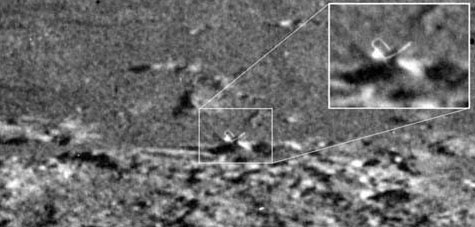
NASA Photo Lab Tech Saw Negative of Alien “Object” On Moon Blacked Out.

“I saw the negative of the alien object on the moon opaqued out with ink-like substance that was thick and black.”

- Donna Hare, former Philco-Ford and NASA photo lab technician, Austin, TX

“What I think Donna Hare is referring to is Photo Lab techs taking the original negatives, making positive prints from them and then painting out the unmentionables (UFOs), and then making copy negatives for public distribution from those altered prints.

- Keith Laney, digital imaging specialist and web producer of Lunar and Martian Anomalies Files

Donna Hare, a former Philco-Ford and NASA Photo Lab tech, identifies this strange object on the moon photographed during Apollo Mission 10, on NASA Frame No. AS10-32-4822. Donna says she watched a female NASA employee in Building 8, NASA Manned Space Center in Clear Lake, Texas, near Houston (later Johnson Space Center), use thick, black ink to “paint out” the object on a negative. Graphic by Keith Laney from original positive print provided by retired NASA human test engineer Ken Johnston.

July 2, 2016 Austin, Texas - Another eyewitness to the NASA Photo Lab painting and airbrushing evidence of an alien presence on the moon and Earth is Donna Hare, 70. She was born in Houston, Texas, in 1945. After graduating from Jessie Jones High School in 1965, she applied for work in the growing aerospace industry around the Apollo program. In 1967, she was hired by Philco-Ford Aerospace in Houston to work as a technical publications illustrator and designer. So this was off-site sub-contractor work for NASA over the next fifteen years, working on manuals for astronauts in what became the Johnson Space Center (JSC).


Click here to subscribe and get instant access to read this report.

Click here to check your existing subscription status.

Existing members, login below:

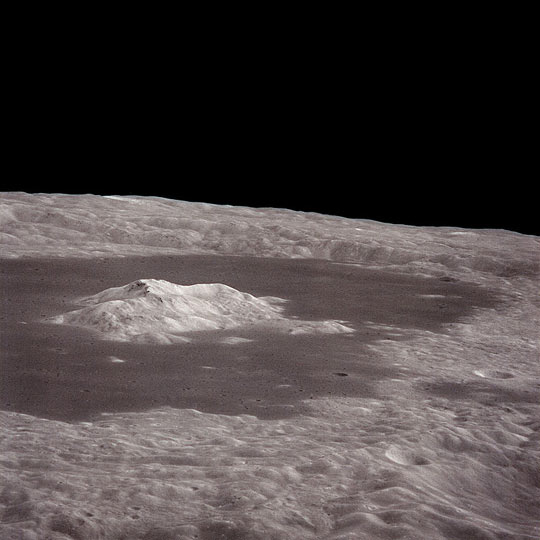
Former NASA Engineer Says 5 Structured Domes in Moon Crater Photo Blacked Out

“We’re approaching Crater Tsiolkovskiy and the sun angle was such that about half of the crater was in shadow. And in the shadow portion of the crater, there are five illuminated domes.”

- Ken Johnston, D. Th., former Marine and NASA aerospace human test engineer, NASA Manned Space Center, 1966 - 1972, Clear Lake, TX

July 1, 2016 Albuquerque, New Mexico - On June 7, 2016, the Albuquerque Journal in New Mexico reported that “former National Aeronautics and Space Administration, or NASA, consultant pilot Ken Johnston today says photos and films from Apollo missions were doctored” to paint out evidence of extraterrestrial structures and activities on the moon. To date, NASA has always denied manipulating images to hide E. T.s/UFOs.

The article also said The Roswell Daily Record has announced that Dr. Ken Johnston, who has a 1980 theology doctorate from the Reformed Baptist Seminary in Denver, Colorado, has given digital copies of his three large binders of original NASA photographs to the International UFO Museum and Research Center in Roswell.

Fifty years ago — after four years in the Marines — in 1966, Ken Johnston began working as a human test engineer for Apollo mission efforts by the Grumman Aerospace Corporation in Clear Lake, Texas, near Houston, a region that would evolve to the NASA Johnson Space Center. It was during the Apollo 14 flight that launched on January 31, 1971, and returned to Earth on February 6, 1971, that Ken Johnston had a rude awakening from his NASA boss at the time, Thornton Page, Ph.D., astronomer and member of the Robertson Panel in January 1953 that was organized by the Central Intelligence Agency to investigate UFOs and their implications for national security.


Click here to subscribe and get instant access to read this report.

Click here to check your existing subscription status.

Existing members, login below:
EARTHFILES