
Large Hadron Collider: Looking for the “God Particle” and Beyond

“We are absolutely and totally confident that the LHC machine
is perfectly safe, just as we were last year. And I'm not at all worried
about it being destroyed by its own future!”

- Lyndon Evans, Ph.D., Physicist and Manager, LHC Construction

“We’re really confident with the LHC that we’re going to find
the Higgs boson or something similar, which will help to explain what’s
going on in the universe.”

- Steven Goldfarb, Ph.D., LHC Muon Spectrometer, ATLAS Experiment
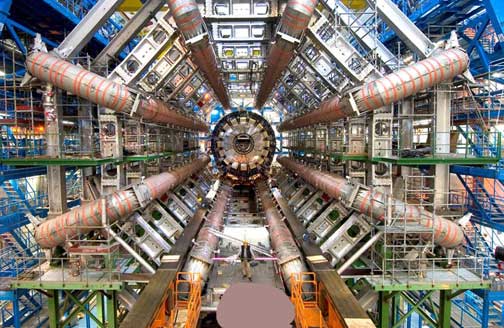
Looking straight down a segment of the 17-mile-long circular  Large Hadron Collider (LHC) accelerator. Image courtesy CERN LHC.
Looking straight down a segment of the 17-mile-long circular Large Hadron Collider (LHC) accelerator. Image courtesy CERN LHC.
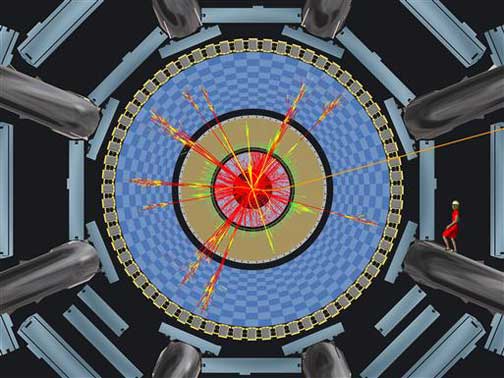
In some theories, microscopic black holes may be produced in particle collisions that occur when very-high-energy cosmic rays hit particles in our atmosphere. These  microscopic-black-holes would decay into ordinary particles in a tiny fraction of a second and  would be very difficult to observe in our atmosphere. The ATLAS Experiment offers the exciting  possibility to study them in the lab (if they exist). The simulated collision event shown is viewed along the beampipe. The event is one in which a microscopic-black-hole was produced  in the collision of two protons (not shown). The microscopic-black-hole decayed  immediately into many particles. The colors of the tracks show different types of particles emerging from the collision (at the center). Computer graphic and actual Large Hadron Collider image below courtesy CERN LHC.
In some theories, microscopic black holes may be produced in particle collisions that occur when very-high-energy cosmic rays hit particles in our atmosphere. These microscopic-black-holes would decay into ordinary particles in a tiny fraction of a second and would be very difficult to observe in our atmosphere. The ATLAS Experiment offers the exciting possibility to study them in the lab (if they exist). The simulated collision event shown is viewed along the beampipe. The event is one in which a microscopic-black-hole was produced in the collision of two protons (not shown). The microscopic-black-hole decayed immediately into many particles. The colors of the tracks show different types of particles emerging from the collision (at the center). Computer graphic and actual Large Hadron Collider image below courtesy CERN LHC.
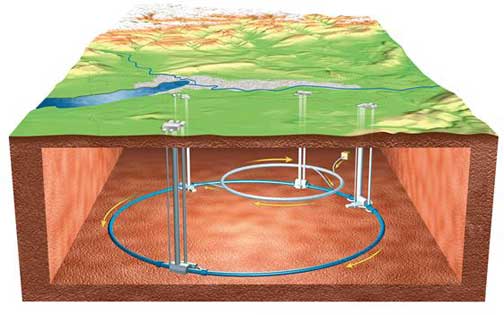
This computer-generated image shows the location of the 17-mile-long (27 km)  Large Hadron Collider (LHC) tunnel (in blue) about 300 feet down on the Swiss-French border. The four main experiments (ATLAS, CMS, ALICE, and LHCb) are located in underground caverns  connected to the surface by 50 meter to 150 meter pits. Part of the pre-acceleration  chain is shown in gray. Illustration courtesy CERN LHC.
This computer-generated image shows the location of the 17-mile-long (27 km) Large Hadron Collider (LHC) tunnel (in blue) about 300 feet down on the Swiss-French border. The four main experiments (ATLAS, CMS, ALICE, and LHCb) are located in underground caverns connected to the surface by 50 meter to 150 meter pits. Part of the pre-acceleration chain is shown in gray. Illustration courtesy CERN LHC.

November 19, 2009  CERN Geneva, Switzerland - Beginning Friday night, November 20, 2009, on the border between Switzerland and France, not far from Geneva, and three hundred feet underground, humans will try again to start producing subatomic energies close to those in the Big Bang. By early Saturday morning, the first beam of particles should be circulating one way around the LHC’s 17-mile-long underground ring. Then a second beam traveling in the opposite direction should start soon after. But the first low-energy collisions won't happen until about a week later.

 

Click here to subscribe and get instant access to read this report.

Click here to check your existing subscription status.

Existing members, login below:

Updated: Is There Life in Europa’s Huge Ocean?

“Probably the best chance of finding current life in our solar system right now would be on Europa.”

- Richard Greenberg, Ph.D., Univ. of Arizona

Click for podcast.

Click for podcast.

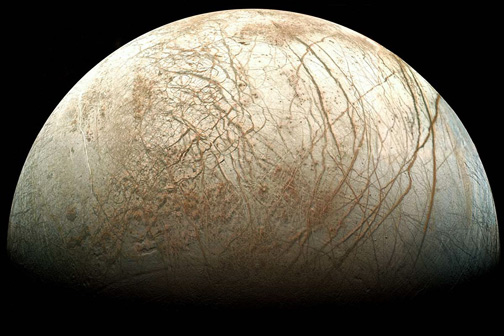
The icy surface of Europa is cracked like an egg from the tug and pull of Jupiter's gravitational stretching. Below the ice is a 100-miles-deep liquid water ocean and new data indicates more oxygen than expected reaches that ocean from the icy surface. Water plus oxygen could mean life there right now. Image from Galileo spacecraft, 1995 - 2003, by JPL, NASA and Ted Stryk.
NASA released this image of Europa as true color of the moon's icy surface full of cracks. The slightly reddish tint of the surface cracks is still a mystery, but the hypothesis is that sulfur compounds are responsible. Image courtesy NASA/JPL.

Updated November 2, 2009, with podcast and Europa book information at end of report from Tucson, Arizona - There is a moon in our solar system that is about the size of Earth's moon, but beneath its icy surface is a liquid water ocean 100 miles deep. That moon is Europa, one of 49 known moons that orbit Jupiter, of which Europa, Io, Ganymede and Callisto are the largest.


Click here to subscribe and get instant access to read this report.

Click here to check your existing subscription status.

Existing members, login below:

How Long Will Our Sun Remain Quiet and Cosmic Rays Increase?

We don’t have records prior to 1874 that give us details about the sun. Compared to the past 130 years, our sun now is unprecedented as far as how slow this Solar Cycle 24 is taking off - or not taking off!”

- David Hathaway, Ph.D., NASA Heliospheric Team Leader


NASA'S Advanced Composition Explorer satellite (ACE) launched August 1997 to study solar particles and galactic cosmic rays. It has nine instruments onboard that helps it track solar wind and galactic cosmic rays from interstellar space beyond the heliosphere. ACE serves as a space weather station while in orbit. ACE can provide a one-hour advance warning of any geomagnetic storms that are caused by coronal mass ejections. Strong solar coronal mass ejections can disrupt radio, TV and telephone communications on Earth. Logo by NASA.


October 30, 2009  Huntsville, Alabama - For twelve years, NASA has had a satellite positioned a million miles in front of Earth with the sun about 92 million miles beyond. Its mission has been to study particles that come near Earth from our sun, the solar system and the galaxy. The satellite is called Advanced Composition Explorer, or ACE, and some of the highly energetic particles ACE has been monitoring are cosmic rays.


Click here to subscribe and get instant access to read this report.

Click here to check your existing subscription status.

Existing members, login below:

Cosmic Rays Reaching Earth At Highest Level in 50 Years

“We think if the tilt of the sun’s solar magnetic fields continue to decline over the next few months or year, the intensity of cosmic rays reaching Earth will go up even more – perhaps from 19% to even 30% more than we have ever observed in the Space Age.”

- Richard Mewaldt, Ph.D., Cal Tech Physicist


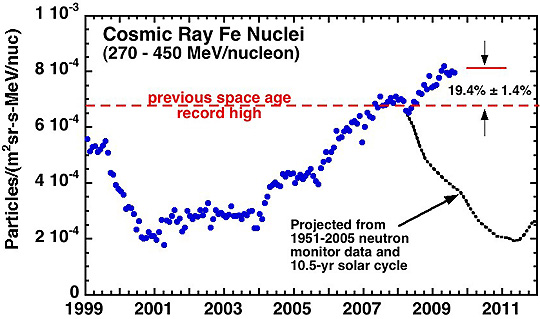
Galactic cosmic ray intensities are 19% higher for all elements. Graphic by Richard Mewaldt, Cal Tech.

October 6, 2009  Pasadena, California - In August 1997, a satellite was launched called the Advanced Composition Explorer (ACE) to “study the particles that come near the Earth from our Sun, from space between the planets and from the Milky Way galaxy beyond our solar system.” The ACE satellite is positioned at “L-1,” a site a million miles in front of the Earth with the sun some 92 million miles beyond.


Click here to subscribe and get instant access to read this report.

Click here to check your existing subscription status.

Existing members, login below:

Former RAF Bentwaters Staff Sgt. James Penniston Recalls Black, Glassy, Triangular Craft, Symbols and Missing Time

“The best way to describe that craft is if you had an onyx stone
that measured 9 feet long and 6 feet high - that's what you would see.”

- Former USAF Staff Sgt. James Penniston

 Click for Earthfiles Podcast.
 Click for Earthfiles Podcast.
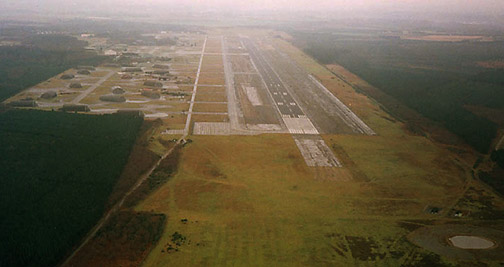
Aerial image of the runway at RAF Woodbridge surrounded by the thick Rendlesham Forest.
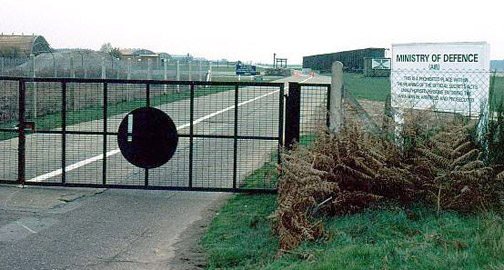
East Gate at RAF Woodbridge, Suffolk County, England.
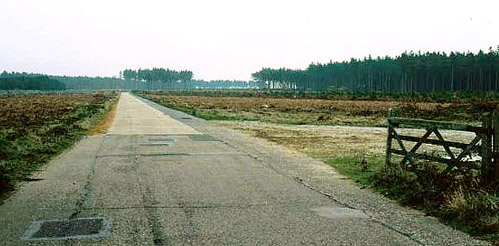
East Gate at RAF Woodbridge open with road and Rendlesham Forest beyond.

September 24, 2009  Freeport, Illinois -  Former RAF Bentwaters Staff Sergeant James W. Penniston was RAF Woodbridge Security Supervisor on December 26, 1980. He was 26-years-old at the time and had been in the U. S. Air Force since 1973 after graduating from Freeport High School in Freeport, Illinois. His RAF Bentwaters Deputy Base Commander was Col. Charles I. Halt.


Click here to subscribe and get instant access to read this report.

Click here to check your existing subscription status.

Existing members, login below:

Former RAF Bentwaters Airman John Burroughs – Was He Taken Into A Craft?

“...Adrian Bustinza said that yes, the light appeared to pull me up inside.
Adrian also told me that he did not fall down. He was knocked down and
something held him to the ground.”

- Former USAF Airman John Burroughs

 Click for Earthfiles Podcast.
 Click for Earthfiles Podcast.
John Burroughs, age 49, in Tempe, Arizona, on October 4, 2008. Image © 2008 by Linda Moulton Howe.

September 24, 2009  Phoenix, Arizona - John Burroughs was born in Bloomington, Illinois in 1960, and joined the U. S. Air Force right after high school graduation. He received orders to go to RAF Bentwaters, England, and arrived in July 1979, about eighteen months before the highly strange encounters with lights, beams and craft in the Rendlesham Forest between RAF Bentwaters and nearby RAF Woodbridge the end of December 1980. During that time, John worked as an Air Force police officer and says nothing strange ever happened until after midnight on December 26, 1980.


Click here to subscribe and get instant access to read this report.

Click here to check your existing subscription status.

Existing members, login below:

Updated – Part 2: RAF Bentwaters Feedback, Another Military Eyewitness Speaks for First Time

“The light in Rendlesham Forest had a dome quality to it
... a strange light ... probably about the size of a football field.”

- Richard Bertolino, former RAF Bentwaters Airman 1st Class

Click for podcast.
Click for podcast.

Updated:  September 17, 2009, comments from former RAF Bentwaters Deputy Base Commander Charles I. Halt:  “I definitely was not out in the forest with Capt. Mike Verano [ on December 26, 1980]. I only knew he was out the next day because several others told me. ...Ray Gulyas (E-4 or E-5, Buck Sgt. or Staff Sgt.) ... somewhere I've seen pictures he took of the ‘landing site’ the morning after [of] the first event.”


Click here to subscribe and get instant access to read this report.

Click here to check your existing subscription status.

Existing members, login below:

China Solar Eclipse Image of “Unidentified Object.”

“During the July 22 total solar eclipse observation, China had discovered
near the sun an unidentified object, it's physical nature remains to be further studied.”

- Ji Haisheng, Dir., Jijinshan Astronomical Observatory, Nanjing, China,
as quoted on September 7, 2009, by U. K. Daily Mail

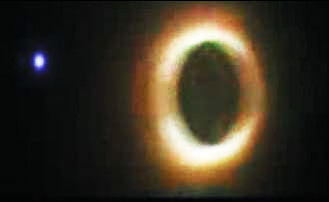
Small white object haloed in blue to left of red-white solar corona during July 22, 2009, total solar eclipse. Image © 2009 by Jijinshan Astronomical Observatory, Nanjing, Jiangsu, China.


September 13, 2009  Nanjing, Jiangsu, China -  Ji Haisheng, Director of the Jijinshan Astronomical Observatory in Nanjing, China, is upset that on September 7, 2009, U. K.'s Daily Mail used his quotes in an article headlined:  “UFO ‘filmed for 40 minutes’ by Chinese scientists during solar eclipse.” Dr. Haisheng told CHINAdaily.com on September 12, “Obviously, there have been misunderstandings. That's false news. I said ‘an unidentified object,’ not ‘an unidentified flying object.’” Dr. Haisheng explained further that the bright spot might be “some coronal activity filmed during the total eclipse” and it could take a year to analyze and identify. Dr. Haisheng confirmed his observatory recorded 40 minutes of the solar corona during the total solar eclipse, not 40 minutes of a UFO.


Click here to subscribe and get instant access to read this report.

Click here to check your existing subscription status.

Existing members, login below:

Part 4: 1980 Bentwaters Lights – Were They Time Travelers?

“They are time travelers. They are us.
... and they are using us like Band-Aids.”

- USAF Staff Sergeant James W. Penniston (Ret.),
Dec. 1980 RAF Bentwaters, from 1994 hypnosis session


Click here to subscribe and get instant access to read this report.

Click here to check your existing subscription status.

Existing members, login below:

EARTHFILES