Click here to subscribe and get instant access to read this report.
Click here to check your existing subscription status.
Existing members, login below:


Reported and Edited by Linda Moulton Howe
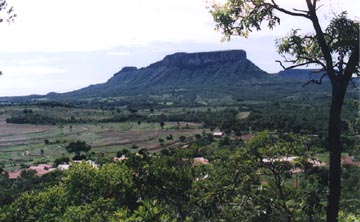
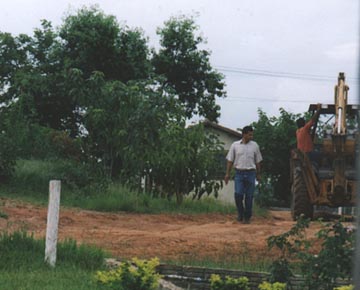
June 21, 2003 Campo Grande, Mato Grosso do Sul, Brazil - On Friday, Corguinho, Brazil farmer Urandir Oliveira traveled to Campo Grande to join with his first wife, Maria do Carmo da Silva, and his attorney, Mr. Danilo Costalunga, in a telephone discussion with Whitley Strieber and me for Dreamland Online and Earthfiles.com. The Portuguese-to-English translation during the interview was provided by Felipe Branco, University of London-trained businessman, who is now an executive in Rocheston Ltd., Milan, Italy, and cattle rancher, Campo Grande, Brazil.
“You have presented us with objects that are well outside the things we have encountered before, outside our experience.”
- Art Johnson, Ph.D., Prof. of Geology, Univ. of Pennsylvania
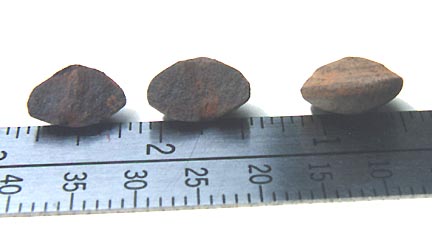
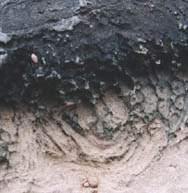
June 6, 2003 Philadelphia, Pennsylvania - Biophysicists W. C. Levengood's observations about the titanium and magnetic quality of the Corguinho, Brazil stones were reinforced by the x-ray diffractometry (XRD) work done May 22-23 at the University of Pennsylvania. Prof. Johnson, whose field is soil analysis, had selected nine objects from my rock trays and collection bags. I also gave him two halves of Stone 2 that Phyllis Budinger had split open. During the first XRD run, he was joined by Prof. Gomaa Omar, an eminent rock expert, and another geologist who specializes in rare earth isotopes. First up was one half of Stone 2, which they called the “button” on the XRD analysis shown below.
Second was a piece of the melted rock that local Corguinho eyewitnesses found in October 2000 after a light came down to the top of a hill and took off again. That rock was arbitrarily labeled “lightening strike” because Dr. Omar said very high temperature had to have been involved.
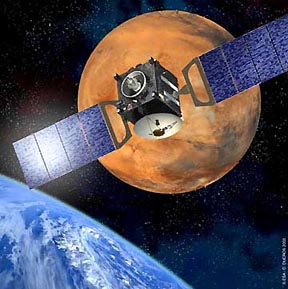
June 2, 2003 Baikonur, Kazakhstan - Today the European Space Agency (ESA) launched its first mission to Mars called "Mars Express" aboard a Russian rocket from Baikonur, Kazakhstan. Attached to the orbiter was Britain's Beagle 2 lander which will land on the surface and look specifically for signs of Martian life. The "robotic geologist" will dig into Mars soil and sample the atmosphere hunting for organic material or methane gas produced by living organisms.

May 14, 2003 Garching, Germany - The Hubble Space Telescope-European Coordinating Facility and European Southern Observatory in Garching, Germany, near Munich, announced in April 2003 that Hubble has discovered what might be the "ashes" from the first stars in this universe. The powerful telescope found significant iron in the light from primordial quasars only 900 million years old. The theory is that the iron is the residue, the ashes, of first generation stars that formed perhaps as early as 200 million years after the Big Bang and then died in supernova explosions that produced all the iron later recycled into the quasars. According to Wolfram Freudling who led the Hubble research, 200 million years for first star births is much earlier than previously thought.