

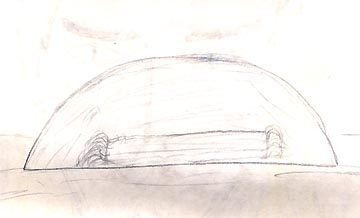
Part 3 – Corguinho, Brazil: Return from the Non-Human Craft on September 18, 2002


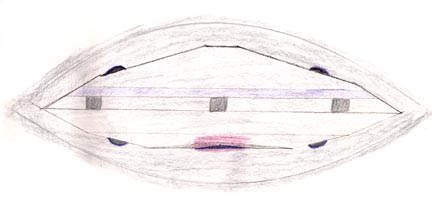
Drawings for Linda Moulton Howe by Urandir Oliveira  on February 9, 2003, of non-human craft, decontamination bubble  and violet-colored transport beam, © 2003 by Earthfiles.com.
Drawings for Linda Moulton Howe by Urandir Oliveira on February 9, 2003, of non-human craft, decontamination bubble and violet-colored transport beam, © 2003 by Earthfiles.com.


February 26, 2003  Corguinho, Mato Grosso do Sul, Brazil - The transport process was reversed, according to Urandir Oliveira, when the tall, blond beings decided to return him on the evening of September 18, 2002, after three days on a second floor room where a large wall screen showed Urandir and many other non-human beings images of Earth's alleged future. During our February 10, 2003, interview about the experience, I asked Urandir if he and the others were in the same room all three days. He answered, "Yes, it's like the walls were endless. I walked, but never reached the walls, so it gave the impression that the room was really big. I explained to him that other people have described "infinite" interiors in non-human craft and have been given information that time and space are some how distorted within the craft. But Urandir did not have such knowledge.

 

Click here to subscribe and get instant access to read this report.

Click here to check your existing subscription status.

Existing members, login below:

Ink Jet Printers That Produce Living Tissues

Ink jet printer modified to contain cells, proteins and other biological molecules,  instead of colored inks. The goal is to pinpoint specific biological units in precise X and Y  coordinates on plastic sheets to grow tissue, in the same manner that ink jet printers distribute dots  of color on paper. Photograph © 2003 by Thomas Boland, Ph.D., Clemson  University, Clemson, South Carolina.
Ink jet printer modified to contain cells, proteins and other biological molecules, instead of colored inks. The goal is to pinpoint specific biological units in precise X and Y coordinates on plastic sheets to grow tissue, in the same manner that ink jet printers distribute dots of color on paper. Photograph © 2003 by Thomas Boland, Ph.D., Clemson University, Clemson, South Carolina.

January 25, 2003  Clemson, South Carolina - According to bioengineer, Thomas Boland, at Clemson University in South Carolina, a future is coming in which ink jet printer technology will provide hospitals with full grown organs for transplant into diseased patients - starting from a flat sheet!


Click here to subscribe and get instant access to read this report.

Click here to check your existing subscription status.

Existing members, login below:

Update on 6,500-Year-Old Astronomical Stone Circle and Megaliths in Nabta, Egypt

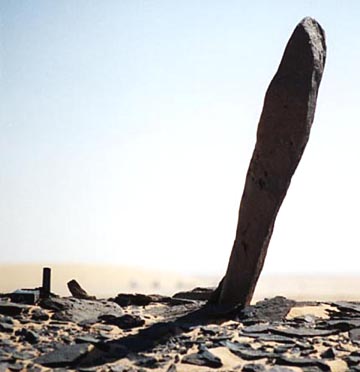
Nabta astronomical stone circle and megaliths discovered and radiocarbon dated by scientists in 1998 to be at least 6,500 years old, the oldest known astronomical alignment of megaliths in the world. Some of the stone slabs are nine feet high and originated miles away from the constructed circle. Photograph courtesy Professors J. M. Malville, Univ. of Colorado, and F. Wendorf, Southern Methodist University.
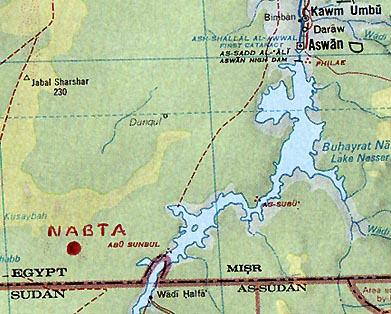
Nabta astronomical stone circle and megaliths are 100 kilometers (62 miles) west of Abu Simbel (Sunbul) in southern Egypt's Sahara Desert far west of the Nile River.

November 2, 2002  Albany, N.Y. - Four years ago in 1998, a team of scientists lead by Fred Wendorf, Ph.D., Anthropology Professor at Southern Methodist University, reported in the science journal, Nature, about the oldest known astronomical stone circle on earth. The stone circle is associated with a series of flat, carved stone structures, six lines of standing and toppled megaliths and two buried megalithic sculptures in southern Egypt's Nabta Playa 100 kilometers (62 miles) west of Abu Simbel. Radiocarbon dating indicated the structures were in 4,500 B. C. sedimentary layers, at least a thousand years older than Stonehenge in England. Nabta Playa is rich in prehistoric remains of the early Holocene age when there was rain and a lake, but no skeletal human remains have ever been found.


Click here to subscribe and get instant access to read this report.

Click here to check your existing subscription status.

Existing members, login below:

Former White House Aide, John Podesta, Says Government Should Open Up UFO Files

White House Chief of Staff, John Podesta, (on right) briefs President Bill Clinton as they walk to the Oval Office in 1999, Washington, D. C. Photograph courtesy White House files.

October 26, 2002  Washington, D. C. - A former Chief of Staff in the Clinton White House met with reporters at the Press Club in Washington, D. C. on Tuesday, October 22, to talk about Area 51 in Nevada and its relationship to UFOs. John Podesta was President Bill Clinton's Chief of Staff, is a visiting professor at the Georgetown University Law Center, and now runs a public relations firm in Washington called PodestaMattoon. Earlier this year he was hired by the State of Nevada to lobby Congress into rejecting using the Yucca Mountain site northwest of Las Vegas as a nuclear waste repository. He was not successful.


Click here to subscribe and get instant access to read this report.

Click here to check your existing subscription status.

Existing members, login below:

63 A.D. Inscription Refers to “Jesus.”

"First appearance in the archaeological record," say experts.

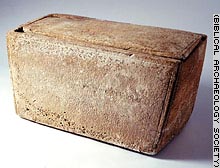
Limestone ossuary dated to A.D. 63 inscribed in Aramaic with the word "Jesus." Photograph courtesy Biblical Archaeology Society.

October 22, 2002  Washington, D. C. - The first and only appearance, so far, of the word “Jesus” inscribed in the archaeological record has been discovered by Andre Lemaire, a French expert in ancient inscriptions. Dated to A.D. 63, the words in Aramaic - the language that Christ and his followers used - are carved into a limestone burial box known as an ossuary: “James, son of Joseph, brother of Jesus.” Lemaire says that ossuary burials - digging up a grave after a year to put the bones into a limestone box - were generally practiced between 20 B. C. and A. D. 70, exactly the time of the earliest Christian efforts in Jerusalem. According to Biblical scholars, the presence of all three famous names is extraordinary. Historic research to date have confirmed that only twenty men with the name “James” in Jerusalem in A.D. 63 would have had a father named Joseph and a brother named Jesus.


Click here to subscribe and get instant access to read this report.

Click here to check your existing subscription status.

Existing members, login below:

U. S. DOD Satellites Detected Explosion of Siberian Bolide

"U.S. satellites detected the impact of a bolide near Bodiabo (Bodajbo) in Siberia at 16:48:56 UTC (12:48:56 EDT) on 24 September 2002. The object was simultaneously detected by both visible wavelength and IR (infrared) sensors. The object was first detected at 57.91 North Latitude, 112.90 East Longitude at an altitude of approximately 62 kilometers (38.5 miles). It was tracked to 58.21 N, 113.46 E at an altitude of approximately 30 kilometers (18.6 miles). The observed visible wavelength peak intensity was 2.4 x 10^11 Watts/ster. The total radiated energy was 8.6 x 10^11 Joules (6000K black body)."

- Peter Brown, Ph.D., Physicist, Univ. of Western Ontario, Canada

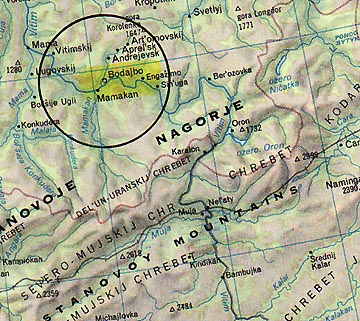
Presumed bolide explosion on September 24, 2002, during the Russian night at 58.21N, 113.46 E near Bodajbo, Siberia, Russia.

October 21, 2002  London, Ontario, Canada - On September 24, 2002 at 12:48:56 EDT and 16:48:56 UTC, night time in Russia, American Department of Defense satellites detected the explosion of a presumed bolide approximately 18.6 miles above Bodajbo, Siberia, Russia (58.21 N, 113.46E). The explosion was equivalent to 100,000 tons of TNT, or a meteorite about three meters in diameter burning up in the earth's atmosphere.


Click here to subscribe and get instant access to read this report.

Click here to check your existing subscription status.

Existing members, login below:

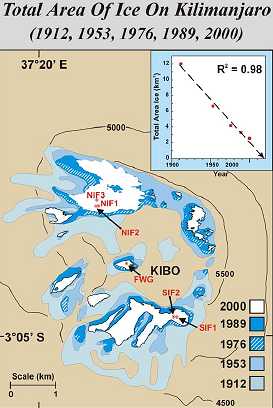
Mt. Kilimanjaro’s Ice Cap Is Melting Fast

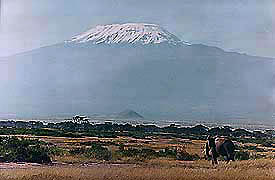
Mt. Kilimanjaro, Tanzania, is Africa's highest mountain at 19,340 feet.

"Between 1912 and 2000, Mt. Kilimanjaro has lost 80 percent of the ice area on the mountain."

- Lonnie Thompson, Ph.D., Geologist, Ohio State University

This map by Ohio State University researchers shows the retreat of Mt. Kilimanjaro's ice cap between 1912 and 2000, an 80 percent reduction.


Click here to subscribe and get instant access to read this report.

Click here to check your existing subscription status.

Existing members, login below:

Could Cheops Pyramid’s Small Channels and “Doors” Be Resonators or Antennae?

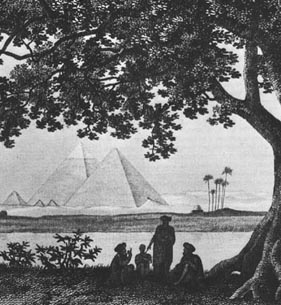
The Great Pyramid of Cheops built 4,500 years ago for King Khu-fu in the 4th Dynasty, near Cairo, Egypt. The three pyramids on the Giza plateau seen from across the Nile. Cheops appears smaller than Kephren with the white Tura limestone cap because Kephren is on higher ground. The third smaller to the left are Mykerinos and the two other smallest were for the wife and daughter of King Khu-fu. Drawing © 1971 Peter Tompkins.
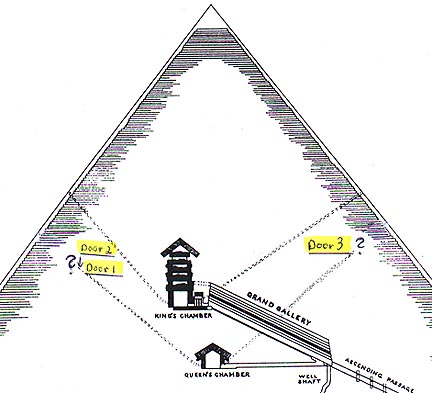
"Doors" 1 and 2 are in the southern shaft rising from the Queen's Chamber on the left of the above diagram. The most recently discovered "Door 3" is on the northern shaft rising from the same chamber. Both Door 1 and Door 3 have copper pins, staples or handles. Door 1 and Door 3 also block the two respective shafts at approximately the same distance from the Queen's Chamber: 210 feet. Door 2 is seven inches beyond Door 1. The actual path to Door 3 is now known to have three turns in it to get past the Grand Gallery. No one yet knows what is behind Door 2 and Door 3 or what the purpose of these strange, narrow shafts and little blocks might truly be.

October 12, 2002  Athens, New York - In 1957, a brilliant analysis of Egyptian architecture was published by philosopher Schwaller de Lubicz in a 3-volume book entitled, The Temple of Man, after his fifteen years of painstaking measurement work at Luxor and other Egyptian sacred sites. The miraculous pyramid and temple structures were, for de Lubicz, the end result of evolved consciousness applying the universe's rules of sacred geometry and Law of One in which "as above, so below" provided an architectural blueprint for the soul/spirit's evolution toward immortality.


Click here to subscribe and get instant access to read this report.

Click here to check your existing subscription status.

Existing members, login below:

EARTHFILES