





Formaldehyde, Ammonia and Benzene Molecules on Mars? Would Probably Mean Life.

"Speculation is that already methane is a rather strong indicator life is probably present today on Mars. Just simply based on methane. ...Formaldehyde is destroyed in the Martian atmosphere within 7.5 hours. There is no way that formaldehyde can exist and remain for a long time in the Martian atmosphere. If (formaldehyde) confirmed, possibly life on Mars today, yes."

- Vittorio Formisano, Ph.D., Physicist

The Planetary Fourier Spectrometer (PFS) mounted on the Mars Express spacecraft in orbit around Mars has already confirmed a surprisingly large amount of methane in the Martian atmosphere. See 03/31/04 Earthfiles. If molecules of formaldehyde, benzene and ammonia are also confirmed, it would definitely mean biological life processes are at work on Mars. ESA 2001 Illustration by Medialab.

May 6, 2004  Rome, Italy - Back on March 31, 2004, I reported at Earthfiles.com that methane measurements in the Martian atmosphere are being analyzed by Physicist Vittorio Formisano, Ph.D., Principal Investigator of the Planetary Fourier Spectrometer (PFS) which he built and is mounted on the European Space Agency's (ESA) Mars Express Orbiter designed to detect methane and other gaseous molecules. Dr. Formisano is based at the Institute of Physics and Interplanetary Science in Rome, Italy, and has been commuting to ESA offices in Darmstadt, Germany to gather more data from the Planetary Fourier Spectrometer in hopes that he will be able to confirm the location of one or more sources of the Martian methane. In March, he hoped he would be able to make a definitive statement at the European Geophysical Union (EGU) conference on April 26, 2004, in Nice, France.


Click here to subscribe and get instant access to read this report.

Click here to check your existing subscription status.

Existing members, login below:

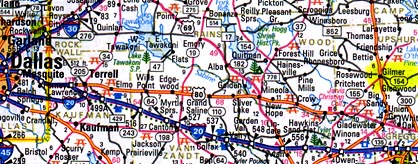
Seventeen Cattle, One Dog Die Mysteriously in Gilmer, Texas

Gilmer, Texas, is small ranching community 150 miles east of Dallas.
Remaining herd on Ronnie Blasingame's ranch in Gilmer, Texas, after the mysterious die off of 17 animals the week of April 18-25, 2004. Photograph on April 30 © 2004 by KLTV, Channel 7, Tyler, Texas.
Remaining herd on Ronnie Blasingame’s ranch in Gilmer, Texas, after the mysterious die off of 17 animals the week of April 18-25, 2004. Photograph on April 30 © 2004 by KLTV, Channel 7, Tyler, Texas.

May 5, 2004 Gilmer, Texas – On Sunday, April 18, 2004, neighbor ranchers A. D. Varner and Ronnie Blasingame were out working when they found a dead cow on Mr. Blasingame’s ranch in Gilmer, Texas, aabout 150 miles east of Dalls. Ronnie started dragging it off and found another dead cow. While he was dragging that second cow off, he came across three more dead cows. All had a small amount of blood coming out of their mouth along with a large quantity of clear fluid. Neither rancher had ever seen animals die like that before.Click for report.

Part 3 – 25 Years After Three Mile Island, Is Another Nuclear Power Plant Disaster Inevitable?

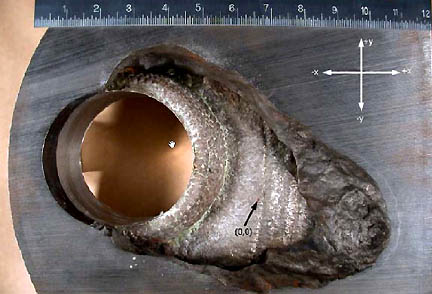
“The Nuclear Regulatory Commission missed warning signs that the Davis-Besse Nuclear Power Station (near Toledo, Ohio) had a massive hole in its reactor head because inspectors failed to notify officials at NRC headquarters of the findings. …The NRC Inspector General said it was the most extensive corrosion ever found on top of a U. S. nuclear plant reactor.”

– The News Herald, Port Clinton, Ohio, October 22, 2003

Leaking boric acid ate a 6-inch wide hole around the steel cladding of Nozzle #3 in the reactor head at the Davis Besse nuclear power plant near Toledo, Ohio. Discovered in 6-inch steel casing and photographed in March 2002. Plant shut down to avoid potential core melt down. Photograph from Nuclear Regulatory Commission.

Click here for Part 2Click for report.

Part 2 – Ted Phillips’s Search for “Black Mirror” Cylinder in Slovakia

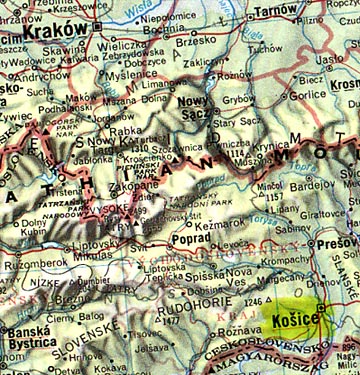
The Tatra mountains in which the cave and black, shiny cylinder were explored by Antonin Horak in October 1944, are west of Kosice, Slovakia.

April 30, 2004  Branson, Missouri - Nearly thirty years ago, Ted Phillips was working closely with astronomer J. Allen Hynek, Ph.D., who consulted for the U. S. Air Force on Project Blue Book and later founded the Center for UFO Studies (CUFOS). Dr. Hynek was also a professor in the Department of Astronomy at Northwestern University and director of its Dearborn Observatory.


Click here to subscribe and get instant access to read this report.

Click here to check your existing subscription status.

Existing members, login below:

Part 1 – Ted Phillips Photographs Mysterious “Dover Lights”

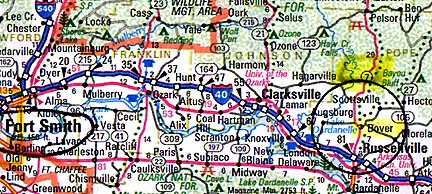
The Piney River valley - ten miles north of Dover, Arkansas, and northeast of Fort Smith - has a long tradition of mysterious moving lights and green fog. Local residents call them the "Dover lights."

April 29, 2004  Branson, Missouri - At the 2004 Eureka Springs, Arkansas UFO Conference three weeks ago, we heard new reports about mysterious glowing objects down in the Piney River valley that local residents since at least the 1800s have called "Dover lights." This year at the conference, Ted Phillips, Director of the Center for Physical Trace Research in Branson, Missouri, talked about his own recent encounter with the Dover lights on March 26, 2004, at "twenty minutes past sunset," or about 6 p.m. Central time. In Eureka Springs, Ted showed a series of color photographs as the lights appeared and changed patterns for a half hour, starting with one moving.


Click here to subscribe and get instant access to read this report.

Click here to check your existing subscription status.

Existing members, login below:

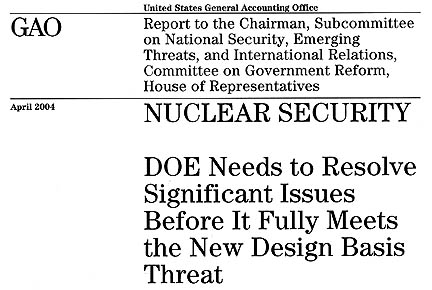
GAO Report On Nuclear Security: “DOE Needs to Resolve Significant Issues”

Cover page of April 27, 2004, U. S. General Accounting Office (GAO) report for Cong. Christopher Shays, Chairman, Subcommittee on National Security, Emerging Threats and International Relations in the Committee on Government Reform in the U. S. House of Representatives, Washington, D. C.
Cover page of April 27, 2004, U. S. General Accounting Office (GAO) report for Cong. Christopher Shays, Chairman, Subcommittee on National Security, Emerging Threats and International Relations in the Committee on Government Reform in the U. S. House of Representatives, Washington, D. C.

April 27, 2004  Washington, D. C. – A General Accounting Office (GAO) report was released today about the Department of Energy (DOE)’s slow response since 9/11 to change its plans for dealing with terrorist threats at American sites containing nuclear weapons and/or nuclear materials such as plutonium. In fact, it’s now estimated that it will take until 2008 for DOE to implement its updated plan to deal with terrorist threats.

Click for report.

Update About Microbiologist Dan Burisch, Ph.D.

Microbiologist Dan (formerly Crain) Burisch, Ph.D., Las Vegas, Nevada. Photograph © 2002 by Bill Hamilton.

Microbiologist Dan (formerly Crain) Burisch, Ph.D., Las Vegas, Nevada. Photograph © 2002 by Bill Hamilton.April 26, 2004  Los Angeles, California - Dan Burisch is a microbiologist who received his Ph.D. from the State University of New York, Stonybrook, in 1989. He is 40 years old now, born on February 2, 1964. His birth certificate name was Danny Benjamin Crain. I have met and talked with his mother, Dodie Crain, and with Dan Burisch, Ph.D., himself.


Click here to subscribe and get instant access to read this report.

Click here to check your existing subscription status.

Existing members, login below:

At the X-Conference, Former Naval Intelligence Officer, C. B. Scott Jones

"The Chinese told me over and over again of the amount of evidence they have from which they conclude that the ET phenomenon is real, in the sense that there are real tangible craft penetrating their airspace."

- C. B. Scott Jones, Former U.S. Naval Intelligence

C. B. Scott Jones, former U. S. Naval Intelligence officer; Special Assistant in UFO Research for U. S. Senator Claiborne Pell, 1985-1991; and now Founder, Peace and Emergency Action Coalition for Earth (P.E.A.C.E.).

April 21, 2004  Gaithersburg, Maryland - This past weekend at the X-Conference in Gaithersburg, Maryland, the focus was on American government knowledge of an extraterrestrial presence on Earth and the cover-up of that knowledge. There has been a policy of silence and denial about ETs and advanced technologies in the interest of national security since at least the presidency of Harry S. Truman in the 1940s.


Click here to subscribe and get instant access to read this report.

Click here to check your existing subscription status.

Existing members, login below:

China Launches “Mini” and “Micro” Satellites

China's Long March 11C rocket took off Sunday, April 18, 2004, carrying its "first nanotechnology micro-satellite" and a mini-satellite. Photo © 2004 by Associated Press.

April 19, 2004  Xichang, Sichuan, China - China has launched "Experimental Satellite I," a mini-satellite weighing 93 pounds (204 kilograms) and "Nano-satellite I," a 55-pound (25 kilograms) "micro-satellite" in which metals are bonded at the atomic level. The two satellites are the first of ten that China plans to orbit around the Earth this year and the smallest is a miniature technology breakthrough.


Click here to subscribe and get instant access to read this report.

Click here to check your existing subscription status.

Existing members, login below: