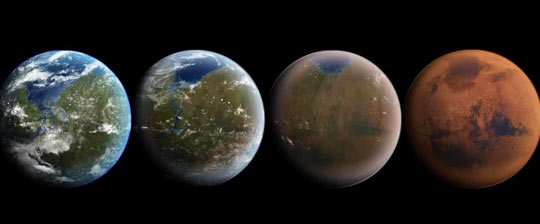
Earth and Mars were similar watery planets once upon a time. Rock formations show that liquid water once flowed on the surface and today the permafrost, if thawed, could flood the red planet again. Of its many mysteries, why and when did the water disappear from the surface and the Martian atmosphere blow away? Collage by mental_floss.
“Fresh food is one of the biggest boosts of morale for astronauts.
Now they get to watch the strawberry grow, see the it develop, turn from
pink to red. There's a psychological benefit through those visual cues.
And at the end, you get the prize [to eat].”
- Heather Hava, Ph.D. student in Aerospace Engineering, Univ. of Colorado, Boulder,
and winner, 2016 Lemelson-MIT Student Prize for Robotic Space Garden
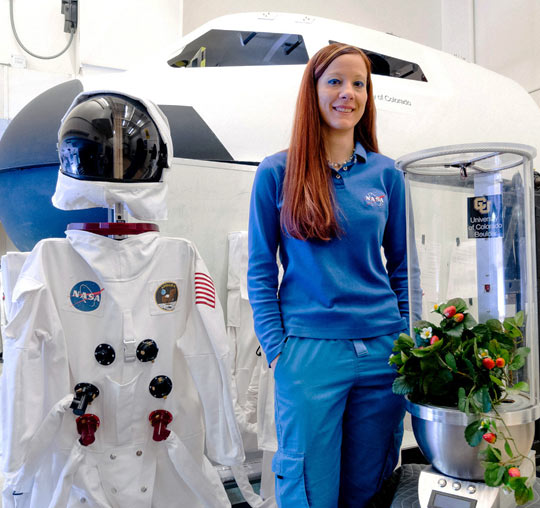
Heather Hava, winner, 2016 Lemelson-MIT Student Prize for robotic space garden invention. Heather is a Ph.D. student in Aerospace Engineering Sciences and Bioastronautics at the University of Colorado in Boulder.
Click here to subscribe and get instant access to read this report.
Click here to check your existing subscription status.
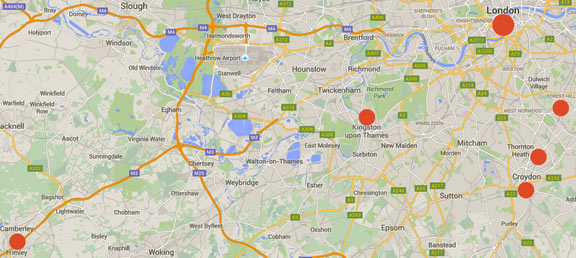
Since January 2016 in the region from Croydon to London and Forest Hill to Frimley, Surrey, more than 50 cats, rabbits and squirrels have been found bloodlessly mutilated ranging from being cut in half to beheaded. Between April 2 - 9, 2016, four more half cats have been found in Forrest Hill, Thornton Heath, Kingston and Frimley, Surrey.
April 18, 2016 South of London, England - Between April 2 to April 9, 2016, four more cats have been found bloodlessly mutilated south of London, England, in Thornton Heath north of Croydon; in Forest Hill northeast of Thornton Heath; in Kingston west of Forest Hill; and further away in Frimley, Surrey southwest of Kingston.
Click here to subscribe and get instant access to read this report.
Click here to check your existing subscription status.
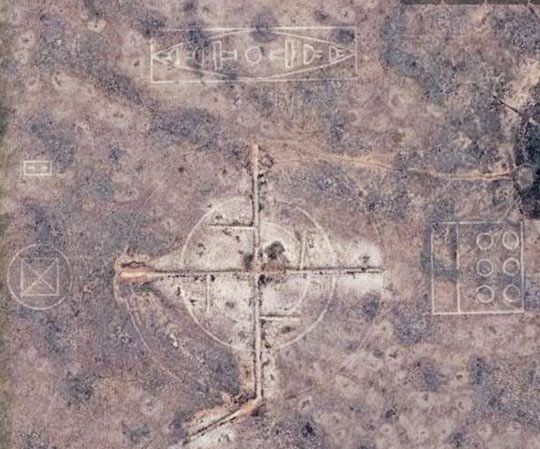
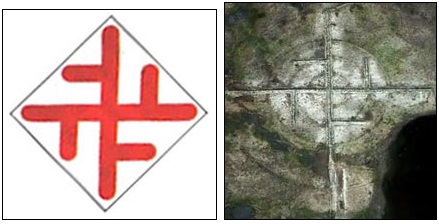
WWII Roswell AAF precision bombing target did use Slavic central pattern surrounded by other patterns. Some targets were more free of impact craters because RAAF sometimes dropped bags of water or sand instead of explosives. Source: NM Bombing Ranges and Targets.Ancient Slavic symbol of eternity and constant cycle between Life and Death (left) does match the desert patterns (right) discovered on Google Earth east and northeast of Roswell, New Mexico. Source: Slavorum.org.
Click here to subscribe and get instant access to read this report.
Click here to check your existing subscription status.
“Much as wind pushes a sail, there's a way to be propelled by light or photons.”
- Philip Lubin, Ph.D., Prof. of Physics,
Univ. of Calif. - Santa Barbara
Illustration of laser array beaming photons at small, unmanned spacecraft to accelerate up to 30% the speed of light, opening up the possibility of interstellar research to nearby stars. Graphic by Experimental Cosmology Group at the Univ. of California – Santa Barbara.
April 5, 2016 Santa Barbara, California - In the past 60 years, only one human-made machine from Earth has left our solar system and is now in interstellar space. That was Voyager 1 launched in 1977. Today NASA and Russia are talking about building nuclear thermal propulsion spacecraft to take humans from Earth to Mars in maybe 45 days, much shorter than the nine months to get the rovers to Mars.
Click here to subscribe and get instant access to read this report.
Click here to check your existing subscription status.
“Are the Americans any better than the Japanese? No.
Our industry is just as much in bed with the regulators as the Japanese
were, but we were just lucky and they were unlucky. ”
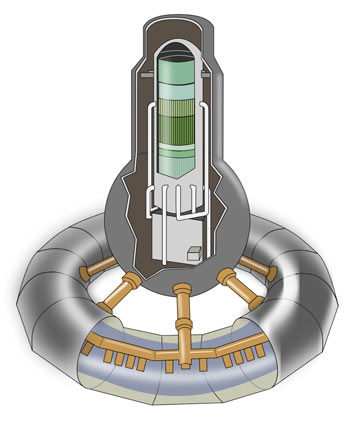
Schematic GE BWR inside a Mark I containment. Wikimedia.
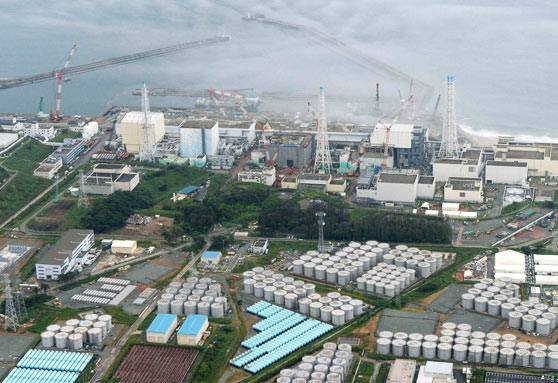
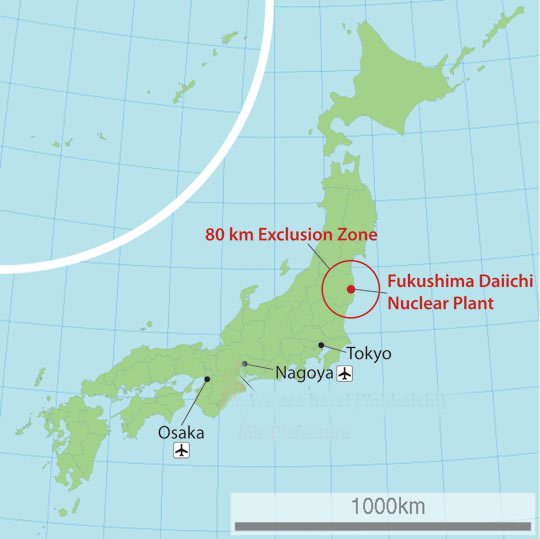
April 1, 2016 Burlington, Vermont - The nuclear power reactors at TEPCO's Fukushima facility are General Electric's BWR-1, which stands for Boiling Water Reactor. The BWR-1 represents the design of a large percent of the fission nuclear reactors around the world. All of them depend upon large quantities of cold water to keep the radioactive fuel rods cooled and safe from melt down. If the pumps of that coolant water are in a water region that can be flooded, it is logical that the pumps should be either constructed on higher ground or be engineered to be submersible. Otherwise, water flooding is always going to be a threat.
Click here to subscribe and get instant access to read this report.
Click here to check your existing subscription status.
“What we found is the wind and the rain and the movement of radioactive dust everywhere is recontaminating areas that TEPCO claims are clean ... and Fukushima fishermen take their contaminated fish and seafood further south to markets that don't know the sources are Fukushima waters.”
“A lot of these satellites were for military purposes, for surveillance, for both the U. S. and Soviet Union. We used plutonium, the most toxic radioactive substance.”
- Karl Grossman, Prof. of Journalism, SUNY-Old Westbury, NY
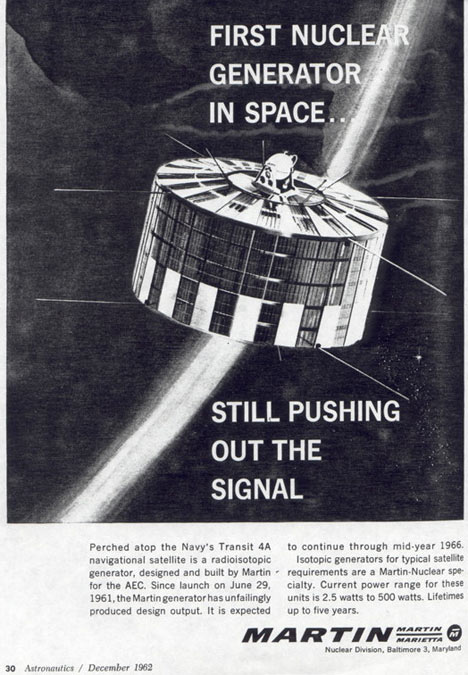
Transit 4A, launched June 29, 1961, was the first satellite to use a radioactive power source (a SNAP-3). Transit 4B (1961) also had a SNAP-3 RTG. Transit 4B was among several satellites which were inadvertently damaged or destroyed in a nuclear explosion, specifically the United States Starfish Prime high-altitude nuclear test on July 9, 1962 and subsequent radiation belt. Astronautics, December 1962.
April 1, 2016 Old Westbury, New York - A report in 2011 by the U.S. National Research Council warned NASA that the amount of orbiting space debris is at a critical level. According to some computer models, the amount of space debris “has reached a tipping point, with enough currently in orbit to continually collide and create even more debris, raising the risk of spacecraft failures.” The report called for international regulations to limit debris that is now in the thousands of pieces and figure out a way to get rid of it.
Click here to subscribe and get instant access to read this report.
Click here to check your existing subscription status.
“This kind of event is very rare. Occasionally you see wolves
kill five or six animals, but 19 is very unusual.”
- Mike Jimenez, Northern Rockies Wolf Coordinator,
U. S. Fish & Wildlife Service, Montana
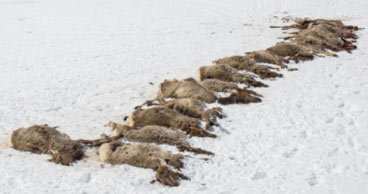
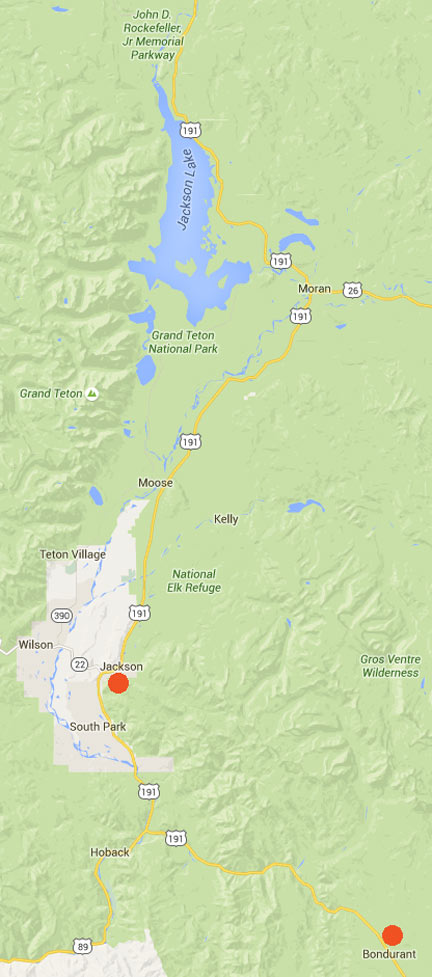
19 elk found dead and not eaten on the McNeel Elk Feedground near Bondurant, Wyoming. Photographed on March 25, 2016, by Ryan Dorgan.Bondurant, Wyoming (lower right red circle), and the McNeel Elk Feedground are about 34 miles from Jackson, Wyoming.
March 26, 2016 Bondurant, Wyoming - The U. S. Fish & Wildlife Service based in Montana along with the Wyoming Game and Fish Department are reporting their speculation that in the McNeel Elk Feedground near Bondurant, Wyoming, a pack of Gray wolves recently attacked 17 elk calves and two adult elk cows in “surplus killings.” That means the wolves killed all nineteen, but did not eat them. Exact date of deaths unknown, but photographs of the relatively fresh-looking elk bodies were taken on March 25, 2016.
Click here to subscribe and get instant access to read this report.
Click here to check your existing subscription status.
“The most intense part of the beam was the center.
It lasted until about 6:45 am EST, but not sure how long it was present
prior to the initial sighting at 6:30 am. It continued to pulsate until
it collapsed on itself in the middle after ten minutes of pulsing.”
- Resident of Pedricktown, NJ — See large image below
March 20, 2016 Pedricktown, New Jersey - On March 18, 2016, I received an email with an unusual photograph attached taken a month ago in the early morning of February 15, 2016, in Pedricktown, New Jersey.
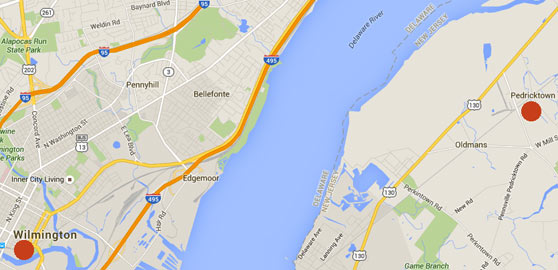
Pedricktown is near the Delaware River about 20 miles northeast of Wilmington, Delaware. It's an unincorporated town with a population of 524 in farm country that is home to the Salem Oak Winery.
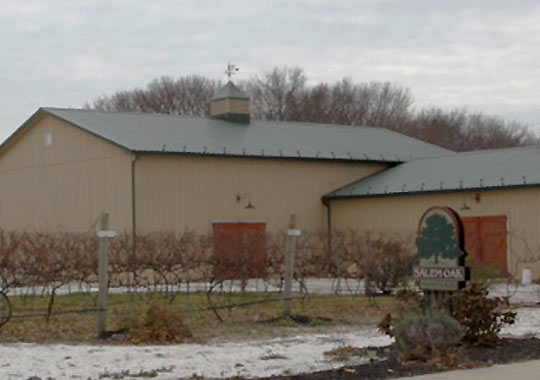
Salem Oak Winery in the farm country of Pedricktown, New Jersey, is one of 62 wineries in the state.
A Pedricktown resident sent the following email with his image of a mysterious, pulsing pink beam that lasted for at least ten minutes before the strange beam kept contracting on itself half a dozen times getting smaller and smaller until it disappeared.
Click here to subscribe and get instant access to read this report.
Click here to check your existing subscription status.