May 4, 2007 Gainesville, Florida - In the last week of April 2007, media headlined that University of California-San Francisco biochemists had “tracked down suspect in honey bee disappearances.”
Click here to subscribe and get instant access to read this report.
Click here to check your existing subscription status.
“I would really like to know how they wound up there!
But I think that’s going to be one of the great mysteries because
if they traveled two miles on foot, they had to cross a large, busy road.”
– Sgt. Cathy Katzman, Charlotte County Animal Control
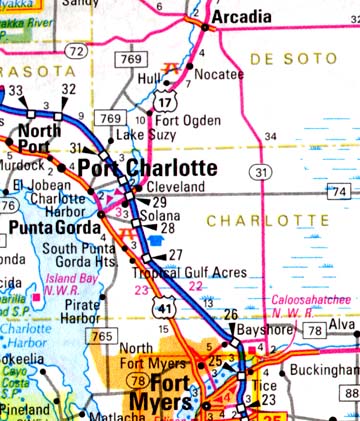
Port Charlotte is on the west coast of Florida in Charlotte County between Tampa and Fort Myers.Port Charlotte is on the west coast of Florida in Charlotte County between Tampa and Fort Myers.
April 21, 2007 Port Charlotte, Florida – The Port Charlotte Sun-Herald reported on April 18, 2007, under the headline Cows! or The Bovine Invaders: “There were eight, big-eyed and long-horned, voraciously eating lawns and carelessly trampling the gardens that lay in their path. … Cindy Collins was one of those who called 911 when she saw the animals. Collins didn’t think anyone would believer her. ‘There’s cows at my house! There’s cows with horns!’ is what she told the 911 dispatcher.”Click for report.
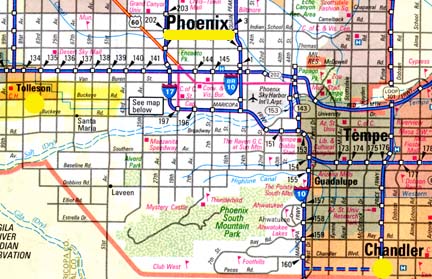
Chandler is a suburb southeast of Phoenix where a randomly downed crop formation was discovered by Michael A. Polani on March 25, 2007. Two years ago in May 2005, other odd randomly downed patterns in barley were found on the west side of Phoenix in the suburb of Tolleson.
April 12, 2007 Chandler, Arizona – The first unusual downed crop in the 2007 American season was discovered on March 25, 2007, by Michael A. Polani, a resident of Chandler, Arizona. It is very similar to the first American cases of randomly downed crop I investigated fifteen years ago in the neighbor communities of Linfield and Limerick, Pennsylvania, where odd patterns were found in different fields on May 24, 1992.Click for report.
“Some of the cats were cut in half with what some say is almost surgical precision, others disemboweled or skinned. One resident said, ‘There is never any blood at the scene, the animals are often dismembered with surgical precision and paws and other body parts are often left on the ground in strikingly similar arrangements.'”
– The New York Times, August 13, 1989
Please Note: This report contains photographs of half cats which might be disturbing to some viewers.
April 9, 2007 Corpus Christi, Texas – Texas has had repeating cycles of cat and other animal mutilations for at least sixteen years. In Plano, Texas, an affluent suburb north of Dallas, in 1991 and 1993, police received dozens of reports about cats found cut in half, usually with the front half near the owners’ yards or sidewalks. Plano Police Detective Mike Box also had missing reports on more than 80 domestic house cats that wore collars and identification tags, but were never found. Detective Box investigated satanic cult activities, but could not find any evidence that connected them to the mutilated and missing cats and other animals such as dogs.Click for report.
April 6, 2007 London, England – When hives in Toronto and Saskatchewan, Canada, were opened up in the last week of March, at least 40% had either disappeared – or in another twist of the mystery – in some Canadian hives, thousands of bee bodies were found dead.Click for report.
April 5, 2007 China – China View is reporting that unidentified aerial lights were seen and photographed on April 2, 2007, over Jilin University in Changchun City in northeastern China, and over the Shijiazhuang Airport in northern China.
Jilin University, Changchun City
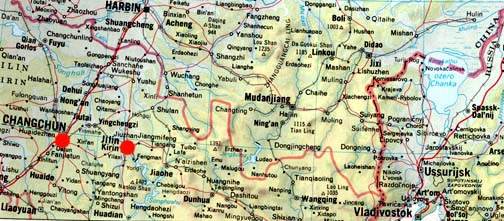
West of the Sea of Japan and Vladivostok, Russia, is Changchun, China. Nearby is the university town of Jilin. Both are highlighted with red circles.
China View electronically published four images provided by Xinhua Photo with text.
China View: “A mysterious luminary is seen in the skies of NE China’s Changchun city. In the evening of April 2, 2007, a moving luminary appeared over Jilin University and was photographed (in two images below). Whether it is a UFO or astronomical phenomenon is still not clear.”Click for report.
Gary McKinnon in Trafalgar Square, London, England, his home city. In February 2007, he turned 41-years-old. He is a self-taught internet technology consultant. Image courtesy mother, Janis McKinnon.
April 4, 2007 London, England – On Tuesday, April 3, 2007, the defense lawyers (Kaim Todner solicitors) lost their appeal to the High Court in London to prevent the extradition of Gary McKinnon to the United States.Click for report.
“When you create a genetically modified crop or organism, it’s not like you’re sticking a gene in like a Lego piece that snaps into place. There is massive collateral damage that occurs within the DNA. This can create unpredictable side effects.”
– Jeffrey Smith
March 22, 2007 Fairfield, Iowa – The United States accounts for nearly two-thirds of all biotechnology crops planted globally. Since 1996, the United States has consistently planted more GM crops than any other country. Total acres of genetically modified corn, soybeans, cotton, and canola planted in the United States in 2006 totaled 128.3 million acres – an increase of nearly 10% more GMs planted than in 2005.
In addition to large farming of soy, corn, cotton, canola, and alfalfa, other smaller GM crops now include zucchini, crooked neck squash, and Hawaiian papaya. Meanwhile, data keeps piling up about human allergies and sick and dying animals and amphibians linked to interactions with GMs. One man is convinced that GMs should be eliminated from the world’s agriculture. He is Jeffrey Smith, author of the best selling 2003 book, Seeds of Deception. His follow-up book will be released in April with a title he says sums up the situation in two words: Genetic Roulette. His subtitle is: “The documented health risks of genetically engineered foods.”
The Foreword is written by Michael Meacher, former U. K. Environment Minister, who states: “The case presented is absolutely a smoking shotgun that should stop in its tracks any dabbling with GM foods, whether by individual families, food companies or indeed, nations. … Jeffrey Smith is the modern David against the GM Goliath. This book may well provide the slingshot to change the global course of events this century.”
Recently, I talked with Jeffrey Smith about some of the documented health risks to humans and animals and why genetically modified crops are different than naturally evolved crops.
“How much of our food production do we want to turn over to other
countries that might be friendly now and not friendly in the future? The federal government is looking at this and my question is: Are honey bees the canary in the coal mine? What are honey bees trying to tell us that we humans should be paying more attention to?”
– Jerry Hayes, Chief, Apiary Section, Florida Dept. of Agriculture, Gainesville, Florida
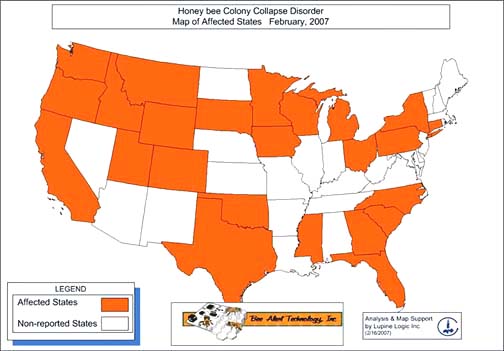
February 2007 map showing states so far affected by the honey bee collapse disorder in which beekeepers have reported 60% to 100% honey bee disappearances without explanation to date. Map courtesy MAAREC.
March 16, 2007 Washington, D. C. – In my previous February 23, 2007, Earthfiles and Coast to Coast AM news updates about the mysterious honey bee disappearances, I interviewed a Pennsylvania honey beekeeper who has had nearly 2,000 of his 2900 hives disappear – a 60% loss to date. That is David Hackenberg of Hackenberg Apiary in Pennsylvania. He said he had never seen so many deserted hives that were also left alone by predator moths and beetles. That’s why he suspects some kind of pesticide is getting into the flower pollen and nectar and poisoning the hives. He contacted Penn State’s bee experts to investigate. But to date, there is no answer.Click for report.
“The amphibians were around before the dinosaurs. Now, the amphibians are starting to get hit. They survived all that before, and now they are going down the tubes!”
February 23, 2007 Corvallis, Oregon – In the past few weeks, I have interviewed scientists who are alarmed that global warming could destroy the Amazon and other rainforests and devastate the biodiversity of plants around the world. In Svalbard, Norway, construction begins in March to build a Noah’s Ark to preserve the Earth’s plants in a seed bank built inside an Arctic mountain. In the oceans, corals and much marine life are threatened with extinction. On land, millions and millions of honey bees that pollinate so many of the fruits, vegetables, nuts and melons we expect in supermarkets have been disappearing in the United States, Spain and Poland.Click for report.