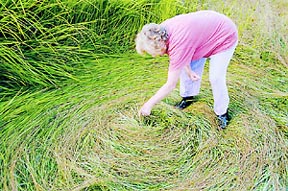
April 7, 2004 Montville, Queensland, Australia – Kate Dash grew up in the Thames Valley of England in a house her mother called “Avebury.” Forty years ago, she moved to Australia and has lived the past 35 years in Montville about forty minutes from Conondale. She is fascinated by the crop circle phenomenon and has visited Wiltshire, England, several summers to climb the hills and walk through the mysterious patterns in the crop fields. But she never expected to see beautifully “combed” circles in grass so close to her Montville home.Click for report.
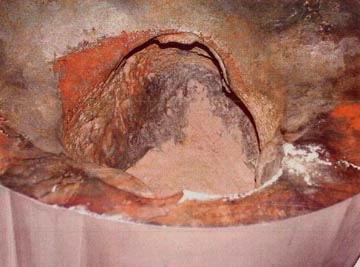
“When I first saw the 2002 photograph of the hole that was eaten into the Davis-Besse reactor (Toledo, Ohio), I could hardly believe it. We realized that we were really lucky that we did not have a nuclear accident and studies indicated that we were just a month or so away from it (potential melt down event).”
– Scott Portzline, Three Mile Island Alert
Six-inch hole eaten away by leaking boric acid from a cracked reactor drive nozzle at the Davis Besse nuclear power plant in Toledo, Ohio. Discovered and photographed in 2002 and plant shut down to avoid potential core melt down. Photograph from Nuclear Regulatory Commission.
April 5, 2004 Harrisburg, Pennsylvania and Washington, D. C. – The worst American nuclear power plant accident began at 4:00 a.m. on March 28, 1979. The Unit 2 reactor at the Three Mile Island nuclear power facility near Harrisburg, Pennsylvania, overheated. Due to the loss of reactor coolant, fuel rods began to melt. Because the fuel rods were sticking up out of the lowered water level, the nuclear chain reaction could not be controlled. The rods actually melted into the remaining water, dropped to the bottom of the reactor where enough collected to start another uncontrolled nuclear chain reaction.For five days, scientists and engineers struggled to prevent the unimaginable nightmare of a core melt down that would have poisoned all the Harrisburg population with radiation. Fortunately, the nuclear chain reaction was finally stopped, but a lot of radiation was released into the atmosphere. On March 29, 1979 – the second day of the ongoing crisis – the Nuclear Regulatory Commission (NRC) reported a reading of 3,000 millirads per hour taken above Three Mile Island. The 1979 President’s Commission on Three Mile Island finally estimated that the radioactive release over thirty-one days to the environment ranged from 2.4 million to 13 million curies – or 13 megacuries.
“The total release of radioactivity to the enviroment from March 28 through April 27 has been established as 13 to 17 curies of iodine and 2.4 million to 13 million curies of noble gases.” (Page 31, Section 13, 1979 Report of the President’s Commission on the Accident at Three Mile Island.) For comparison, all combined radioactive isotope contamination at the Chernobyl melt down is estimated ato have been100 to 130 million curies, or 100 to 130 megacuries.
– Curie (Ci) is defined as 37 billion disintegrations per second.
–Megacuries (MCi) are 1 million curies (1 x 10⁶ Ci).
Megacuries are used in measuring the very large amount of radioactivity released from nuclear weapons.
–Picocuries (pCi) are 1 million millionth of a curie (1 x 10-12 Ci). Picocuries are used in measuring the typically small amount of radioactivity in air and water.
–Millicuries (mCi), or 1/1000 Ci
– Nanocuries (nCi), or 1 billionth of a curie.
–RADs and Millirads: See More Information below.
Any Evidence of Radiation Damage in Three Mile Island Region?
Higher Cancer Rates
On February 24, 1997, the National Institutes of Health issued a press release entitled “Three Mile Island Nuclear Accident Data Revisited” by Professor Steven Wing, M.D., and his colleagues at the University of North Carolina at Chapel Hill, who published their study of medical data about TMI community cancer rates in the February 24, 1997, Environmental Health Perspectives, the journal of the National Institute of Environmental Health Sciences.
“NATIONAL INSTITUTES OF HEALTH
————————————————————-
Monday, Feb. 24, 1997
12:01 AM Eastern Time
Three Mile Island Nuclear Accident Data Revisited
“Exposure to radiation after the 1979 nuclear accident at Three Mile Island may have increased cancer among some Pennsylvanians downwind of the plant, according to a recalculation of data to be published Feb. 24 in Environmental Health Perspectives, the journal of the National Institute of Environmental Health Sciences.The controversial new study was carried out by Professor Steven Wing and colleagues at the University of North Carolina at Chapel Hill. The new study involved re-analyzing data from a 1990 report that concluded the nation’s worst civilian nuclear accident was NOT responsible for excess cancers because radiation exposures were too low. However, the new analysis takes a contradictory position.
Dr. Wing comments: ‘Several hundred people at the time of the accident reported nausea, vomiting, hair loss and skin rashes, and a number said their pets died or had symptoms of radiation exposure. We figured that if that were possible, we ought to look at [the data] again. After adjusting for pre-accident cancer incidence, we found a striking increase in cancers downwind from Three Mile Island… I would be the first to say that our study doesn’t prove by itself that there were high-level radiation exposures, but it is part of a body of evidence that is consistent with high exposures.’
“In 1998, U. S. District Court Judge Sylvia Ramob dismissed more than 2,000 damage claims filed against the Davis-Besse power plant by nearby residents.”
In December 2002, the U. S. Third Circuit Court of Appeals found that the district court had erred in excluding increased incidence of lung cancer data, but declined to hear an appeal of Judge Rambo’s dismissal. Attorneys representing 1,990 remaining plaintiffs in the TMI case declared they would take no further legal action, despite their conviction that Dr. Wing’s research indicated higher cancer rates after March 29, 1979, in the Three Mile Island region.
2003 Follow-Up On TMI Cancer Rates
In November 2003, Dr. Wing published “Objectivity and Ethics in Environmental Health Science” in the journal, Environmental Health Perspectives. He described information from a spring 1987 survey of 450 people living with “unobstructed views of TMI at distances of between 3 and 8 miles.” After the TMI accident, residents who had been out-of-doors reported ” a metallic taste, nausea, vomiting, hair loss, erythema (redness of skin caused by chemical, poisoning or burn). …Residents reported 19 cancer deaths during 1980-1984 (5 year period after nuclear disaster), compared with an expected number of 2.6.”
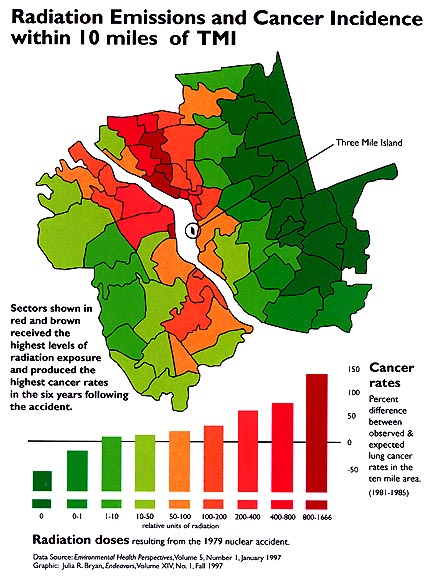
“We found positive relationships between accident dose estimates and cancer rates for all three categories of cancer (lung cancer, leukemia, childhood cancers). The slope of the dose-response estimates was largest for leukemia, intermediate for lung cancer, and smallest for all cancers. …Lung cancer showed the most consistent dose-response relationship across levels of dose. The map below shows dose estimates in relation to lung cancer rates, based on the 400 cases diagnosed in the 10-mile area during 1981-1985, adjusted for pre-accident variation in lung cancer incidence, but not for socioeconomic status. The height of the bars represents the difference between the observed numbers of cases at each dose level and the number that would have occurred if each area had experienced the average lung cancer rates of the 10-mile area population as a whole.”
Radiation emissions and incidence of lung cancer, 1981-1985, in the TMI 10-mile area. Graphic by Julia R. Bryan for Endeavors Journal, Volume XIV, No. 1, Fall 1997, University of North Carolina-Chapel Hill.
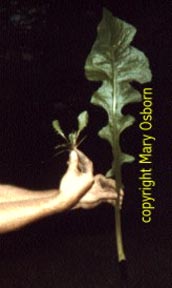
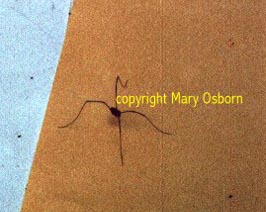
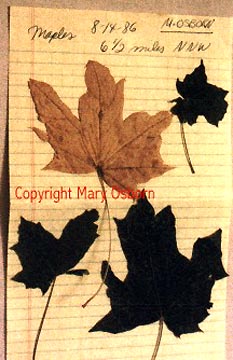
Daddy-long-legged spider with only four legs photographed on Sunday, July 27, 1996, about 6.5 miles north-northwest direction. Normal spiders have 8 legs.Dark, misshapen Maple leaves with grossly deformed margins found in August 1987, approximately 6.5 miles north-northwest from TMI.
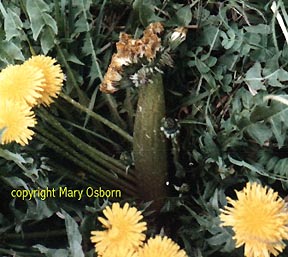
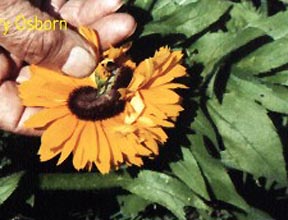
Deformed Gloriosa daisy found in 1989 on the river banks of the Susquehanna in Goldsboro, directly across from Three Mile Island. This plant also had a very wide, flat stem and many deformed flower heads. Some looked like caterpillars and one was a double flower growing back-to-back.
Mary Osborn gave these leaves to Japanese botanist, Dr. Sadao Ichikawa, who said he had seen similar effects in Germany after the Chernobyl nuclear disaster of April 1986.Is
Another Nuclear Power Plant Disaster Inevitable?
Continued About Davis-Besse “Near-Disaster” in Part 2.
More Information:
Measurement
International (SI)
Unit U.S.
Unit Conversions
Radioactivity
Becquerel (Bq)
Curie (Ci)
3.7 x 10¹⁰ Bq = 1 Ci
Absorbed Dose
Gray (Gy)
RAD
1 Gy = 100 RADs
Equivalent Dose
Sievert (Sv)
REM
1 Sv = 100 REMs
Absorbed Dose: RADs and Grays
This relates to the amount of energy actually absorbed in some material, and is used for any type of radiation and any material. Rads describe doses from both external penetrating radiation and from radionuclides contained within the body, but do not measure specific biological damage. A rad to the hand, for example, is not considered as dangerous as a rad distributed over the whole body.
A RAD is the American unit used to measure absorbed dose, and stands for “Radiation Absorbed Dose.” One RAD is defined as the absorption of 100 ergs per gram of material, and amounts to approximately one ionization per cubic micron.
“We’re not at all convinced at this point that usnic acid is the toxic compound we are dealing with. It’s been hypothesized, but not proven, and it’s going to take a fair amount of work to determine exactly what the toxic compound is in this lichen that is causing the paralysis effect in the elk. …We’ve had e-mails going out to all of our colleagues throughout the nation, and even some international people, and no one has ever heard of anything like this before.” – Walter Cook, Ph.D. and D.V.M., Wyoming Wildlife Veterinarian
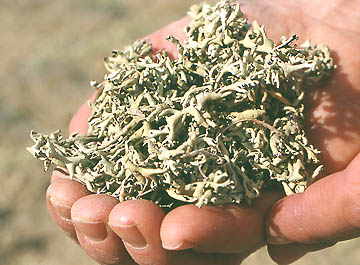
Xanthoparmelia chlorochroa, tumbleweed shield lichen, common to the region south of Rawlins, Wyoming. There in a 50-square-mile region, 304 elk have been paralyzed and died since the first of February 2004. Unidentified toxin suspected in the lichen. Image courtesy Wyoming Game and Fish Department.
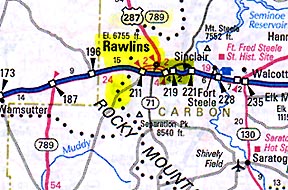
March 29, 2004 Laramie, Wyoming – The Wyoming Game and Fish Department’s Veterinarian Laboratory, working in conjunction with the Wyoming State Veterinarian Laboratory, have ruled out 38 possible explanations for the paralysis of 304 elk in a 50-square-mile region south of Rawlins since the beginning of February 2004. Ironically, the culprit might be one of the most common ground plants in the region – a lichen known as Xanthoparmelia chlorochroa, or “tumbleweed shield lichen.” But no animal expert in North America or the rest of the world has ever seen such a mysterious assault on elk or caribou before.
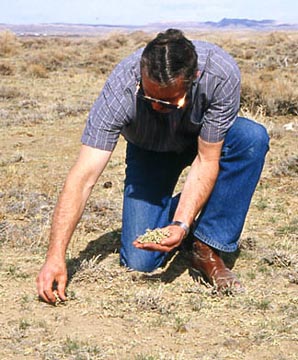
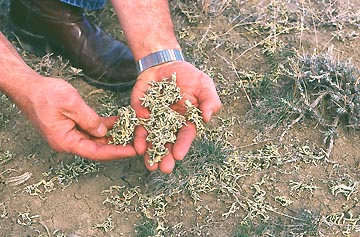
Puzzled by what could be seriously damaging the muscles in so many otherwise healthy elk, veterinarian toxicologist Dr. Merl Raisbeck, D.V.M. and Ph.D., from the Wyoming State Veterinarian Lab, walked some of the region with game warden, Benge Brown. Both noticed a large concentration of the lichen where the elk had been found unable to stand up. The lichen also appeared to have been eaten by the elk and later necropsies confirmed the lichen was in dead elk stomachs. But to date, no specific breakdown of chemical ingredients in the lichen has been made and no specific toxin has been identified – despite erroneous media reports that the poison was usnic acid.
Gary Butler, Wyoming Game and Fish Habitat Program Manager, collects Xanthoparmelia chlorochroa, also known as “tumbleweed shield lichen,” that had been browsed by elk in areas where the paralyzed animals were found south of Rawlins. Photograph courtesy Wyoming Game and Fish Department.
Interview:
Walter Cook, Ph.D. and D.V.M., Wildlife Veterinarian, Wyoming Game and Fish Department’s Veterinarian Laboratory, University of Wyoming,Laramie, Wyoming:
Healthy Elk Fed Lichen To See If Poisonous
“Indeed, when we had the rumen contents (stomach contents) of the elk analyzed, they did detect this lichen in the rumen contents. Consequently, Dr. Merl Raisbeck found some literature from the 1950s suggesting that one of the lichen that is fairly common in Wyoming caused a similar syndrome in the 1950s in cattle. So, based on that, we got kind of suspicious about this lichen – Xanthoparmelia chlorochroa, or “tumbleweed shield lichen” – and we decided the best way to definitely find out if the lichen was the culprit was basically to feed it to some research elk.
The Wyoming Game and Fish Department has a research compound for wild animals and has some elk in that compound. So, we took three elk and put them on a diet of this lichen that is found out there and after seven days on the diet, one of the three elk went down. It exhibited virtually identical signs that we have seen in the field. Then three days later, or after ten days of being on that diet, the second animal went down. We still have a third animal who has been on that lichen diet for two weeks and that animal is doing fine. Based on that experiment, it looks very suspicious that the lichen is the culprit.
Rehydrating Sick Elk Did Not Work
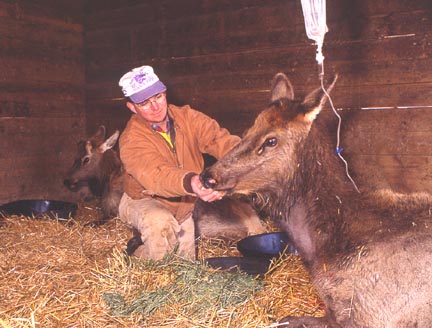
Testing the idea that something might be interfering with the elk’s vitamin or mineral intake, four elk were kept alive on saline solution and food to see if they could be restored to better health. But after one week, one died, two became more ill and had to be put to sleep and the fourth remained very ill.
Two of the four paralyzed elk that the Wyoming Game and Fish Department tried to rehydrate to restore vitamin and mineral intake. But none of the animals improved. Image courtesy Wyoming Game and Fish Dept.
Deteriorated Elk Muscle Contains White Lesions
DID YOU DO NECROPSIES ON EITHER OF THOSE TWO SICK ELK THAT WENT DOWN AFTER YOUR EXPERIMENTAL DIET? IF YOU DID, WHAT ABOUT THE MUSCLES IN THE DISEASED ELK THAT HAVE BEEN REPORTED AS WHITISH AND SICKLY LOOKING, WHICH HAS NOT BEEN LINKED TO THIS TYPE OF TOXICITY BEFORE?
Yes, that’s correct. The two elk that went down and we did euthanize and necropsy them. The results on the first elk are completed now and the second one, we are waiting to get the histology results back from the pathologist at the State Vet Lab. But on the first animal, we have the same type of lesions there and see the same kind of muscle degeneration. So, that seems to indicate that whatever toxic compound is in the lichen is causing these muscles to break down.
AND TURN WHITE?
That occurs over an extended period of time. It is very difficult to see with the naked eye, except in the very advanced stages. But under a microscope, you can pretty clearly see the muscle degeneration.
Toxin Could Be Usnic Acid, But Lichen Components Still Not Known
IS IT TRUE THAT ONE OF THE CONFUSIONS IS THAT IN PEOPLE, THE SAME KIND OF USNIC ACID IS FOUND IN CERTAIN KINDS OF DIET PILLS BUT NO ONE HAS EVER SEEN MUSCLE DETERIORATION IN HUMANS – ONLY LIVER TOXICITY?
That’s my understanding from the people I have talked to, but I should point out that we’re not at all convinced at this point that usnic acid is the toxic compound we are dealing with. It’s been hypothesized, but not proven and it’s going to take a fair amount of work to determine exactly what the toxic compound is in this lichen that is causing the effect in the elk.
SO USNIC ACID IS NOT CONFIRMED AT ALL?
That’s exactly correct. Some of the reports in some of the newspapers make it sound like this is definitely the answer, but we’re nowhere near that point yet.
HOW LONG DO YOU THINK IT’S GOING TO BE?
We can analyze the lichen for usnic acid relatively rapidly in a matter of a few weeks. But even if we find usnic acid in the lichen, that doesn’t necessarily mean that usnic acid is what is causing this particular problem. If usnic acid is isolated, we then have to try that out itself (on the elk) to see if that is the toxic compound.
The other thing that toxicologist Dr. Raisbeck is interested in doing is fractionating out various compounds from this lichen and going through and testing each one of them individually to see which compound is actually the toxic compound.
I AM SURPRISED TO LEARN THAT THERE HAS NOT EVEN BEEN A CONFIRMATION OF USNIC ACID IN THIS PARTICULAR LICHEN, GIVEN SOME WYOMING MEDIA REPORTS.
That’s correct. At this point, we don’t even no if it has usnic acid. The research that was done in the 1950s, they were able to detect usnic acid in the lichen. But we don’t even know if we are for sure dealing with the same species of lichen as they were in the 1950s.
I have been disappointed in some of the media articles. They were basically taking what were hypotheses and stating as facts. It might turn out that usnic acid is the culprit here. But we are not to that point yet.
Why Would Elk Eat Toxic Plants?
Wyoming Game and Fish personnel investigated ground around paralyzed elk and discovered large concentration of the lichen Xanthoparmelia chlorochroa. No specific toxic chemical in the lichen has yet been identified. Photograph courtesy Wyoming Game and Fish Dept.
ANOTHER PUZZLE TO ME IS THAT ELK ARE AN INTELLIGENT ANIMAL AND THEY ARE VERY RUGGED AND THEY ARE ALL OVER THIS AREA IN WYOMING. I’M HEARING YOU SAY THAT THERE HASN’T BEEN ANYTHING IN ELK LIKE THIS BEFORE AND THAT IT WAS A 1950 STUDY RELATED TO CATTLE THAT IS FOCUSED ON USNIC ACID. WHY WOULD ELK EAT ANYTHING THAT WOULD CONTAIN A TOXIC POISON?
Well, that’s one of the things that we would like to figure out for ourselves. We really don’t know. There are a couple of different hypotheses.
One is that elk regularly ingest lichen and regularly ingest this particular type of lichen (Xanthoparmelia Chlorochroa), but that for whatever reason, the lichen in the red rim south of Rawlins has concentrated the toxin that it normally does not have, or has at very low levels. So that’s one hypothesis.
The other hypothesis would be that the habitat conditions, the foraging conditions, that are out there are relatively poor and so they didn’t have a lot of different forage to choose from. It might have been a matter of necessity that the lichen was abundant and that’s why they chose to eat that instead of something else because they didn’t have any choice. Those are the kinds of things that we definitely want to work out.
Toxic Metals?
SOME PEOPLE HAVE E-MAILED ME ABOUT URANIUM CONTAMINATION IN THAT WYOMING REGION’S WATER, BOTH GROUND WATER AND SURFACE WATER. COULD THE LICHEN ABSORB SOMETHING FROM URANIUM IN THE SOIL?
Probably not uranium itself. We tested for the heavy metals early on in the course of this investigation and couldn’t identify any. But there is a possibility of a different toxic compound that might be out there.
SOMETHING IN THE ENVIRONMENT, PERHAPS SUCH AS DRYNESS AND SUDDEN WATER COULD CONCENTRATE IT IN LICHEN?
That’s another hypothesis that we are working on that there is a fairly significant drought in this area and there are some toxins in some plants that do tend to concentrate under conditions of environmental stress, so that is certainly a possibility.
SO, WITHOUT THE DROUGHT, THE LICHEN MIGHT BE TOTALLY HARMLESS?
Yes, that is exactly right.
Most Females and Calves Disabled in Mid-February 2004
DO YOU STILL HAVE A STEADY DRIP OF A FEW PARALYSIS CASES EVERY DAY OR WEEK?
No, it seems like the event is over at this point. We had a peak of the number of cases probably in mid to late February. We had a few cases at the beginning of February and then it increased and got a lot of cases around mid-February and then it’s tapered off in March. I haven’t heard of any new cases in the last ten days.
WAS THERE ANYTHING THAT ANYBODY HAS BEEN ABLE TO POINT A FINGER TO THAT HAPPENED IN MID-FEBRUARY IN TERMS OF WEATHER OR INDUSTRY OR ANYTHING IN THAT AREA?
No, not yet.
DO YOU PERSONALLY HAVE ANY SUSPICIONS?
I guess I have two hypotheses I’m working from. One is the one I’ve already mentioned to you that habitat stress, probably the drought, increased a level of a toxic compound in the lichen that doesn’t normally get concentrated enough to cause a problem.
The other is that perhaps the animals are slowly introduced to this stuff that their gut could slowly adapt to it so it doesn’t become a problem. Because we have other animals in this area, particularly pronghorn in there, and we haven’t verified this yet, but it’s possible the pronghorn are eating the same lichen and not having the effects. So, the idea that the animals might be able to adapt if they were gradually introduced to this stuff is a good possibility.
ISN’T THAT ONE OF THE PUZZLES THAT THE ONLY ANIMALS THAT SEEM TO BE AFFECTED WERE MOSTLY FEMALE ELK?
That was one of the things that was particularly puzzling about this the fact that it was the females isn’t particularly troublesome because the herd itself was made up mostly of cows and calves. There weren’t a lot of bulls in there, so you wouldn’t expect to see a lot of bulls sick. But the fact that it was strictly elk when there are pronghorn out there, a few deer, a few head of cattle and horses, that is what is particular puzzling.
AND STILL NO ANSWER AS TO WHY.
Still no answer as to why, other than this adaptation hypothesis kind of makes sense from that perspective.
BUT WHY WOULD A PRONGHORN BE ABLE TO ADAPT WHEN A RUGGED ELK COULD NOT?
It’s just that the pronghorn is in that habitat year after year, but the particularly affected elk herd does not normally winter in this area. It normally winters considerably further south. So, if it is not normally accustomed to eating this particular lichen and it moves in there and suddenly eats a bunch of it. It seems plausible they could have over-indulged and got whatever toxic compound is in there at such a concentration that it caused this problem.
WHY WEREN’T THE ELK IN THEIR NORMAL FURTHER SOUTH AREA?
That’s anybody’s guess.
IT MIGHT HAVE SOMETHING TO DO WITH THE DROUGHT?
It could. I really don’t know why they chose to be there this year (south of Rawlins) rather than where they have normally wintered.
IS IT TRUE THAT NO ONE HAS EVER SEEN SUCH A DETERIORATION IN 304 ELK EVER BEFORE?
Nothing like this. The only kind of die-offs we get on this kind of scale are usually winter-related mortalities, either starvation events or extreme cold weather. So, this is quite unique.
THIS IS UNIQUE AND IT IS UNIQUE TO THE ENTIRE GLOBE OF THE ELK POPULATION?
As far as I know. We’ve had e-mails going out to all of our colleagues throughout the nation, and even some international people, and no one has ever heard of anything like this before.
WHAT IS THEIR COMMENT BOTH ON THE UNIQUE DETERIORATION OF THE MUSCLES THAT CAN BE SEEN AS SICKLY WHITE?
They are quite surprised, to say the least. There are a variety of wildlife species that eat a variety of lichens. Caribou are probably the most well known. Caribou are closely related to elk and they make up a large part of their diet from various lichens. So, it was pretty puzzling to everybody. The muscle lesions again, that is something that has not been described before with any kind of toxin like this. It is a unique situation.
Toxin Interfering With Cell’s Energy Production?
FROM YOUR VETERINARIAN DOCTORATE AND Ph.D. DEGREE, IS THERE ANY LESION IN ANY OTHER DISEASE THAT AFFECTS ELK THAT COMES CLOSE TO THIS?
Yes, if animals are over-exerted, basically run too hard, their muscles can deteriorate like this. I have seen that both in wild animals and in endurance riding with horses. Horses, if they are over-exerted in endurance rides, can have the same kind of thing.
WHAT WOULD CAUSE EXTREME EXERTION IN PREGNANT FEMALE ELK?
One of the hypotheses out there is that whatever toxic compound it might shut down the cell’s ability to manufacture energy. Because of that, the energy sources of that muscle cell get depleted very rapidly and so the muscle degrades because of that. It’s not because the muscle is being over-exhorted. It’s that the muscle is unable to regenerate its energy supply.
DOES THIS FALL IN ANYWAY INTO THE CATEGORY OF WHAT HAPPENS IN THINGS LIKE MULTIPLE SCLEROSIS AND THINGS LIKE PRION-RELATED DISEASE?
No, this seems to be pretty much so far dealing just with the muscle. It doesn’t seem to be that the nerves are affected at all. There is no indication of any kind of prion activity occurring at all.
Trying To Understand Why 50-Square-Miles Became Poisonous to Elk
DO YOU IN AN EPIDEMIOLOGICAL WAY TO SOLVE SUCH A MYSTERY THAT SEEMS TO HAVE A BELL-SHAPED CURVE IN CAUSE AND AFFECT THAT WENT THROUGH FEBRUARY, PEAKING IN MID-FEBRUARY? HOW DO YOU TRY TO FIND OUT WHAT MIGHT HAVE HAPPENED IN THE LANDSCAPE?
Fifteen miles south of Rawlins, Wyoming, in a 50-square-mile area owned and managed by the Wyoming Game and Fish Department (WGFD) 304 elk have been disabled by baffling paralysis since first of February 2004, and subsequently euthanized by the WGFD.
That is actually a good question and that is one of the things that lead up to this. When we first started having the deaths occurring, we have this list of differential diagnoses anything that could cause a similar syndrome. Very early on, we determined that this was not an infectious agent. The vet lab did not isolate any bacteria or viruses or parasites that would have lead to something like this. there was no indication of an immune response as you would expect in an infectious disease. So, fairly rapidly in the course of this investigation, we decided it was some kind of a toxin. Then we started thinking about what is the possibility for a toxic water source or a toxic spill that might have occurred at some place. then as the whole thing progressed and we start of getting what you are describing, the bell-shaped curve of death, and also deaths occurring over a very wide area about 50 square miles in which the elk were dying. that made it very unlikely that we were dealing with a single point source of a toxin. Most spills in a toxic water problem would be a single point source, so the animals would die in a fairly small radius to that point source.
That was another thing that keyed us into that whatever this toxin is, it is pretty equally distributed out there in the environment. That was when Dr. Merl Raisbeck and Mr. Benge Brown, game warden with the Wyoming Game and Fish Dept., noticed all the lichen appeared to have been browsed upon. But what it is in the lichen that is causing this, we don’t know yet and it will probably be a matter of months before we are able to say for sure.
THE GOOD NEWS IS THAT WHATEVER HAPPENED, THE ELK DON’T SEEM TO BE DYING IN THE NUMBERS THAT THEY WERE IN FEBRUARY?
That’s correct. Whether that’s because they adapted to it, or more likely, it’s because they moved out of there. They’ve headed back south into their more traditional migration for summer. They are out of the area of the toxin.
BUT ISN’T THAT A MYSTERY BECAUSE THAT 50-SQUARE-MILE AREA STILL HAS A LOT OF ANIMALS IN IT? WHY AREN’T THE OTHER ANIMALS AFFECTED? WHY ONLY THOSE PREGNANT ELK AND THEIR CALVES?
That’s one of the things we want to work up on. There are still some deer and pronghorns in the area, whether it’s because they chose not to eat the lichen or because they adapted to it. We want to look at the diets of the other animals out there to see if they have eaten any of this – or learned to avoid it.”
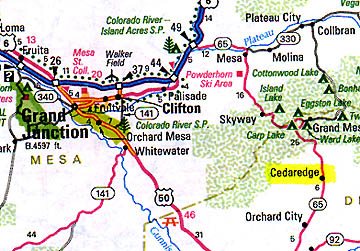
Cedaredge is a farming and ranching community southeast of Grand Junction, Colorado.
March 12, 2004 Cedaredge, Colorado – Cedaredge, Colorado is west of Grand Junction in a Rocky Mountain region that has long been the home of farmers and ranchers. And one of those ranchers had 31 of his cattle die last weekend on Saturday, March 6, 2004, in only 12 hours. Vern Hillis estimates the one yearling bull and 30 mostly pregnant heifers were worth about $31,000. Veterinarians at first were not able to confirm what caused the cattle to stumble and fall down kicking and tossing their heads until their last breath. But today, a positive test was confirmed for a particular milkweed plant that grows in the region. It can kill cattle rapidly and violently.
Rancher Vern Hillis is 62-years-old and was born and raised on the ranch first settled by his grandfather. In the past half century of working the family’s 1400 acres, Mr. Hillis told me he has never encountered anything like the mass death of half his herd. I talked with him this week about what happened – prior to the Friday, March 12, lab confirmation that the culprit was milkweed.Click for report.
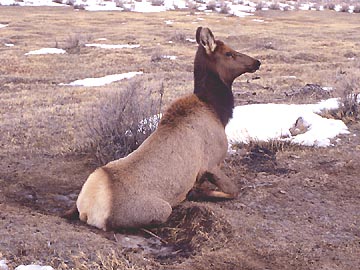
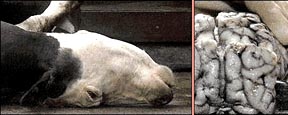
Fifteen miles south of Rawlins, Wyoming, in a 50-square-mile area owned and managed by the Wyoming Game and Fish Department (WGFD) 300 elk have been disabled by baffling paralysis and subsequently euthanized by the WGFD.Female elk unable to rise on her legs. Ten animals have been airlifted by helicopters to veterinarian pathologists trying to find an answer for the bizarre paralysis. So far, no answers, as the numbers of disabled elk keep rising. Image courtesy WGFD.
March 9, 2004 Cheyenne, Wyoming – On February 8, 2004, Wyoming coyote hunters contacted the Wyoming Game and Fish Department in Rawlins to report their finding two live elk down on their chests, unable to rise. The location was about 15 miles southwest of Rawlins on land actually owned and managed by the Wyoming Game and Fish Department. A Rawlins field biologist went to investigate, found the two elk and subsequently, other field investigators found another 80 live, paralyzed elk. The number of debilitated animals has now risen to almost 300 today. Nine more, all alive, were found the weekend of March 6-7, 2004. Sadly, all found alive and paralyzed have been euthanized to put them out of their misery.This week I talked about the baffling phenomenon with Tom Reed, Publications Supervisor, Wyoming Game and Fish Department, Cheyenne, Wyoming.Click for report.
Title page of futurist study commissioned by the Pentagon’s Office of Net Assessment, finalized in October 2003 and leaked via media on February 22, 2004.
February 27, 2004 New York City, New York – One year ago at the Office of Net Assessment in the Pentagon, its director – Andrew Marshall – read the 2002 National Academies of Sciences study entitled Abrupt Climate Changes: Inevitable Surprises. Scientists have been warning for years that uncontrolled build up of carbon dioxide around the Earth could heat up the planet so much that drought, flooding, high winds, more severe storms, food shortages and wars over water might result. However, global warming and potentially rapid climate change have been controversial and politically unacceptable to discuss in this current Bush Administration which has also rejected proposals to control carbon dioxide emissions. Click for report.
January 29, 2004 London, England – The World Health Organization’s Director of the Influenza Collaborating Centre, Alan Hay, said this week, “The extent of this (avian flu) outbreak is unprecedented.” It is also virulent and jumping from birds to humans. The big medical fear is: What happens if the avian virus begins jumping from human to human? How fast and far could it spread? The worry is warranted. SARS in 2003 was also a virus that jumped from animals to humans and began spreading and killing rapidly.
The deadly prion disease known as “Mad Cow” in cattle attacks brains and spinal nerves. Affected tissues, if eaten in livestock feed, supplements or even cooked meals, can apparently transfer the distorted and destructive proteins from animal to animal or into humans.
January 27, 2004 Washington, D. C. – In its first act to change American laws since bovine spongiform encephalopathy (BSE), or “mad cow” disease, was found on December 23, 2003, in a Washington state Holstein cow, the Food and Drug Administration (FDA) has announced that no more mammalian blood, blood products or chicken waste can be added to livestock feed. Further, no meat scraps from large restaurants can be recycled into cattle feed. Factories that make food for livestock and food for other animals that use cow ingredients will have to have separate production lines to guard against accidental contamination from the deadly prion proteins.
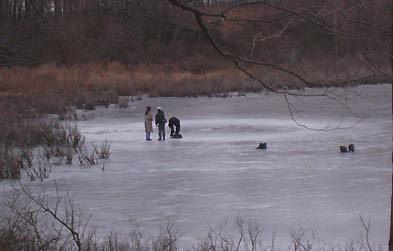
January 16, 2004 Horton, Michigan – On January 3, 2004, Earthfiles.com reported about an “incredibly brilliant white light” that local resident, Vaughn Hobe, saw hovering over the hill above Mud Lake about a thousand feet from his house in Horton. When a large, nearly perfect circle was discovered in Mud Lake ice on December 28, 2003, many wondered if there was a link between the bright light and the ice circle. Some of the local residents say the cove end of the lake where the ice circle emerged has been called the “Devil’s Hollow” because people have seen so many strange lights there. In fact, over the past few years, near the same hill above Mud Lake, Vaughn Hobe has repeatedly seen large, orange glowing spheres at least 25-feet in diameter hovering in the sky. He says the orange is the color of a ripe pumpkin and that he has only seen one sphere at a time, never in groups. The closest approach was once about 200 feet away. The orange spheres have been stationary and then move off, seeming to dip down toward the hill beyond his house where he saw the bright, white bar of light on December 18, 2003.
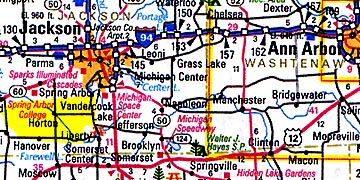
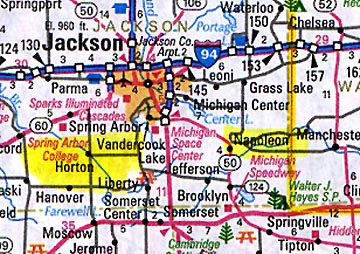
Napoleon, Michigan, is fifteen miles east of Horton where the bright light was seen on December 18, 2003, prior to the discovery of an ice circle at Mud Lake on December 28, 2003. Several Napoleon residents have seen highly strange aerial craft in January 2004.
January 16, 2004 Napoleon, Michigan – Since the middle of December, residents of Horton and Napoleon, Michigan, west of Ann Arbor, have seen some very strange lights and objects in the sky. Another mystery was a large, nearly perfectly round ice circle discovered on December 28th at Mud Lake near Horton. The ice circle was probably created by Nature. But the sky objects are highly strange, returning to the same places, and changing shape in front of at least half a dozen people. One of the shapes included hawk-like wings.Click for report.