July 9, 2000 New Bern, North Carolina - In southeastern Europe the past several days, temperatures above 100 degrees in many places - and up to 113 degrees in the Turkey and Romania region - have killed at least 38 people. Strong winds from the Sahara desert began blowing on Friday causing hundreds of fires in Greece, Italy and Croatia. And this is only the first of July. What happens in August and September?
Click here to subscribe and get instant access to read this report.
Click here to check your existing subscription status.
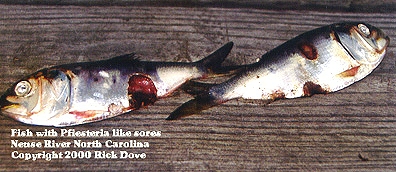
Widespread outbreak of a microscopic algal bloom known as "brown tide" in Long Island's Great South Bay threatens shellfish industry. Photograph courtesy NOAA.
July 2, 2000 Stony Brook, New York - Biologists in the Marine Sciences Research Center at State University of New York at Stony Brook are puzzled by the vigorous brown tide algal bloom this spring that has killed off most of the shellfish in Long Island's Great South Bay. Part of the problem, in addition to the more traditional link of algal blooms to pesticide and fertilizer runoffs from land, is global warming. Winter 2000 was warmer than normal and Spring 2000 was the warmest spring on record in the United States. But no one expected brown tide algae to persist through the winter and then flourish and spread as far as it has in the Great South Bay.
Click here to subscribe and get instant access to read this report.
Click here to check your existing subscription status.
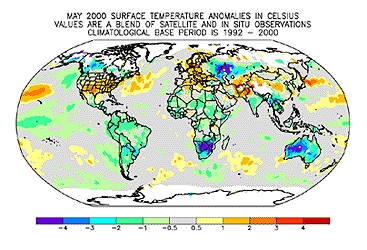
Yellow to orange colors of warm temperatures over two-thirds the United States in May 2000. Data from the June 16, 2000 National Climatic Data Center report, a division in the U. S. National Oceanic and Atmospheric Administration (NOAA). Temperature graphic courtesy NOAA.
June 18, 2000 Asheville, North Carolina - This weekend, the National Oceanic and Atmospheric Administration's National Climatic Data Center announced that this spring of 2000 has been the warmest on record for the United States. NOAA reports that during this spring season, "every state in the continental U. S. was warmer than its long-term average. ... The extremely warm temperatures contributed to worsening drought conditions in many areas of the country. Parts of the Southeast, Midwest and
Click here to subscribe and get instant access to read this report.
Click here to check your existing subscription status.
"I have no doubt in my mind that at the present time the greatest polluting element in the earth's environment is the proliferation of electromagnetic fields. "
- Robert O. Becker, M. D., Orthopedic Surgeon
May 14, 2000 London, England - The British government this past week received a medical research recommendation that controls be placed on mobile phone use, especially for all young people under the age of sixteen. Tayside University Hospitals in Scotland reported that in its study of the sort of microwave radiation emitted by cell phones on worms - scientists discovered changes in proteins consistent with cooking of the tissues. The British report said that children in particular are considered to be at risk because their nervous systems are still developing and because the smaller size of a child's skull allows greater absorption into the brain tissue of the low level microwaves emitted by mobile phones. Right now in Britain, one in four mobile phone users is under 18 years of age.
Click here to subscribe and get instant access to read this report.
Click here to check your existing subscription status.
"Foremost is the rapidness with which the water level has dropped three feet over the past two years. On Lakes Michigan and Huron, this is the largest two year drop that we've had in our 140 years of record."
- Frank H. Quinn, Ph.D., May 2000 Great Lakes Environmental Research Laboratory
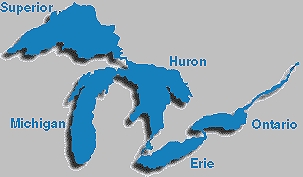
May 7, 2000 Ann Arbor, Michigan - Drought has taken hold in the Great Lakes in a severity not seen since the mid 1960s and the 1930s. With water levels in the lakes near record lows, big cargo ships can no longer carry the heavy loads they used to. So far in 2000, the Great Lakes Carriers Association estimates it's having to lighten each trip by about 8,000 tons and the costs are climbing. For example, iron ore and coal are valued at $35/ton per trip. So, every 8,000 pounds left behind to get a cargo ship across the shrinking lake waters is a loss of $300,000 in cargo.
Click here to subscribe and get instant access to read this report.
Click here to check your existing subscription status.
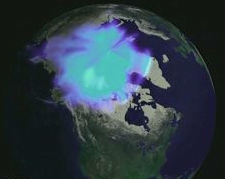
Aurora borealis glows in the atmosphere above the Arctic. The winter of 1999 to 2000, NASA and a European Commission measured the largest ozone depletion, a 60% loss, at 11 miles above the North Polar region. That was greater deterioration in the Arctic than observed during the previous ten years. Image of Arctic region courtesy of National Oceanic and Atmospheric Administration (NOAA).
April 20, 2000 Greenbelt, Maryland - This winter, NASA and a European Commission sent two NASA research aircraft up to 70,000 feet above northern Sweden to measure gasses in the upper atmosphere. The specific concern was ozone levels. The stratosphere was much colder than normal this winter which makes ozone deterioration worse. And even though satellites and ground instruments monitor the atmosphere, there hadn't been direct measurement by instruments on a high flying plane since 1992. The result? More than 60 percent of the Arctic ozone at 11 miles above the North Polar region had been depleted.
Click here to subscribe and get instant access to read this report.
Click here to check your existing subscription status.
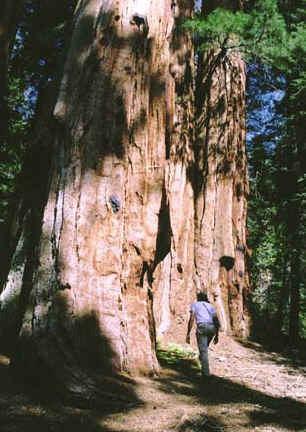
Giant California Sequoias are the largest living organism on the earth today. Some are more than 3000 years old, rise up to 300 feet tall, and measure 100 feet around the base. Photograph courtesy Sierra Club.
April 16, 2000 Washington, D. C. - This past week, President Bill Clinton declared a large section of the Sequoia National Forest in California to be a "national monument" in order to permanently preserve the giant redwood trees. The President used his executive authority under the 1906 Antiquities Act which allows U. S. Presidents to safeguard objects of historic or scientific interest without going to Congress.
Click here to subscribe and get instant access to read this report.
Click here to check your existing subscription status.
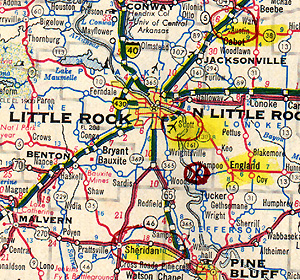
Red X marks area of mysterious fires at the intersection of Lonoke, Pulaski and Jefferson Counties in Arkansas, first reported to 911 by the Little Rock Airport and a Scott resident around 11:20 PM CST on Thursday, March 9, 2000.
March 16, 2000 Scott, Arkansas - The mystery of unexplained fires about 25 miles southeast of Little Rock, Arkansas might actually be related to a fiery bolide that apparently came down and evaporated north of Austin around 8:30 PM CST, March 9th. I interviewed one eyewitness from Cabot, Arkansas today who wishes to remain anonymous, but told me, "It was 8:25 p.m. We were on Stagecoach Road and Highway 38 outside Old Austin. We started driving down the road heading home and I looked over at my husband and right there to his left, I could see out of nowhere running parallel with us on the road was what we thought at first was a small airplane on fire."
Click here to subscribe and get instant access to read this report.
Click here to check your existing subscription status.
Cast made by Georgia police officer in 1997 of a 16.5 inch footprint found in woods after “large gorilla creature” reported. Print has same unusual vertical derma ridges similar to two other casts found in California and Washington State. The diagonal line is a cast artifact. Forensics expert Jimmy Chilcutt says the cast footprints he has studied are from “an animal of a different species that we haven’t studied before.”
March 16, 2000 Conroe, Texas – Recently I talked with Dr. Jeff Meldrum, an anatomy and anthropology professor at Idaho State University in Pocatello who has examined at least 100 casts of alleged Sasquatch footprint casts. He has also collaborated with Police Officer Jimmy Chilcutt of Conroe, Texas who is a crime scene investigator and latent fingerprint examiner for the Conroe Police Department. Officer Chilcutt was so impressed by three of the casts he studied that he told Field and Stream magazine in January, “I can assure you there’s an animal up in the Pacific Northwest that we have never seen.”Click for report.
Winter for Philadelphia this year was a few cold, snowy days at the end of January into February. Before then and since, it has been unusually warm. And yesterday on March 11th, big, booming thunderstorms with lightning and heavy rain roiled around here most of the day through last night.
Click here to subscribe and get instant access to read this report.
Click here to check your existing subscription status.