“The captain with Northwest Florida University asked (over the VHF marine radio) for captains - who worked in the oil clean up and are coughing up blood, blowing blood out of their nose, and have skin rashes - not to speak to the media till after fishing season. No one wants to be responsible for scaring away tourist dollars.”
- Gulf Fisherman, Destin, Florida
Click here to subscribe and get instant access to read this report.
Click here to check your existing subscription status.
“The captain with Northwest Florida University asked (over the VHF marine radio) for captains - who worked in the oil clean up and are coughing up blood, blowing blood out of their nose, and have skin rashes - not to speak to the media till after fishing season. No one wants to be responsible for scaring away tourist dollars.”
- Gulf Fisherman, Destin, Florida
Subject: Sick fish in Gulf of Mexico
Date: May 29, 2011 7:13:58 PM MDT
To: Linda Moulton Howe <[email protected]>
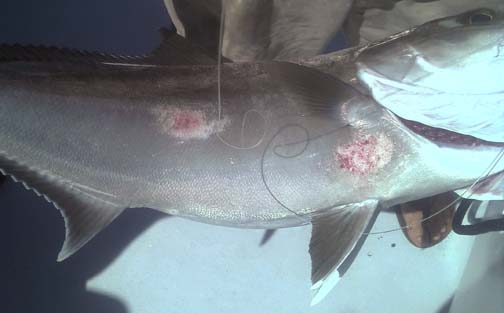
“I run a deep sea fishing business in Destin, Fl. I have been professionally fishing the Gulf since 1998. I'm 42 and grew up fishing the Gulf. I came across your Earthfiles website while searching for info on the sick fish in the Gulf. I have been catching sick fish with lesions. Before now, I have caught tens of thousands of fish and have never thrown one back because of skin lesions.
I took the attached photo on today's fishing trip. This is the first fish of the trip (Amberjack.) We caught 5 more AJ's all with lesions. NOAA is stating a one in 1500 chance of catching a sick fish. Today May 29, my catch ratio was 100% sick fish. My last trip Fri. May 27 we caught 8 AJ's, 5 with lesions.
Sick Amberjack with lesions caught by Gulf fisherman off Destin, Florida, on May 29, 2011. Five more Amberjacks caught with this one all had lesions. Image provided by Destin fisherman.
Click here to subscribe and get instant access to read this report.
Click here to check your existing subscription status.
“If it turns out booms are coming from a mile or two deep,
yeah, it's small earthquakes. But if the cause is determined to be
only about 100 feet deep, then something else is happening.”
- Clifford Thurber, Ph.D., Geophysicist, Univ. of Wisconsin-Madison
April 7, 2012 Washington, D. C. - A United States Geological Survey (USGS) research team headed by USGS geophysicist William Ellsworth, will be presenting their data at an upcoming Seismological Society of America meeting in San Diego, California, April 17 - 19. The presentations entitled, “Are Seismicity Rate Changes in the Midcontinent Natural or Manmade?”
Click here to subscribe and get instant access to read this report.
Click here to check your existing subscription status.
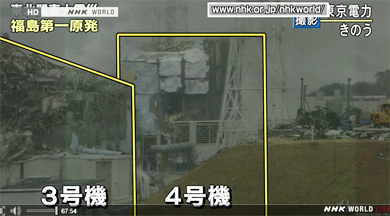
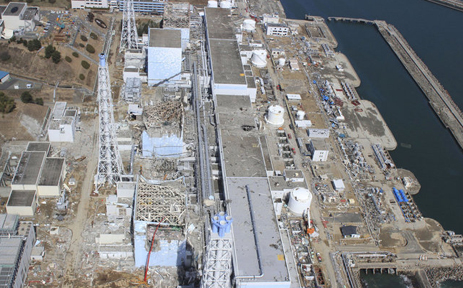
At Fukushima, the amount of long-lived, highly radioactive Cesium-137 is about 134 million curies — roughly 85 times the amount of Cs-137 released at the Chernobyl accident, as estimated by the U.S. National Council on Radiation Protection (NCRP).
“If an earthquake or other event were to cause this Unit 4 pool to drain, this could result in a catastrophic radiological fire involving nearly 10 times the amount of Cs-137 released by the Chernobyl accident.”
- Robert Alvarez, Senior Scholar, Inst. for Policy Studies
April 8, 2012 Fukushima, Japan - Japan’s former Ambassador to Switzerland, Mr. Mitsuhei Murata, was invited to speak about the Fukushima nuclear power plant disaster at a public hearing of the Budgetary Committee of the House of Councilors on March 22, 2012.
Click here to subscribe and get instant access to read this report.
Click here to check your existing subscription status.
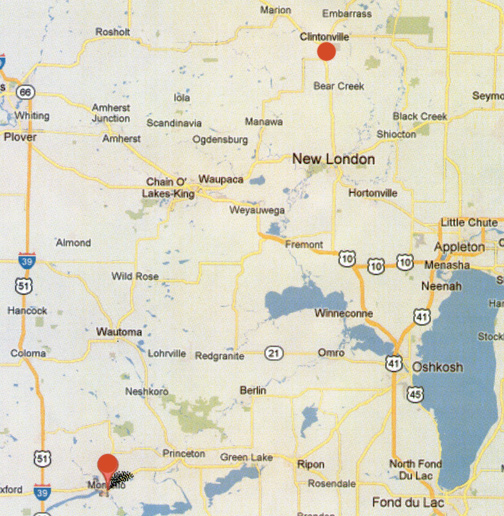
“Boom reports in Montello have been pretty much community wide.
We've checked with our typical sources such as utility companies and anybody maybe drilling or doing construction in the area and at this point in time we don't know what it is.”
- Richard Olson, Police Chief of Montello, Wisconsin
“Clearly it simply jolts you. It sounds like someone drops a piece of dynamite outside of the building you’re in. Or that something sort of exploded under the ground. ...We have checked gas lines, sewers, water pressures and consulted with meteorologists, seismologists, U. S. military, utilities experts and mining companies, but have come up empty-handed.”
- Lisa Kuss, City Administrator, Clintonville, WI
Beginning at 5:30 PM Central on Tuesday, March 20, 2012, in Montello, Wisconsin, about 80 miles southwest of Clintonville, residents called police about loud booms shaking their houses and rattling windows. University of Wisconsin-Madison Seismologist Harold Tobin said he was not aware of any seismic readings or reports near Montello.
Click here to subscribe and get instant access to read this report.
Click here to check your existing subscription status.
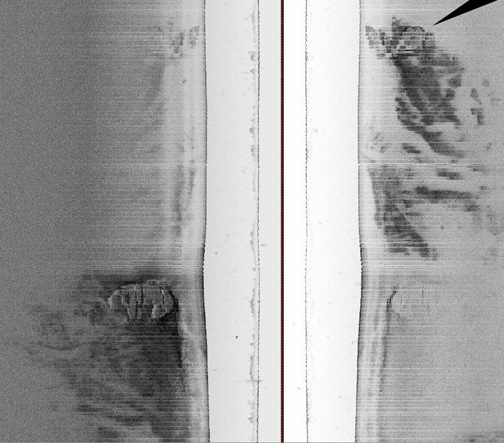
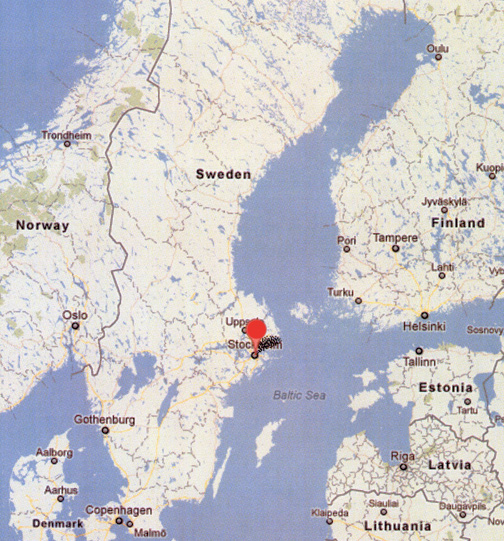
“In mid-May 2012, we are preparing an expedition with more sophisticated sonars, cameras and other equipment to hopefully determine what these strange objects are and if it is safe to try a dive to them.”
- Peter Lindberg, Co-Owner, Ocean Explorer, Stockholm, Sweden
March 30, 2012 Stockholm, Sweden - The Baltic Sea is a good preservative. The salt content is low and there are no wood-burrowing organisms. Andreas Olsson, Head of Archaeology at the Swedish Maritime Museum, estimates there could be 20,000 ship wrecks on the Baltic Sea floor. “It's like a ship wreck laboratory - the best in the world” where the cold, dark water has preserved sunken objects for centuries.
Click here to subscribe and get instant access to read this report.
Click here to check your existing subscription status.
“Early Saturday morning on March 17th, 2012, at 5:42 a.m., I was awakened by a single, very intense explosion. The concussion shook the building and was not accompanied by any other sound. Just one explosion that came from out of nowhere and then silence.”
March 30, 2012 Albuquerque, New Mexico - Since February 2012, Earthfiles has received an increasing number of loud, jolting boom reports from all over North America - and one report from Latvia. So, the March 18 to March 28, 2012, persistent booms in Clintonville, Wisconsin, are part of a larger pattern that are not explained by the March 20, 2012, small 1.5 magnitude quake that USGS recorded in the vicinity of Clintonville.
Click here to subscribe and get instant access to read this report.
Click here to check your existing subscription status.
“Tokyo soil samples would be considered nuclear waste in the U. S.”
- Arnie Gundersen, Nuclear Engineer, Fairewinds
The New York Times, March 29, 2012.
March 30, 2012 Burlington, Vermont - On March 29, 2012, The New York Times reported under a headline “Japan Admits Nuclear Plant Still Poses Dangers” that the “damage to the core of at least one of the meltdown-stricken reactors at Fukushima could be far worse than previously thought, raising fresh concerns over the plant's stability and gravely complicating the post-disaster cleanup.” The source is an internal investigation released this week by the Tokyo Electric Power plant operator, also known as TEPCO, is the manager of the Fukushima nuclear power planet. The TEPCO investigation has revealed that the Unit No. 2 reactor barely has water in the containment vessel that holds the radioactive fuel rods. Unit 2 has only two feet of water instead of the 33 feet its supposed to have to keep the fuel rods stable.
Click here to subscribe and get instant access to read this report.
Click here to check your existing subscription status.
“In many of these incidents the cats have been severed
almost perfectly in half with a sharp object.”
- Marcie Moriarty, Provincial SPCA Cruelty Investigations, March 23, 2012
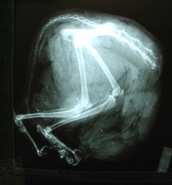
X-ray of back half of mutilated cat examined by veterinarian Cherie Good, D. V. M., in August 2003, found in Bothel, Washington, south of Vancouver, B. C., Canada. The half-cat phenomenon in the Vancouver region has been reported since at least the early 1990s. See Archive: 091203 Earthfiles.
March 24, 2012 Vancouver, B. C., Canada - Seven months ago the SPCA in Maple Ridge, B. C., Canada, east of Vancouver, reported between July 15 and September 15, 2011, that four cats were found dead and bloodlessly mutilated - including a cat's head removed. Other half cats had been found as early as June 2011, in this related ongoing round of cat attacks in the Vancouver region. The Royal Canadian Mounted Police (RCMP) also confirms that at least seven cats had been found cut in half in White Rock, Surrey and Langley in October 2010. See map below in this report and the Earthfiles Archive: 102810 Earthfiles.
Click here to subscribe and get instant access to read this report.
Click here to check your existing subscription status.