NASA’s Dangerous Juno Mission Will Soon Try to Reach 3,000 Miles from Jupiter’s Cloudtops Without Being Destroyed

“The scariest thing to me are the unknowns. So much about the Jupiter environment we will have to withstand is unknown. Nothing is certain about what's going to happen.”

- Planetary Scientist, NASA Jet Propulsion Laboratory, Pasadena, California

“Juno is only about one third the way through its primary mission, and already we are seeing the beginnings of a new Jupiter. These astonishing science results are yet another example of Jupiter’s curve balls, and a testimony to the value of exploring the unknown from a new perspective with next-generation instruments. Juno’s unique orbit and evolutionary high-precision radio science and infrared technologies enabled these paradigm-shifting discoveries.”

- Scott Bolton, Ph.D., Juno Principal Investigator, Southwest Research Institute, San Antonio, TX

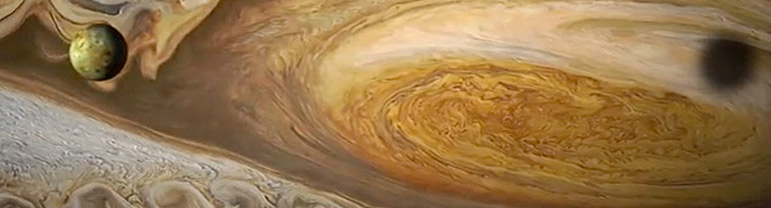
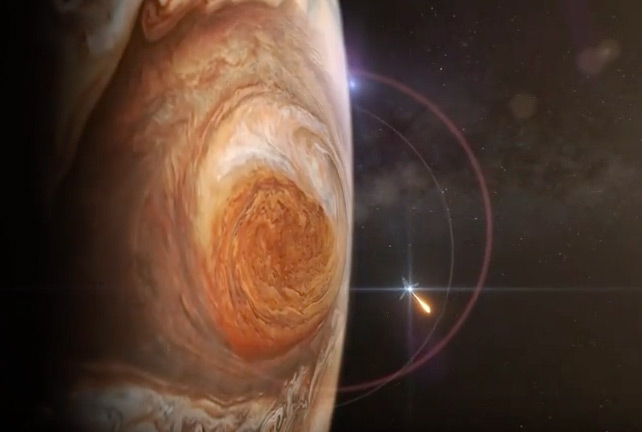
No other human-made spacecraft from Earth has tried to fly this deeply into Jupiter's radiation belts to reach 3,000 miles from Jupiter's cloudtops. No scientist knows what will happen. Illustration of NASA/JPL's Juno spacecraft on July 4, 2018, headed to 3,000 miles from Jovian cloudtops.

March 17, 2018 Pasadena, California - In less than four months, NASA/JPL's Juno spacecraft will try the closest approach of any Earth machine so far with the goal to penetrate the giant planet's radiation belts. Scientists are now trying to keep up with Juno's data stream as it approaches the strongest gravity and magnetic fields in our solar system. July 4th, 2018, will be a big unknown. Will Juno be able to enter orbit around the biggest gas planet in our solar system without being destroyed after seven and a half years to get there (August 5, 2011-July 4, 2018)? Scientists in charge of this unique effort are actually afraid of what could happen when Juno tries to get to 3,000 miles from Jupiter's cloudtops.


Click here to subscribe and get instant access to read this report.

Click here to check your existing subscription status.

Existing members, login below:
Cosmic Ray Radiation Is Dangerous and Getting Worse As Sun Is Often Spotless

“The radiation environment is worsening more rapidly than previously estimated. Over the last decade, the solar wind has exhibited low densities and magnetic field strengths, representing anomalous states that have never been observed during the Space Age.”

- Nathan Schwadron, Ph.D., Physicist, Univ. of New Hampshire

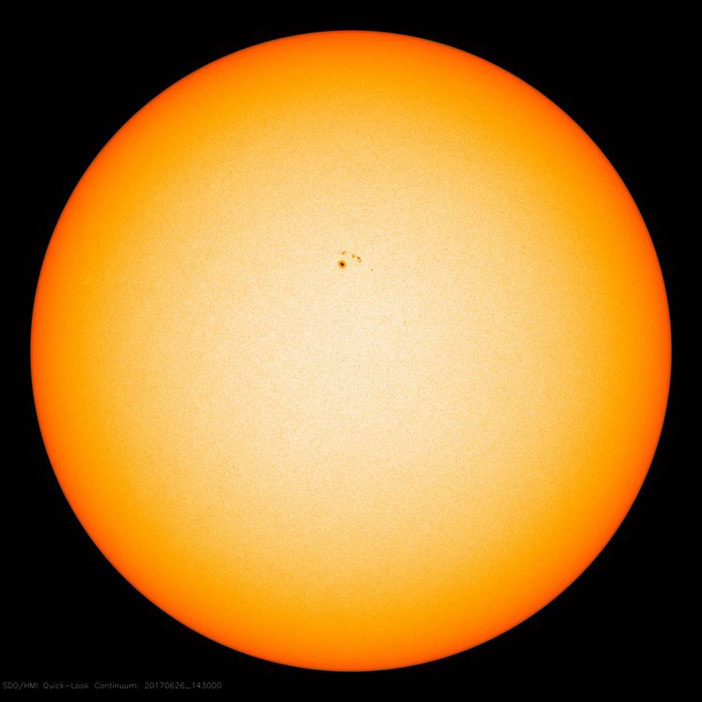
Eight months ago on June 26, 2017, our Sun had only one small sunspot region. In 2017, the sun was completely blank 25% of the year as that Solar Cycle 24 was historically weak with the lowest number of sunspots since the Solar Cycle 14 of 1906, 112 years ago. Image by NASA.

March 8, 2018 Durham, New Hampshire - In mid-February 2018, solar activity was as low as 2007 levels, which was one year before that solar minimum began. That's why solar physicists now project that the Solar Cycle 24 minimum leading up to Solar Cycle 25 will begin a year from now in the spring of 2019. Some solar physicists have even placed bets about whether low energy Solar Cycle 24 will keep extending into Solar Cycles 25 to 26 ending up in a Maunder Minimum of 1645 to 1715, when our Sun was blank without sunspots most of the time and coincided with a Little Ice Age.


Click here to subscribe and get instant access to read this report.

Click here to check your existing subscription status.

Existing members, login below:

Exoplanet Near Earth’s Nearest Star Might Have Been Scorched by Gigantic Solar Flare

“It’s likely that Proxima b was blasted by high energy radiation during this flare. Over the billions of years since Proxima b formed, flares like this one could have evaporated any atmosphere or ocean and sterilized the surface, suggesting that habitability may involve more than just being the right distance from the host star to have liquid water.”

- Meredith MacGregor, Ph.D., Astronomer, Carnegie Institution, Washington, D. C.

March 6, 2018 Albuquerque, New Mexico - A year ago on March 24, 2017, one of Earth's nearest stars beyond our own sun — Proxima Centauri — unleashed a solar flare that grew in brightness by 1,000 times in ten seconds compared to the normal Proxima Centauri sun. The enormous hot flare lasted for approximately one minute. All that heat and light must have scorched nearby exoplanet Proxima b, a planet 30% more massive than Earth, which orbits near Proxima Centauri.


Click here to subscribe and get instant access to read this report.

Click here to check your existing subscription status.

Existing members, login below:

Largest Genome Ever Sequenced: 32 Billion Base Pairs!

“We're just as excited as people were when they first decoded the human genome.”

- Elly Tanaka, Ph.D., Sr. Scientist, Research Institute of Molecular Pathology, Vienna, Austria

February 6, 2018 Albuquerque, New Mexico - Like a miracle creature, the axolotl amphibian salamander from Mexico is famous for “walking” on its cute arms and legs and being able to regrow those appendages if they get cut off, including bones, muscles and nerves. If the axolotl is wounded, it can heal without a scar. This amazing creature can even regenerate its own damaged internal organs. And if something crushes its spinal cord, the axolotl can restore its spinal cord to full function.


Click here to subscribe and get instant access to read this report.

Click here to check your existing subscription status.

Existing members, login below:

India’s First-Ever Moon Mission to Launch for Lunar South Pole in March 2018.

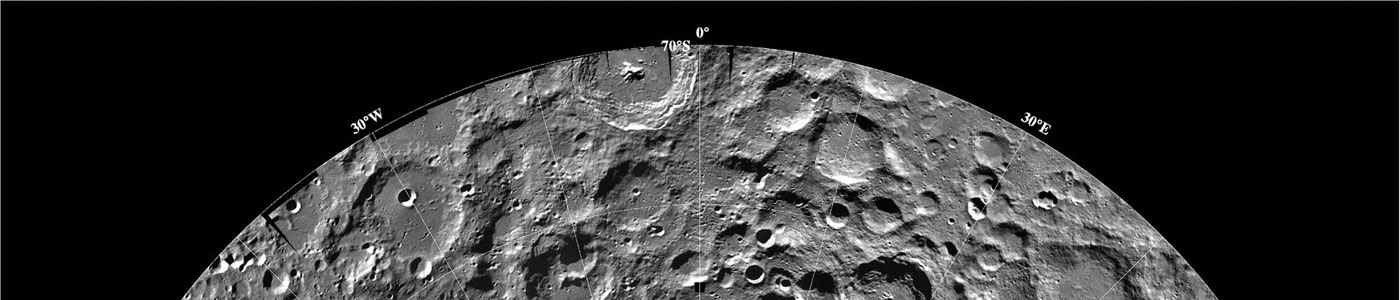
February 2, 2018 Albuquerque, New Mexico - The South Pole on our moon contains areas that never have darkness in lunar southern summers. For example, there is a hill in Shackleton crater that gets sunshine non-stop, “the most illuminated place on the moon,” by some estimates. That means permanent solar energy and those all-sun places are logical sites for moon bases. Who gets there and builds first is the question. China has plans to build a base in a year or two. But exploring the South Pole first could be India's claim to fame.


Click here to subscribe and get instant access to read this report.

Click here to check your existing subscription status.

Existing members, login below:

Part 2: Pentagon Wants to Use Nuclear Weapons Against Cyberattacks

“We could see an unprecedented number of false warnings being issued by cyber attacks. And think how upsetting that will be to people.”

- Scott Portzline, Three Mile Island Alert, Security Committee Chairman, Harrisburg, PA

Pentagon headquarters of the U. S. Department of Defense, January 2008.


Click here to subscribe and get instant access to read this report.

Click here to check your existing subscription status.

Existing members, login below:

Climate Warming Is Turning 99% of Baby Green Sea Turtles Female

“This blew our minds because no one had ever heard of anything like this in a vertebrate. ... I think we're going to look at the greatest drop in species diversity ever seen since man has been around.”

- Biologist David Owens, Ph.D. Emeritus, College of Charleston, SC

Rising temperatures on Raine Island, Australia, are causing 99%  of baby green sea turtles to be female because of the “shocking discovery of temperature-based sex determination.” Image by Australia Travel.

January 26, 2018 - Charleston, South Carolina - For centuries in ancient China, Indonesia, Bali, Australia, Hawaii and the Cayman Islands, the big and beautiful green sea turtles have been eaten as a delicacy and their skin tanned for handbags. All the hunting, poaching and egg harvesting have greatly reduced the turtle populations. And now another threat to their survival is coming in a bizarre way. Climate change is turning 99% of baby sea turtles into females. That means fewer and fewer males to fertilize females, so by the end of this century warming century, the green sea turtles could be facing extinction.


Click here to subscribe and get instant access to read this report.

Click here to check your existing subscription status.

Existing members, login below:

EARTHFILES