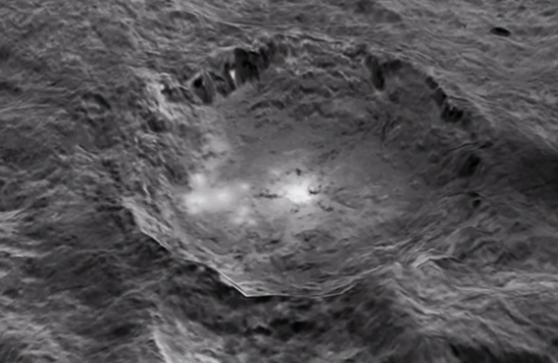
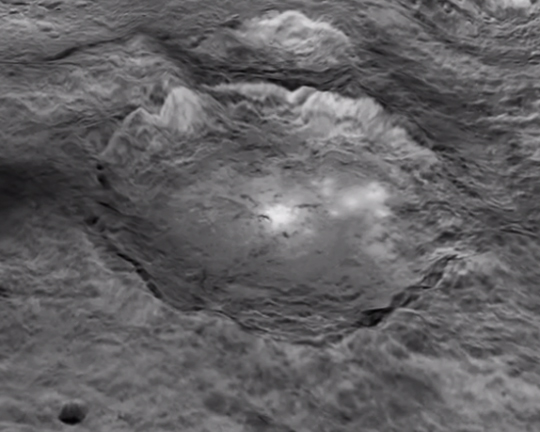
“Whether there is water in liquid or solid form underground on Ceres will depend not only on the (internal) temperature, but also on the specific composition of the materials that are dissolved in it.”
- Marc Rayman, Ph.D., Director, Dawn Mission, JPL/NASA, Pasadena, CA
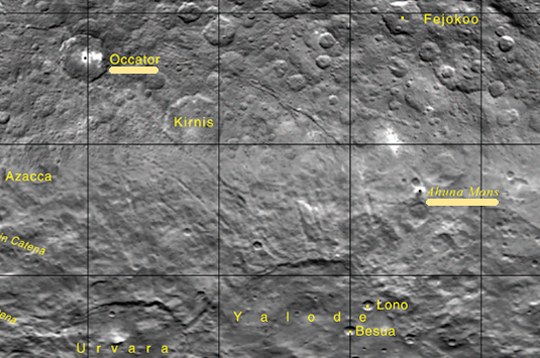
Upper left corner, underlined, is Occator crater north of the Ceres equator that has the bright, white spots that spectroscopic analysis suggests are "probably magnesium sulfate" like Epsom salts. Underlined on the far right south of the Ceres equator is Ahuna Mons, the only 4-mile-high mountain on the dwarf planet. Click to enlarge full Ceres map.
December 18, 2015 Pasadena, California - After spending August to October at 915 miles (1,470 km) above Ceres — that 600-mile-diameter dwarf planet between Mars and Jupiter — NASA's Dawn spacecraft on October 23rd fired up its ion engine to lower another 675 miles. In a couple of weeks by Christmas 2015, Dawn will be in its lowest and final mapping orbit of 240 miles above Ceres, photographing at a resolution of 120 feet (35 meters) per pixel. By 2016, the engine will run out of fuel and Dawn will then be a permanent, but non-working, satellite, orbiting Ceres.
Click here to subscribe and get instant access to read this report.
Click here to check your existing subscription status.
“There’s also a correlation between the times of comet impacts and large scale volcanism on the Earth. ...They are tens of thousands of times larger than the stuff that’s been coming out of Kilauea in the past 20 or 30 years.”
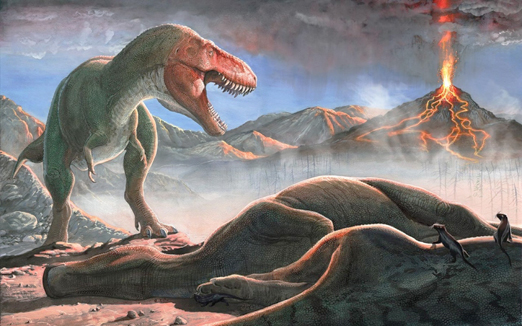
November 23, 2015 New York City, N.Y. - There was a “double whammy” of global volcanic agitation of Earth 66 million years ago at the same time that a 6-mile-wide outer space chunk of rock or ice slammed into the Gulf of Mexico creating the 12-mile-deep and 112-mile-wide Chicxulub crater that wiped out the dinosaurs.
Even more ancient back to 511 million years ago during the Early-Middle Cambrian, there was the first dramatic reduction in complex multicelluar life on Earth considered to be the first mass extinction. At that time, there were huge volcanic eruptions from the Kalkarindji volcanoes in Northern and Western Australia that covered 2 million square kilometers/ 772,204 square miles with deep lava.
Click here to subscribe and get instant access to read this report.
Click here to check your existing subscription status.
“The pyramid itself, yeah, it’s incredible that they did it and
it would be great to know how they did it. If there was an internal ramp,
how did it work? Will it tell us anything about how they turned the
corners with the blocks? That would be great to know!”
- John Coleman Darnell, Ph.D., Prof. of Egyptology, Yale University
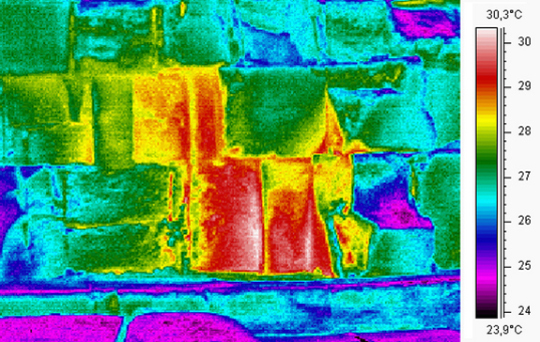
Thermal imaging of the Great Pyramid of Khufu or Cheops at Giza has revealed anomalies of an estimated 6-degrees-higher temperature in three of the highlighted limestone blocks above on the east side as well as in the upper half of the Great Pyramid. The thermal investigation began October 25, 2015, by the Scan Pyramid project. Additional thermal anomalies have been detected at the pyramid of Khafre as well as the Red and Bent Pyramids at Dahshur. Is there an opening behind these warmer stones? Image courtesy Scan Pyramids.This thermal scan shows that the temperature of three limestone blocks at ground level on the eastern facing side of the Great Pyramid is elevated by a few degrees, see scale on the right. Researchers say cause could be internal air currents, differences in the limestone or by an opening behind the wall. Thermal image courtesy Scan Pyramids.
November 20, 2015 New Haven, Connecticut - The Great Pyramid of Giza — also known as the Khufu Pyramid or Cheops (Greek name) — is the oldest and largest of the three big pyramids in the Giza compound outside Cairo, Egypt. Built some 4,560 years ago, the Great Pyramid was the tallest manmade structure in the world for nearly 4,000 years.
Click here to subscribe and get instant access to read this report.
Click here to check your existing subscription status.
“I think everything began 13 to 20 thousand years ago by the earliest settlers to the Middle East and Europe.”
- Dimitriy Dei, Kazakhstan archaeologist, who first discovered mysterious geoglyphs
“...I’ve never seen anything exactly like these.”
- Persis B. Clarkson, Ph.D., Prof. of Anthropology, Univ. of Winnipeg
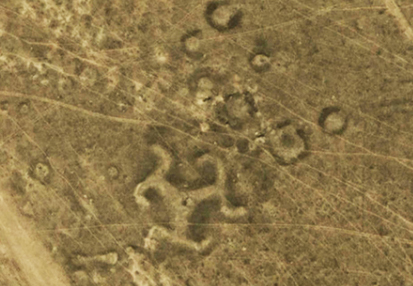
Turgay Swastika next to circles or rings first discovered in February 2007 by Kazakh archaeologist Dimitriy Dei. The 3-armed pattern is unusual, measures 90 meters in diameter, or 295 feet, and is estimated to be 7,000 to 8,000 years old. Google Earth image.
November 20, 2015 Greenbelt, Maryland - Kazakhstan is the ninth largest country in the world, larger than Western Europe, and extends from the Caspian Sea on the west to Mongolia on the east; from Russia in the north to Uzbekistan, Kyrgyzstan and China in the south. Kazakhstan was the second largest republic in Russia until the 1991 collapse of the U.S.S.R.
Kazakhstan has been inhabited for a long time and it is thought those people were the first humans to domesticate and ride horses. In fact, the name, Kazakhstan, is from an old Turkic word that meant “independent, a free spirit.”
Click here to subscribe and get instant access to read this report.
Click here to check your existing subscription status.
A 26-million-year-cyclical pattern has been linked to periodic motion
of our solar system through the dense mid-plane of the Milky Way galaxy.
“The correlation between the formation of these impacts and extinction
events over the past 260 million years is striking and suggests
a cause-and-effect relationship.”
- Michael Rampino, Ph.D., NYU Biologist
Illustration by David A. Hardy, astroart.org.
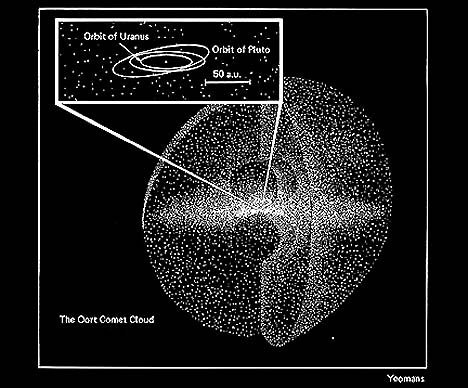
Earth solar system is where the two lines come together near the center of the Oort Cloud of comets, rocks and dust, emphasizing how much greater the icy comet-making region is beyond planets. The Kuiper Belt, another comet-making region, is closer to the planets. The distance from our Sun to the outer limits of the Oort comet cloud is about three trillion miles, or one-half a light year. Our nearest star, Alpha Centauri, is four light years away. Graphic courtesy Yeomans, University of Louisiana.
November 20, 2015 New York City, NY -99% of all the species on Earth that have ever lived are now extinct. Earth's history has been marked by periodic mass extinctions of this planet's evolving life forms. The dinosaurs thrived for about 135 million years until a 6-mile-diameter asteroid slammed into the Gulf of Mexico 66 million years ago leaving the 12-mile-deep and 112-mile-wide Chicxulub crater.
Click here to subscribe and get instant access to read this report.
Click here to check your existing subscription status.
“We do know that it takes weeks (for light blocker) to pass in front of the star. ... And the dimming is almost random. That suggests that whatever's blocking the star's light has a very complex structure. ... And there's a lot of them.”
- Jason Thomas Wright, Ph.D., Penn State Astronomer
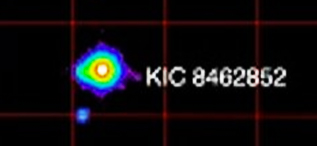
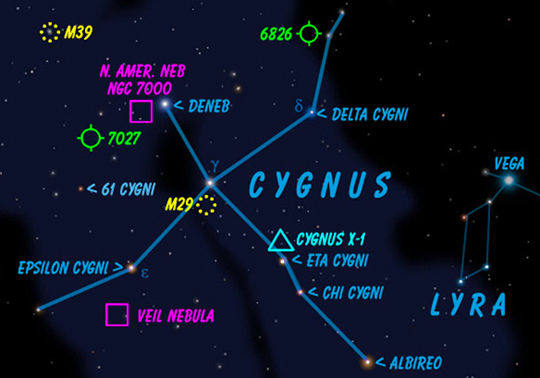
Star KIC 8462852 is 1,480 light-years from Earth between the Cygnus and Lyra constellations in our Milky Way galaxy in colorful star map below. Image by Kepler Space Telescope for Planet Hunters project/Tabetha Boyajian, Ph.D., Yale University astronomer.
October 28, 2015 University Park, Pennsylvania - Last week on October 22nd, senior scientist Gerald Harp at the Search for Extraterrestrial Intelligence Institute in Mountain View, California, reported to Universe Today: “We either caught something shortly after an event like two planets crashing together — or alien intelligence.” He was talking about a very strange star that astronomers call KIC 8462852. This large, mature star 1,480 light-years from Earth has the strangest star light dimming and brightening pattern of some 150,000 stars in the Milky Way Galaxy studied by the Kepler Space Telescope and Planet Hunters project. Kepler was launched by NASA on March 7, 2009, specifically to look for Earth-like planets orbiting other stars.
Click here to subscribe and get instant access to read this report.
Click here to check your existing subscription status.
Editor's Note: This Part 2 is about the Ceres 4-mile-high mountain from September 1, 2015, interview with Prof. Christopher Russell, UCLA, Principal Investigator of the Dawn Mission to Ceres. But as of this date, September 4, 2015, no new images or official NASA/JPL information have been released about the latest and lower 915 mile mapping orbit — except one August 19, 2015, aerial image (below report) of the mysterious 4-mile-high shiny, grooved mountain in the Ceres Southern Hemisphere
Since the NASA Dawn spacecraft entered its new, lower mapping orbit of 915 miles above the dwarf planet's surface, an embargo by the journal Nature is preventing the release of new images taken at the new lower 915 mile orbit above the Occator crater and its mysterious, persistent “bright spots.”
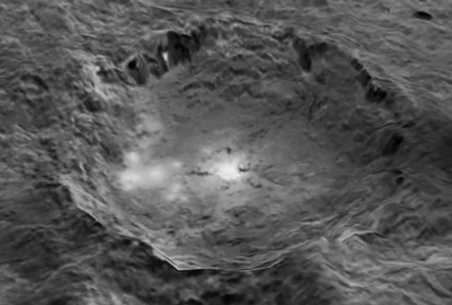
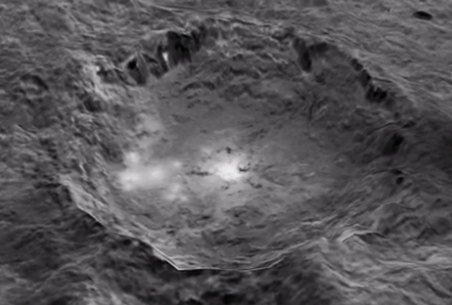
This July 2015 image was taken from 2,700 miles altitude in which the vertical relief was exaggerated by a factor of 5 generated by NASA to better highlight topography and subtle features. These intriguing Ceres bright spots are in a crater named Occator, which is about 60 miles (90 km) across and 2 miles (4 km) deep. Credits: NASA/JPL-Caltech/UCLA/MPS/DLR/IDA/LPI.
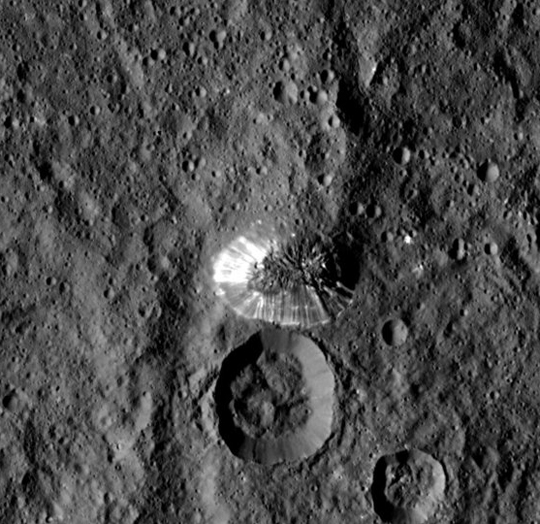
September 4, 2015 - Los Angeles, California- Part 2 continues the interview with Dawn Mission's Principal Investigator Christopher Russell, Ph.D., Professor of Geophysics and Space Physics, University of California-Los Angeles (UCLA), about the unique and singular 4-mile-high shiny, grooved mountain in the Ceres Southern Hemisphere that is an estimated 250 miles (400 km) from the Occator crater with the mysterious bright spots in the Northern Hemisphere.
NASA's Dawn spacecraft spotted this tall, conical mountain on Ceres from a distance of 915 miles (1,470 kilometers). The mountain, located in the southern hemisphere, stands 4 miles (6 kilometers) high. Its perimeter is sharply defined, with almost no accumulated debris at the base of the brightly streaked slope. Credits: NASA/JPL-Caltech/UCLA/MPS/DLR/IDA
Click here to subscribe and get instant access to read this report.
Click here to check your existing subscription status.
The NASA Dawn spacecraft is in a new, lower mapping orbit of 915 miles above the dwarf planet's surface, but an embargo by the journal Nature is preventing the release of new images taken closer to the Occator crater and its mysterious, persistent “bright spots.”
The intriguing bright spots on Ceres lie in a crater named Occator, which is about 60 miles (90 km) across and 2 miles (4 km) deep. This image was generated from July 2015 NASA animation using earlier images and Dawn spacecraft data from 2,700 miles altitude in which the vertical relief has been exaggerated by a factor of 5 to better highlight topography and subtle features. Credits: NASA/JPL-Caltech/UCLA/MPS/DLR/IDA/LPI
“We're now getting data from the VIR spectrometer, and I got a report
back yesterday that all of the data over the bright spot was obtained ...
but the white substance is still unidentified.”
- Christopher Russell, Ph.D., Dawn Mission's Principal Investigator, UCLA
September 3, 2015 - Los Angeles, California- The Dawn Mission's Principal Investigator is Christopher Russell, Ph.D., Professor of Geophysics and Space Physics at the University of California-Los Angeles (UCLA). Prof. Russell has spent fifteen years working on NASA's Dawn mission to the asteroid belt between Mars and Jupiter where Dawn first photographed asteroid Vesta and is now in a new mapping orbit around the enigmatic dwarf planet Ceres.
Click here to subscribe and get instant access to read this report.
Click here to check your existing subscription status.
“It looks to me like Cycle 25 is going to be not much bigger and probably smaller than Cycle 24. But I don't think anyone on the planet really knows.”
- David Hathaway, Ph.D., Solar Physicist, NASA Ames Research Centers, Moffett Field, California
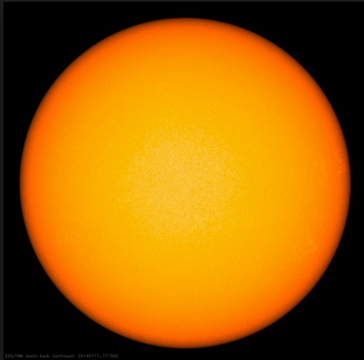
July 17, 2014, the sun facing Earth had no sunspots.
Will Solar Cycle 25 be normal? Or is our Sun headed for a no sunspot
Grand Minimum? Image by Solar Dynamics Observatory (SDO).
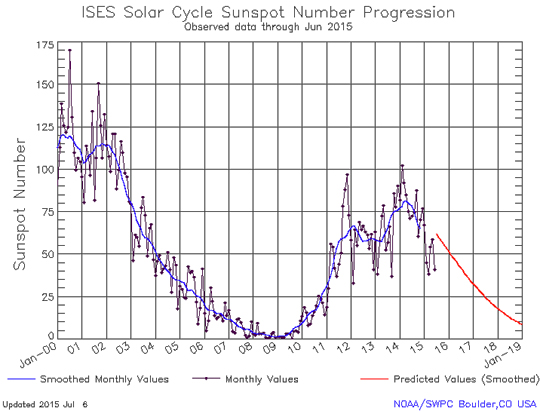
Solar Cycle 24 is the 24th solar cycle since 1755, when extensive recording of solar sunspot activity began. It is the current solar cycle, and began on January 4, 2008, but there has been minimal activity until early 2010. Solar Cycle 24 could break records as the lowest recorded sunspot activity since accurate records began in 1750. Graph by NOAA.
September 2, 2015 - NASA Ames, Moffett Field, California- On July 9, 2015, at a National Astronomy Meeting in the U. K.'s Llandudno, Wales, solar physicist Valentina Zharkova and colleagues from the U. K.'s Northumbria University, presented a computer model of solar activity projected some fifteen years into the future to the 2030s. Prof. Zharkova reported, “We found magnetic wave components appearing in pairs, originating in two different layers in the Sun’s interior. They both have a frequency of approximately 11 years, although this frequency is slightly different, and they are offset in time. Over the cycle, the waves fluctuate between the northern and southern hemispheres of the Sun. Combining both waves together and comparing to real data for the current solar cycle, we found that our predictions showed an accuracy of 97%,” said Zharkova.
Click here to subscribe and get instant access to read this report.
Click here to check your existing subscription status.
“Scientists have not yet determined what it is about the composition
or structure of the bright spots that is responsible for their extreme brightness. ...To discover their real nature, we need to get more data from lower altitudes.”
- Marc Rayman, Ph.D., Director, Dawn mission orbiting Ceres
The intriguing bright spots on Ceres lie in a crater named Occator, which is about 60 miles (90 kilometers) across and 2 miles (4 kilometers) deep. This image comes from recent NASA animation generated from Dawn spacecraft data in which the vertical relief has been exaggerated by a factor of 5 to better highlight topography and subtle features. Credits: NASA/JPL-Caltech/UCLA/MPS/DLR/IDA/LPI
August 9, 2015 Pasadena, California - NASA/JPL's DAWN spacecraft team now calls the Ceres crater of mysterious bright spots Occator (oh-KAH-tor), one of twelve “assistant gods” to Ceres of Greek lore. Occator is the one that harrows the ground with heavy metal breaking up dirt clods, removing weeds and covering seeds.
In an August 6, 2015, newly released NASA/JPL video produced from DAWN spacecraft's data, Marc Rayman, Dawn Mission Director, asks,“How can you not be mesmerized by those glowing spots?" (See 080615 NASA video below).
Click here to subscribe and get instant access to read this report.
Click here to check your existing subscription status.