
Fluorescence Mystery in Red Rain Cells of Kerala, India 

“ ...Organisms replicating at 300 degrees Celsius and showing this kind of autofluorescence are currently unknown to exist on earth, which is again an indication supporting the view that these cells are possibly extraterrestrial.”

- Godfrey Louis, Ph.D., Physics, Cochin University, Kerala, India
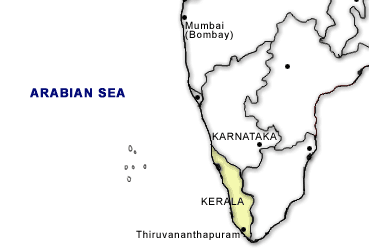
South of Bombay, the state of Kerala, India, is in the southwestern tip of the country bordered on the west by the Arabian Sea. Its capital is Thiruvananthapuram.  Map © by mapsofindia.com.
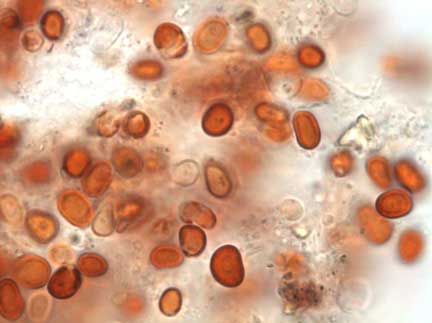
2001 summer, red and white cells collected from red rain that fell for first time on the state of Kerala, India. Photomicrograph © 2007 by Godfrey Louis, Ph.D.
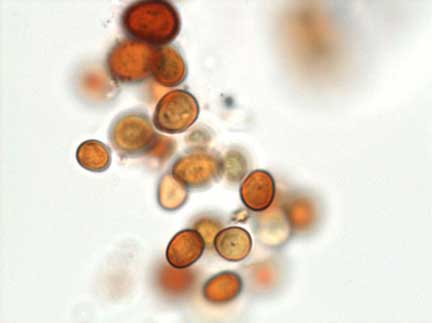
2006 summer, red and white cells collected from red rain that fell for a second time on the state of Kerala, India. Photomicrograph © 2007 by Godfrey Louis, Ph.D.
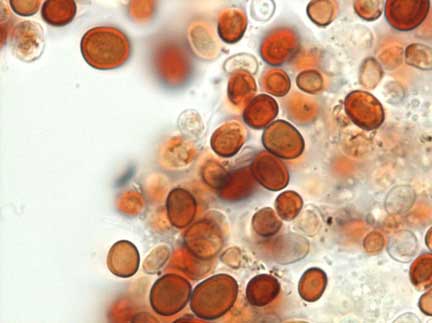
August 2007, red and white cells collected from red rain that fell for a third time on the state of Kerala, India. Photomicrograph © 2007 by Godfrey Louis, Ph.D.

February 14, 2009  Kerala, India   - Three years ago in the April 4, 2006, journal Astrophysics and Space Science was a published paper entitled: “The Red Rain Phenomenon of Kerala and Its Possible Extraterrestrial Origin.” Kerala is on the Malabar Coast in southwestern India. The astrophysical paper was about an event that occurred in July to September 2001 - and several summers since - when raindrops falling on Kerala stained peoples’ clothes. White T-shirts were covered with pinkish-red rain splatters and residents wondered what was happening?
 

Click here to subscribe and get instant access to read this report.

Click here to check your existing subscription status.

Existing members, login below:

Part 1: Nanodiamonds Link Outer Space Impactors to Earth Extinctions 12,900 Years Ago

“Nanodiamonds only form under very high temperatures and pressures consistent with a major cosmic impact event.”

- Douglas Kennett, Ph.D., Univ. of Oregon


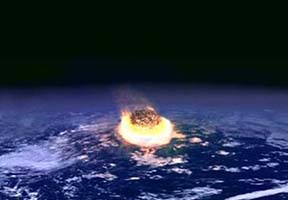
Illustration of outer space object headed for Earth impact.

January 29, 2009  Eugene, Oregon -  14,000 years ago, the last Ice Age was ending at the close of the Pleistocene. The Earth was warming up, forests began to grow back and large animals such as the Irish Elk and the Woolly Mammoth flourished in Europe and North America. In fact, temperatures were even warmer than they are today. North America was teeming with very large animals such as giant sloths, American lions and camels, saber-toothed tigers, mammoths and mastodons.


Click here to subscribe and get instant access to read this report.

Click here to check your existing subscription status.

Existing members, login below:

Part 2: Nanodiamonds Link Outer Space Impactors to Earth Extinctions 12,900 Years Ago

The danger of comets hitting Earth has not been adequately
addressed because we don’t know where most of them are. SOHO has
discovered 500 new comets in the last eight years!”

- Ted Bunch, Ph.D., Northern Arizona Univ.

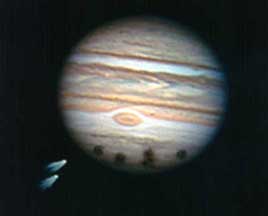
On lower left are two of the twenty-one comet fragments that impacted Jupiter's atmosphere leaving dark holes on July 16 to 22, 1994. Each impact mark is larger than Earth. This event was the only time in human history that comet fragment collisions with a planet has been witnessed and photographed. Image © 1994 by John Chumack, Galactic Images.

Return to Part 1.

January 29, 2009  Flagstaff, Arizona - Adding to the great mystery about what exactly happened 12,900 years ago to this planet, there have been discoveries of ancient animals in the permafrost of Arctic tundra such as woolly mammoths with undigested buttercups and grass in their frozen mouths and stomachs. The freezing of the mammoth animals was rapid and thorough.


Click here to subscribe and get instant access to read this report.

Click here to check your existing subscription status.

Existing members, login below:

Methane Mystery On Mars

“We observed and mapped multiple plumes of methane on Mars,
one of which released about 19,000 metric tons of methane.”

- Geronimo Villanueva, Ph.D., NASA Goddard

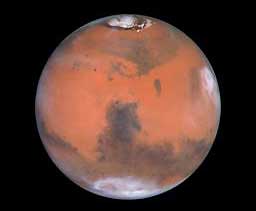
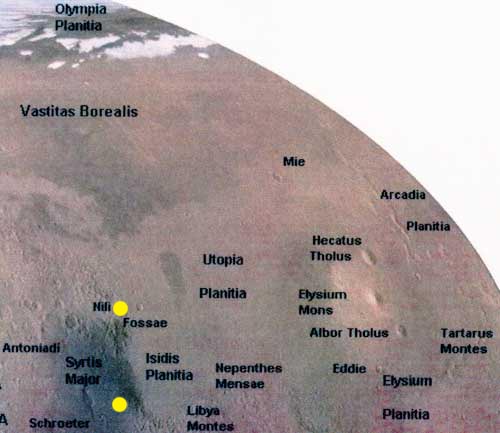
Dark central area is region of Syrtis Major Planum, locations of Nili Fossae and Syrtis Major ancient volcano, both emission sites of methane gas plumes. Image by Hubble.
Yellow circles at Nili Fossae and southeast quadrant of Syrtis Major, ancient volcano, mark where NASA and the European Space Agency (ESA) have measured large quantities of methane emissions since 2003. The persistent size of methane quantities imply a continually replenishing source. Is it geological? Or biological? Map created by Alwyn Botha, www.the-planet-mars-com.

January 25, 2009  Greenbelt, Maryland -  Methane on Mars was first detected in 1999 and 2001, and then has been measured in persistent quantities since 2003 over at least two “hot spots” in the Martian northern hemisphere shown on map above:


Click here to subscribe and get instant access to read this report.

Click here to check your existing subscription status.

Existing members, login below:

Carbonate Finally Found On Mars

“We know there’s been water all over the place, but how frequently have the conditions been hospitable for life? We can say pretty confidently that when water was present in the places we looked at, it would have been a happy, pleasant environment for life.”

- John Mustard, Ph.D., Geological Sciences, Brown University

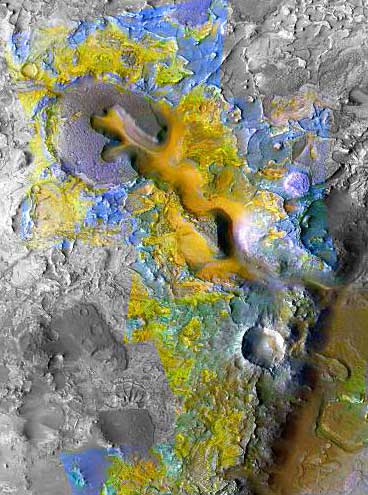
NASA's Mars Reconnaissance Orbiter has finally found carbonate minerals on Mars that show up as green in the above image of a 12-miles-wide region in Nili Fossae on the edge of the Isidis impact basin. Scientists hypothesize the carbonates might have formed at the surface when olivine-rich rocks were exposed and altered by running water. Image courtesy NASA/JPL/JHUAPL/MSSS/Brown University.

December 20, 2008  San Francisco, California -  At the annual American Geophysical Union Fall 2008 meeting held in San Francisco from December 15 to December 19, Brown University graduate student, Bethany Ehlmann, reported finding the mineral carbonate on Mars, increasing the chances that life might have existed on the red planet in the past when there was a less acidic watery surface. Carbonates result from carbon dioxide dissolved in water.


Click here to subscribe and get instant access to read this report.

Click here to check your existing subscription status.

Existing members, login below:

Solar Wind Pressure Lowest in 50 Years

“The entire sun is blowing solar wind significantly less harder, about 20% to 25% less harder and 13% lower temperature, than it was during the previous solar minimum a decade ago. ...Over the entire record of solar wind observations (about 50 years), this is the lowest prolonged pressure that we’ve ever observed.”

– Dave McComas, Ph.D., Solar Wind Principal Investigator, Ulysses


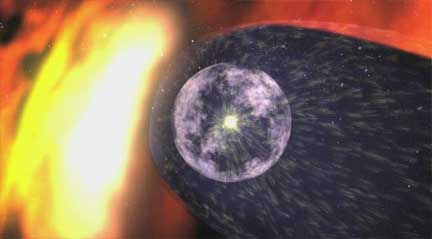
Sun depicted as bright white-yellow object on left blowing off electrons, protons and some heavy ions at nearly 1 million mph (400 kilometers/second) past the earth and out through the solar system. NASA's and ESA's Ulysses spacecraft has measured the pressure of the solar wind decreasing 20% to 25% since 1990. Implications for Earth and solar system are unclear. Graphic illustration by NASA Goddard Space Flight Center.

September 23, 2008  Pasadena, California - NASA produced a media teleconference today with Ulysses spacecraft scientists to announce, “The entire sun is blowing significantly less hard, about 20% to 25% less hard, than it was during the previous solar minimum a decade ago and its solar wind temperature has lowered 13%.” Ulysses is the first spacecraft from Earth to orbit around the poles of the sun. Since its launch on October 6, 1990, from the Space Shuttle Discovery (mission STS-41) as a joint venture of NASA and the European Space Agency, Ulysses has completed almost three orbits around the sun's poles that began with the 1990 solar minimum, included the 2000 solar maximum and is running out of heat and power as it nearly completes a third orbit during this 2008 solar minimum that has had a prolonged period without sunspots.


Click here to subscribe and get instant access to read this report.

Click here to check your existing subscription status.

Existing members, login below:

Part 2: Getting Close to the “Big Bang” Inside Large Hadron Collider?

“The discovery of Higgs boson particles would be the discovery
of a new force of Nature and the first one we will have seen in over a century.”

- Joseph Lykken, Ph.D., Fermi Lab Particle Physicist


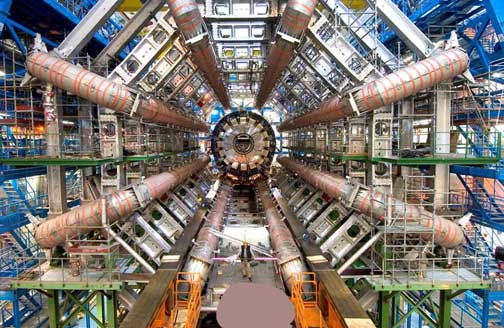
Looking straight down a segment of the 17-mile-long circular  Large Hadron Collider accelerator. Image courtesy CERN LHC.
Looking straight down a segment of the 17-mile-long circular Large Hadron Collider accelerator. Image courtesy CERN LHC.
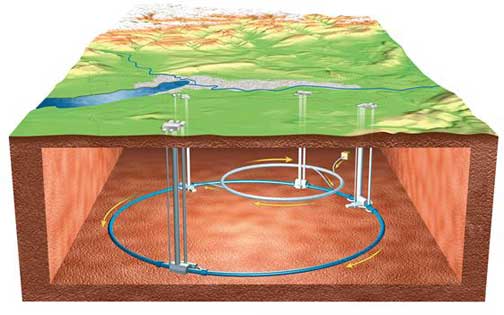
 This computer-generated image shows the location of the 17-mile-long (27 km)  Large Hadron Collider (LHC) tunnel (in blue) about 300 feet down on the Swiss-France border. The four main experiments (ALICE, ATLAS, CMS, and LHCb) are located in underground caverns  connected to the surface by 50 meter to 150 meter pits. Part of the pre-acceleration  chain is shown in grey. Illustration courtesy CERN LHC.
This computer-generated image shows the location of the 17-mile-long (27 km) Large Hadron Collider (LHC) tunnel (in blue) about 300 feet down on the Swiss-France border. The four main experiments (ALICE, ATLAS, CMS, and LHCb) are located in underground caverns connected to the surface by 50 meter to 150 meter pits. Part of the pre-acceleration chain is shown in grey. Illustration courtesy CERN LHC.

Return to Part 1

September 9, 2008  Batavia, Illinois -

Composition of Universe  ­     .4% glowing matter such as stars.­   3.6% “normal” matter as we know it in planets and stars.­ 22.0% cold, invisible “dark matter” detectable only by its gravitational influence on normal matter.­ 74.0% invisible “dark energy.”


Click here to subscribe and get instant access to read this report.

Click here to check your existing subscription status.

Existing members, login below:

Still No Sunspot Action on the Sun

“I am surprised that if it’s going to be big solar cycle 24, it’s taking this long for sunspots to get started.”

- David Hathaway, Ph.D., Solar Physics Team Leader,
NASA Marshall Space Flight Center, Huntsville, Alabama


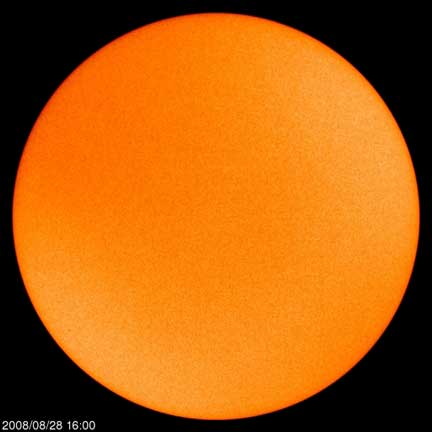
No sunspots on sun, August 28, 2008, and the sun has been going spotless for weeks at a time. The minimum of solar cycle 23 was 1996 and NASA says solar cycle 24 began on December 11, 2007 (see images below). Image courtesy SOHO.
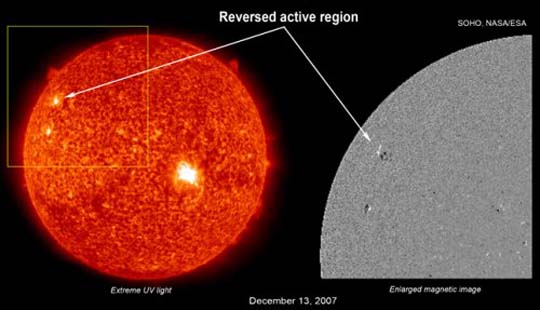
On left, is Extreme UV-wavelength image of the sun and on right, a B&W magnetogram showing positive (white) and negative (black)  magnetic polarities. On December 11, 2007, this new high-latitude active solar region was magnetically reversed from sunspot magnetic directions in the previous Solar Cycle 23. So, this new sunspot officially marks the beginning of Solar Cycle 24.  Images courtesy SOHO/NASA/ESA.

August 29, 2008  Huntsville, Alabama - On July 11, 2008, NASA headlined one of its press releases as, “What's Wrong with the Sun? (Nothing).” The featured scientist in the news release was solar physicist David Hathaway, Ph.D., Solar Physics Team Leader, NASA Marshall Space Flight Center in Huntsville, Alabama. Dr. Hathaway received his Ph.D. in Astrophysics from the University of Colorado - Boulder in 1979.


Click here to subscribe and get instant access to read this report.

Click here to check your existing subscription status.

Existing members, login below:

EARTHFILES