Click here to subscribe and get instant access to read this report.
Click here to check your existing subscription status.
Existing members, login below:

Reported and Edited by Linda Moulton Howe
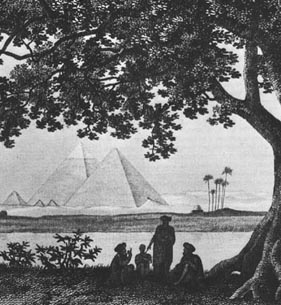
September 25, 2002 Boston, Massachusetts - In ancient Egyptian cosmology, after the moment of death there came existence in the afterlife where joys of earthly existence were duplicated. One of the "machines" to get to that heaven was the Great Pyramid of Cheops built 4,500 years ago for King Khu-fu in the 4th Dynasty on the Giza plateau near Cairo. Some have called the pyramid a launching pad for the King's "ka," or soul, to travel to the circumpolar stars in the north, known as the "imperishable ones," and to the star Sirius and Orion constellation in the south where Osiris, King of the Dead, reigned eternal. In a paradoxical way, the Egyptians thought that whatever worked in this life would not work in the afterlife. So, in the burial chambers of noblemen, they carved doors out of stone with locks that no human could use, but the ka of the dead could move into and through the symbolic stone doors in a kind of Alice In Wonderland way to activate life in the opposite hereafter.
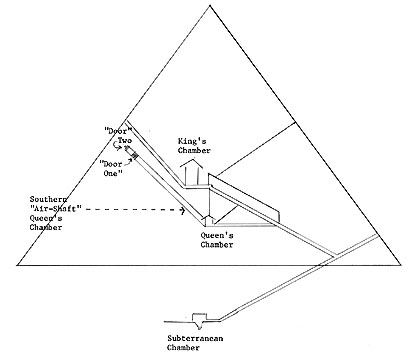
September 21, 2002 Washington, D. C. - On Monday night, September 16, 2002, a television program co-produced by the Fox network and National Geographic was broadcast live from the great Cheops pyramid near Cairo, Egypt. The title was Pyramids Live: Secret Chambers Revealed. The goal was to have the television audience, Egyptologists and other scientists discover at the same time what was behind the little Tura limestone "door" bearing two small copper handles that blocks the southern "air-shaft" which extends from the so-called Queen's Chamber below the King's Chamber. Egyptologists generally agree now that since the Queen had her own burial pyramid, the chamber below the King's Chamber must have had another purpose.
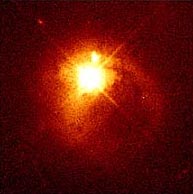
September 7, 2002 Charlottesville, Virginia - A billion light years from earth there is a very bright quasar known as JO841+1842. Quasars give off enormous energy from great distances. Tomorrow, Sunday, September 8, Jupiter in our solar system will pass very close to the light's path from that quasar.
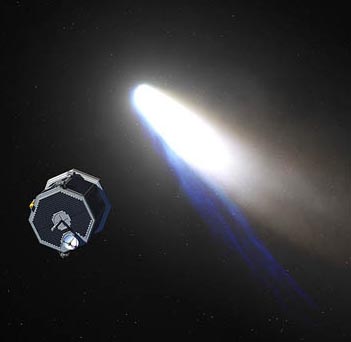
NASA UPDATE ON AUGUST 26, 2002:
"On Aug. 15, CONTOUR's STAR 30 solid-propellant rocket motor > was programmed to ignite at 4:49 a.m. EDT, giving CONTOUR > enough boost to escape Earth's orbit. At that time, CONTOUR > was about 140 miles above the Indian Ocean and out of radio > contact with controllers. The CONTOUR mission operations team > at APL expected to regain contact at approximately 5:35 a.m. > EDT to confirm the burn, but NASA's Deep Space Network (DSN) > antennas did not acquire a signal. > > Since then, there has been no contact with CONTOUR. Commands > pre-programmed into the spacecraft's flight computer system, > designed to instruct the spacecraft to try various alternate > methods of contacting Earth when contact is lost, also have > not worked to date. > > Images from a Spacewatch ground-based telescope at Kitt Peak, > Ariz., show three objects at the location where CONTOUR was > predicted to be, images which may indicate the spacecraft has > broken apart. Mission controllers at APL will continue > listening for signals from the spacecraft periodically until > early December, when CONTOUR will come into a more favorable > angle for receiving a signal from Earth."
August 16, 2002 Laurel, Maryland - Late this afternoon at Johns Hopkins University's Applied Physics Laboratory (JHUAPL), Dr. Robert Farquhar, Mission Director for the Comet Nucleus Tour (CONTOUR), teleconferenced with reporters about the status of the missing CONTOUR spacecraft. CONTOUR's STAR 30 solid-propellant rocket motor was programmed to ignite at 4:49 a.m. EDT yesterday, August 15, to launch the probe out of Earth orbit onto a trajectory to study two or three comets over the next few years. At that burn time, CONTOUR was over the Indian Ocean at 140 miles (225 kilometers), too low for NASA's Deep Space Network stations to track the spacecraft during the burn. All systems seemed to be OK going into the burn, but 45 minutes later when the JHUAPL mission operations team tried to regain contact with the probe, no signal was received.
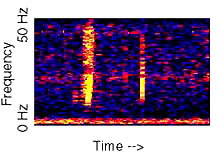
June 30, 2002 Woods Hole, Massachusetts - The June 13, 2002 issue of New Scientist featured an article by reporter John von Radowitz in London about an underwater sound deep in the ocean recorded in 1997 by NOAA scientists that remains unidentified. The "Bloop" was detected and recorded from an array of underwater hydrophones (microphones) originally set up by the U. S. Navy in the 1960s to track Soviet submarines. The listening technology is distributed in a deep ocean level known as the "sound layer" which marine animals such as whales and human technology such as submarines use for long-range communication.
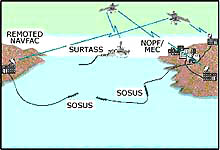
The "Bloop" was detected by hydrophones up to 4,800 kilometers apart (2,983 miles). That is a long distance for a single sound to be heard. Thus, speculation began about what the "Bloop" might be. The New Scientist article stated that the great distance it covered "meant it had to be much louder than any recognized animal noise, including that produced by the largest whales."
Recently, NOAA scientist Chris Fox who originally recorded the "Bloop," sent one recording to Dr. Phil Lobel, a marine biologist at the Woods Hole Laboratory in Massachusetts and a Professor of Marine Biology at Boston University. Dr. Lobel studies underwater sounds made by fish and other marine animals. I asked him what he thought the Bloop could be.
"We are talking about a global disaster of apocalyptic dimensions if an asteroid that size were to hit us."
Benny Peiser, Ph.D., Liverpool John Moores University, U. K.
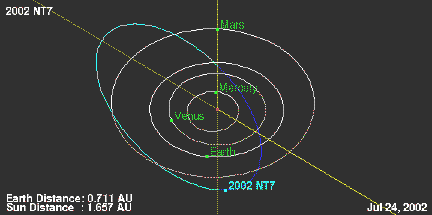
July 25, 2002 Liverpool, England - The newly discovered potential threat to the earth in another seventeen years is known by scientists as "Asteroid 2002 NT7." It was discovered on July 9, 2002 by researchers from M.I.T. (Massachusetts Institute of Technology) and the Lincoln Near Earth Asteroid Research (LINEAR) project funded by the United States Air Force and NASA. The goal of the LINEAR program is to demonstrate the application of technology, originally developed for the surveillance of earth orbiting satellites, to the problem of detecting and cataloging Near Earth Asteroids (also referred to as Near Earth Objects, or NEOs) that threaten the Earth.
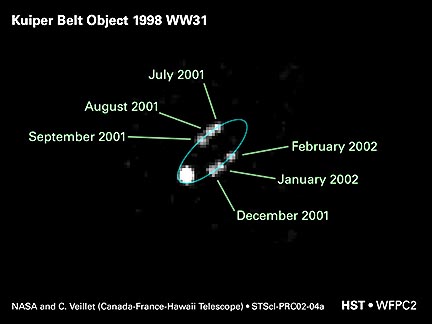
July 11, 2002 Baltimore, Maryland One of the most recent discoveries in our solar system, NASA reports, is an "intriguing new class of objects, dim and fleeting, which travel in pairs in the frigid, mysterious outer realm of the solar system called the Kuiper Belt." These Kuiper Belt Objects (KBOs), inhabit a region that begins around Neptune and extends out more than nine billion miles. At least half of the short-period comets that come through the solar system, around the sun and back out again are from the Kuiper Belt, named after astronomer Gerard P. Kuiper who headed the Lunar and Planetary Laboratory at the University of Arizona until his death in 1973.
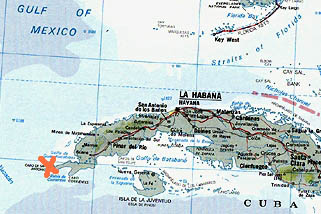
"They (megalithic stones) are very unique structures. They really are not easy to understand and I do not have any easy explanation for them in a natural geological process."
Manuel Iturralde-Vinent, Ph.D., Geologist, National Museum of Natural History, Havana, Cuba
July 10, 2002 Havana, Cuba A year ago in May 2001, I first reported at Earthfiles.com the startling comments made by ocean engineer, Paulina Zelitsky in Havana, Cuba about her finding earlier in 2000 "possibly a sunken city built in the pre-classic period and populated by an advanced civilization similar to the early Teotihuacan culture of Yucatan. ...Researchers using sonar equipment have discovered at a depth of about 2,200 feet (700-800 meters) a huge land plateau with clear images of what appears to be urban development partly covered by sand. From above, the shapes resemble pyramids, roads and buildings." (See Earthfiles May 18, 2001.)
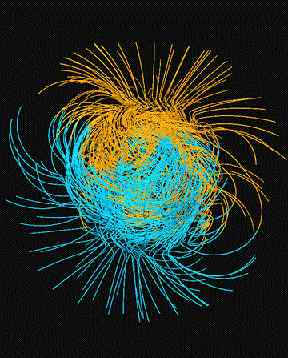
April 27, 2002 Cambridge, Massachusetts - Deep beneath our feet as we walk around in fact, 4,000 miles down is the center of the earth where an iron core is so hot it is liquid and boils around like cooking porridge. That moving, melted iron also produces the magnetic fields that surround the earth and upon which much of earth's surface life, satellites and space technology depend upon for orientation, and for protection. If magnetic fields did not trap highly energetic particles racing from the sun, all kinds of damage could be done to living organisms and space technologies. For nearly a million years, magnetic field lines have been coming out of the south pole and entering the north pole of the earth. That is called the magnetic dipole.