





Part 3: Mars, A Sulfate Salty Planet – Could It Have Sulfate-Loving Microbes?

Mars and deep gash of Valles Marinaris, largest canyon in the solar system,by the Hubble Space Telescope.

March 5, 2004  Pasadena, California - When the Opportunity rover's rock abrasion tool (RAT) drilled a hole in a piece of Martian bedrock called "McKittrick" in late February, NASA/JPL scientists were surprised that the sulfur content jumped up four times higher than the amount registered on the surface of the rock. When the rover moved over to another piece of bedrock called "Guadalupe," the sulfur amount jumped up to five times more than measured in the soil. At this week's NASA press conference in Washington, D. C., respected geochemist, Benton C. Clark, member of the Mars Explorer Rover (MER) science team and Chief Scientist of Space Exploration at Lockheed Martin said, "This supposed rock now looks like it is a chemical sediment." Sedimentation of high concentrations of sulfur and sulfate salts on earth means solution in water, the water evaporated, and left the salts.


Click here to subscribe and get instant access to read this report.

Click here to check your existing subscription status.

Existing members, login below:
Part 2: Scientific Challenge of Identifying Substances in the Martian World

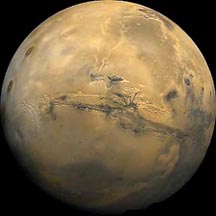
Mars, with its icy poles, photographed  by the Hubble Space Telescope.
Mars, with its icy poles, photographed by the Hubble Space Telescope.

March 3, 2004  Pasadena, California - At the March 2, 2004, NASA press conference in Washington, D. C., I learned from German geologist, Goestar Klingelhoefer, Ph.D., that his Mossbauer spectrometer needs an area of about 1.5 centimeters in order to get accurate readings about iron and other elements. Very small objects such as the many unidentified spherules, or "blueberries," at the Opportunity Meridiani Planum site are too small for the Mossbauer to get an accurate reading on one, or even a few. The spherule diameters range from 1 to 5 millimeters. To date, what those mysterious little balls are made of is still a mystery.So, in the next couple of weeks, it is hoped that the Opportunity rover can put its robotic arm and various sensors - including the Mossbauer - down against a concentration of the spherules. The idea is that the instruments would then have a dense, larger area in which to take measurements.


Click here to subscribe and get instant access to read this report.

Click here to check your existing subscription status.

Existing members, login below:

Opportunity Grinds Bedrock; Spirit Ready to Grind “Humphrey”

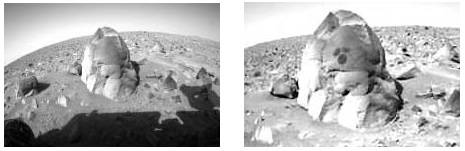
Left: Spirit rover approaches big Martian rock called "Humphrey" to dust off in triad pattern and analyze before grinding. Right: Triad pattern after Spirit's dusting shows dark rock beneath lighter dust. Images by Front Hazard Camera Non-linearized Full frame EDR acquired on Sol 55 of Spirit's mission to Gusev Crater at approximately 13:48:37 Mars local solar time. Image credit: NASA/JPL.

March 1, 2004  Pasadena, California - Nasa reports that the Spirit rover: "...used its rock abrasion tool for brushing the dust off three patches of a rock named "Humphrey," during its 55th sol on Mars, ending at 5:53 p.m. Saturday, PST. Before applying the wire-bristled brush, the rover inspected the surface of the rock with its microscope and with its alpha particle X-ray spectrometer, which identifies elements that are present. Brushing three different places on a rock one right after another was an unprecedented use of the rock abrasion tool, designed to provide a larger cleaned area for examining.


Click here to subscribe and get instant access to read this report.

Click here to check your existing subscription status.

Existing members, login below:
Part 3: UFO Crash/Retrievals: The Inner Sanctum – Status Report VI © July 1991 by Leonard H. Stringfield

© July 1991 by Leonard H. Stringfield

With permission, reprinted in Earthfiles.com © 2004 by Linda Moulton Howe.

Click here to see Part 1 of Status Report VI

To be more computer-friendly, the reprint has been divided into parts. Here begins Part 3 of Status Report VI, from July 1991. These status reports were written by Leonard H. Stringfield from 1978 to 1994. Status Report VII begins at Earthfiles 12/15/03. Leonard Stringfield died on December 18, 1994.

Len Stringfield - continued:

Roswell is a small town's name in New Mexico, adjacent to the old air base known as Roswell Air Field to its south. Both town and base are 75 miles away from the Max Brazel ranch near the still smaller town of Corona. There, allegedly, an alien saucer with its crew crashed on July 2, 1947. (Dates vary). Niched in history because of that event, Roswell will become even more enshrined when new evidence will be released in 1991 in two books. One entitled, UFO Crash At Roswell is co-authored by Don Schmitt, Director of Special Investigations for CUFOS, and Kevin Randle, Captain, USAF Reserves. The other is by scientist Stanton Friedman and aviation writer, Don Berliner. All four are battle-tested UFO researchers. And lest we forget, it was Bill Moore (and co-author Charles Berlitz) with Stan Friedman whose spadework investigations put the "Roswell Incident" on the map in a book of that title published in 1980.)


Click here to subscribe and get instant access to read this report.

Click here to check your existing subscription status.

Existing members, login below:
Abrupt Climate Change: Scenario from A Pentagon-Commissioned Report

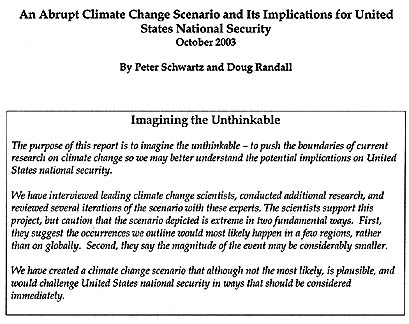
Title page of futurist study commissioned by the Pentagon's Office of Net Assessment, finalized in October 2003 and leaked via media on February 22, 2004.
Title page of futurist study commissioned by the Pentagon’s Office of Net Assessment, finalized in October 2003 and leaked via media on February 22, 2004.

February 27, 2004  New York City, New YorkOne year ago at the Office of Net Assessment in the Pentagon, its director – Andrew Marshall – read the 2002 National Academies of Sciences study entitled Abrupt Climate Changes: Inevitable Surprises. Scientists have been warning for years that uncontrolled build up of carbon dioxide around the Earth could heat up the planet so much that drought, flooding, high winds, more severe storms, food shortages and wars over water might result. However, global warming and potentially rapid climate change have been controversial and politically unacceptable to discuss in this current Bush Administration which has also rejected proposals to control carbon dioxide emissions.
Click for report.

Part 2: UFO Crash/Retrievals: The Inner Sanctum – Status Report VI © July 1991 by Leonard H. Stringfield


© July 1991 by Leonard H. Stringfield With permission, reprinted in Earthfiles.com © 2004 by Linda Moulton Howe. 

Click here to see Part 1 of Status Report VI

To be more computer-friendly, the reprint has been divided into parts. Here begins Part 2 of Status Report VI, from July 1991. These status reports were written by Leonard H. Stringfield from 1978 to 1994. Status Report VII begins at Earthfiles 12/15/03. Leonard Stringfield died on December 18, 1994.

Len Stringfield - continued:

Cloak and Dagger Drama at MUFON Conference, Dayton, Ohio, July 29, 1978

After a brief interlude with TV newsmen for a prearranged interview and still under heavy guard, I was taken to my room. Before I could order a sandwich, I was told that I was being transferred to another room. Out went my luggage and in came a lady's wardrobe on a pushcart. Fast work, indeed. Before one of the plainclothesmen departed, he advised, "Stay in your room until notified."

Minutes later, I was visited by my friend with the CIA connection. Concerned by the threats, he phoned his contact and was reminded that he had been advised there would be trouble. No further explanation. About 15 minutes later, another visitor with official credentials joined by a known friend in research, requested a copy of my paper and the tape of the UFO crash witness. Still later, I learned that one of my medical informants, associated with the doctor who had performed an autopsy on an alien body, came to my vacated room and left a note under the door which was never delivered.


Click here to subscribe and get instant access to read this report.

Click here to check your existing subscription status.

Existing members, login below:

Is There Liquid Water on Martian Surface?

 OMEGA, the combined Mars Express camera and infrared spectrometer, observed the southern polar cap of Mars on January 18, 2004, as seen on all three bands. Left: H2O, water ice. Middle: CO2, carbon dioxide. Right: Visible image of Martian south pole. Images credit: European Space Agency (ESA).
OMEGA, the combined Mars Express camera and infrared spectrometer, observed the southern polar cap of Mars on January 18, 2004, as seen on all three bands. Left: H2O, water ice. Middle: CO2, carbon dioxide. Right: Visible image of Martian south pole. Images credit: European Space Agency (ESA).
South Pole of Mars - Is there melt in the water and carbon dioxide ice? Image courtesy Malin Space Science Systems.
 North and south poles of Mars are icy. Photo courtesy Hubble Space Telescope.
North and south poles of Mars are icy. Photo courtesy Hubble Space Telescope.

February 23, 2004  Pasadena, California - The stated goal of the Mars rover missions is to look for evidence of water that might once have flowed in rivers, pooled in lakes, or even created an ocean on the red planet. Photographs like the branching delta below taken by the Mars Orbiter Camera suggest a large flow of water.


Click here to subscribe and get instant access to read this report.

Click here to check your existing subscription status.

Existing members, login below:

New Form of Mad Cow Disease Resembles Human Creuzfeldt-Jakob Disease (CJD)

British cow infected by deadly misshapen proteins called prions which cause "Mad Cow" disease, also known as Bovine Spongiform Encephalopathy (BSE). Cow brain tissue on right is filled with microscopic holes like a sponge, produced by the deaths of brain cells. Photographs courtesy www.mad-cow.org.
Left: is the normal prion protein, PrP-C. Right: is the abnormal, misshapen PrP-SC. These diagrams are from Huang, Z., Prusiner, Stanley B. and Cohen, Fred E. from "Structures of Prion Proteins and Conformational Models for Prion Diseases in Prions," (ed. S.B. Prusiner) Berlin: Springer-Verlag, © 1996.
Top: is the normal prion protein, PrP-C. Bottom: is the abnormal, misshapen PrP-SC. These diagrams are from Huang, Z., Prusiner, Stanley B. and Cohen, Fred E. from "Structures of Prion Proteins and Conformational Models for Prion Diseases in Prions," (ed. S.B. Prusiner) Berlin: Springer-Verlag, © 1996.

February 19, 2004  San Francisco, California - "Mad cow" disease once thought to be confined to England has spread to other countries the past few years, including most recently herds in Canada and Washington State. And this week came another disturbing discovery: Italian researchers have found a second type of deadly prion disease in cattle that closely resembles the prion proteins that sporadically and spontaneously attack and kill humans in what is called Creutzfeldt-Jakob Disease, or CJD. That means controlling what goes into cattle feed won't stop all mad cow disease - and that there are even more deadly prions in the food chain than anyone knew until now.


Click here to subscribe and get instant access to read this report.

Click here to check your existing subscription status.

Existing members, login below: