





Pure Hemoglobin Confirmed On Alabama Mutilated Cow

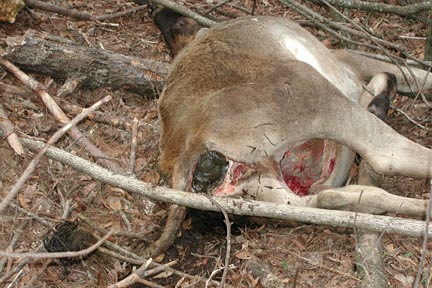
Young cow discovered dead and mutilated on a northeastern Alabama farm, February 21, 2001. Tissue was cleanly excised from rectum and vagina, the udder was removed, and tissue was excised from the right eye and lips. Photograph © 2001 by owner who requests name and location not be used.

July 28, 2001  Grass Lake, Michigan - On October 15-16, 2000, I reported about the discovery of hardened bovine hemoglobin on a mutilated bull in Red Bluff, California. (See: Earthfiles 10/15-10/16/00.) Since the 1950s, unusual deaths called "animal mutilations" have been reported around the world. Both domestic animals and wild game have been affected, especially horses and cattle. Ranchers and law enforcement have long been puzzled because animals are found with the same pattern of hide and tissue removed - usually without blood - from the head, sexual organs, and rectum. There are no signs of struggle or tracks around the dead animals, not even the animal's own tracks. That peculiar fact provoked law enforcement to wonder if perpetrators came in and out of pastures using aerial craft, picking animals up and dropping them back down after taking tissues and fluids.
 

Click here to subscribe and get instant access to read this report.

Click here to check your existing subscription status.

Existing members, login below:

Pure Hemoglobin Confirmed On Alabama Mutilated Cow

Young cow discovered dead and mutilated on a northeastern Alabama farm, February 21, 2001. Tissue was cleanly excised from rectum and vagina, the udder was removed, and tissue was excised from the right eye and lips. Photograph © 2001 by owner who requests name and location not be used.

July 28, 2001  Grass Lake, Michigan - On October 15-16, 2000, I reported about the discovery of hardened bovine hemoglobin on a mutilated bull in Red Bluff, California. (See: Earthfiles.com Environment 3-parts 10/15-10/16/00.) Since the 1950s, unusual deaths called "animal mutilations" have been reported around the world. Both domestic animals and wild game have been affected, especially horses and cattle. Ranchers and law enforcement have long been puzzled because animals are found with the same pattern of hide and tissue removed - usually without blood - from the head, sexual organs, and rectum. There are no signs of struggle or tracks around the dead animals, not even the animal's own tracks. That peculiar fact provoked law enforcement to wonder if perpetrators came in and out of pastures using aerial craft, picking animals up and dropping them back down after taking tissues and fluids.
 

Click here to subscribe and get instant access to read this report.

Click here to check your existing subscription status.

Existing members, login below:

Hartsville Update: No Lightning on July 6, 2001

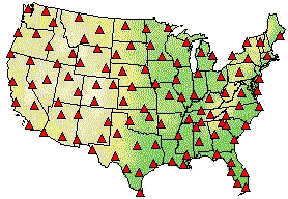
National Lightning Detection Network (NLDN) has 108 sensors throughout United States. Graphic courtesy LightningStorm.com and Global Atmospherics, Inc.

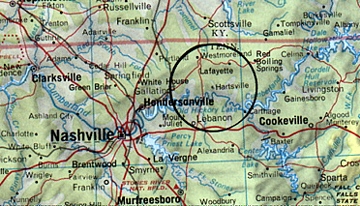
July 25, 2001  Tucson, Arizona - Since several atmospheric scientists suggested that the abnormal power surge in Hartsville, Tennessee on July 6, 2001 at 10:45 a.m. might have been a rare clear day lightning strike, I contacted the National Lightning Detection Network (NLDN), the only national lightning detection network in the United States. The network has more than 108 sensors that instantaneously detect the electromagnetic signals given off when lightning strikes the earth's surface. Each sensor transmits the lightning information via satellite to the Network Control Center (NCC) in Tucson, Arizona. Using data from two or more sensors, the "intersection" of the data enables the determination of a strike location with a 15 mile radius.


Click here to subscribe and get instant access to read this report.

Click here to check your existing subscription status.

Existing members, login below:

Abnormal July Heat in 2001

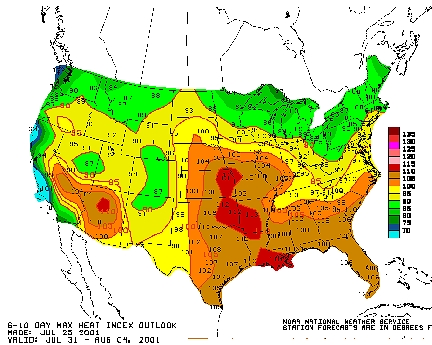
Map by the National Oceanic and Atmospheric Administration (NOAA) where red indicates highest temperatures projected for July 31 to August 4, 2001 after previous week of abnormally high temperatures.

July 25, 2001  Washington, D. C. ­ Late July 2001 temperatures in Texas, Oklahoma, Kansas, Arkansas and New Mexico have averaged five to ten degrees above normal. According to the National Oceanic and Atmospheric Administration (NOAA)'s National Weather Service, central Kansas hit 109 degrees Fahrenheit and southwest Oklahoma sweltered at 108 degrees F.


Click here to subscribe and get instant access to read this report.

Click here to check your existing subscription status.

Existing members, login below:

Missing Link Between Humans and Chimpanzees ­Ethiopian Forest Bipeds 5.8 Million Years Ago?

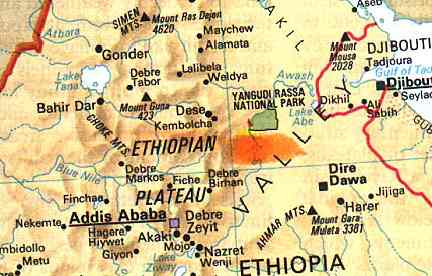
140 miles northeast of Ethiopia's capital, Addis Ababa, near the Awash River marked in orange, paleontologists have discovered bones of a primate dubbed Ardipithecus ramidus kadabba which might have been the first upright ancestor to human lineage 5.8 million years ago.

July 21, 2001  Alayla, Ethiopia - A graduate student named Yohannes Haile-Selassie studying paleontology at the University of California, Berkeley, found bones on December 16, 1997 at a site 140 miles northeast of Ethiopia's capital, Addis Ababa, Ethiopia which might be the missing link in evolving primates that went on to become humans. This creature, Ardipithecus ramidus kadabba, might have been the first primate to walk upright and the oldest human ancestor who lived in Ethiopian forests, not grassy plains, as far back as 5.8 million years ago. That's a million and a half years earlier than any other previous discovery and challenges the long held theory that primates stood up when they moved from trees to grassy plains.


Click here to subscribe and get instant access to read this report.

Click here to check your existing subscription status.

Existing members, login below:

Part 2 – Gog Magog Hills, Cambridge, England – Two Unusual Crop Formations

"And I saw a great white throne and the one who sat upon it, from whose face the earth and sky fled away, but they found no place to hide. I saw the dead, great and small, standing before God; and The Books were opened, including the Book of Life. And the dead were judged according to the things written in The Books, each according to the deeds he had done. ...And if anyone's name was not found recorded in the Book of Life, he was thrown into the Lake of Fire."

The Revelation in the Bible 20:11-15

Second formation in wheat at Gog Magog Hills southeast of Cambridge, Cambridgeshire, England, reported on July 25, 2001.


Click here to subscribe and get instant access to read this report.

Click here to check your existing subscription status.

Existing members, login below:

Continual Power Surges Force Hartsville, Tennessee’s WJKM Radio to Move

At least sixty birds were found dead with feathers burned and melted, scattered all over the yard around country music radio station WJKM (1090 AM) on July 6, 2001 in Hartsville, Tennessee. Photograph © 2001 by David Randall.

July 18, 2001  Hartsville, Tennessee ­ Today I learned from Ted Randall that dead birds with burned wings were found all over Hartsville's city park, a diameter of at least a mile. In fact, in the afternoon of that same day, power surges and dimming lights were reported at an insurance company more than a mile from WJKM. This afternoon, I talked with Ted Randall and Dave Fluehe, owner of Dave's Covert Surveillance in Hartsville who provides electronic camera and video security monitoring equipment to businesses. On July 6 in the afternoon, Dave Fluehe was in an insurance company more than a mile away from WJKM when more electronic interference occurred.


Click here to subscribe and get instant access to read this report.

Click here to check your existing subscription status.

Existing members, login below:

Mysterious, Destructive Power Surge at WJKM Radio in Hartsville, Tennessee

One of the sixty some dead bird's burned and melted wings after mysterious power surge hit WJKM in Hartsville, Tennessee at 10:45 a.m. on July 6, 2001. Photograph © 2001 by David Randall.

July 14, 2001 Hartsville, Tennessee - Friday, July 6, was a clear and sunny morning. But at 10:45 a.m., something very odd surged through the air, radio transmitter, power and phone lines at country music radio station WJKM (1090 AM) near the city park in downtown Hartsville, Tennessee. It also affected theVidette newspaper office next door and shocked one of the employees sitting at her desk.


Click here to subscribe and get instant access to read this report.

Click here to check your existing subscription status.

Existing members, login below:

Laos – Part 4: The Rugged Road to Vilabouli, Laos.

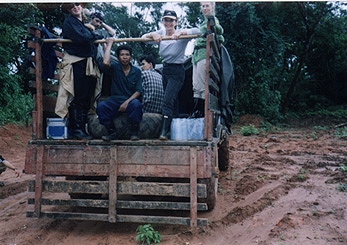
On the rugged road to Vilabouli (Vilaburi), left to right: Producer Denise Blazek from Perth, Australia; Soundman Martin Geissmann from Bangkok, Thailand; a Laotian guide; Soukhasavanh Sanaphay, Vientiane Ministry of Foreign Affairs Press Department; Reporter Linda Moulton Howe; Associate Producer Jax Hayes, Bang Productions Ltd., Hong Kong. Photograph by Videographer Brad Dillon from Hong Kong.


Return to Part 1

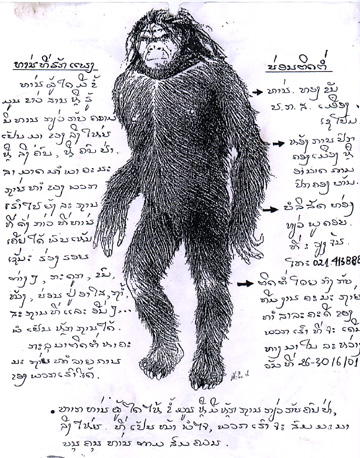
July 12, 2001  Xepon, Laos – On June 29, the Bang Productions Ltd. crew, Phoudai Travel representatives, Mr. Soukhasavanh Sanaphay of the Vientiane Ministry of Foreign Affairs Press Department and I got into an old Soviet military truck in Xepon, Laos to follow the trail of “Wild Men” sightings.Click for report.