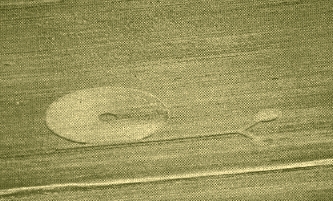
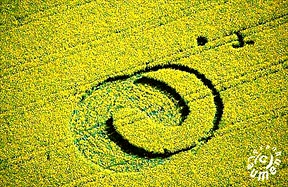
First week of June 2001 reported on television in Serbia, Yugoslavia. Photograph courtesy Milan Manchich.
June 6, 2001 Serbia, Yugoslavia - Milan Manchich, grew up in Serbia, now one of the two republics in the Federation of Yugoslavia. The other is Montenegro. Kosovo is a third political community currently under U. N. supervision. Milan reports by e-mail: "Something or someone made this on the land near my home town. (Town name to be confirmed) This picture was on the every TV station in Serbia. Local people noticed that animals was very disquiet the night before when in the morning people found this.
Click here to subscribe and get instant access to read this report.
Click here to check your existing subscription status.
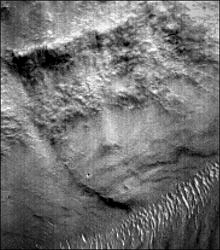
Malin Space Science Systems (MSSS) MOC narrow-angle image M02-03051 of unusual face-like surface feature in valley of Libya Montes near equator on Mars, approximately 275 degrees West and 2.66 degrees North. Image released by MSSS on May 22, 2000. To find this feature, it is necessary to turn the original MOC image upside down.
June 2, 2001 Tempe, Arizona - Unusual surface features on Mars imaged by the Global Surveyor continue to provoke controversy among scientists and civilians. One such image looks like a female face taken a year ago in May 2000 in the valley of Libya Montes near the Martian equator, but not publicized until the New York Post featured the image on May 9 after a press conference by astronomer Tom Van Flandern, Ph.D. and former astronaut Brian O'Leary. This week I discussed the face image with planetary geologist, David Nelson. Mr. Nelson is a Research Specialist in the Department of Geological Sciences at Arizona State University in Tempe. His current work is to study the Mars Global Surveyor images and to contribute ideas about where the next NASA Mars Excursion landing sites should be in January 2004. Two rovers are planned for that mission and one likely exploration site will be near sedimentary deposits in the walls of Valles Marineris, the 3000 mile long canyon that runs near the Martian equator.
Click here to subscribe and get instant access to read this report.
Click here to check your existing subscription status.
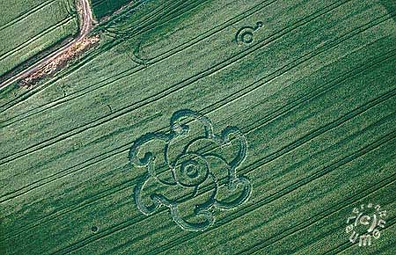
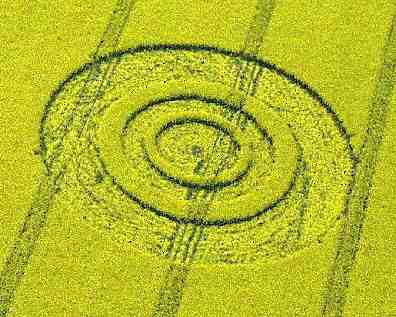
May 31, 2001 Southern England - Since May 12 when a farmer near Warnford, Hampshire found a flattened circle surrounded by rings in his yellow flowering oilseed rape, there have been four more reported in the counties of Dorset, Wiltshire and Hertfordshire.
May 2001
May 12, 2001 - Double ringed circle, 100 feet diameter, oilseed rape,
at Old Winchester Hill near Warnford, Hampshire.
May 25, 2001 Washington, D. C. - The United States now has one hundred fifteen million cell phone subscribers. In only three more years, global use of cell phones is estimated to reach 2.1 billion . Yet, no one can guarantee their safety.
Click here to subscribe and get instant access to read this report.
Click here to check your existing subscription status.
Eastern Tent Caterpillar feeds on wild black cherry tree leaves which contain cyanide. The insects overwhelmed Kentucky trees and fields in the spring of 2001. Is there a connection to the aborted foal syndrome? Photograph courtesy University of Kentucky College of Agriculture.
News Update - May 24, 2001 Lexington, Kentucky - Tonight laboratory experts confirmed that liver enzymes which indicate cyanide poisoning were confirmed in pathology analyses of aborted fetuses and foals. The main suspect for the cyanide source remains the Eastern Tent Caterpillar combined with the cyanide in wild cherry tree leaves containing more cyanide than normal because of the freeze after record high temperatures in mid-April. Still unknown is exactly how the caterpillar cyanide gets into the pregnant mares. While scientists begin more tests on pasture grasses, Lexington horse breeders are going to cut down wild cherry trees near their pastures and spray the Tent Caterpillar moths before they lay eggs that would hatch next spring.
Click here to subscribe and get instant access to read this report.
Click here to check your existing subscription status.
Updated above with photo of May 23, 2001 new formation at Niederelsungen, Hessen, Germany.
May 21, 2001 Aalten, Holland - On May 6, 2001, Dutchman Barend Lubbers was driving along a small road in Aalten, Holland when he found an unusual formtion in grass. Mr. Lubbers took measurements and made a drawing on May 9. The "insect-like" series of circles and "antennae" were about 150 feet long. As in the Hampshire formation, this pattern was an echo of the early patterns of 1990 to 1991.
Click here to subscribe and get instant access to read this report.
Click here to check your existing subscription status.
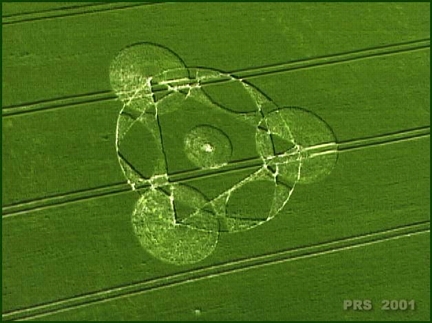
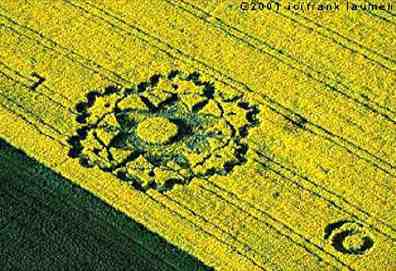
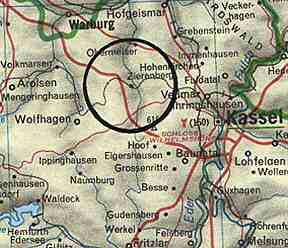
May 19, 2001 Zierenberg, Germany - The fourth European crop formation since April 26 was discovered on Sunday, May 13 at 7:30 a.m. by the farmer in yellow flowering oilseed rape not far from Kassel, Germany in the farming community of Zierenberg. Each year for the past several years from May 1 on, formations have emerged in Zierenberg crops. The sixfold formation in 2001 is one of the most intricate ever to appear in crisp, dense oilseed rape (canola). On either side of the sixfold pattern are "signatures" of an "L" an a crescent ring.
Click here to subscribe and get instant access to read this report.
Click here to check your existing subscription status.
"We are the first people ever to see the bottom of Cuban waters over 50 meters...It's so exciting. We are discovering...even possibly a sunken city built in the pre-classic period and populated by an advanced civilization similar to the early Teotihuacan culture of Yucatan."
- Paulina Zelitsky, ocean engineer, Advanced Digital Communications, May 2001
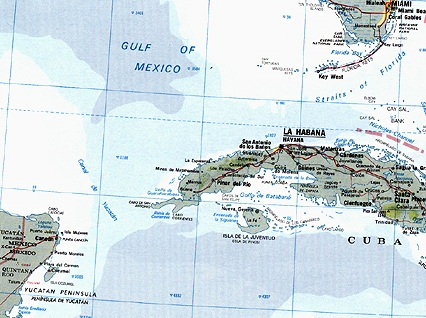
At the western tip of Cuba at a depth of about 2,200 feet (700-800 meters), ocean engineer Paulina Zelitsky of Advanced Digital Communications reports large plateau with "shapes that resemble pyramids, roads and buildings."
May 18, 2001 Washington, D. C. - Reporter Andrew Cawthorne reporting from Havana, Cuba for Reuters bylined a May 15 story entitled "Explorers Comb Cuban Seas for Treasure, Mysteries." (See complete text below.) He interviewed ocean engineer Paulina Zelitsky, employed by Advanced Digital Communications and based in Tarara along the Cuba coast east of Havana. According to the article, Ms. Zelitsky said, "We are the first people ever to see the bottom of Cuban waters over 50 meters. It's so exciting. We are discovering ...even possibly a sunken city built in the pre-classic period and populated by an advanced civilization similar to the early Teotihuacan culture of Yucatan. ...Researchers using sonar equipment have discovered at a depth of about 2,200 feet (700-800 meters) a huge land plateau with clear images of what appears to be urban development partly covered by sand. From above, the shapes resemble pyramids, roads and buildings. "
Click here to subscribe and get instant access to read this report.
Click here to check your existing subscription status.
Lexington, Kentucky thoroughbred mare and foal. Photograph courtesy University of Kentucky.Between April 28 and May 16, 2001, 477 cases of first trimester dead fetuses and third trimester stillborn foals were reported to the Livestock Disease Diagnostic Center in Lexington, Kentucky.
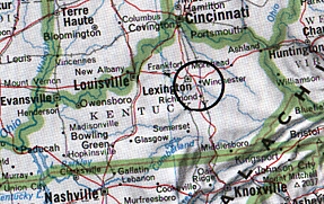
May 16, 2001 Lexington, Kentucky - Seventeen thousand thoroughbred mares live in the Kentucky blue grass fields around Lexington, the largest racehorse breeding area in the United States. Since the end of April 2001, pregnant mares have lost 477 fetuses and stillborn foals. Last year, only 46 aborted foals or fetuses were reported to the University of Kentucky Livestock Disease Diagnostic Center. That means something has caused a 700% increase in fetal deaths.
Click here to subscribe and get instant access to read this report.
Click here to check your existing subscription status.