"Until now, nobody had a clue the two other rings were there..."
- Mark Showalter, SETI Institute
Hubble Space Telescope images credit: NASA, ESA, and M. Showalter, SETI Institute.
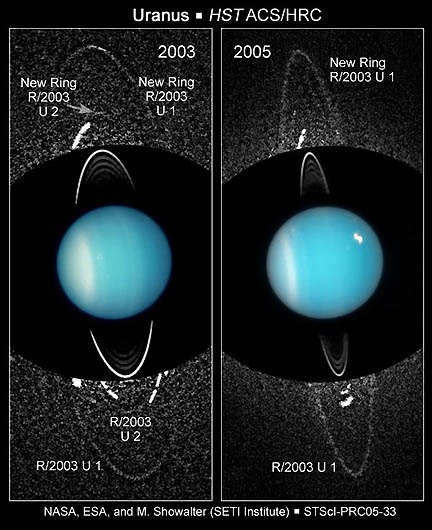
December 23, 2005 Baltimore, Maryland - Hubble researchers report: "These composite images from several observations by NASA's Hubble Space Telescope reveal a pair of newly discovered rings encircling the planet Uranus. The left composite image is made from Hubble images taken in 2003. The new dusty rings are extremely faint and required long exposures to capture their image. The background speckle pattern is noise in the image. The outermost ring (R/2003 U 1) is likely replenished by dust blasted off a newly discovered satellite called Mab, embedded in the ring and visible as a bright streak at the top of the outer ring. The new outermost ring is twice the radius of the previously known ring system around Uranus, as seen near image center. (The inner rings are much brighter, so no noise is visible in the background). Approximately halfway between the outermost ring and inner ring system is a second newly discovered ring (R/2003 U2). Only a faint segment of it appears at the 12:00 o'clock position. Because of the long exposures, the moons are smeared out and appear as arcs within the ring system.
Click here to subscribe and get instant access to read this report.
Click here to check your existing subscription status.
[ Editor's Note: In the mid-1990s, I was approached by former Las Cruces, New Mexico State Representative, Andrew Kissner. He told me about his official research into UFO crashes and retrievals in New Mexico, and his off-the-record conversations with military and intelligence operatives from White Sands Missile Range, the Naval Research Lab and other government agencies. Rep. Kissner had assembled many old newspaper articles and government documents leaked to him.
Former Rep. Kissner asserted that in the late 1940s to early 1950s, there was an American government policy to shoot down unidentified aerial discs. But the discs retaliated. Many of our pilots died, which forced an end to our "shoot down" policy. ]
Part 1
Prologue
By J. Andrew Kissner, August 1995
In a democracy, the people must be aware of and learn fundamental truth. Without this knowledge, others are empowered to make decisions for the people secretly with little regard to the checks and balances of constitutional government. It is evident that most United States decision makers involved with this phenomenon have not been elected to public office.
Click here to subscribe and get instant access to read this report.
Click here to check your existing subscription status.
"We're absolutely thrilled, after 143 years of frustration, to finally get the information we need about this star so that we can work out whether our theory of white dwarfs is actually correct."
- Martin Barstow, Ph.D., Leicester Univ., U.K.
Hubble Space Telescope Wide Field and Planetary Camera image of Sirius A, the brightest star in our nighttime sky, along with its faint, tiny sun companion, Sirius B, in lower left quadrant. Image credit: NASA, ESA, STScl, U. Leicester, U. Arizona.
December 17, 2005 Baltimore, Maryland - For the first time in human astronomical history, scientists have used NASA's Hubble Space Telescope to isolate the light from the white solar dwarf known as Sirius B orbiting its huge and bright companion, Sirius A, in the constellation Canis Major. Since the Sirius B discovery in 1862, astronomers have been frustrated by the intense glow of Sirius A overwhelming their ability to "see" and "weigh" tiny, but very dense, Sirius B.
Click here to subscribe and get instant access to read this report.
Click here to check your existing subscription status.
"It is very interesting that the signal penetrated quite easily through about 2 kilometers (1.2 miles) of material in the crater and that suggests to us that material is probably ice-rich."
- Jeffrey Plaut, Ph.D., JPL
MARSIS, Mars Advanced Radar for Subsurface and Ionosphere Sounding, has been looking below the Martian surface since June 2005 for water ice and/or liquid water. Composite image by European Space Agency.
December 16, 2005 Pasadena, California - Far from Earth is a mystery that scientists are trying to solve from an orbiting spacecraft that is now looking below the surface of Mars with deep ground-penetrating radar. It's called "MARSIS," which stands for Mars Advanced Radar for Subsurface and Ionosphere Sounding.
Click here to subscribe and get instant access to read this report.
Click here to check your existing subscription status.
“We’ve got one spot out in the middle of a wheat field – it kind of looks like a geyser. It’s shooting anywhere from 7 to 10 feet in the air – water, mud and gas fumes. I’ve never seen anything like it. The Corporation Commission of Oklahoma has never seen anything like it.”
– John Crawford, Kingfisher, Oklahoma Fire Chief
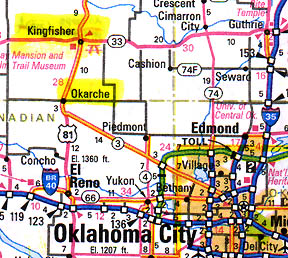
Kingfisher, population 4,500, and Okarche, population 2,000, are linked by the Winter Camp Creek (originally known as Dead Indian Creek). Between December 9 to 13, 2005, the gas and water eruptions had grown along 12 miles of the creek and tributaries to within 1 mile of Kingfisher and about 7 miles from Okarche.
December 15, 2005Update – Today, more methane gas bubbling has spread south toward Okarche. Yesterday, four more gas eruptions in a wheat field were discovered about two miles from the city limits of Kingfisher, Oklahoma. The unprecedented – and so far, uncontrolled – eruptions of methane, water and mud on a 12-mile-long stretch of Winter Camp Creek and surrounding fields continues to frustrate authorities. Chesapeake Energy Corp., an independent oil and gas exploration company, was drilling on December 9, about eight miles from where the first gas and mud eruptions were reported in Section 2 of Kingfisher County. Today, Chesapeake said it would start flaring off some of the escaping gas and try to capture and sell more of it. What no one knows is whether this will reduce the underground pressure of the gas enough to slow down, or stop, the continuing gas eruptions that have occurred since the morning of December 9. Geologists are trying to figure out what has happened and what can be done to control the potentially explosive situation.Click for report.
"You're really left with two possibilities. One is that they are really old hominids - shockingly old - or they're not footprints."
- Paul Renne, Ph.D., UC-Berkeley
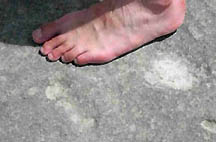
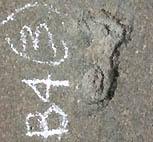
Above: Human left foot placed next to what appears to be left footprint in volcanic rock, Puebla, Mexico. Below: Possible right footprint, showing toe impressions and ball and heel, first discovered in 2003. Images courtesy John Moores University, U.K.
December 8, 2005 Berkeley, California - This past summer on the 4th of July at the British Royal Society Summer Exhibition Program, geologist Silvia Gonzalez, Ph.D., from Liverpool's John Moores University, announced that what appear to be human footprints in volcanic rock near Puebla, Mexico, were 40,000 years old. Puebla is about 1.5 hours by car southeast of Mexico City. The date was determined from Optically Stimulated Luminescence (OSL) of "some baked particles incorporated into the ash." Dr. Gonzales and her colleagues had first discovered the prints in 2003 and hypothesized that early hunters walked near a lake there across freshly deposited ash from volcanoes that are still active in the region. The ash mixed with rain and water which over time turned to rock.
Click here to subscribe and get instant access to read this report.
Click here to check your existing subscription status.
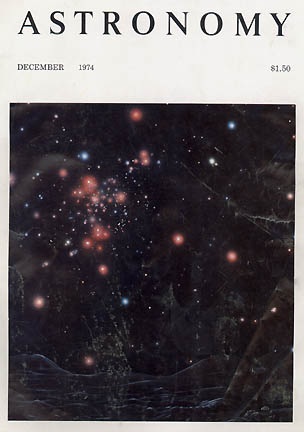
"Betty described the (star) map as three-dimensional, like looking
through a window. The stars were tinted and glowed. The map material was flat and thin (not a model), and there were no noticeable lenticular lines like one of our (human) three-dimensional processes. It sounds very much like a reflective hologram."
- Marjorie Fish, Amateur Astronomer, Astronomy, December 1974
December 7, 2005 Thirty-one years ago the December 1974 issue of Astronomy magazine featured a 15-page article entitled, "The Zeta Reticuli Incident" by astronomer and author, Terence Dickinson. His article began:
Click here to subscribe and get instant access to read this report.
Click here to check your existing subscription status.
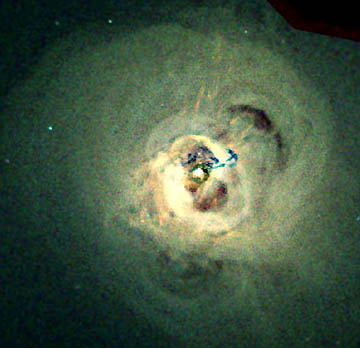
"The Perseus Galaxy cluster is a dramatic example of how a relatively tiny, but massive, black hole at the center of a galaxy can control the heating and cooling behavior of gas far beyond the confines of the galaxy."
- CXC
Massive Perseus galaxy cluster contains thousands of galaxies immersed in hot gas with massive black hole at center 250 million light years from Earth. Chandra X-ray Observatory image credit: NASA/CXC/IoA/A. Fabian et al.
December 4, 2005 Cambridge, Massachusetts - Chandra X-Ray Observatory in Cambridge, Massachusetts reports: "An accumulation of 270 hours of Chandra observations of the central regions of the Perseus galaxy cluster reveals evidence of the turmoil that has wracked the cluster for hundreds of millions of years. One of the most massive objects in the universe, the cluster contains thousands of galaxies immersed in a vast cloud of multimillion degree gas with the mass equivalent of trillions of suns.
Click here to subscribe and get instant access to read this report.
Click here to check your existing subscription status.








 December 8, 2005 Berkeley, California - This past summer on the 4th of July at the British Royal Society Summer Exhibition Program, geologist Silvia Gonzalez, Ph.D., from Liverpool's John Moores University, announced that what appear to be human footprints in volcanic rock near Puebla, Mexico, were 40,000 years old. Puebla is about 1.5 hours by car southeast of Mexico City. The date was determined from Optically Stimulated Luminescence (OSL) of "some baked particles incorporated into the ash." Dr. Gonzales and her colleagues had first discovered the prints in 2003 and hypothesized that early hunters walked near a lake there across freshly deposited ash from volcanoes that are still active in the region. The ash mixed with rain and water which over time turned to rock.