“The (Aztec disk's) cabin was constructed of a metal resembling aluminum, but the actual make-up of the metal has defied analysis.”
- Wyandotte Echo, Kansas City, Kansas, January 6, 1950
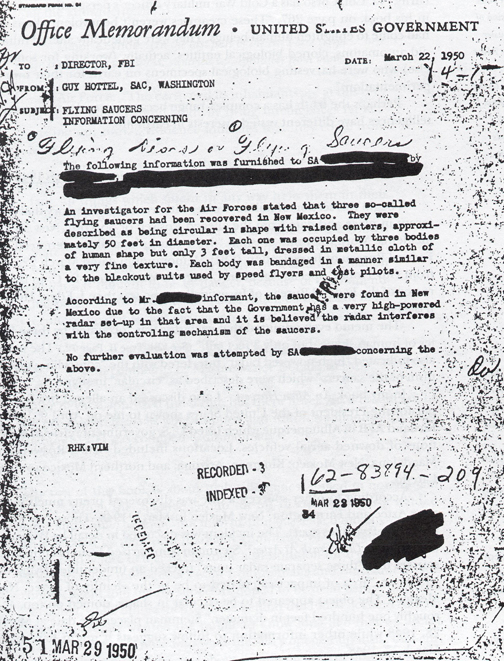
April 29, 2011 Charlotte, North Carolina - Recently the FBI released on its website a 61-year-old FBI document dated March 22, 1950, without historic context. Then the U. K. Daily Mail and Sun printed headlines claiming the FBI memo proves the July 1947 Roswell crashes. But that memo was not about Roswell. It’s about Aztec and was written by Guy Hottel - Special Agent In Charge in the Washington, D. C. office to FBI Director J. Edgar Hoover. It was first released in May 1977 after Navy physicist Bruce Maccabee filed a Freedom of Information Act (FOIA) request with the FBI. Hottel’s memo states that “three so-called flying saucers had been recovered in New Mexico. According to Mr. [ name blacked out], an informant, the saucers were found in New Mexico due to the fact that the Government has a very high-powered radar set-up in that area and it is believed the radar interferes with the controlling mechanism of the saucers.”
“It looked like the staircase appeared out of nowhere on the disc,
according to Doug Noland. And there was talk of bodies on board the craft, alien bodies - between 14 and 16 bodies were on that ship.”
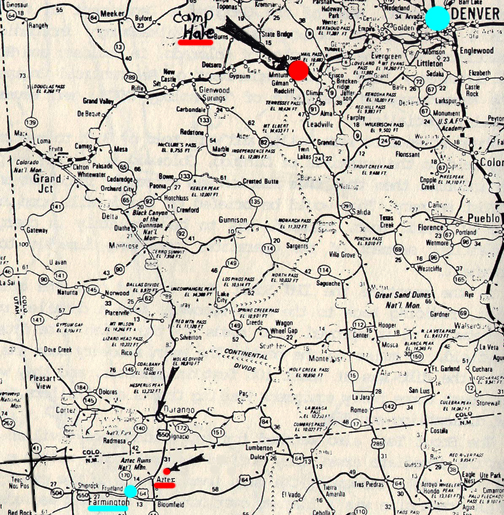
[ Editor's Note: Wikipedia - Camp Hale, between Red Cliff and Leadville in the Eagle River valley in Colorado, was a U.S. Army training facility constructed in 1942 for what became the 10th Mountain Division. It was named for General Irving Hale. Soldiers were trained in mountain climbing, Alpine and Nordic skiing, and cold-weather survival. When it was in full operation, approximately 15,000 soldiers were housed there. From 1959 to 1964, Tibetan guerrillas were secretly trained at Camp Hale by the CIA. The site was chosen because of the similarities of the terrain with the Himalayan Plateau. The Tibetans nicknamed the camp ‘Dhumra,’ meaning The Garden. The CIA circulated a story in the local press that Camp Hale was to be the site of atomic tests and would be a high security zone. Until the camp was closed in 1964, the entire area was cordoned off and its perimeter patrolled by military police. ]
April 29, 2011 Charlotte, North Carolina - Frank Scully wrote on Page 23 of his September 1950-released book Behind the Flying Saucers that Scientist X, or “Dr. Gee” had told University of Denver students on March 8, 1950, in a 50-minute pre-scheduled presentation that a saucer “had landed less than two years previous to his talk, ‘on a site within 500 miles of Denver.’” Apparently no local reporters were recording the talk, but Frank Scully found a detailed summary in the Summerside Journal published on Prince Edward Island in Canada. On Pages 24 - 28 of Scully's book, he writes about what he learned from the Canadian newspaper:
Click here to subscribe and get instant access to read this report.
Click here to check your existing subscription status.
“Flying object of unknown origin recovered near Aztec, New Mexico. Craft approximately 100 feet diameter, 30 feet height, one window port blown, bodies on board.”
- 1948 Telex from Camp Hale, Colorado,
to Army Intelligence, Washington, D. C.
April 29, 2011 Charlotte, North Carolina - In his 1986 book, UFO Crash At Aztec: A Well Kept Secret, William Steinman describes in detail how military and government authorities were alerted that a large disc was on a mesa in Hart Canyon twelve miles northeast of Aztec, New Mexico. On Page 45, he states: “A telex was sent to Headquarters, Assistant Chief of Staff, G-2 (Army Intelligence) in Washington, D. C., from Camp Hale, Colorado, describing the craft and the recovery operation. A copy was transmitted to Counterintelligence Special Headquarters at Pope Air Force Base, within the Fort Bragg Complex in North Carolina. Captain Virgil A. Postlethwait, with the Counterintelligence V-Corps along with his Air Force Counterpart, Captain Donald A. Broadus (A-2), handled this TWX, which went as follows:
Click here to subscribe and get instant access to read this report.
Click here to check your existing subscription status.
“At 7 o'clock in the evening (March 1, 2011), hundreds of people
in different locations of Osinsky district (near Irkutsk) saw a bright
flash in the sky, and then a fall of an unknown flying object.”
- Galina Sotnikova, Reporter, TV Center, Irkutsk, Russia
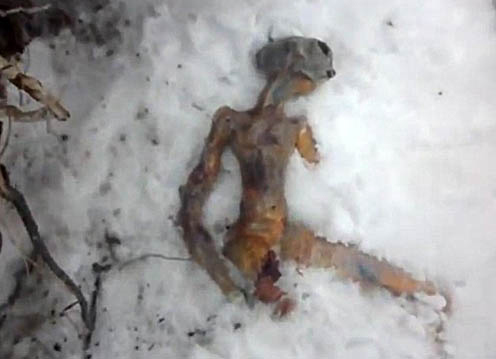
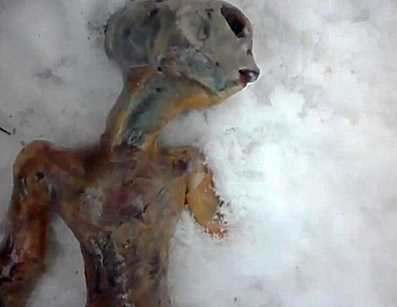
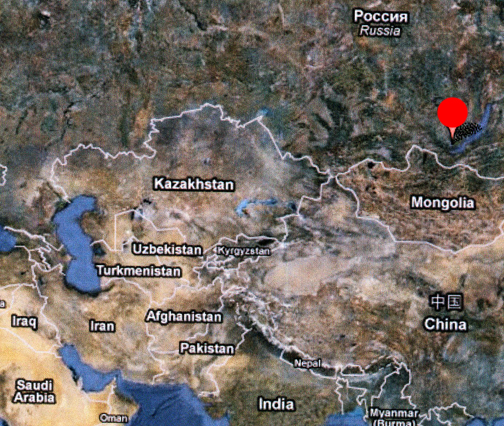
Alleged non-human body found on snow where villagers near Irkutsk, Russia, reported unidentified aerial lights on two nights from February 28 to March 1, 2011, as well as a bright flash of light. No craft debris was ever found by authorities, according to NTV Russian television, but the small, non-human body above was videotaped and distributed on Youtube. In comparison to the surrounding environment, the size of the alien body is not much more than a foot - or two feet if the legs and seemingly very long arms were intact. See video link at end of Translation 1.
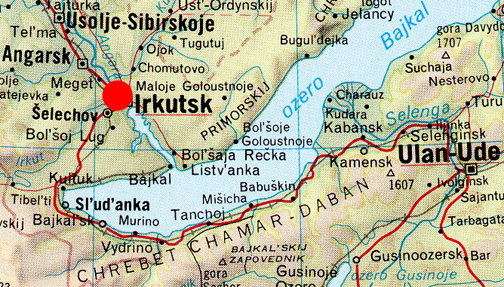
Irkutsk, Russia, (above and below maps) is marked by the red circle above Mongolia. Irkutsk, with a population of about 600,000 is one of the largest cities in Siberia and is the administrative center of Irkutsk Oblast, 5,185 kilometers (3,222 mi) by rail from Moscow.
April 20, 2011 Irkutsk, Russia - Russian TV Channel, NTV (HTB in Russian) reported in a recent newscast that on February 28 to March 1, 2011, many glowing, aerial objects at night were seen and videotaped on at least one cell phone in villages near Irkutsk, Russia. An explosion of light was also reported and a very small body (above) on snow was also videotaped and distributed on YouTube. The following are translations of two videos with hot links to each videotape source. The translator is Tania Ivanova-Sullivan, Ph.D., Asst. Professor of Russian, Department of Foreign Languages and Literatures at the University of New Mexico in Albuquerque.
Click here to subscribe and get instant access to read this report.
Click here to check your existing subscription status.
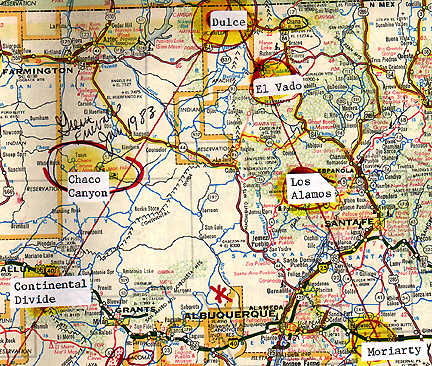
A triangle of sensitive geographic areas and three secret experimental microwave radar stations. Construction begun in late 1947 of El Vado (AFS-P8), Moriarty (AFS-P7), and Continental Divide (AFS-P51). The three radar stations were part of the U. S. Aircraft Control and Warning (AC&W) system that also became known as LASHUP. One of El Vado's specific missions was to protect the Los Alamos Laboratory and the Atomic Energy Commission's atomic bomb production at Los Alamos and Sandia Base.
April 11, 2011 Albuquerque, New Mexico - Editor's Note: Odd that the FBI chose April 2011 to release the March 22, 1950, document now on their website without proper context and that U. K. editors, who apparently don't know the history, are issuing headlines claiming the memo proves the Roswell crashes. That March 22, 1950, document from Guy Hottel, Special Agent In Charge (SAC), Washington, D. C., to FBI Director J. Edgar Hoover was first released after a mid-1970s Freedom of Information Act (FOIA) request from Navy physicist Bruce Maccabee to the FBI. The memo references “circular in shape” and “a very high-powered radar set-up in that area.”
Click here to subscribe and get instant access to read this report.
Click here to check your existing subscription status.
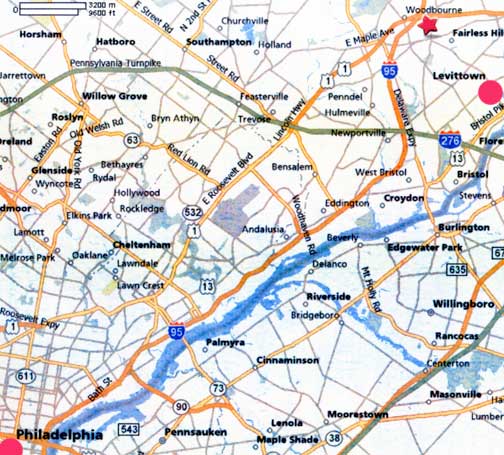
About thirteen miles northeast of Philadelphia up the Delaware River is Levittown. Close to Levittown is the Oxford Valley Mall, marked with red star above. 2008 UFO reports ranged from an unidentified aerial object over the mall in January to a series of six sightings over a Levittown apartment complex that involved one “snowfall” of squares of light.
April 1, 2011 Levittown, Pennsylvania - On July 13, 2008, I received a phone call from Robert Gardner, Pennsylvania MUFON Field Investigator living in Philadelphia. Bob told me that he had an ongoing case with a female resident in a Levittown apartment where “glittering pieces of light” had fallen from a large, aerial disc the month before on June 12, 2008.
Click here to subscribe and get instant access to read this report.
Click here to check your existing subscription status.
“The (Corexit) dispersant is sticking around. Key dispersant chemicals
underwent negligible or slow rates of biodegradation.”
- Elizabeth Kujawinski, Ph.D., Marine Chemist,
Woods Hole Oceanographic Institution
“None of eight Corexit products tested are ‘without toxicity,’
and the ecological effect of mixing the dispersants with oil is unknown,
as is the toxicity of the breakdown products of the dispersant.”
- EPA Administrator
“Some medical doctors have been turning patients away from their offices because they don’t want to deal with political fall out of confirming Gulf oil and Corexit illnesses.”
- Rodney Soto, M. D.
March 30, 2011 Orange Beach, Alabama, and Santa Rosa Beach, Florida - Microbiologist Samantha Joye, Ph.D., University of Georgia, showed images of oil-suffocated marine creatures at the bottom of the Gulf of Mexico 10 miles north of the BP Macondo oil disaster site that she photographed in recent research presented before the American Association for the Advancement of Science (AAAS) annual conference in Washington, D. C., on February 19, 2011.
BP Deepwater Horizon oil rig burning after the April 20, 2010, explosion that killed 11 men working on the platform and injured 17 others. The disastrous crude oil gusher from the broken BP Macondo well a mile down on the sea floor lasted from April 20 until July 15, 2010, when the well was finally capped. Meanwhile, 770,000 gallons of toxic Corexit dispersant had been sprayed on Gulf waters to allegedly reduce the thick oil slick. Image by EPA.
Click here to subscribe and get instant access to read this report.
Click here to check your existing subscription status.
“I think the Unit 4 firefighters were withdrawn (March 16, 2011) because the fuel pools are drying out. That means high levels of Cesium-137 (gamma rays) at the site and the uranium products will turn into radioactive gasses that can touch skin and be breathed in. This could be as bad as, or worse than, Chernobyl.”
- Arnie Gundersen, Nuclear Engineer and Safety Expert, Fairewinds Assoc.
Fukushima Update 10:30 AM Pacific March 19, 2011 - Radiation Found in Milk and Spinach. More Electric Power Cables Laid to Radioactive Reactors, But Hook Ups Not Tested.
“Though radioactive iodine has a short half-life of about eight days and decays naturally within a matter of weeks, there is a short-term risk to human health if radioactive iodine in food is absorbed into the human body.”
- International Atomic Energy Agency (IAEA)
Chief Cabinet Secretary Yukio Edano announced today that levels of radiation exceeding Japanese safety limits were found in milk sampled 19 miles (30 km) from the Fukushima plant and in spinach sampled 65 miles (100 km) south, almost half way to Tokyo. The radiation level is about 7 millisieverts. If the contaminated food were eaten continuously for a year, the amount of ingested radiation would be equivalent to one CT scan.
Japanese fire truck spraying water on Fukushima Unit 3, the only reactor that contains MOX fuel, "mixed-oxide" that contains plutonium as well as uranium. Plutonium is the most dangerous radioactive material with a half-life of 24,000 years. If it is released in smoke and steam from a burning reactor, that plutonium can be inhaled and will contaminate soil downwind. Image by Japanese Defense Ministry.
Click here to subscribe and get instant access to read this report.
Click here to check your existing subscription status.