May 4, 2007 Gainesville, Florida - In the last week of April 2007, media headlined that University of California-San Francisco biochemists had “tracked down suspect in honey bee disappearances.”
Click here to subscribe and get instant access to read this report.
Click here to check your existing subscription status.
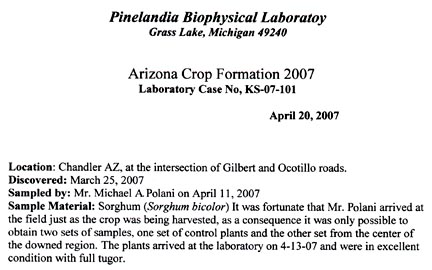
Biophysicist W. C. Levengood's Pinelandia Biophysical Laboratory Case No. KS-07-101 about his analysis of the Sorghum bicolor plants in the Chandler, Arizona, randomly downed formation first discovered on March 25, 2007, by Michael A. Polani.
May 1, 2007 Grass Lake, Michigan - After Chandler, Arizona, resident, Michael A. Polani, discovered the randomly downed pattern of Sorghum bicolor plants on March 25, 2007, I asked him if he would be willing to sample the plants for biophysicist W. C. Levengood. Michael agreed and went to the formation field on April 12, 2007, to gather both downed and standing formation plants and normal controls far outside the formation. To Michael's great surprise, at least 95% of the young, lush green plants had been cut out and removed. It was definitely not time for harvest and Michael still has not been able to confirm who owned the field, let alone why the premature removal of the plants. But about 5% of the randomly downed formation was left where he could collect samples from both flattened and standing sorghum. I provided Federal Express so that the plants would arrive at biophysicist Levengood's lab the next day, April 13, 2007.
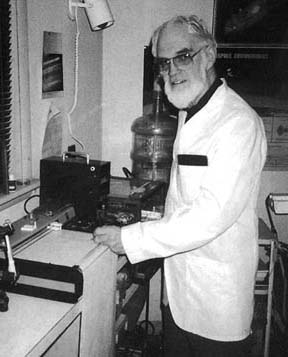
W. C. Levengood taking respiration measurements of Charge Density Plasmas from crop formation plants in his Pinelandia Biophysical Laboratory in Grass Lake, Michigan. Photo by Linda Moulton Howe.
Click here to subscribe and get instant access to read this report.
Click here to check your existing subscription status.
"It is not yet clear if atmospheric turbulences may be induced
by rough topography below the clouds."
- ESA
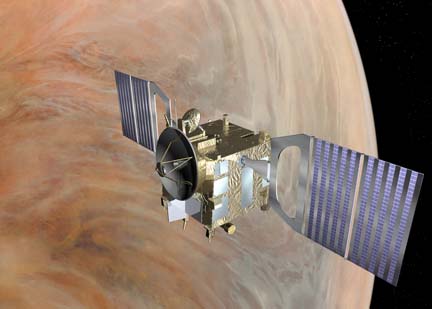
Artist's impression of European Space Agency's Venus Express orbiting Venus, courtesy ESA.
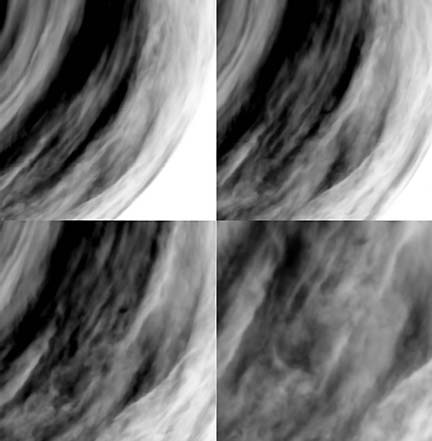
April 3 , 2007 Paris, France - New images and data from the European Space Agency’s mission to Venus provide more details about the turbulent and noxious atmosphere of Earth’s sister planet. What causes violent winds and turbulences? Is the surface topography playing a role in the complex global dynamics of the atmosphere?
The images, showing a complex cloud system, were taken on the night-side of Venus at a wavelength of 1.7 micron that allows viewing the deep atmospheric layers. Credits: ESA/VIRTIS/INAF-IASF/Obs. de Paris-LESIA.
Click here to subscribe and get instant access to read this report.
Click here to check your existing subscription status.
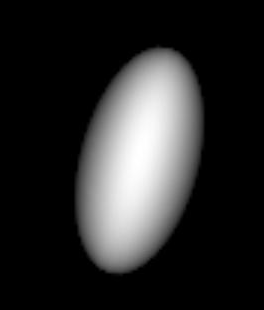
March 30, 2007 Pasadena, California - For the first time in astronomical history, a huge, bizarre rock beyond Neptune has been linked to other orbiting bodies out there. Some how the big rock called 2003 EL61, which is almost the size of Pluto, got into orbit out in the Kuiper Belt where most every other object is made of ice. Not only is this huge rocky object there, it is the only object in our solar system shaped like an American football and tumbling long end-over-end every four hours.
Computer-generated image of 2003 EL61, courtesy Michael E. Brown, Ph.D., Cal Tech. To see it move, visit: http://www.gps.caltech.edu/~mbrown/
Click here to subscribe and get instant access to read this report.
Click here to check your existing subscription status.
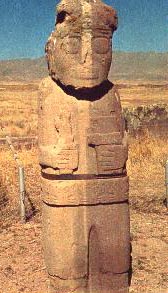
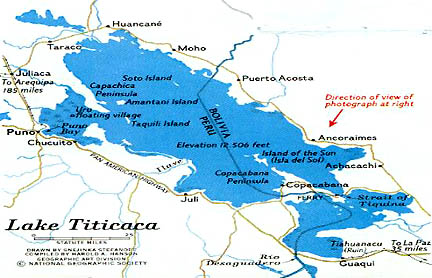
February 3, 2003 Windsor, Colorado - After Brian Scott encountered the large disc in the summer of 1971 near the Superstition Mountains east of Phoenix, he found himself onboard the craft with eight to nine foot tall non-humans with bright red hair, clear blue eyes, and very white skin. (See Earthfiles, Part 4.) With the tall, red-haired beings were equally tall creatures with big heads, very long ears, long noses, sunken eyes and very thick arms, legs and torsos. Brian was told by the red-haired beings that they had originally built the ancient megalithic Tiahuanaco temple at Lake Titicaca with the aid of the grey-skinned creatures. Brian understood that one of the red-haired extraterrestrial supervisors of the stone constructions was named "Viracocha," which the local humans worshiped as a god. Viracocha means "he who walks on the foam of the water," and Tiahuanaco means the "home of Viracocha."
Click here to subscribe and get instant access to read this report.
Click here to check your existing subscription status.
"It would not surprise me if it caused the destruction of at least one working satellite and maybe a couple. I would be surprised if it was bad enough to cause the destruction of many satellites."
- Jonathan McDowell, Ph.D., Harvard Astrophysicist
Illustration of aging FengYun-1 weather satellite destroyed January 11, 2007, in Chinese anti-satellite weapon test, courtesy Earth Observation Resources.
January 19, 2007 Cambridge, Massachusetts - Craig Covault in Aviation Week & Space Technology online reported January 17, 2007, that "U. S. intelligence agencies believe China performed a successful anti-satellite (asat) weapons test at more than 500 miles altitude (new estimate is 530 miles up) on January 11, 2007, destroying an aging Chinese weather satellite target with a kinetic kill vehicle launched on board a ballistic missile.
Click here to subscribe and get instant access to read this report.
Click here to check your existing subscription status.
"It’s a little confusing this time around, actually. We haven’t had this problem before ...but indicators (of big solar maximums) that have agreed and worked in the past don’t agree this time."
- David Hathaway, Ph.D., NASA
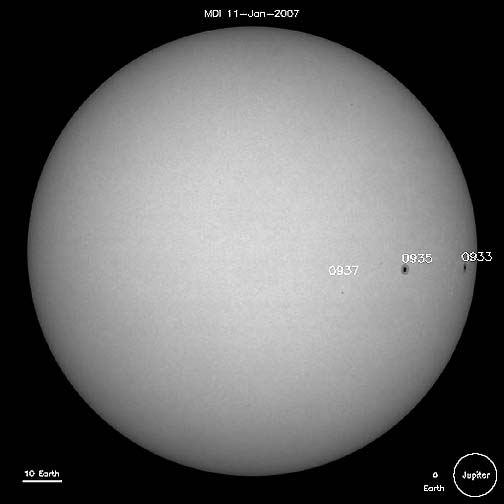
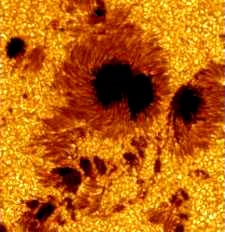
Three sunspots on the sun, January 11, 2007. Individual sunspots are often larger than planet Earth, which is shown scaled to size in the lower right, along with massive Jupiter. The scale line at lower left compares to the length of 10 Earths. Image courtesy SOHO.July 15, 2002, "most detailed images ever of sunspots" (Region 10030) on sun's granular surface by solar telescope in La Palma, Canary Islands, off African coast. Resolution is 62 miles (100 km). Colorized image by Royal Swedish Academy of Sciences Institute for Solar Physics.
January 13, 2007 Huntsville, Alabama - If you could fly near the surface of the sun, there would be a lot of humming and sonic booms. At Stanford University and the University of California-Berkeley, physicists have processed radio signals from the sun and produced audio files. The sun vibrates with a hum that goes up and down every five minutes. Stanford scientists call it "the singing sun."
Click here to subscribe and get instant access to read this report.
Click here to check your existing subscription status.
"Without dark matter, there would have been insufficient mass
in the universe for structures to collapse and galaxies to form. ...Normal matter - including stars, galaxies and gas - is built inside an underlying
scaffolding of dark matter."
- NASA/JPL
First 3-dimensional map of dark matter distribution in this universe moving from the early universe (left) to the more recent universe (right). Image credit NASA, ESA and R. Massey, Cal-Tech.
Age of Universe: 13.7 billion years
Composition: .4% glowing matter such as stars.
3.6% "normal" matter as we know it in planets and stars.
23.0% cold, invisible "dark" matter detectable only by its gravitational influence on "normal" matter.
73.0% invisible "dark" energy.
Click here to subscribe and get instant access to read this report.
Click here to check your existing subscription status.
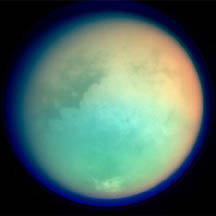
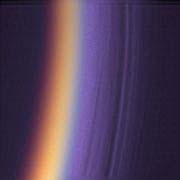
Titan, Saturn's largest moon, and second largest moon in solar system, after Earth's moon. 3200 miles in diameter. Image by Cassini-Huygens/NASA JPL.Layers of haze seen in a colorized ultraviolet image of Titan's night-side limb. Image by Cassini-Huygens/NASA JPL.
January 6, 2007 Pasadena, California - NASA's JPL reports that scientists now have "definitive evidence of the presence of lakes filled with liquid methane" on Saturn's moon Titan. The radar data was published in this week's journal Nature cover story. Radar imaging data from a July 22, 2006, fly-over by the Cassini-Huygens spacecraft provided convincing evidence for large bodies of liquid methane. on Titan today.
Click here to subscribe and get instant access to read this report.
Click here to check your existing subscription status.
"Imagine trying to see fireworks at night from across a crowded city. If you could turn off the city lights, you might get a glimpse at the fireworks. We have shut down the lights of the Universe to see the outlines of its first fireworks."
- Alexander Kashlinsky, Ph.D., NASA Goddard Astronomer
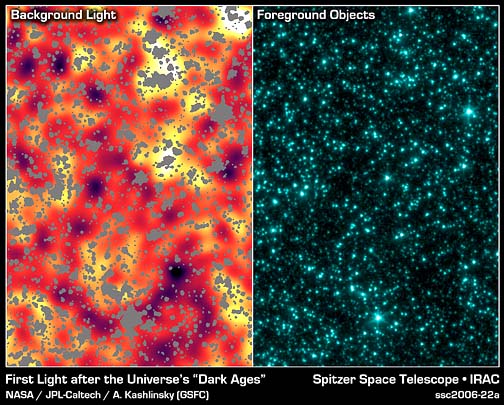
"Foreground Objects" (right) is an image from NASA's Spitzer Space Telescope of stars and galaxies in the Ursa Major constellation. This infrared image covers a region of space so large that light would take up to 100 million years to travel across it. "Background Light" (left) is the same image after stars, galaxies and other sources were masked out. The remaining background light is from a period of time when the universe was less than one billion years old, and most likely originated from the universe's very first groups of objects - either huge stars or voracious black holes. Darker shades in the image on the left correspond to dimmer parts of the background glow, while yellow and white show the brightest light. Image Credit: NASA/JPL-Caltech/A. Kashlinsky (GSFC).
Click here to subscribe and get instant access to read this report.
Click here to check your existing subscription status.