
“Godzilla” of the Ancient Seas

The December 2005 issue of National Geographic magazine, provided in advance by National Geographic.

November 12, 2005  Washington, D. C. - National Geographic announced this week that a large fossil sea monster about 135 million years old with a head like a carnivorous dinosaur and a tail like a fish's has been discovered in Argentina's Neuquen Basin at the foot of the Andes. The scientist who found the specimen is calling the fierce-looking animal "Godzilla," or "chico malo," which means the "bad boy" of the ocean.


Click here to subscribe and get instant access to read this report.

Click here to check your existing subscription status.

Existing members, login below:

Dust Storm On Mars, Cosmic First Light and Huge Black Hole At Our Galaxy’s Center

November 9, 2005   -

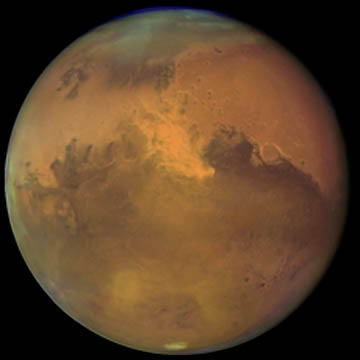
Hubble Space Telescope image of Mars and growing dust storm on October 28, 2005, one night before its close approach to Earth at 41 million miles on October 29, 2005. Image credit: NASA, ESA, The Hubble Heritage Team (STScI/AURA), J. Bell (Cornell University) and M. Wolff (Space Science Institute).

NASA's Hubble Space Telescope snapped this picture of Mars on October 28, 2005, within a day of its closest approach to Earth on the night of October 29, 2005. Hubble astronomers were also excited to have captured a regional dust storm on Mars that has been growing and evolving over the past few weeks. The dust storm, which is the bright "feathery" feature in the middle of the planet in this picture, is about 930 miles (1500 km) long measured diagonally. That's about the size of Texas, Oklahoma and New Mexico combined.


Click here to subscribe and get instant access to read this report.

Click here to check your existing subscription status.

Existing members, login below:

Saturn’s Icy Moon, Dione, Up Close

"Dione reveals a wonderful variety of surface features that are simultaneously familiar and unlike any other place in the solar system."

- NASA/JPL/Space Science Institute.

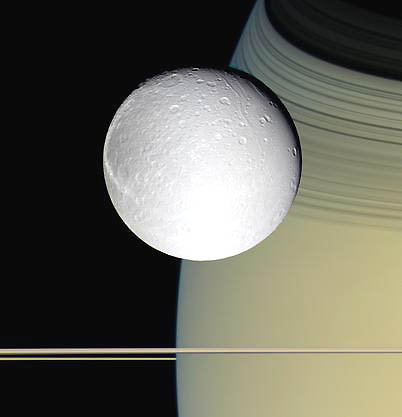
October 11, 2005, image of Saturn's icy moon, Dione, above the planet's thin rings. Behind Dione are the shadows of Saturn's B and C rings. Image from the Cassini spacecraft at 24,200 miles (39,000 kilometers) distance. Image courtesy NASA/JPL/Space Science Institute.

October 19, 2005  Pasadena, California - NASA reports that "speeding toward pale, icy Dione, Cassini's view is enriched by the tranquil gold and blue hues of Saturn in the distance. The horizontal stripes near the bottom of the image are Saturn's rings. The spacecraft was nearly in the plane of the rings when the images were taken, thinning them by perspective and masking their awesome scale. The thin, curving shadows of the C ring and part of the B ring adorn the northern latitudes visible here, a reminder of the rings' grandeur."


Click here to subscribe and get instant access to read this report.

Click here to check your existing subscription status.

Existing members, login below:

Red In Fall Leaves – Chemical Warfare?  

Left: red maple; Right: Oak. The red colors are produced by anthocyanin molecules. Research shows red maple anthocyanin can destroy other plant seeds.
Left: red maple; Right: Oak. The red colors are produced by anthocyanin molecules. Research shows red maple anthocyanin can destroy other plant seeds.

October 10, 2005  Hamilton, New York - Colgate University biology professor, Frank Frey, and graduate student, Maggie Eldridge, report new research about trees that produce red leaves, such as maples and oaks, that might be trying to destroy all other tree seeds in the area.

"Foliage changes color in autumn when chlorophyll in leaf cells (green color) breaks down and exposes the pigments that remain, such as carotenoid pigments which appear yellow or orange. But the story is different for maples and a handful of other trees whose leaves turn scarlet. The anthocyanin pigments in maple foliage are actually manufactured by the trees - rather than simply revealed - at a time of year when the organisms can't afford to use up a lot of metabolic energy for such a complex process."


Click here to subscribe and get instant access to read this report.

Click here to check your existing subscription status.

Existing members, login below:

9 X-Class Solar Flares Between September 7 – 19, 2005.

"Why is such a wimpy Solar Minimum cycle, with only a few sunspots, so strong when it comes to making flares?"

- David Hathaway, Ph.D., NASA Solar Physicist

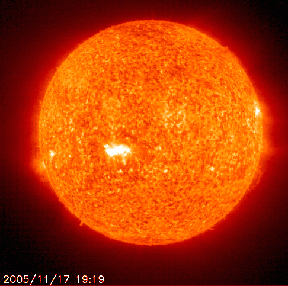
September 23, 2005  Huntsville, Alabama - The sun in our solar system is a big ball of hydrogen and helium gas that's 107 times larger than the Earth. The sun is like a big nuclear fusion reactor that gives light and heat to the planets. Even at 93 million miles from the sun, the temperatures can support life from the icy poles to the hot equator. Scientists who have studied ice cores report that long before the current Industrial Age's emissions of greenhouse gases linked to global warming, there have been many cycles of heating and cooling on the planet. Could it be that the so-called Solar Constant is not so constant? Could cycles in the sun ranging from lots of sunspots and big solar flares to few sunspots and small solar flares have more to do with Earth temperatures than originally thought?


Click here to subscribe and get instant access to read this report.

Click here to check your existing subscription status.

Existing members, login below:

“Planet X” and the Kuiper Belt’s Oddballs, “Santa” and “Easterbunny”

 "Instead of Pluto being a unique object that's difficult to understand (has frozen methane crust), we now see it as part of a family of objects (Xena, Sedna and Easterbunny that also have frozen methane crusts). We can try to understand the entire family, with Pluto being the middle sized member of the three. That's very exciting to us."

- Michael E. Brown, Astronomer  

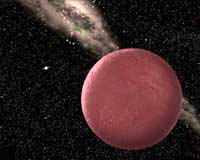
Planet X, or Xena, or 2003 UB313, illustrated as red in color because it has a surface  of frozen methane similar to Pluto, "Easterbunny," and Sedna. Nine billion miles from the sun,  Xena is 20 to 30 percent larger than Pluto. Illustration by Cal Tech.
Planet X, or Xena, or 2003 UB313, illustrated as red in color because it has a surface of frozen methane similar to Pluto, "Easterbunny," and Sedna. Nine billion miles from the sun, Xena is 20 to 30 percent larger than Pluto. Illustration by Cal Tech.

September 15, 2005  Pasadena, California - A couple of months ago in late July, astronomer Michael Brown and his colleagues at the California Institute of Technology, announced their discovery of "Planet X." It's a big chunk of rock and ice nine billion miles from the sun. It's actually bigger than Pluto - and far beyond Pluto in what is known as the Kuiper Belt that circles our solar system. Now, almost two months later, the International Astronomical Union still has not decided if the exciting discovery should be classified a planet or what it's official name should be.


Click here to subscribe and get instant access to read this report.

Click here to check your existing subscription status.

Existing members, login below:

Dust Devils and “Lemon Rinds” on Mars

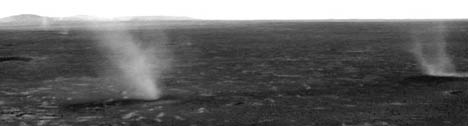
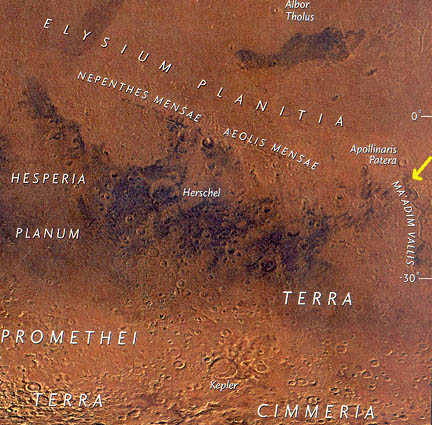
Above: Several dust devils caught by NASA's Mars Exploration Rover, Spirit, on July 13, 2005, during its exploration of the Gusev Crater. Below: Mars map, yellow arrow points in far right at the Ma'Adim Vallis dry river channel that empties into the Gusev Crater nera the Elysium Planitia region at the Martian equator. Image credit: NASA/JPL/Cornell.

August 24, 2005  Pasadena, California - For twenty months now, the robotic explorer, Spirit, has been exploring the Gusev Crater on Mars, while its twin rover, Opportunity, has been exploring the Meridiana Planum. The two sites are 6,600 miles from each other in the equatorial region.


Click here to subscribe and get instant access to read this report.

Click here to check your existing subscription status.

Existing members, login below:

Deep Impact Spectra: Carbonate, PAHs and Some Amino Precursors in Comet Tempel I

Left: NASA illustration of Deep Impact's impactor just before hitting Comet Tempel I on July 4, 2005. Right: Actual cratered surface of Comet Tempel I ninety seconds before the impactor smashed into the fluffy ice at 23,000 mph. Photograph courtesy NASA.
Above: NASA illustration of Deep Impact's impactor just before hitting Comet Tempel I on July 4, 2005. Below: Actual cratered surface of Comet Tempel I ninety seconds before the impactor smashed into the fluffy ice at 23,000 mph. Photograph courtesy NASA.

Moment of impact on potato-shaped Comet Tempel I at 10:52 p.m. PDT, July 3, 2005 / 1:52 a.m. EDT, July 4, 2005. Image by NASA, ESA, Johns Hopkins University Applied Physics Lab.

August 12, 2005  College Park, Maryland - This week geologists, chemists, physicists and planetary scientists from around the world gathered at the 9th International Asteroids, Comets and Meteors Conference in Brazil. One of the presentations was by Carey Michael Lisse, Ph.D., Prof. of Physics at the University of Maryland, and member of the Deep Impact Science Team. Dr. Lisse is Principal Investigator of Deep Impact spectral results from the Chandra X-Ray and Spitzer telescopes.


Click here to subscribe and get instant access to read this report.

Click here to check your existing subscription status.

Existing members, login below:

EARTHFILES