
Sirius’s Companion Star, Sirius B, Finally “Weighed”

"We're absolutely thrilled, after 143 years of frustration, to finally get the information we need about this star so that we can work out whether our theory of white dwarfs is actually correct."

- Martin Barstow, Ph.D., Leicester Univ., U.K.
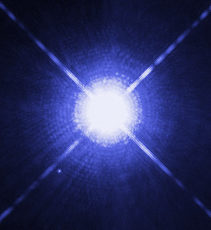
Hubble Space Telescope Wide Field and Planetary Camera image of Sirius A, the brightest star in our nighttime sky, along with its faint, tiny sun companion, Sirius B, in lower left quadrant. Image credit: NASA, ESA, STScl, U. Leicester, U. Arizona.

December 17, 2005  Baltimore, Maryland - For the first time in human astronomical history, scientists have used NASA's Hubble Space Telescope to isolate the light from the white solar dwarf known as Sirius B orbiting its huge and bright companion, Sirius A, in the constellation Canis Major. Since the Sirius B discovery in 1862, astronomers have been frustrated by the intense glow of Sirius A overwhelming their ability to "see" and "weigh" tiny, but very dense, Sirius B.

 

Click here to subscribe and get instant access to read this report.

Click here to check your existing subscription status.

Existing members, login below:

MARSIS Radar Looking Below Surface of Mars

"It is very interesting that the signal penetrated quite easily through about  2 kilometers (1.2 miles) of material in the crater and that suggests to us that material is probably ice-rich."

- Jeffrey Plaut, Ph.D., JPL

MARSIS, Mars Advanced Radar for Subsurface and Ionosphere Sounding, has been looking below the Martian surface since June 2005 for water ice and/or liquid water. Composite image by European Space Agency.

December 16, 2005  Pasadena, California - Far from Earth is a mystery that scientists are trying to solve from an orbiting spacecraft that is now looking below the surface of Mars with deep ground-penetrating radar. It's called "MARSIS," which stands for Mars Advanced Radar for Subsurface and Ionosphere Sounding.


Click here to subscribe and get instant access to read this report.

Click here to check your existing subscription status.

Existing members, login below:

Mystery of “Footprints” in 1.3 Million Year Old Mexico Volcanic Rock

"You're really left with two possibilities. One is that they are really old hominids - shockingly old - or they're not footprints."

- Paul Renne, Ph.D., UC-Berkeley

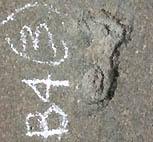
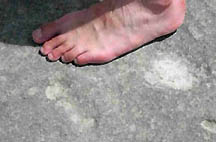
Left: Human left foot placed next to what appears to be left footprint in volcanic rock, Puebla, Mexico. Right: Possible right footprint, showing toe impressions and ball and heel, first discovered in 2003. Images courtesy John Moores University, U.K.
Above: Human left foot placed next to what appears to be left footprint in volcanic rock, Puebla, Mexico. Below: Possible right footprint, showing toe impressions and ball and heel, first discovered in 2003. Images courtesy John Moores University, U.K.


December 8, 2005  Berkeley, California - This past summer on the 4th of July at the British Royal Society Summer Exhibition Program, geologist Silvia Gonzalez, Ph.D., from Liverpool's John Moores University, announced that what appear to be human footprints in volcanic rock near Puebla, Mexico, were 40,000 years old. Puebla is about 1.5 hours by car southeast of Mexico City. The date was determined from Optically Stimulated Luminescence (OSL) of "some baked particles incorporated into the ash." Dr. Gonzales and her colleagues had first discovered the prints in 2003 and hypothesized that early hunters walked near a lake there across freshly deposited ash from volcanoes that are still active in the region. The ash mixed with rain and water which over time turned to rock. 
 

Click here to subscribe and get instant access to read this report.

Click here to check your existing subscription status.

Existing members, login below:

Central Black Hole Affects Massive Perseus Galaxy Cluster

"The Perseus Galaxy cluster is a dramatic example of how a relatively tiny, but massive, black hole at the center of a galaxy can control the heating and cooling behavior of gas far beyond the confines of the galaxy."

- CXC

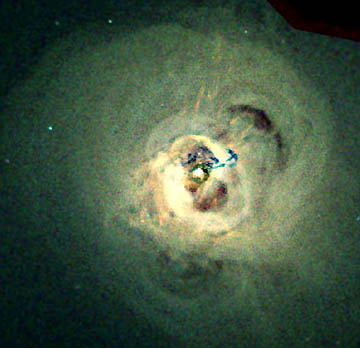
Massive Perseus galaxy cluster contains thousands of galaxies immersed in hot gas with massive black hole at center 250 million light years from Earth. Chandra X-ray Observatory image credit: NASA/CXC/IoA/A. Fabian et al.

December 4, 2005  Cambridge, Massachusetts - Chandra X-Ray Observatory in Cambridge, Massachusetts reports: "An accumulation of 270 hours of Chandra observations of the central regions of the Perseus galaxy cluster reveals evidence of the turmoil that has wracked the cluster for hundreds of millions of years. One of the most massive objects in the universe, the cluster contains thousands of galaxies immersed in a vast cloud of multimillion degree gas with the mass equivalent of trillions of suns.


Click here to subscribe and get instant access to read this report.

Click here to check your existing subscription status.

Existing members, login below:

Is the Sun Heating Up?   

"The Sun right now is probably averaging over several decades the most active it's been in 400 years."

- Sallie Baliunas, Ph.D., Harvard Smithsonian Center for Astrophysics

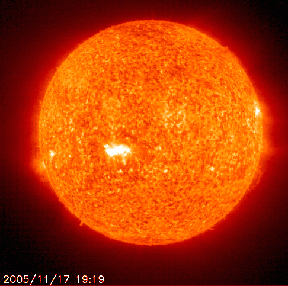
The large white spot on the face of the sun is called "Sunspot 822." Its current length on November 17, 2005, is 87,000 miles (140,000 km), about the size of Jupiter. According to SpaceWeather.com, "This sunspot poses a threat for M-class solar flares. NOAA forecasters estimate a 50% chance of one during the next 24 hours. Eruptions in the days ahead could cause magnetic storms on Earth." November 17, 2005, solar image by Solar and Heliospheric Observatory (SOHO).

November 18, 2005  Cambridge, Massachusetts - Astrophysicists are scratching their heads about what's happening on the sun and in our solar system. Why has this so-called "Solar Minimum" been so active? It should be quiet now with very few sunspots because this is supposed to be the low point of the Sun's 11-year-sunspot cycle. But this week, there was a sunspot called 822 that's 87,000 miles across - the size of the planet Jupiter! Could it erupt with more powerful X-flares as has happened the past few months. Big flares threaten all the broadcast, global positioning and military satellites that now orbit our planet. As I've reported before in Earthfiles, the sun is not "normal." Is it warming up? Earth's North Pole and Mars's South Pole are melting at a surprisingly rapid rate. Even far out Pluto seems to show some melting. Is the sun a bigger player in all this than originally thought? 


Click here to subscribe and get instant access to read this report.

Click here to check your existing subscription status.

Existing members, login below:

“Godzilla” of the Ancient Seas

The December 2005 issue of National Geographic magazine, provided in advance by National Geographic.


November 12, 2005  Washington, D. C. - National Geographic announced this week that a large fossil sea monster about 135 million years old with a head like a carnivorous dinosaur and a tail like a fish's has been discovered in Argentina's Neuquen Basin at the foot of the Andes. The scientist who found the specimen is calling the fierce-looking animal "Godzilla," or "chico malo," which means the "bad boy" of the ocean.


Click here to subscribe and get instant access to read this report.

Click here to check your existing subscription status.

Existing members, login below:

Dust Storm On Mars, Cosmic First Light and Huge Black Hole At Our Galaxy’s Center

November 9, 2005   -

Hubble Space Telescope image of Mars and growing dust storm on October 28, 2005, one night before its close approach to Earth at 41 million miles on October 29, 2005. Image credit: NASA, ESA, The Hubble Heritage Team (STScI/AURA), J. Bell (Cornell University) and M. Wolff (Space Science Institute).

NASA's Hubble Space Telescope snapped this picture of Mars on October 28, 2005, within a day of its closest approach to Earth on the night of October 29, 2005. Hubble astronomers were also excited to have captured a regional dust storm on Mars that has been growing and evolving over the past few weeks. The dust storm, which is the bright "feathery" feature in the middle of the planet in this picture, is about 930 miles (1500 km) long measured diagonally. That's about the size of Texas, Oklahoma and New Mexico combined.


Click here to subscribe and get instant access to read this report.

Click here to check your existing subscription status.

Existing members, login below:

Saturn’s Icy Moon, Dione, Up Close

"Dione reveals a wonderful variety of surface features that are simultaneously familiar and unlike any other place in the solar system."

- NASA/JPL/Space Science Institute.

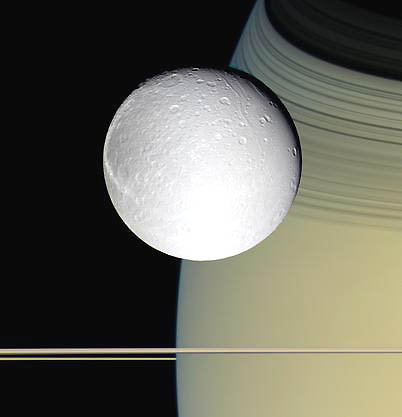
October 11, 2005, image of Saturn's icy moon, Dione, above the planet's thin rings. Behind Dione are the shadows of Saturn's B and C rings. Image from the Cassini spacecraft at 24,200 miles (39,000 kilometers) distance. Image courtesy NASA/JPL/Space Science Institute.

October 19, 2005  Pasadena, California - NASA reports that "speeding toward pale, icy Dione, Cassini's view is enriched by the tranquil gold and blue hues of Saturn in the distance. The horizontal stripes near the bottom of the image are Saturn's rings. The spacecraft was nearly in the plane of the rings when the images were taken, thinning them by perspective and masking their awesome scale. The thin, curving shadows of the C ring and part of the B ring adorn the northern latitudes visible here, a reminder of the rings' grandeur."


Click here to subscribe and get instant access to read this report.

Click here to check your existing subscription status.

Existing members, login below:

Red In Fall Leaves – Chemical Warfare?  

Left: red maple; Right: Oak. The red colors are produced by anthocyanin molecules. Research shows red maple anthocyanin can destroy other plant seeds.
Left: red maple; Right: Oak. The red colors are produced by anthocyanin molecules. Research shows red maple anthocyanin can destroy other plant seeds.

October 10, 2005  Hamilton, New York - Colgate University biology professor, Frank Frey, and graduate student, Maggie Eldridge, report new research about trees that produce red leaves, such as maples and oaks, that might be trying to destroy all other tree seeds in the area.

"Foliage changes color in autumn when chlorophyll in leaf cells (green color) breaks down and exposes the pigments that remain, such as carotenoid pigments which appear yellow or orange. But the story is different for maples and a handful of other trees whose leaves turn scarlet. The anthocyanin pigments in maple foliage are actually manufactured by the trees - rather than simply revealed - at a time of year when the organisms can't afford to use up a lot of metabolic energy for such a complex process."


Click here to subscribe and get instant access to read this report.

Click here to check your existing subscription status.

Existing members, login below:

EARTHFILES