


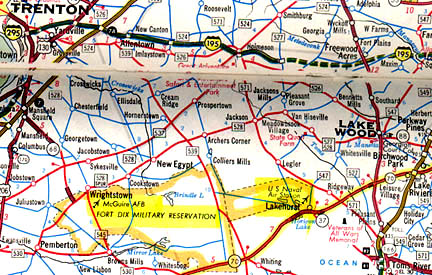
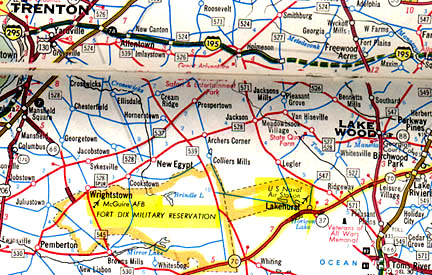
"After the shooting of the non-human entity], taking command was a new and unfamiliar team of Blue Berets that suddenly descended onto the scene, just moments after the runway had been cordoned off. With speed and efficiency, 'they took over,' he said, 'and when asked who they were, we were told nothing and ordered to stay outside the ropes.'"
- Source: USAF Security Policeman, McGuire AFB, New Jersey
Click back to Part I, Status Report IV
To be more computer-friendly, the reprint has been divided into parts. Here begins Part 3 of Status Report IV, written for the June 28-30, 1985, MUFON 1985 UFO Symposium Proceedings in conjunction with the national MUFON conference held in Saint Louis, Missouri. The series of status reports, I through VII, were written by Leonard H. Stringfield from 1978 to 1994. Previous Status Report V begins at Earthfiles 012805. Leonard Stringfield died on December 18, 1994.

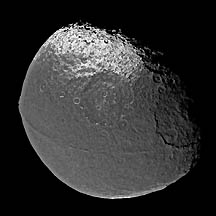
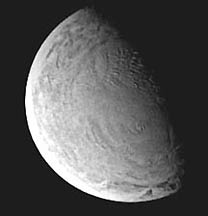
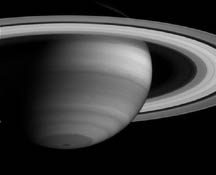 February 17, 2005 Pasadena, California - The current NASA Cassini mission to Saturn has produced the clearest pictures human eyes have ever seen of Saturn's rings, which are made out of ice and dust and iron. In addition to the rings, Saturn has 33 moons, including Titan Saturn's biggest moon and second largest moon in the Solar System after Jupiter's Ganymede. Beyond the mysterious Titan where methane apparently rains down into dark lakes, Cassini has also taken the clearest images of two other moons which baffle scientists. Those moons are Iapetus (eye-AP-uh-tus) and Enceladus (en-SELL-uh-dus) from Greek mythology. The entire Saturnian system is named from the Greek dramas about gods and the universe. Saturn was the Titan who ruled over the Olympian Gods, including Iapetus. Iapetus was the father of Atlas, who carried the Earth on his shoulders, and father of Prometheus who was mankind's savior. Saturn ended up killing his father, Uranus, to become lord of the Universe. After the murder, revenging giants sprang from the father's blood. One of those giants was called Enceladus.
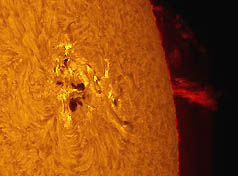
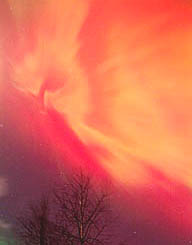 February 11, 2005 Huntsville, Alabama - On Saturday, January 15, the Sun erupted with three strong solar flares. The next day, the Sun erupted again. The Space Weather office at the National Oceanic and Atmospheric Administration (NOAA) in Boulder, Colorado, released warnings about intense radiation storms that could damage satellites and interrupt radio communications. By Monday, January 17th, the Sun erupted yet again with a strong solar flare and some of the brightest auroras in years were being photographed over the northern latitudes. The next day there was yet another strong solar flare, totaling six major eruptions in four days.'