Click here to subscribe and get instant access to read this report.
Click here to check your existing subscription status.
Existing members, login below:

Reported and Edited by Linda Moulton Howe
"Instead of Pluto being a unique object that's difficult to understand (has frozen methane crust), we now see it as part of a family of objects (Xena, Sedna and Easterbunny that also have frozen methane crusts). We can try to understand the entire family, with Pluto being the middle sized member of the three. That's very exciting to us."
- Michael E. Brown, Astronomer
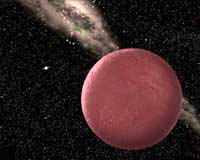
September 15, 2005 Pasadena, California - A couple of months ago in late July, astronomer Michael Brown and his colleagues at the California Institute of Technology, announced their discovery of "Planet X." It's a big chunk of rock and ice nine billion miles from the sun. It's actually bigger than Pluto - and far beyond Pluto in what is known as the Kuiper Belt that circles our solar system. Now, almost two months later, the International Astronomical Union still has not decided if the exciting discovery should be classified a planet or what it's official name should be.
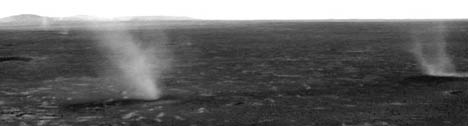
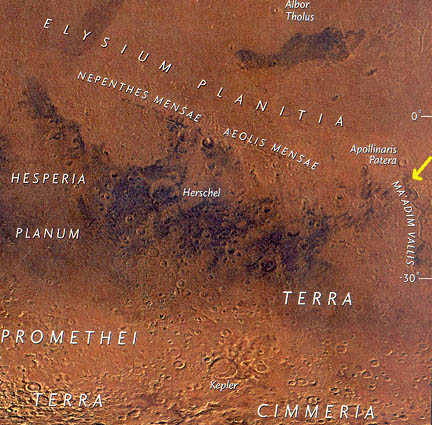 August 24, 2005 Pasadena, California - For twenty months now, the robotic explorer, Spirit, has been exploring the Gusev Crater on Mars, while its twin rover, Opportunity, has been exploring the Meridiana Planum. The two sites are 6,600 miles from each other in the equatorial region.
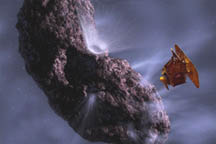
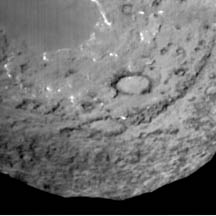
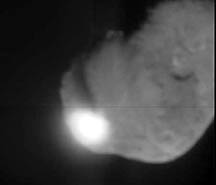
August 12, 2005 College Park, Maryland - This week geologists, chemists, physicists and planetary scientists from around the world gathered at the 9th International Asteroids, Comets and Meteors Conference in Brazil. One of the presentations was by Carey Michael Lisse, Ph.D., Prof. of Physics at the University of Maryland, and member of the Deep Impact Science Team. Dr. Lisse is Principal Investigator of Deep Impact spectral results from the Chandra X-Ray and Spitzer telescopes.
"It is bigger than Pluto!!!"
Astronomer Michael Brown of Cal Tech wrote at his website.
"And it's not planetoid 2003EL61 announced yesterday,"
also by Brown's group.

July 30, 2005 Pasadena, California - Brown had hoped to confirm the object's size before public disclosure. But late last night at NASA's Jet Propulsion Laboratory in California, he made a rushed announcement after his astronomy team, including Chad Trujillo (Gemini Observatory), and David Rabinowitz (Yale University), learned that a hacker had broken into their data with the idea of making "the tenth planet" discovery public first. Beyond 2003UB313, it has no other name yet, but a "more melodious name" was submitted to the International Astronomical Union in Paris for approval. It might have "Lila" in it, since Michael Brown has a 3-week-old daughter named Lila.
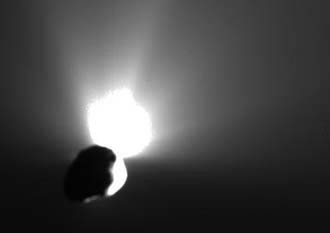
July 10, 2005 Austin, Texas - Astronomer Anita Cochran has been working at the University of Texas since 1982. Now she is a senior research scientist and Assistant Director of the McDonald Observatory in Austin. She and several hundred scientists around the world are helping to analyze the spectral data from the Deep Impact crash with Comet Tempel I on July 3 to 4, 2005. That night, Dr. Cochran was in Hawaii at the Kech I telescope, the largest in the world, watching to see if a light flare at the moment the impactor hit the very dim magnitude 11 comet could be seen.
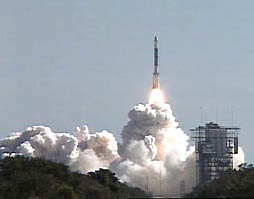
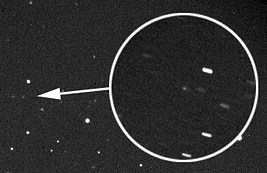 Schedule of Impact Events
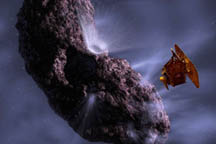
- NASA TV coverage: Begins July 3, 8:30 p.m., Pacific Daylight Time, PDTFor NASA TV, click on: http://www.nasa.gov/multimedia/nasatv/index.html
- Expected time of impact with comet: July 3, 10:52 p.m. PDT 11:52 p.m. MDT July 4, 12:52 a.m. CDT 1:52 a.m. EDT
- NASA Post-impact briefing: July 4, 1 a.m. PDT - NASA Post-impact press conference: July 4, 11 a.m. PDT
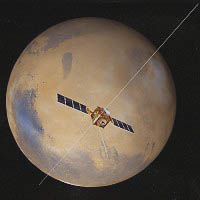
June 23, 2005 Darmstadt, Germany - I learned something amazing today from the Mars Express Orbiter Spacecraft Operations Manager. He is Michel Denis based at the European Space Agency's office in Darmstadt, Germany. I was getting an update about the plans for the deep ground-penetrating radar on ESA's Mars Express Orbiter which was turned on for the first time at 3 p.m. Pacific. The amazing fact I learned was that a month ago on May 7th, the Mars Express Orbiter and NASA's two spacecraft, the Odyssey and the Mars Global Surveyor could have collided!