
Unexplained Objects in Opportunity and Spirit Images

February 4, 2004 Vancouver, B. C., Canada - This morning I received the following e-mail with images attached from Paul Anderson, Director, Canadian Crop Circle Research Network (CCCRN). He and others have been looking at Opportunity and Spirit images on Mars in some detail and have questions about yet unexplained features. Below is Paul's e-mail with images and I will follow up with planetary geologists for further comments in a future Earthfiles.com report.


Click here to subscribe and get instant access to read this report.

Click here to check your existing subscription status.

Existing members, login below:
Opportunity Rolls Onto Martian Soil and Confirms Hematite

"For the first time in history, two mobile robots are exploring the surface of another planet at the same time."

- January 31, 2004, NASA/JPL

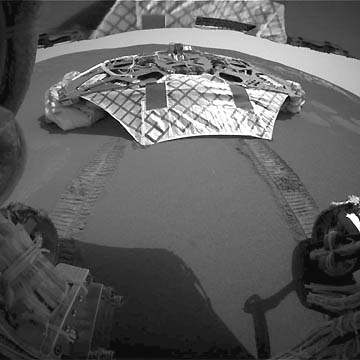
NASA's Mars Opportunity rover rolled out of its lander in the Meridiani Planum at 3:01 a.m. PST on January 31, 2004. Image credit: NASA/JPL/Cornell University.

January 31, 2004 Pasadena, California - Early this morning, NASA got the Mars Opportunity lander moving a few days before schedule and out onto the soil of the Meridiani Planum shallow crater it landed in. Controllers at NASA's Jet Propulsion Laboratory received confirmation of the successful drive at 3:01 a.m. Pacific Standard Time via a relay from the Mars Odyssey orbiter and Earth reception by the Deep Space Network. Cheers erupted a minute later when Opportunity sent a picture looking back at the now-empty lander and showing wheel tracks in the Martian soil. Opportunity drove down a reinforced fabric ramp at the front of its lander platform.


Click here to subscribe and get instant access to read this report.

Click here to check your existing subscription status.

Existing members, login below:
Is There Living Green Algae in the Gusev Crater on Mars?

"Certainly like the green in the Gusev crater picture or by looking at the development of darker spots toward the South Pole which are tied to seasonal variations, it certainly gives rise to the speculation that there could be algae."

 - Michael McKay, European Space Agency


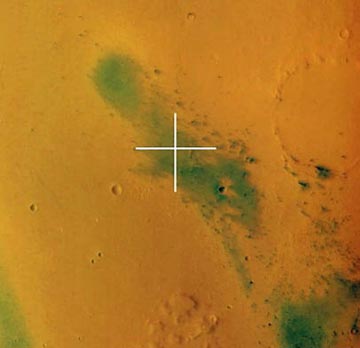
The center of the Gusev crater with the landing site of the NASA Spirit rover marked with a cross. The image was taken by the HRSC instrument in color and 3-Dimension on January 16, 2004, from a height of 320 kilometers (199 miles). Gusev is a large crater about 160 kilometers in diameter. Scientists believe that the crater was covered by standing water, maybe in the form of a lake, early in the history of Mars. Image by European Space Agency's Mars Express: ESA/DLR/FU Berlin (G. Neukum).


January 31, 2004 Darmstadt, Germany - The European Space Agency's Mars Express Orbiter has been exploring the red planet from 186 miles (300 kilometers) altitude. Its high resolution stereo camera has been sending back extraordinary color images. Some, like the Gusev crater image above, show green areas. Some like the Reull Vallis ancient river channel below show blue and blue-green regions.


Click here to subscribe and get instant access to read this report.

Click here to check your existing subscription status.

Existing members, login below:
Opportunity Lands on Mars – in “Muddy” Hematite?

 "I will attempt no science analysis, because it looks like nothing I've ever seen before. I've got no words for this. I am flabbergasted. I am astonished. I am blown away. Opportunity has touched down in a bizarre alien landscape."

- Steven Squyres, Principal Investigator, Cornell University

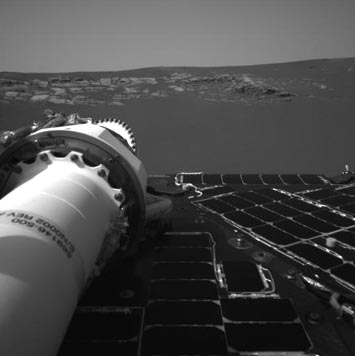
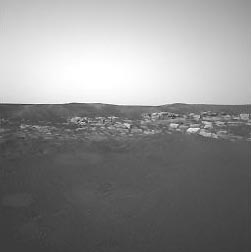
Above and below: Opportunity's panorama camera shows rocky "butte" surrounded by dark "sea of soil" that is thought to be grey hematite, a very different mineral from the iron, olivine and nickel soil that Spirit landed on in the Gusev crater. Image: NASA/JPL.


January 25, 2004  Pasadena, California - Opportunity, NASA's second rover, landed on Mars five minutes after 9 p.m. in California and after midnight on the East Coast as expected. Opportunity bounced down in its airbag-covered lander on to a smooth plane called Meridiani Planum near the equator half way around Mars from the Gusev crater where the first damaged rover, Spirit, landed on January 3, 2004. Opportunity's mission is to search for signs of water and its landing marks and the soil look even muddier than the Gusev crater's.


Click here to subscribe and get instant access to read this report.

Click here to check your existing subscription status.

Existing members, login below:
Updated – Spirit Alive, But in “Critical” Condition. Mars Express Sees Water Ice and Ancient River Channel


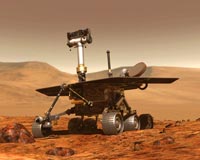
NASA artist's concept of Spirit rover working in the Gusev crater on Mars. Image: NASA/JPL.

Updated - January 24, 2004  Pasadena, California -

Spirit Communication Revived Briefly,
But Rover's In "Critical" Condition

On January 23, the flight team for NASA's Spirit rover finally received data from the silent robot in a communication session that began at 5:26 a.m. PST and lasted 20 minutes at a data rate of 120 bits per second. Spirit's response was provoked by a JPL command to Spirit at 5:02 PST via the NASA Deep Space Network antenna complex near Madrid, Spain, telling Spirit to begin transmitting about its problems.


Click here to subscribe and get instant access to read this report.

Click here to check your existing subscription status.

Existing members, login below:

Spirit Rover’s First Martian Soil Analysis Has Surprises

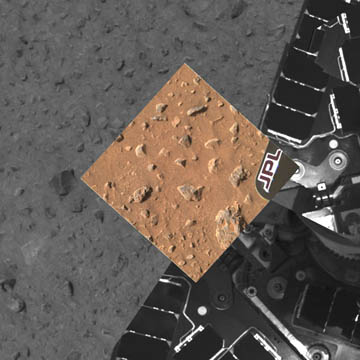
This image shows the patch of soil scientists examined at Gusev Crater just after Spirit rolled off the Columbia Memorial lander. Image credit: NASA/JPL.

January 21, 2004 Pasadena, California - Scientists at NASA's Jet Propulsion Laboratory (JPL) in Pasadena yesterday were puzzled about the first soil examined by the Spirit rover in its alpha particle X-ray spectrometer as it begins its exploration of the Martian Gusev crater.


Click here to subscribe and get instant access to read this report.

Click here to check your existing subscription status.

Existing members, login below:

Martian Soil “Clumpy” – Electrostatic Binding of Dust?

"Scientists liken the alien soil to clumpy cocoa powder."

NASA Jet Propulsion Laboratory

January 19, 2004  Pasadena, California - The Mars Exploration Rover Spirit deployed its robotic arm early Friday morning, January 16, 2004, to use its microscopic imager, one of four geological instruments located on the arm. The instrument will help scientists analyze and understand Martian rocks and soils by taking very high resolution, close-up images. The first surprise was the clumpy nature of the red soil and some planetary geologists wonder if an electrostatic binding of the dust could be at work.


Click here to subscribe and get instant access to read this report.

Click here to check your existing subscription status.

Existing members, login below:

Part 2 – Is Dark Matter the “Heavy Shadow” of Light Matter?

Click here for Part 1

Quarks and leptons are the major atomic particle building blocks of the universe. The muon is in the bottom, center row. Image courtesy Fermi National Laboratory.

January 17, 2004  Urbana-Champaign, Illinois - Not everyone is certain that Supersymmetry of super atomic particles is the answer to Dark Matter. In fact, some theoretical physicists argue about whether the Brookhaven muon magnetic moment measurement is even a meaningful discrepancy.


Click here to subscribe and get instant access to read this report.

Click here to check your existing subscription status.

Existing members, login below:

EARTHFILES