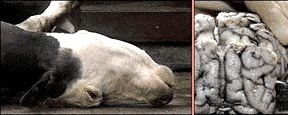
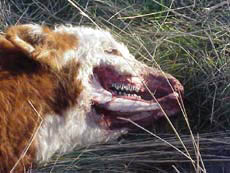
Cow infected by Bovine Spongiform Encephalopathy (BSE) that destroys brain tissue (on right) with a myriad of holes that resemble a sponge. Photographs courtesy www.mad-cow.org.
June 27, 2005 Washington, D. C. – The U. S. Department of Agriculture confirmed on June 25, 2005, that the second U. S. cow in 18 months has tested positive for bovine spongiform encephalopathy, or BSE, also known as Mad Cow disease. The first case of Mad Cow found in the U.S. was in December 2003 in a Washington state dairy cow that had been imported from Canada.This 2005 infected cow was at least 8 years-old and rumors in the cattle industry are that the animal was born and raised in Texas. If so, this would be the first confirmation that the always fatal BSE prion disease that destroys brains and nervous systems is in some American cattle and not solely linked to imported animals, as once previously thought.
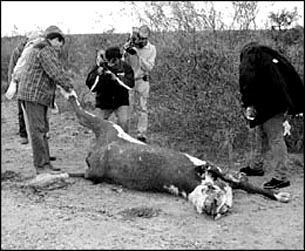
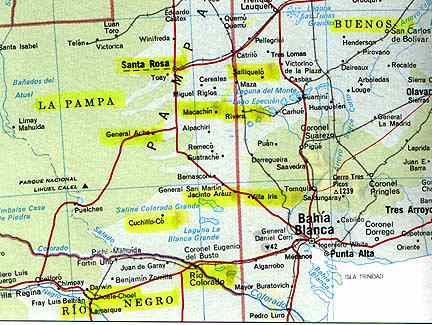
Updated June 23, 2005 Bradford, Pennsylvania - The number of unusual large animal deaths since 2002 in Argentina and Chile keeps climbing. I talked with Scott Corrales, Editor and Translator of Inexplicata, the Journal of Spanish Ufology, based in Bradford, Pennsylvania. Scott received his M. A. in Spanish Literature from Rutgers University. Scott's website, Inexplicata, provides Spanish-to-English translations about UFO-related incidents in Mexico, Central and South America.
Click here to subscribe and get instant access to read this report.
Click here to check your existing subscription status.
“This event in the vertebrates that created the ultra conserved elements in the birth of the vertebrate lineages was a unique event. …It cannot be a coincidence that there have been so few changes in these (vertebrate 481 ‘junk DNA’) elements over this enormous span of half a billion years. It’s got to be that they are functionally important.”
– David Haussler, Ph.D., UC-Santa Cruz
June 25, 2005 Santa Cruz, California – A biomolecular engineer at the University of California in Santa Cruz was published in a recent Science journal stating his lab has found 481 genetic sequences that are the same in all vertebrates from humans to rats and are so important they have not changed in nearly half a billion years. But until now, those genes were considered “junk DNA.”Click for report.
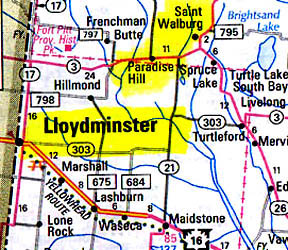
June 17, 2005 Paradise Hill, Saskatchewan, Canada – Rancher Ray Riguidel, 68, was born and raised in Saint Walburg, Saskatchewan, Canada, northwest of Saskatoon. The past thirty-five years he has run cattle on pastures in both Saint Walburg and nearby Paradise Hill. Nothing strange had ever happened to his animals until he discovered one of his 10-year-old cows dead and mutilated on Friday evening, June 10, 2005. She had been alive and well, nursing her 2-month-old calf, only three days before.Click for report.
“…Wilbert Smith (Canadian engineer) was provided, for research purposes, a fragment allegedly obtained from an alien craft which had been shot off by USAF interceptors near Washington, D. C., in July 1952.”
To be more computer-friendly, the reprint has been divided into parts. Here begins Part 13 of Status Report III, written in June 1982. The series of status reports, I through VII, were written by Leonard H. Stringfield from 1978 to 1994. Previous Status Report IV begins at Earthfiles 021205. Leonard Stringfield died on December 18, 1994. Click for report.
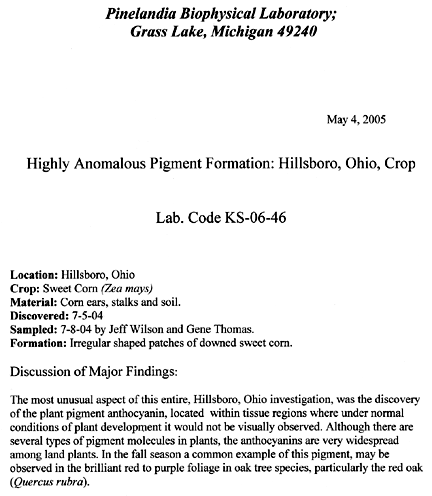
“ …We find in this Hillsboro, Ohio, case that there are statistically significant alterations in all downed corn samples, relative to the normal control plants. If we now add to that the anomalous pigment formation in corn seeds, we must come to the conclusion that the Hillsboro, Ohio, sweet corn patch interacted with a very complex and tremendously high energy vortex plasma.”
– Biophysicist W. C. Levengood
June 2, 2005 Grass Lake, Michigan – May 4, 2005 report about Hillsboro, Ohio, July 5, 2004, mysteriously flattened corn plants, by W. C. Levengood, Biophysicist, Pinelandia Biophysical Laboratory, Grass Lake, Michigan:Click for report.
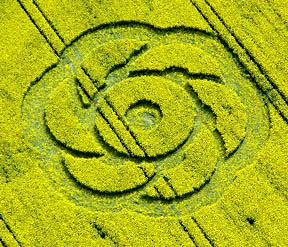
May 20, 2005 – One year ago on May 22, 2004, I reported at Earthfiles.com an overview of 12 crop formations which had been reported in six countries. [See052204 Earthfiles.] The list included:
– four patterns in yellow flowering oil seed rape in Germany;
– four patterns in oil seed rape in England;
– one pattern of grass circles in Hoeven, Holland;
– one circle geometry of wheat in Poland;
– one pattern of circles laid down in tall pasture grass in Queensland, Australia;
– and randomly downed wheat along straight lines in Mexico.
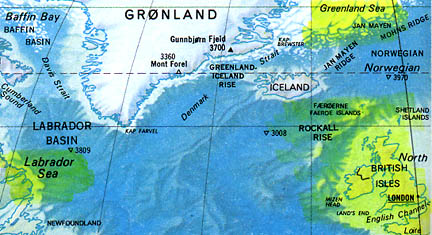
“We do expect that this reduction in the volume of sinking water (in Greenland Sea) will lead to a reduction in the volume of warm water reaching Europe. That will cool down Europe or at least parts of Europe that are accessible to the ocean. … (England and coastal parts of Europe) will be getting more violent types of weather that are due to the higher temperature differences that are happening everywhere.”
– Ocean Physicist Peter Wadhams, Cambridge University, U. K.
Labrador and the British Isles are on the same latitude. But Britain has enjoyed a mild climate compared to cold Labrador because of the North Atlantic Drift, also known as the Atlantic Thermohaline Circulation, which conveys warm equatorial water to the U. K. and Faeroe Islands.
May 11, 2005 Cambridge, England – Normally in the Atlantic Ocean, warm water moves from the Equator up to the British Isles, keeping England and parts of Europe warmer than Labrador which is at the same northern latitude. The warming is caused by a huge convection process called the Atlantic Thermohaline Circulation, or North Atlantic Drift. Equatorial warm water is circulated to the Labrador Sea and Greenland Sea, cools off, and then sea ice forms. The ice does not take up the sea salt which is left behind in the ocean and makes the water denser and it sinks. For more than a century, at least a dozen cylinder-shaped columns of cold water have been sinking into the deep ocean and heading back south toward the Equator which has kept the big conveyor belt of warm-to-cold-to-warm water going in the Atlantic Ocean.Click for report.
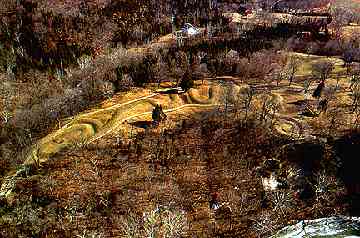
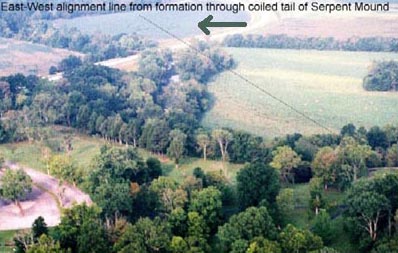
“All of us agreed that the mysterious lights seemed to be coming from the direction of the Serpent Mound area, which from my sister’s house would have been off to the right in our field of vision. We actually joked at the time, ‘Maybe there will be a crop circle there in the morning.’”
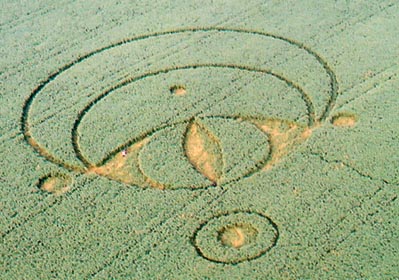
May 9, 2005 Batvia, Ohio – Two years ago, between August and November 2003, four crop formations in soybeans were reported in the mysterious and ancient mound-builder’s region of southern Ohio. Most important in terms of plant and soil anomalies was the first one discovered on the morning of August 24, 2003, not far from the famous Serpent Mound near Locust Grove, Ohio. The tall soybean plants had been laid down in a geometry based around the Vesica Pisces symbol found so often in British crop formations. Its longest length was 271 feet and there were no tracks around the entire perimeter or inside the extraordinary pattern.Click for report.
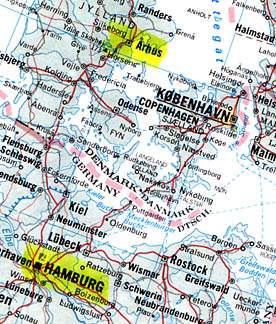
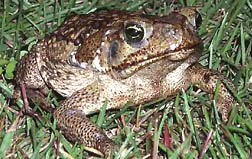
Exploding cane toads have been reported on April 25, 2005, at Lake Mosehullet, Middle Jutland near Laasby in Denmark, northwest of Copenhagen.Originally native to Venezuela, cane toads have poisonous sacs on the back of their heads which can kill crocodiles, snakes and other animals in minutes. Photograph courtesy of USGS.
April 27, 2005 Hamburg, Germany – At first, the idea that poisonous cane toads originally from Venezuela, South America would crawl out of a lake near Hamburg, Germany, and explode to death, sounds like a Monty Python comedy.Click for report.