Environmental Updates

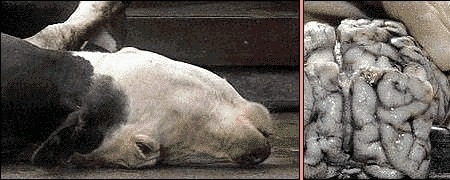
Cow infected by Bovine Spongiform Encephalopathy (BSE) that destroys brain tissue, on right, with a myriad of holes that resemble a sponge. Photographs courtesy www.mad-cow.org.

November 26, 2000 Western Europe - On Friday, a shocked Germany and Portugal reported two new cases of mad cow disease that seems to be spreading in Europe. Doctors think the brain destroying prions that cause loss of muscle control and progressive dementia originated in Great Britain after cattle were given feed containing the ground up remains of infected sheep. There is a form of mad cow disease known as Creutzfeldt-Jakob which enters humans who eat infected meat. In England, 81 people have died of that disease since 1996.


Click here to subscribe and get instant access to read this report.

Click here to check your existing subscription status.

Existing members, login below:

Update On Increased UV Radiation and Amphibian Decline


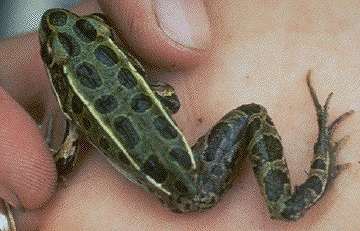
Deformed frog, only one rear leg. Photograph courtesy University of Minnesota.

November 12, 2000 Corvallis, Oregon - This year the largest ozone hole on record at the Antarctic extended over the city of Punta Arenas in Chile, exposing humans, animals and plants to increased ultraviolet radiation which can cause skin cancer, kill amphibian embryos and stunt and deform those that survive. Over the next four months, atmospheric scientists will be monitoring what happens at the North Pole. Will the Arctic ozone hole also get bigger as winter takes hold and expose more humans, animals and plants to increased ultraviolet radiation?


Click here to subscribe and get instant access to read this report.

Click here to check your existing subscription status.

Existing members, login below:

Mysterious Shark Deaths Near Panama City, Florida

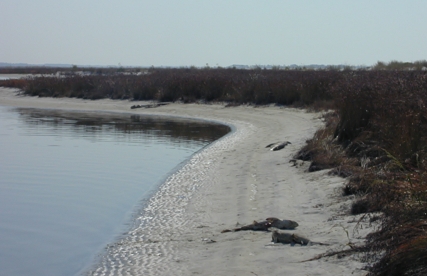
More than 100 dead sharks on the eastern side of Shell Island near Panama City, Florida were reported on October 16, 2000. Photograph © 2000 by John Brusher, National Marine Fisheries Service.

October 22, 2000  Panama City, Florida - More than a hundred blacktip and Atlantic sharpnose sharks were found October 16, 2000 dead and decaying along a half mile of beach on the eastern side of Shell Island near Panama City, Florida. Marine biologists so far cannot explain the mass deaths of a rugged species sometimes called "living fossils" because modern sharks arose during the Jurassic Period between 135 and 190 million years ago. No one can remember so many shark deaths at one time before.


Click here to subscribe and get instant access to read this report.

Click here to check your existing subscription status.

Existing members, login below:

Kentucky Governor Declares State of Emergency After Coal Sludge Spill

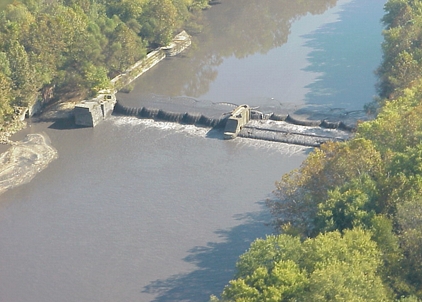
Big Sandy River, Kentucky. Seventy miles of waterways filled with 210 million gallons of coal mine sludge headed for Ohio River after a slurry impoundment broke on October 11.  Photograph courtesy Kentucky Natural Resources and Environmental Protection Cabinet.
Big Sandy River, Kentucky. Seventy miles of waterways filled with 210 million gallons of coal mine sludge headed for Ohio River after a slurry impoundment broke on October 11. Photograph courtesy Kentucky Natural Resources and Environmental Protection Cabinet.

October 22, 2000 Frankfort, Kentucky - Kentucky Governor Paul E. Patton visited the Martin County site near Inez where an estimated 210 million gallons of coal mine sludge collapsed into the Big Sandy and Cold Water Branches of Wolf Creek. Public water supplies in the town of Louisa and Martin County District Number One were immediately polluted. On October 16, Governor Patton declared a State of Emergency for ten counties "in the wake of last Wednesday's failure of a Martin County coal slurry impoundment. ...The declaration covers the counties of Boyd, Bracken, Carter, Fleming, Greenup, Lawrence, Lewis, Martin, Mason and Robertson, all lying within the Big Sandy and Ohio River watersheds." By October 22, at least seventy miles of waterways were filled with the cement-like sludge.


Click here to subscribe and get instant access to read this report.

Click here to check your existing subscription status.

Existing members, login below:

Unidentified Primate (Bigfoot?) Body Print and Hairs Discovered in Washington State

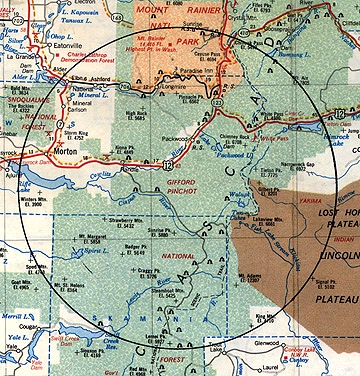
Gifford Pinchot National Forest west of Yakima, Washington is location of unidentified and possible Bigfoot body print and hairs discovered in mud on September 22, 2000.

October 8, 2000 Tahuya, Washington – Bigfoot tracker, landscape contractor and Tahuya resident, Derek Randles, has a large plaster cast of what might be the first partial body print of a Bigfoot ever found. In September, he helped the Bigfoot Field Researchers Organization (BFRO) plan an expedition of fourteen people into the Gifford Pinchot wilderness west of Yakima, Washington. Their goal was to find Bigfoot tracks, hairs and screams for an Australian camera crew producing a segment for the Discovery Channel program Animal X . The group set up a sound projection system to loudly broadcast a Bigfoot scream recorded recently at Lake Tahoe, California. On September 21st, after one of the broadcasts of three Bigfoot screams, the researchers were shocked to hear a nearly identical series of three screams answer back.

Around 3:30 AM on September 22, Derek Randles and some of his colleagues went in the direction of the screams and placed fruit in the middle of a watery, muddy wallow in hopes that whatever was producing the eerie answers might be tempted to eat the fruit and leave tracks in the mud. After sunrise, the men found more than footprints.

Click for report.

Largest-Ever Antarctic Ozone Hole


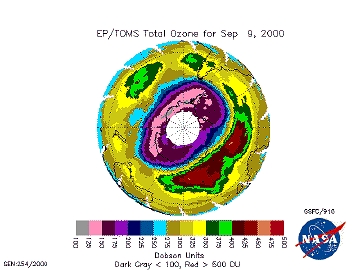
September 2000 Antarctic ozone depletion rates are unprecedented. NASA's Total Ozone Mapping Spectrometer (TOMS) data shows huge white hole over the South Pole devoid of ozone and severe thinning over the entire Antarctic continent and the tip of South America. Graphic courtesy NASA Goddard Space Flight Center, Greenbelt, Maryland.

September 10, 2000  Greenbelt, Maryland - The ozone hole over the Antarctic is the biggest it's ever been and it's only the beginning of September. Usually Antarctic ozone depletion starts in July during the South Pole's winter. That's when extremely cold air intensifies ozone destruction, reaching a peak by the end of September and into October. But this year, NASA's Goddard Space Flight Center in Greenbelt, Maryland reports that already the ozone hole is larger than all of the Antarctic and extends over the southern tip of South America. That's 11 million square miles and breaks all previous records. A spokesman at the United Nations World Meteorological Observation agency in Geneva, Switzerland told reporters: "It is remarkable to find these low values so early in September, perhaps one or two weeks earlier than in any previous year."


Click here to subscribe and get instant access to read this report.

Click here to check your existing subscription status.

Existing members, login below:

Environmental Updates and 79 Cattle Die in Saskatchewan


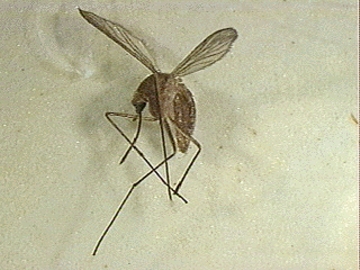
Culex pipiens mosquito which can carry the Kunjin West Nile Fever virus.

September 3, 2000 -

West Nile Virus in New Jersey Crows

This past week, 165 more birds - mostly crows - in central and northern New Jersey have been confirmed to be infected with the West Nile Fever virus. One was found on the campus of Princeton University. This brings the total in New Jersey this year to 322 infected birds.


Click here to subscribe and get instant access to read this report.

Click here to check your existing subscription status.

Existing members, login below:

Pulsing, Jumping Light in West Stowell, England Field

August 26, 2000 East Field, Wiltshire, England – On Monday, July 31st late in the evening, crop circle researchers Ed and Kris Sherwood were in an East Kennett crop formation when a bright yellow unidentified aerial object appeared followed immediately by a loud, military-type helicopter that nearly ran them down in the field. After the couple went to the ground to escape the low-flying helicopter, it pursued the bright yellow object again, both disappearing behind a hill. Then a second bright yellow aerial object appeared. The Sherwoods videotaped the helicopter and yellow object and learned that other people did, too. Frank Laumen, a researcher and photographer from Germany, was at the bridge in Allington and could see lights and a helicopter back toward East Kennett. He videotaped the interactions. Andy Buckley from Manchester, England was also on Martinsell Hill and videotaped helicopter and light activity about the same time.Click for report.

The “Cell from Hell” Is Back in North Carolina Estuaries

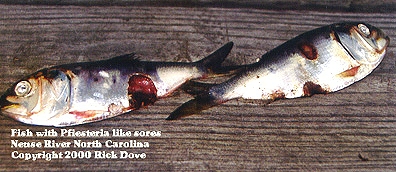
Two menhaden fish among 300,000 dead in recent weeks in the Neuse and Pamlico Rivers of North Carolina's estuaries. The large red and bleeding sores are typical of the Pfiesteria dinoflagellate which can be either an algae plant or amoeba animal, depending upon environmental conditions. In its amoeba form, it likes to eat fish. Photograph © 2000 by Rick Dove.

July 9, 2000  New Bern, North Carolina - In southeastern Europe the past several days, temperatures above 100 degrees in many places - and up to 113 degrees in the Turkey and Romania region - have killed at least 38 people. Strong winds from the Sahara desert began blowing on Friday causing hundreds of fires in Greece, Italy and Croatia. And this is only the first of July. What happens in August and September?


Click here to subscribe and get instant access to read this report.

Click here to check your existing subscription status.

Existing members, login below:

EARTHFILES