
Part 2: Navy Physicist and USAF Geophysicist Discuss UFOs and ETs

"This subject has such huge import for the human future that nobody really wants to know it's true. The admission that creatures are flying around out there doing whatever they are doing and we have no control over them amounts to a loss of control."

- Bruce Maccabee, Ph.D., U. S. Navy Physicist

Return to Part 1.

January 27, 2006  Thurmont, Maryland - Back in early 1986, physicist Bruce Maccabee listened to USAF geophysicist Hawk talk about the "real Project Blue Book" as described in the mid-1960s by his old friend, USAF Lt. Col. Bob Hippler. Hawk had originally met Col. Hippler in Albuquerque when Col. Hippler wanted to know more about the government's knowledge - and cover-up - of E. T.s and their advanced technologies interacting with Earth. When Hawk met up with Col. Hippler a couple of years later, he was living and working in two worlds ­ one real and secret; the other not real and public. Col. Hippler was trying to find a university willing to investigate UFOs for the U. S. Air Force. Dr. Maccabee concluded that Hippler was part of the government cover-up, "searching for patsies who would be willing to officially come up with the answer the Air Force wanted." And what the Air Force wanted was a white wash that would say there was nothing to UFOs, so the public and media would leave them alone.


Click here to subscribe and get instant access to read this report.

Click here to check your existing subscription status.

Existing members, login below:
Part 1: Navy Physicist and USAF Geophysicist Discuss UFOs and ETs

"The pilot said that the missiles had all exploded before they hit the unidentified aerial object (shielded?). Then he said the UFO turned on a blue beam and it was rotating and the beam was starting to move toward him. ...Searchers never found anything ­ no wreckage, nothing."

 - "Hawk," USAF Geophysicist

January 20, 2006  Thurmont, Maryland - Some of the startling facts that are emerging from research about the V-2 rocket history at White Sands Proving Ground in the late 1940s are New Mexico and Texas newspaper headlines about the "peculiar phenomena" that were interfering with those early rocket launches. The peculiar phenomena were causing the rockets to veer off course. Photographs showed the peculiar phenomena were circular discs that instantaneously appeared next to the V-2s right before the rockets went off course and crashed to the ground. General Nathan Twining even referred to the discs as an "enemy weapons system," according to government insiders who have leaked information in the past ten years.


Click here to subscribe and get instant access to read this report.

Click here to check your existing subscription status.

Existing members, login below:
31st Cattle Mutilation on Red Bluff, California Ranch

"We've had a young calf dropped through trees because he had his legs intertwined with tree branches."

- Rancher Jean Barton

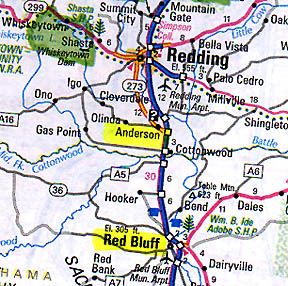
In Red Bluff, California, the Jean and Bill Barton ranch has suffered 31 cattle mutilations over the past decade. A few miles north, a rancher in Anderson, California, had cattle mutilations in 1999 and 2004.

January 13, 2006  Red Bluff, California - For the past half century, unusual deaths that law enforcement call "animal mutilations" have been reported around the world. Both domestic animals and wild game have been affected, especially horses and cattle. Ranchers and law enforcement have long been puzzled because animals are found with the same pattern of hide and tissue removed ­ usually without blood ­ from the head, sexual organs, and vaginal/rectal area. There are no signs of struggle or tracks around the dead animals, not even the animal's own tracks. That peculiar fact provoked law enforcement long ago to wonder if the mutilators came in and out of pastures from the sky?


Click here to subscribe and get instant access to read this report.

Click here to check your existing subscription status.

Existing members, login below:
Einstein’s “Spooky Action At A Distance”

"Of the six beryllium atoms we have entangled, you take five of the atoms and put them into a spaceship and send them to the moon. If you now measure on earth the one that remains, you find it's spinning clockwise. Then you know that the five other ones on the moon will also spin clockwise, but there's no physical interaction between them."  

- Dietrich Leibfried, Ph.D., NIST

January 6, 2006  Boulder, Colorado - In this New Year, time and events seem to hurdle forward faster and faster ­ while advanced computers become smaller and smaller. Some physicists even think by mid-21st Century, there could be quantum computers in which each bit would be an atom. A quantum computer would use one of the strangest properties of our universe to calculate mathematical problems quickly that might take billions of years for classical computers to solve.


Click here to subscribe and get instant access to read this report.

Click here to check your existing subscription status.

Existing members, login below:

Hubble Telescope Discovers More Moons and Rings Around Uranus

"Until now, nobody had a clue the two other rings were there..."

- Mark Showalter, SETI Institute

Hubble Space Telescope images credit: NASA, ESA, and M. Showalter, SETI Institute.

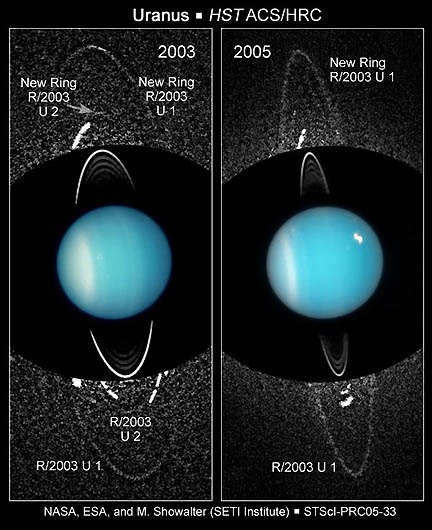
December 23, 2005   Baltimore, Maryland - Hubble researchers report: "These composite images from several observations by NASA's Hubble Space Telescope reveal a pair of newly discovered rings encircling the planet Uranus. The left composite image is made from Hubble images taken in 2003. The new dusty rings are extremely faint and required long exposures to capture their image. The background speckle pattern is noise in the image. The outermost ring (R/2003 U 1) is likely replenished by dust blasted off a newly discovered satellite called Mab, embedded in the ring and visible as a bright streak at the top of the outer ring. The new outermost ring is twice the radius of the previously known ring system around Uranus, as seen near image center. (The inner rings are much brighter, so no noise is visible in the background). Approximately halfway between the outermost ring and inner ring system is a second newly discovered ring (R/2003 U2). Only a faint segment of it appears at the 12:00 o'clock position. Because of the long exposures, the moons are smeared out and appear as arcs within the ring system.


Click here to subscribe and get instant access to read this report.

Click here to check your existing subscription status.

Existing members, login below:
Sirius’s Companion Star, Sirius B, Finally “Weighed”

"We're absolutely thrilled, after 143 years of frustration, to finally get the information we need about this star so that we can work out whether our theory of white dwarfs is actually correct."

- Martin Barstow, Ph.D., Leicester Univ., U.K.

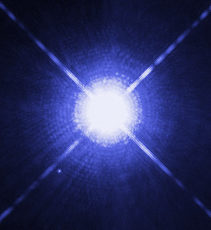
Hubble Space Telescope Wide Field and Planetary Camera image of Sirius A, the brightest star in our nighttime sky, along with its faint, tiny sun companion, Sirius B, in lower left quadrant. Image credit: NASA, ESA, STScl, U. Leicester, U. Arizona.

December 17, 2005  Baltimore, Maryland - For the first time in human astronomical history, scientists have used NASA's Hubble Space Telescope to isolate the light from the white solar dwarf known as Sirius B orbiting its huge and bright companion, Sirius A, in the constellation Canis Major. Since the Sirius B discovery in 1862, astronomers have been frustrated by the intense glow of Sirius A overwhelming their ability to "see" and "weigh" tiny, but very dense, Sirius B.


Click here to subscribe and get instant access to read this report.

Click here to check your existing subscription status.

Existing members, login below:
MARSIS Radar Looking Below Surface of Mars

"It is very interesting that the signal penetrated quite easily through about  2 kilometers (1.2 miles) of material in the crater and that suggests to us that material is probably ice-rich."

- Jeffrey Plaut, Ph.D., JPL

MARSIS, Mars Advanced Radar for Subsurface and Ionosphere Sounding, has been looking below the Martian surface since June 2005 for water ice and/or liquid water. Composite image by European Space Agency.

December 16, 2005  Pasadena, California - Far from Earth is a mystery that scientists are trying to solve from an orbiting spacecraft that is now looking below the surface of Mars with deep ground-penetrating radar. It's called "MARSIS," which stands for Mars Advanced Radar for Subsurface and Ionosphere Sounding.


Click here to subscribe and get instant access to read this report.

Click here to check your existing subscription status.

Existing members, login below:

Mystery of “Footprints” in 1.3 Million Year Old Mexico Volcanic Rock

"You're really left with two possibilities. One is that they are really old hominids - shockingly old - or they're not footprints."

- Paul Renne, Ph.D., UC-Berkeley

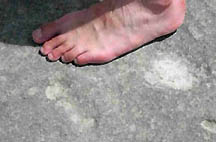
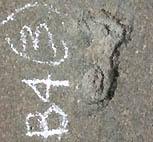
Left: Human left foot placed next to what appears to be left footprint in volcanic rock, Puebla, Mexico. Right: Possible right footprint, showing toe impressions and ball and heel, first discovered in 2003. Images courtesy John Moores University, U.K.
Above: Human left foot placed next to what appears to be left footprint in volcanic rock, Puebla, Mexico. Below: Possible right footprint, showing toe impressions and ball and heel, first discovered in 2003. Images courtesy John Moores University, U.K.

December 8, 2005  Berkeley, California - This past summer on the 4th of July at the British Royal Society Summer Exhibition Program, geologist Silvia Gonzalez, Ph.D., from Liverpool's John Moores University, announced that what appear to be human footprints in volcanic rock near Puebla, Mexico, were 40,000 years old. Puebla is about 1.5 hours by car southeast of Mexico City. The date was determined from Optically Stimulated Luminescence (OSL) of "some baked particles incorporated into the ash." Dr. Gonzales and her colleagues had first discovered the prints in 2003 and hypothesized that early hunters walked near a lake there across freshly deposited ash from volcanoes that are still active in the region. The ash mixed with rain and water which over time turned to rock. 
 

Click here to subscribe and get instant access to read this report.

Click here to check your existing subscription status.

Existing members, login below:

Central Black Hole Affects Massive Perseus Galaxy Cluster

"The Perseus Galaxy cluster is a dramatic example of how a relatively tiny, but massive, black hole at the center of a galaxy can control the heating and cooling behavior of gas far beyond the confines of the galaxy."

- CXC

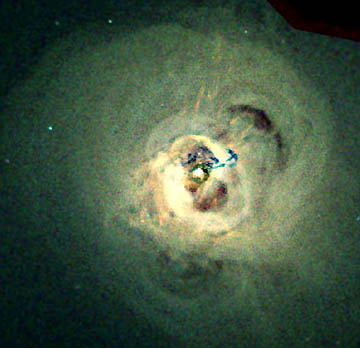
Massive Perseus galaxy cluster contains thousands of galaxies immersed in hot gas with massive black hole at center 250 million light years from Earth. Chandra X-ray Observatory image credit: NASA/CXC/IoA/A. Fabian et al.

December 4, 2005  Cambridge, Massachusetts - Chandra X-Ray Observatory in Cambridge, Massachusetts reports: "An accumulation of 270 hours of Chandra observations of the central regions of the Perseus galaxy cluster reveals evidence of the turmoil that has wracked the cluster for hundreds of millions of years. One of the most massive objects in the universe, the cluster contains thousands of galaxies immersed in a vast cloud of multimillion degree gas with the mass equivalent of trillions of suns.


Click here to subscribe and get instant access to read this report.

Click here to check your existing subscription status.

Existing members, login below:

Is the Sun Heating Up?   

"The Sun right now is probably averaging over several decades the most active it's been in 400 years."

- Sallie Baliunas, Ph.D., Harvard Smithsonian Center for Astrophysics

The large white spot on the face of the sun is called "Sunspot 822." Its current length on November 17, 2005, is 87,000 miles (140,000 km), about the size of Jupiter. According to SpaceWeather.com, "This sunspot poses a threat for M-class solar flares. NOAA forecasters estimate a 50% chance of one during the next 24 hours. Eruptions in the days ahead could cause magnetic storms on Earth." November 17, 2005, solar image by Solar and Heliospheric Observatory (SOHO).

November 18, 2005  Cambridge, Massachusetts - Astrophysicists are scratching their heads about what's happening on the sun and in our solar system. Why has this so-called "Solar Minimum" been so active? It should be quiet now with very few sunspots because this is supposed to be the low point of the Sun's 11-year-sunspot cycle. But this week, there was a sunspot called 822 that's 87,000 miles across - the size of the planet Jupiter! Could it erupt with more powerful X-flares as has happened the past few months. Big flares threaten all the broadcast, global positioning and military satellites that now orbit our planet. As I've reported before in Earthfiles, the sun is not "normal." Is it warming up? Earth's North Pole and Mars's South Pole are melting at a surprisingly rapid rate. Even far out Pluto seems to show some melting. Is the sun a bigger player in all this than originally thought? 


Click here to subscribe and get instant access to read this report.

Click here to check your existing subscription status.

Existing members, login below:

EARTHFILES