
Levitation Possible by Reversing Casimir Force

“In principle, you could use this repelling Casimir force to levitate heavier objects, but not with current technology. With current technology, one could only conceive of levitating very light objects.”

- Thomas Philbin, Ph.D., Theoretical Physicist

August 10, 2007  Fife, Scotland - Theoretical physicists work in their mind and on paper with math and formulas trying to understand the laws of the universe. Some of the greatest of those minds have been Max Planck and Albert Einstein. More than a hundred years ago in 1900, Planck was struggling to understand radiation from black bodies. Actual experiments forced him to suppose that the electromagnetic energy of the light at a given frequency could only take discrete values: it is "quantized." Planck found that if he chose the spacing between the allowed energies correctly, his equations agreed with the experiments. This spacing is determined by a number, now called Planck's constant. For that theoretical physics work - now regarded as the birth of quantum physics - Max Planck received the Nobel Prize in Physics in 1918. For that theoretical physics work – now regarded as the birth of quantum physics - Max Planck received the Nobel Prize in Physics in 1918.


Click here to subscribe and get instant access to read this report.

Click here to check your existing subscription status.

Existing members, login below:
First Water Confirmed in Extrasolar Planet’s Atmosphere

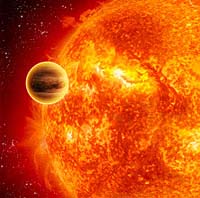
A scorching-hot gas planet beyond our solar system is steaming up with water vapor, according to new observations from NASA's Spitzer Space Telescope and European Space Agency.

Planet HD 189733b is a gas giant 63 light-years away, in the constellation Vulpecula, discovered in 2005 orbiting its parent star. Graphic illustration courtesy European Space Agency (ESA).

July 12, 2007  Paris, France, and Pasadena, California -  Scientists report the first conclusive discovery of the presence of water vapor in the atmosphere of a planet beyond our Solar System. The discovery was made by analyzing the transit of the gas giant HD 189733b across its star, in the Infrared. The findings appear in the July 12, 2007, issue of the scientific journal Nature. The original paper, titled ‘Water vapour in the atmosphere of a transiting extrasolar planet’, is by G.Tinetti, A.Vidal-Madjar, M-C. Liang, J-P. Beaulieu, Y. L. Yung, S. Carey, R. Barber, J. Tennyson, I. Ribas, N. Allard, G. Ballester, D.K. Sing, F. Selsis.


Click here to subscribe and get instant access to read this report.

Click here to check your existing subscription status.

Existing members, login below:

Update: What Is the Moving Light in Saturn’s Rings?


Mysterious moving light changes position from one Saturn ring band on far left in image W00016503 to a further ring band in far right image W00016506, on July 23, 2006. Is it a "sundog" where sunlight reflects off icy, dusty rings? All Cassini-Huygens spacecraft images courtesy NASA/JPL/Space Science Institute

Update - Email from an employee at the Space Science Institute in Boulder, Colorado, on June 23, 2007:

"I enjoy visiting your Earthfiles website for news on topics one normally doesn't hear much about, and your reports to Coast to Coast which I listen to when I stay up late working on art projects or photographs. I like that you're keeping on top of the disappearing bees situation.

About your recent Earthfiles report, What Is the Moving Light in Saturn's Rings? A Sundog? The bright spots in the four images are not a sundog. It's called the 'opposition effect' and is seen in the rings whenever Cassini is looking in the exact same direction as the sunlight. It's due to sunlight illuminating everything face-on (what astronomers call 'zero phase angle') and therefore, no shadows exist.

I work at the Space Science Institute, doing most of the image processing for the Cassini cameras in one of the groups."

[ Editor's Note:  Space Science Institute:  "The opposition effect exists because of two contributing factors. One is due to the fact that the shadows of ring particles directly opposite the Sun from Cassini–the region of opposition–fall completely behind the particles as seen from the spacecraft. These shadows are thus not visible to the spacecraft: all ring particle surfaces visible to Cassini are in sunlight and therefore bright. Away from the region of opposition, the ring particle shadows become more visible to Cassini and the scene become less bright. The surge in brightness falls off in a circular fringe around that point.

"Another contributing factor to the opposition surge is an optical phenomenon called “coherent backscatter.” Here, the electromagnetic signal from the rays of scattered sunlight, making their way back to the spacecraft, is enhanced near the region of opposition because, instead of canceling, the electric and magnetic fields comprising the scattered radiation fluctuate in unison.

The July 23, 2006, images were taken in visible light with the Cassini spacecraft wide-angle camera at a distance of approximately 262,000 kilometers (163,000 miles) from Saturn. Image scale in the radial, or outward from Saturn, direction is 13 kilometers (8 miles) per pixel." ]


Click here to subscribe and get instant access to read this report.

Click here to check your existing subscription status.

Existing members, login below:
Is Earth Close to Dangerous Tipping Point in Global Warming?

“It’s not really so much of a question whether the dangerous tipping point occurs at 450 or 550 ppmv CO2. It’s how do we get the (greenhouse) emissions under control so we don’t push past all the possible points at which the climate change becomes a seriously dangerous issue.”

- Chris Field, Ph.D., Director, Carnegie Institution's Dept. of Global Ecology, Stanford University, Palo Alto, Calif.

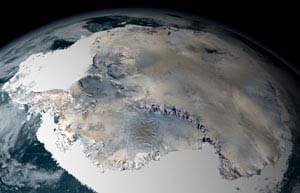
Almost 98% of the Antarctica South Pole continent is covered by ice, which averages a mile thick. Antarctica lost much more ice to the sea than it gained from snowfall, according to a NASA survey done between 1992 and 2002. It also had a corresponding rise in sea level.  The survey documented for the first time extensive thinning of the West Antarctic ice shelves. Credit: NASA/SVSSatellite image courtesy NASA.

June 1, 2007  New York, New York - The United Nations Intergovernmental Panel on Climate Change reported this year that there is at least a 90% certainty that global warming is man-made and will “continue for centuries.” The IPCC also reports that in coming decades, rising temperatures and rising sea levels will cause floods and mass famine. The implication is that there will be massive dislocations of humans and animals that have traditionally lived near coastlines. Despite the hard data, the George Bush Administration has resisted setting CO2 reduction goals, claiming there would be too many economic hardships for Americans. Ironically, it is the United States, which dominates the world list of greatest CO2 emitters.


Click here to subscribe and get instant access to read this report.

Click here to check your existing subscription status.

Existing members, login below:
Antarctica: Unprecedented Western Ice Melt and CO2-Saturated Southern Ocean

"The western Antarctic ice melt was unprecedented.
We’d never seen anything like this in the past 25 years."

- Ted Scambos, Ph.D., Glaciologist, NSIDC

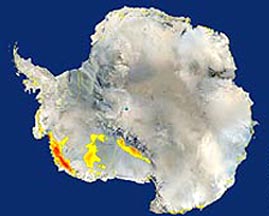
 Yellow and red colors on western Antarctica indicate where NASA's QuikScat satellite in January 2005 detected snowmelt by radar pulses that bounced off ice formed when snowmelt refroze. The unprecedented ice melt was equal to the size of California. Image courtesy NASA/JPL.
Yellow and red colors on western Antarctica indicate where NASA's QuikScat satellite in January 2005 detected snowmelt by radar pulses that bounced off ice formed when snowmelt refroze. The unprecedented ice melt was equal to the size of California. Image courtesy NASA/JPL.

May 18, 2007  Boulder, Colorado -  The Washington Post, on May 16, 2007, published an editorial by three eminent American scientists in which these words were stated:  “Climate change is the most critical problem the Earth has ever faced.”


Click here to subscribe and get instant access to read this report.

Click here to check your existing subscription status.

Existing members, login below:
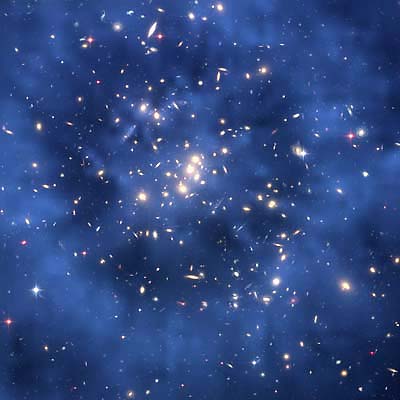
Hubble Finds Dark Matter Ring

"This is the first time we have detected dark matter as having a
unique structure that is different from both the gas and galaxies in the cluster."

- M. James Jee, Ph.D., Astronomer, Johns Hopkins University

The dark matter ring was found within the galaxy cluster Cl 0024+17 (ZwCl 0024+1652), located 5 billion light-years from Earth. The ring measures 2.6 million light-years across. Image courtesy Hubble Space Telescope Science Institute/NASA.

May 15, 2007  Baltimore, Maryland - The Hubble Space Science Institute reported today that astronomers using NASA's Hubble have discovered "a ghostly ring of dark matter that formed long ago during a titanic collision between two massive galaxy clusters.

"The ring's discovery is among the strongest evidence yet that dark matter exists. Astronomers have long suspected the existence of the invisible substance as the source of additional gravity that holds together galaxy clusters. Such clusters would fly apart if they relied only on the gravity from their visible stars. Although astronomers don't know what dark matter is made of, they hypothesize that it is a type of elementary particle that pervades the universe.


Click here to subscribe and get instant access to read this report.

Click here to check your existing subscription status.

Existing members, login below:
Exploded Star 5 Times Brighter Than Any Supernova Seen Before

"This one is way above anything else known. It's really astonishing."

- Nathan Smith, Ph.D., UC-Berkeley

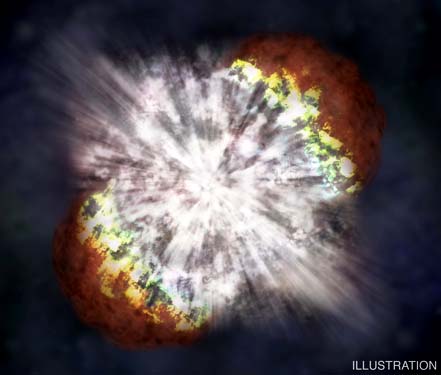
May 8, 2007  Cambridge, Massachusetts - The brightest supernova ever seen by human eyes was discovered in Fall 2006 by NASA's orbiting Chandra X-ray Observatory and the Lick Observatory ground-based optical telescope. The exploded star is called "SN 2006gy" and is five times brighter than hundreds of supernovae seen before. SN 2006gy is also the most energetic stellar explosion ever recorded. In fact, astronomers wonder if it is a new type of explosion that did not become a black hole like other supernovae, took 70 days to reach its supernova peak and remained brighter than other known supernovae for several months.

Illustration of SN 2006gy supernova in the constellation Perseus about 238,000,000 light-years from Earth. Illustration courtesy NASA/CXC/M.Weiss.


Click here to subscribe and get instant access to read this report.

Click here to check your existing subscription status.

Existing members, login below:
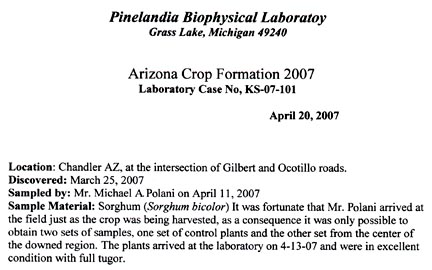
Scientific Analysis of Chandler, Arizona, Sorghum Formation

Biophysicist W. C. Levengood's Pinelandia Biophysical Laboratory Case No. KS-07-101 about his analysis of the Sorghum bicolor plants in the Chandler, Arizona, randomly downed formation first discovered on March 25, 2007, by Michael A. Polani.

Return to April 12, 2007, Earthfiles about Chandler formation.

May 1, 2007  Grass Lake, Michigan - After Chandler, Arizona, resident, Michael A. Polani, discovered the randomly downed pattern of Sorghum bicolor plants on March 25, 2007, I asked him if he would be willing to sample the plants for biophysicist W. C. Levengood. Michael agreed and went to the formation field on April 12, 2007, to gather both downed and standing formation plants and normal controls far outside the formation. To Michael's great surprise, at least 95% of the young, lush green plants had been cut out and removed. It was definitely not time for harvest and Michael still has not been able to confirm who owned the field, let alone why the premature removal of the plants. But about 5% of the randomly downed formation was left where he could collect samples from both flattened and standing sorghum. I provided Federal Express so that the plants would arrive at biophysicist Levengood's lab the next day, April 13, 2007.

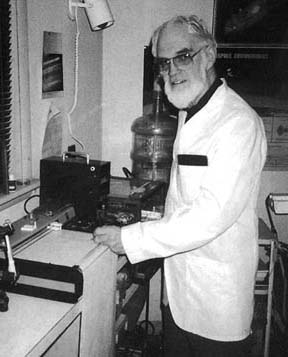
W. C. Levengood taking respiration measurements of Charge Density Plasmas from crop formation plants in his Pinelandia Biophysical Laboratory in Grass Lake, Michigan. Photo by Linda Moulton Howe.


Click here to subscribe and get instant access to read this report.

Click here to check your existing subscription status.

Existing members, login below:
Unexplained Turbulence in Venusian Clouds

"It is not yet clear if atmospheric turbulences may be induced
by rough topography below the clouds."

- ESA

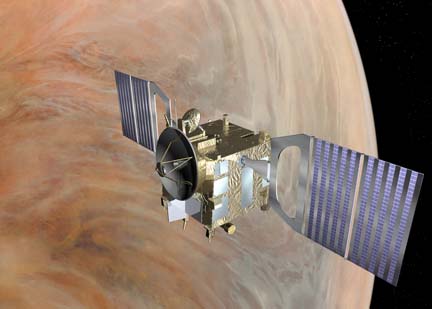
Artist's impression of European Space Agency's Venus  Express orbiting Venus, courtesy ESA.
Artist's impression of European Space Agency's Venus Express orbiting Venus, courtesy ESA.

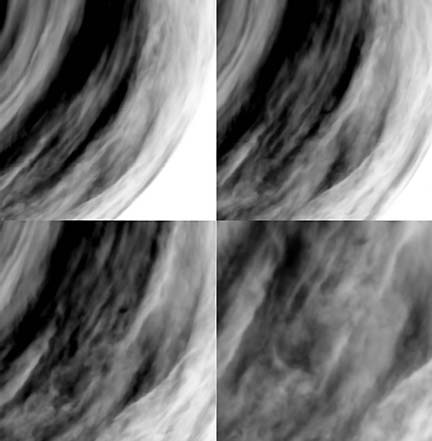
April 3 , 2007  Paris, France -  New images and data from the European Space Agency’s mission to Venus provide more details about the turbulent and noxious atmosphere of Earth’s sister planet. What causes violent winds and turbulences? Is the surface topography playing a role in the complex global dynamics of the atmosphere?

The images, showing a complex cloud system, were taken on the night-side of Venus at a wavelength of 1.7 micron that allows viewing the deep atmospheric layers. Credits: ESA/VIRTIS/INAF-IASF/Obs. de Paris-LESIA.


Click here to subscribe and get instant access to read this report.

Click here to check your existing subscription status.

Existing members, login below:
Fastest Rotating Object in Our Solar System is One of Strangest

“We didn’t expect to find anything so strangely shaped
and so rapidly rotating. It’s the fastest, large rotating object
in the solar system."

- Michael E. Brown, Ph.D., Cal Tech


Click for Earthfiles Podcast  

March 30, 2007  Pasadena, California - For the first time in astronomical history, a huge, bizarre rock beyond Neptune has been linked to other orbiting bodies out there. Some how the big rock called 2003 EL61, which is almost the size of Pluto, got into orbit out in the Kuiper Belt where most every other object is made of ice. Not only is this huge rocky object there, it is the only object in our solar system shaped like an American football and tumbling long end-over-end every four hours.

Computer-generated image of 2003 EL61, courtesy Michael E. Brown, Ph.D., Cal Tech. To see it move, visit: http://www.gps.caltech.edu/~mbrown/


Click here to subscribe and get instant access to read this report.

Click here to check your existing subscription status.

Existing members, login below:
EARTHFILES